From Dashboard to Decision-Maker: Using Creator Insights to Shape Your 2026 SaaS Product Roadmap
42% of leading B2B SaaS companies now have a creator feedback loop integrated into their product management workflow. Companies using real-time social sentiment to guide roadmaps report 15% higher feature adoption rates upon launch. A comment section on a micro-influencer's LinkedIn tutorial about your software reveals what hundreds of users think, in real time, in their own language, about a specific workflow they are actually trying to complete. That is not just marketing intelligence. Properly wired into your product team, it is the most honest, highest-volume, continuously refreshing focus group your SaaS company has ever run.
The Feedback Source Your Product Team Is Missing
Every SaaS company runs user research. Surveys, NPS scores, in-app feedback widgets, quarterly customer interviews. These methods are structured, defensible, and useful. They are also slow, self-selected, and limited by the small sample sizes that structured research inevitably produces.
A 10-person focus group reveals what 10 people think, filtered through the context of a moderated research session, in a setting that does not reflect how they actually use your product. A micro-influencer's LinkedIn tutorial about your software - watched by 3,000 practitioners in your target segment reveals what those practitioners think in real time, expressed in their own words, about a specific workflow they are actively trying to complete.
42% of leading B2B SaaS companies now have a creator feedback loop integrated into their product management workflow. Companies using real-time social sentiment to guide roadmaps report 15% higher feature adoption rates upon launch. This is social listening for product management, not the traditional social listening that monitors brand mentions for PR purposes, but a structured, sentiment-coded extraction of creator content that surfaces genuine product intelligence: feature requests in the form of workarounds, UX friction expressed as audience frustration, competitive gaps demonstrated live in comparison series, and emerging use cases the product team had not anticipated.

Traditional Research vs. the Creator Feedback Loop
Dimension | Traditional User Research | Creator Feedback Loop |
|---|---|---|
Sample size | 10–30 people per study | Hundreds to thousands per creator post |
Frequency | Quarterly or bi-annual | Continuous - new content daily |
User context | Moderated session, not natural product use | Active workflow - authentic frustration or delight |
Signal latency | 4–8 weeks from study to insight | Hours from post to flagged insight |
Use cases surfaced | Limited by question design | Unlimited - includes unanticipated use cases |
Competitive intelligence | Rarely included | Built into comparison series natively |
Cost | ₹5–₹20 lakh per research cycle | Captured as a by-product of existing influencer programme |
Roadmap input cadence | Quarterly | Real-time, continuous |
Market fit signal | Explicit - direct user questions | Implicit - engagement patterns reveal unaddressed segments |
Emotional intensity | Filtered by moderation | Unfiltered - comment tone reveals priority level |
Signal 1 — Creator-Led Feature Prioritisation: The JTBD Framework Applied
The Jobs-to-Be-Done (JTBD) framework, developed by Tony Ulwick and popularised by Harvard Business School professor Clayton Christensen is based on a single core insight: customers do not buy products, they "hire" them to accomplish a specific goal. As Christensen put it, "People don't want a quarter-inch drill. They want a quarter-inch hole." The job stays constant even as the products used to accomplish it evolve.
Applied to creator feedback data, JTBD becomes a continuous intelligence feed rather than a quarterly research exercise. When a micro-influencer documents a workaround to achieve a specific result in your SaaS, they are revealing the exact "job" they are trying to hire your product to do, one that your current feature set does not natively support. They have not filed a feature request through your feedback portal. They have demonstrated the demand publicly, in front of their audience, in a format that reveals the emotional weight of the friction through the quality of the workaround itself.
The most actionable signal from this activity is the jugaad pattern: when five different Creator-Preneurs in your category independently develop the same workaround to achieve the same outcome, that workaround is telling you precisely what your next native feature should be. A team keeps adding features but product adoption is low - JTBD reveals that users are hiring the product to simplify their workflow, not add complexity. The jugaad pattern is the creator-scale version of that discovery, generated continuously without a single research session.
Monitoring feature sentiment in creator comment sections provides a broader, more honest sample size than any structured research method. When a creator's audience responds to a workaround with "I've been doing this for months!" rather than "I didn't know you could do that," the signal is clear: this is not an edge case. It is a mainstream gap that a native feature should close.
Signal 2 — Competitive Intelligence from Comparison Series
The "tool comparison" episodic series - "7 Days of Outreach: Nurdd vs. Legacy Competitor," "Notion vs. Coda: Which One Broke My Workflow?" — is one of the most commercially valuable content formats in B2B SaaS, and almost entirely ignored by the product teams of the brands being compared.
These series reveal, in public, with genuine user experience footage, exactly where competitors are winning on UX and where they are failing. An influencer who says "Tool A is great but cannot do X, so I have to use Tool B just for that one step" has simultaneously delivered a roadmap item, a competitive positioning statement, and a target market segment.
If you can build X in the next quarter and announce it to that creator's audience, you have not just won a feature race. You have won the conversion of every viewer who watched that series while nodding along. AI can mediate competing interests in roadmap prioritisation, if sales advocates for a feature to close enterprise deals but user sentiment data shows low priority, AI-generated evidence from social feedback facilitates trade-off conversations grounded in data rather than assumptions.
The Competitive Intelligence Extraction Checklist
☑ Which specific steps does the creator switch to a competitor to complete?
☑ What emotional language does the audience use when describing that friction?
☑ What workaround does the creator currently use and how complex is it?
☑ How many viewers respond with "me too" signals in the comments?
☑ How often does this comparison appear across multiple creators independently?
Each "yes" in this checklist is a roadmap signal. Five "yes" answers on the same gap is a roadmap priority.
Signal 3 — Micro-Vertical Market Intelligence: When the Dashboard Reveals a Market
The most strategically valuable signal from a connected influencer dashboard is not about a specific feature or a specific competitor. It is about an audience segment the product team did not know existed at the scale the data is revealing.
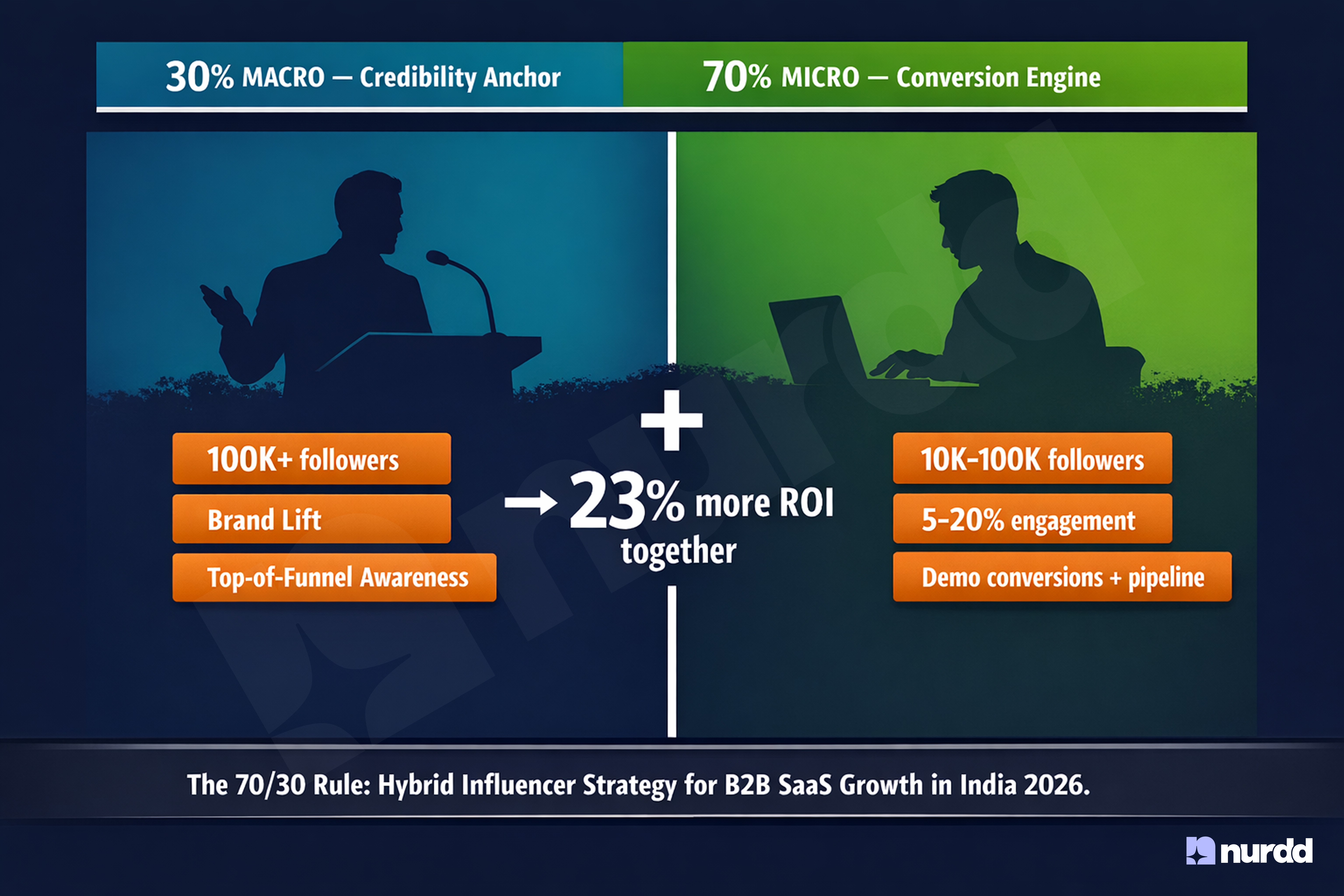
When engagement data from the 70/30 influencer programme shows a spike in high-LTV customers acquired through a creator who specialises in a specific professional niche, that pattern is market-fit data arriving in real time, before the sales team has processed it, before the CRM has segmented it, and before the product team has thought to look for it.
The Indian micro-verticals worth monitoring in 2026's SaaS landscape:
Vertical | Pain Point Signal | Potential Module |
|---|---|---|
CA firms in Tier-2 India | GST reconciliation workflows - manual, error-prone, compliance-critical | GST Compliance Automation module |
MSME founders (₹1–₹10 crore ARR) | Supply chain managed on WhatsApp + Excel - needs a lightweight interface | Vernacular-interface workflow tool |
Real Estate agents navigating RERA | Documentation requirements, timeline tracking, disclosure compliance | RERA Documentation module |
D2C founders expanding beyond metros | Multi-warehouse inventory, regional fulfilment, state-level tax variance | Multi-location inventory management |
Independent CAs and tax consultants | Client communication + document collection during ITR season | Seasonal workflow automation |
Healthcare practitioners | Insurance billing reconciliation, prescription tracking, patient follow-up | Health vertical workflow layer |
Each of these verticals has creator communities publicly documenting their friction. Each represents a micro-vertical module opportunity that arrived through the influencer dashboard before any sales conversation surfaced it.
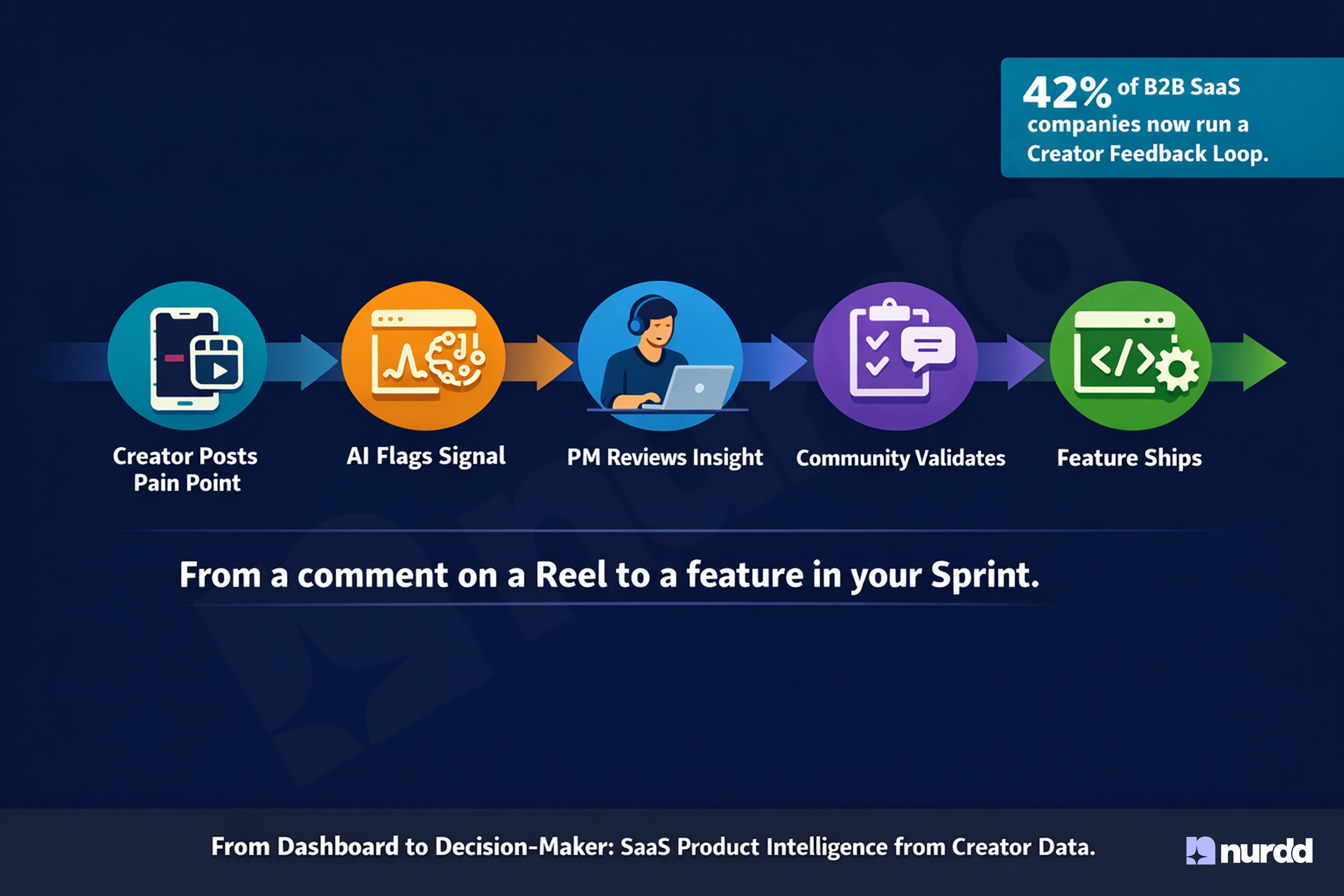
The Five-Step Creator Feedback Flowchart
Step | What Happens | Who Acts | Output |
|---|---|---|---|
1 — Signal | A micro-influencer posts an episodic series showing a recurring pain point, workaround, or competitor comparison | Creator and audience | Publicly documented friction event |
2 — Extraction | Nurdd's API flags high engagement and negative sentiment around the specific workflow, surfacing volume, sentiment score, and demographic data in the insight dashboard | Nurdd AI | Prioritised insight in PM dashboard |
3 — Analysis | Product Manager cross-references the flagged friction with in-app usage data to confirm scale and affected user segment | Product Manager | Validated roadmap candidate |
4 — Validation | Team deploys a targeted poll through the Creator-Preneur's private Slack or WhatsApp community - the CLG community built through the flywheel strategy | Product + Community | Confirmed demand with edge cases |
5 — Execution | Feature is added to the quarterly roadmap with a beta launch announced directly to the creator's community - closing the loop publicly | Product + Marketing | Shipped feature + loyalty signal |
The loop closes publicly. When the creator announces to their community "we asked for this - it shipped," that moment is simultaneously a product launch, a customer loyalty event, and a creator partnership deepened by demonstrated respect. 68% of users feel more loyal to a brand when they see a feature requested by a creator they follow actually get implemented.

Frequently Asked Questions
What is a creator feedback loop in SaaS product management? A creator feedback loop is a system in which signals from influencer content: comment sentiment, workaround patterns, competitor comparisons are automatically extracted by the influencer platform, surfaced to the product team via an insight dashboard, and acted upon in the product roadmap. It converts creator content from a marketing output into a continuous, real-time product intelligence feed at a sample size and authenticity level that traditional focus groups cannot match.
What is the Jobs-to-Be-Done (JTBD) framework and how does it apply to creator feedback? The JTBD framework, developed by Tony Ulwick and popularised by Clayton Christensen at Harvard Business School, holds that customers "hire" products to accomplish a specific job, not because of their features or demographics but because of the outcome they need to achieve. Applied to creator content, JTBD reveals the "job" behind every workaround a creator documents: when five practitioners independently develop the same workaround, they are collectively revealing a job your product has not yet hired itself to do natively.
What is social listening for SaaS product management? Social listening for SaaS product management is the structured, sentiment-coded extraction of creator content to surface product intelligence, feature requests expressed as workarounds, UX friction expressed as audience frustration, competitive gaps demonstrated in comparison series, and emerging use cases the product team had not anticipated. Unlike traditional social listening (which monitors brand mentions for PR purposes), this application feeds directly into the product roadmap process.
What is the jugaad pattern in SaaS product intelligence? The jugaad pattern is the signal generated when multiple creator-practitioners independently develop the same workaround to achieve the same outcome in your SaaS. When five Creator-Preneurs document the same workaround across their separate tutorial series, they are collectively demonstrating a mainstream product gap, not an edge case. The pattern reveals both the desired outcome and the specific friction point that a native feature should resolve, without requiring a single formal user interview.
What is micro-vertical intelligence from an influencer dashboard? Micro-vertical intelligence is the market-fit signal revealed when engagement data from an influencer programme shows a disproportionate clustering of high-LTV customers from a specific professional niche. This pattern indicates that a community has self-selected around a use case the product was not specifically designed for signalling a vertical-specific module opportunity that arrived through the influencer dashboard before the sales team or product team discovered it independently.
How does the creator feedback loop differ from NPS? NPS measures satisfaction on a 0–10 scale at a moment in time, from customers who respond to a survey. The creator feedback loop captures continuous, unsolicited, real-time reactions from active users in their natural workflow, including non-customers (viewers who have not yet purchased), competitive users (viewers who are publicly comparing your product to alternatives), and power users (creators who are pushing the product to its functional limits to produce content). NPS tells you how customers feel. The creator feedback loop tells you what they are actually trying to do.
How do I connect the creator feedback loop to my product roadmap in practice? The practical connection requires three integrations: (1) Nurdd's API flags high-engagement, negative-sentiment content about the brand and surfaces it in a PM-readable insight dashboard; (2) the PM cross-references these signals with in-app usage data to confirm scale; (3) the CLG community built through the flywheel strategy provides a pre-existing validation audience for rapid polling before any feature enters the sprint. The loop closes when the feature ships and is announced to the creator's community, turning the creator into a launch partner.
The Series Conclusion: Influence as Business Infrastructure
This blog is the final piece in a series built around one central argument: in 2026, influencer marketing is no longer a marketing expense. It is business infrastructure.
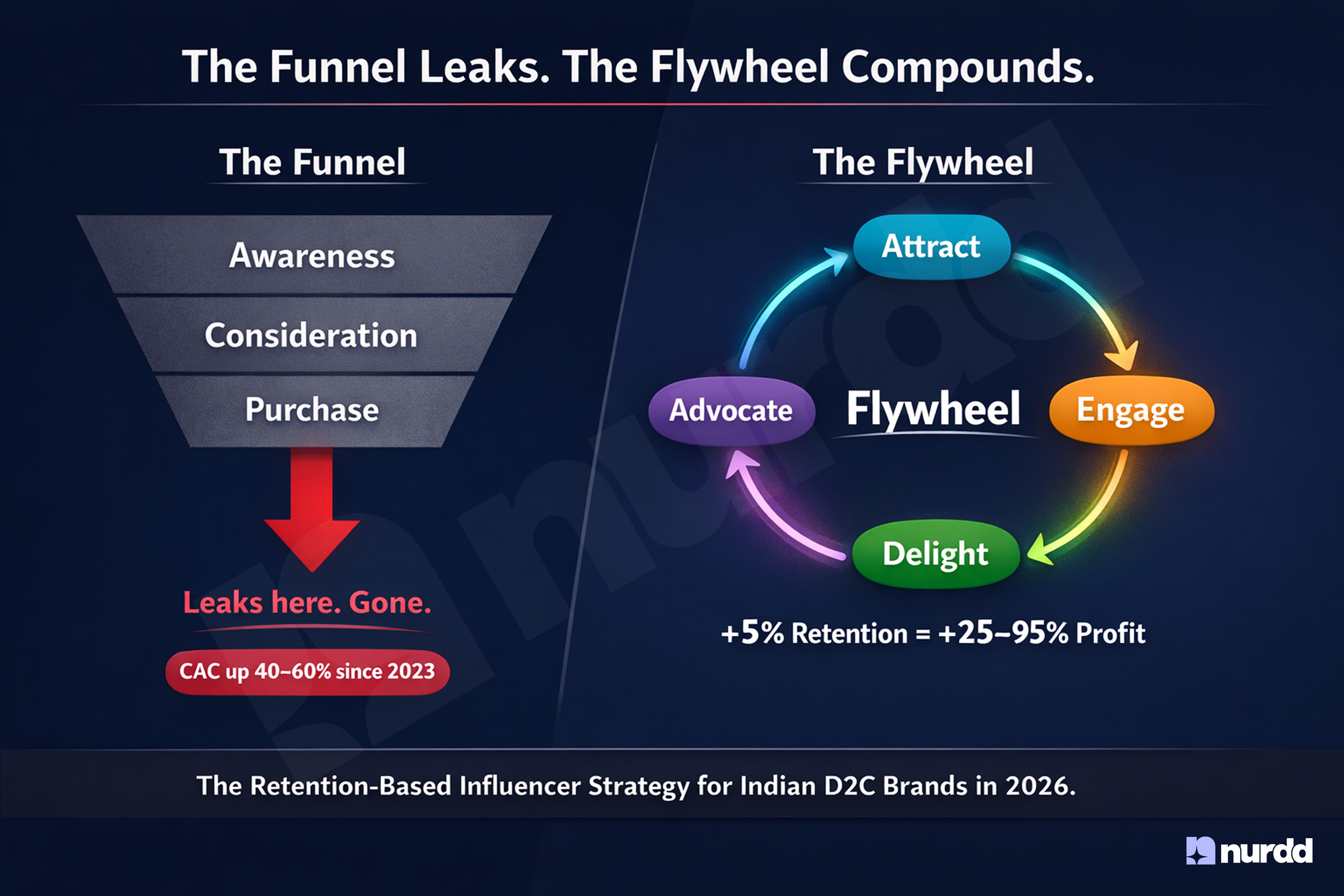
From AI-native virtual mascots providing 24/7 multilingual product support, to Professional Creator-Preneurs shaping enterprise purchase decisions on LinkedIn, to vernacular nano-influencers unlocking Tier-2 and Tier-3 India, to the flywheel that turns customers into community into advocates without additional ad spend, every blog in this series has made the case that the creator relationship, when built with the right infrastructure, compounds in value with every cycle it completes.
The brands that continue to use spreadsheets and one-off flex campaigns will find themselves running harder to stay in place, as acquisition costs rise, attention fragments, and audiences become more sophisticated at identifying transactional content.
The brands that win are those that:
✅ Build flywheels that turn customers into communities and communities into advocates
✅ Automate the boring stuff so their best people focus on creative strategy and creator relationships
✅ Connect their influencer infrastructure to their CRM, their product team, and their compliance stack
✅ Treat their creators as partners in the product journey — not as vendors in a campaign calendar
✅ Use their dashboard as a decision-maker's tool — turning creator signals into product features, market intelligence, and competitive advantage
The 2026 influencer landscape is not a channel. It is an operating system for growth. And like every operating system, its value is not in any single feature. It is in the way every part works together - continuously, compoundingly, to make everything else run better.
Sources
International Journal of Science and Research Archive — AI in Product Management: Automating Roadmap Prioritisation Through Sentiment Analysis (2025): journalijsra.com
Userpilot — The JTBD Framework in Product Management: Complete Guide (Jan 2026): userpilot.com
Strategyn / Tony Ulwick — Jobs-to-Be-Done: A Framework for Customer Needs: jobs-to-be-done.com
ProductSchool — Using the Jobs-to-Be-Done Framework for Product Management: productschool.com
ProductPlan — Jobs-to-Be-Done Framework: Definition and Overview (Nov 2024): productplan.com
Ortto — The Role of Customer Feedback in Shaping SaaS Product Roadmaps: ortto.com
Featurebase — Top 20 Product Feedback Software Tools in 2026 (Mar 2026): featurebase.app
Influencer Marketing Hub — Influencer Marketing Benchmark Report 2026 (Mar 2026): influencermarketinghub.com
Impact.com — Influencer Marketing Trends 2026: Performance Insights (Jan 2026): impact.com