The Flywheel vs. the Funnel: Why Retention-Based Influencer Marketing Is the New Growth Standard in 2026
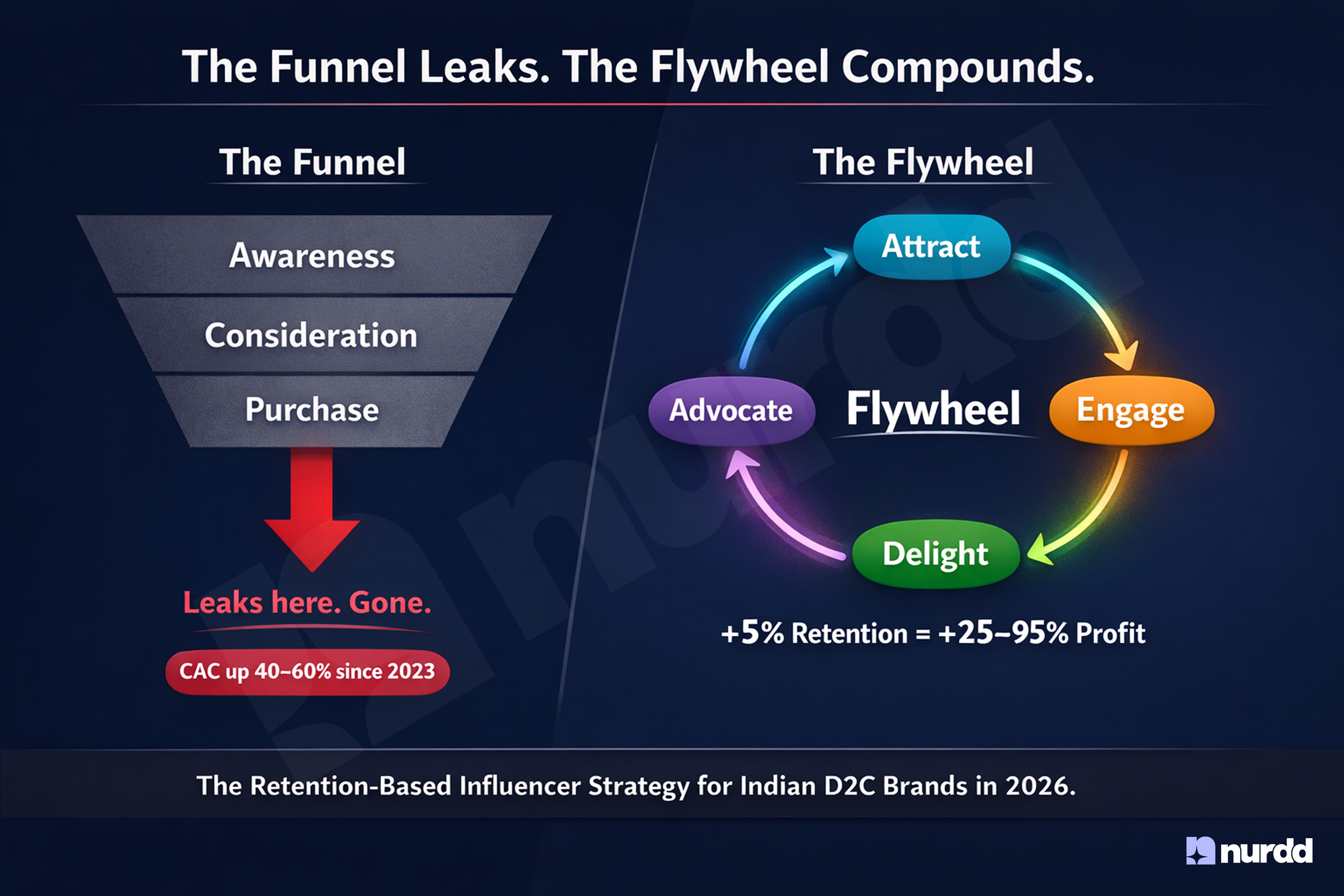
Google Ads CPC rose 30–100% in 2024. Facebook CPM climbed 25–40%. Customer acquisition now costs ₹800–1,200 per new customer in Indian D2C. The funnel model a one-off post, a burst of traffic, a customer who is a stranger to the brand within a week cannot survive these economics. The flywheel model inverts this entirely: the influencer becomes part of the post-purchase experience, customers become community members, and community members become advocates who bring the next wave without additional ad spend. Increasing customer retention by just 5% increases profits by 25–95%. The flywheel is not a retention tactic. It is the most efficient growth engine available to an Indian D2C brand in 2026.
The Leaky Funnel Problem
Every D2C brand that has been running influencer campaigns for more than two years has felt the problem, even without a precise name for it. The campaign performs. The influencer posts. Traffic spikes. Some percentage converts. And then nothing. The customer who arrived through the influencer's Reel buys once and disappears. The influencer moves to the next brand brief. The relationship that produced the first purchase produces nothing that follows.
This is the leaky funnel: a linear model designed for a marketing landscape that no longer exists.
Google Ads CPC rose between 30% and 100% across categories in 2024, while Facebook CPM climbed 25–40%, lifting acquisition costs to ₹800–1,200 per new customer. India's D2C e-commerce channel, projected to grow to USD 55–60 billion by 2030, is simultaneously experiencing the highest acquisition cost environment in its history. It costs 6–7 times more to acquire a new customer through a funnel approach than to retain an existing one through a flywheel community. And yet, the vast majority of influencer programme budgets are allocated entirely to acquisition leaving the post-purchase experience, the community, and the advocacy loop entirely unaddressed.
The funnel sees the customer as the endpoint of the influencer's job. The flywheel sees the customer as the beginning of the brand's most valuable compounding asset.
Funnel vs. Flywheel: The Key Differences
Dimension | The Funnel | The Flywheel |
|---|---|---|
Model shape | Linear customer exits at the bottom | Circular customer feeds back into the top |
Influencer role | Acquisition driver one-off post | Community anchor ongoing relationship |
Post-purchase | Brand disengages customer is on their own | Influencer hosts how-to series, community, hacks |
Customer role | Passive buyer | Active advocate and micro-influencer |
CAC over time | Rises with every platform CPM increase | Falls as community-driven referrals compound |
Content strategy | One-off campaigns | Episodic seasons across the customer lifecycle |
Measurement | Last-click conversion | LTV, retention rate, negative churn |
Growth driver | Ad spend | Community momentum + word-of-mouth |
The Creator Performance Flywheel: Four Stages
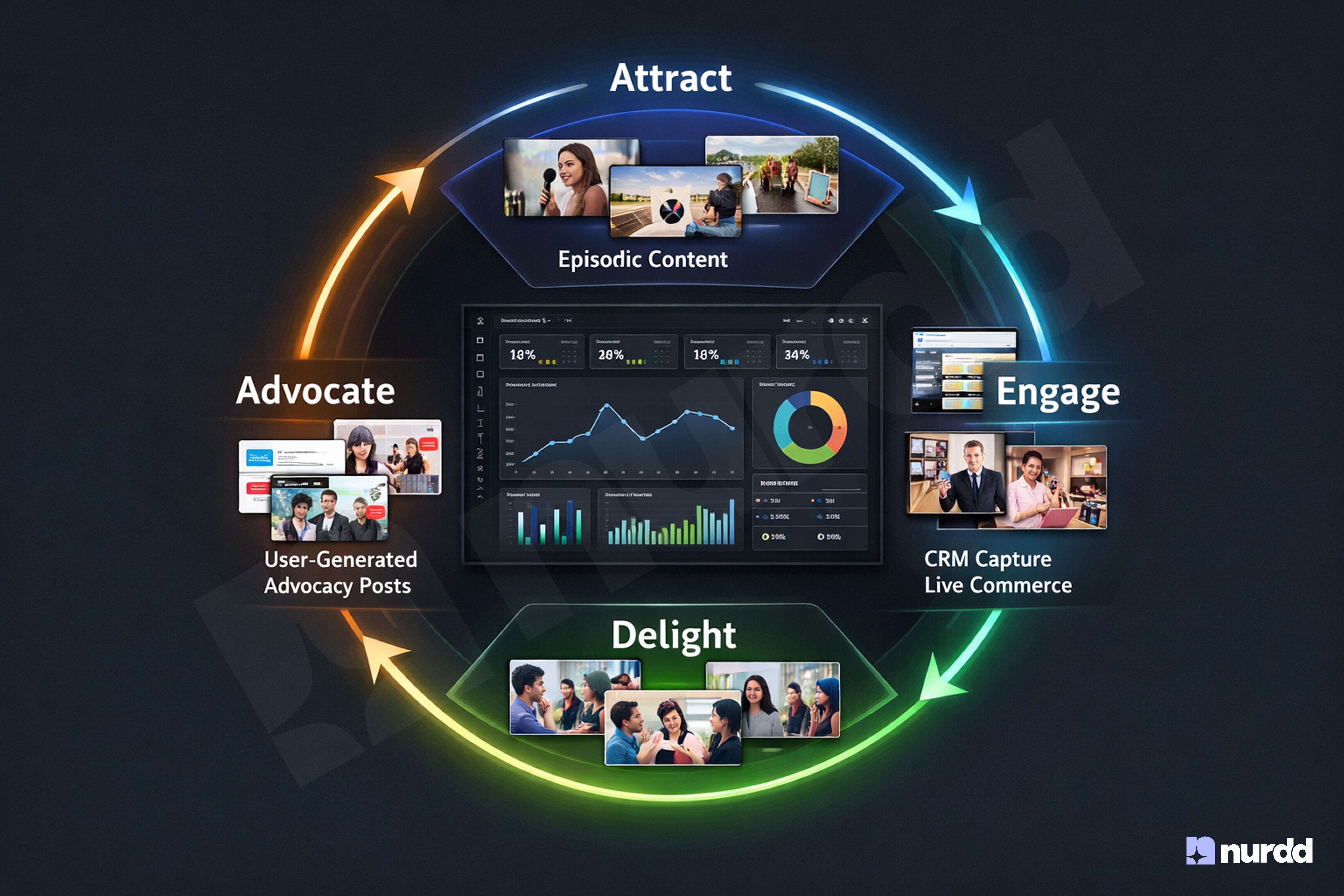
Impact.com's 2026 Performance Insights names the mechanism the creator performance flywheel: the system activated when a brand treats influencer content as high-performing media across every stage of the customer lifecycle not just acquisition. Brands that use influencer content as paid ads, retention content, and community anchors see 2–3x higher engagement and lower CPAs than those using brand-generated creative in isolation. The flywheel is what activates compounding returns from that investment.
Stage 1 — Attract: The Episodic Series
The flywheel's acquisition stage uses episodic, educational creator content to build familiarity and trust before any purchase decision is made. The nano-influencer's 10-part skincare series. The lawyer-Creator-Preneur's weekly GST explainer. The sustainability creator's "Frugal-Core kitchen" mini-series. Each episode builds on the previous one, establishing the creator and the brand as genuinely useful before the viewer has spent a rupee.
Standalone ads attract attention. Series build relationships. The viewer who has watched six episodes of a creator's series before clicking a link is not a cold prospect they are a pre-qualified community candidate who has already spent significant time with the brand's values and product logic.
Stage 2 — Engage: The Infrastructure Layer
When the pre-warmed viewer clicks through, the API-CRM integration covered in the previous blog activates: trackable landing pages, community invitations, CRM capture. The engagement stage converts pre-built attention into a verifiable relationship an email address, a community membership, a first purchase.
The most powerful engagement tool in India's D2C market right now is live commerce creator-hosted Instagram Live sessions where existing community members access new product launches, ask questions directly, and receive exclusive pricing. Brands like Myntra, Meesho, and Mamaearth are investing heavily in influencer-led live product demonstrations that convert 10x higher than static ads. A creator-hosted live commerce event announced through the community WhatsApp, hosted on Instagram Live, with community-only pricing is the flywheel's engagement stage made transactional and exclusive simultaneously.
Stage 3 — Delight: The Post-Purchase Experience
This is where most funnel-based influencer programmes end and where the flywheel begins.
After the purchase, the influencer does not disappear. They host the "How-to" series for existing buyers. They lead the private WhatsApp community for product owners. They answer questions, share Frugal-Core hacks, and surface tips that help customers extract maximum value from what they already own. Influencer-acquired customers have 20–35% higher lifetime value because they came in with pre-built trust and the brands that maintain that trust post-purchase see the LTV gap between influencer-acquired and discount-ad-acquired customers widen every quarter.
Stage 4 — Advocate: The Self-Sustaining Engine
The customer who has been genuinely delighted who feels supported, who has found community, who has discovered hacks they would not have found independently becomes a micro-influencer. They share their results. They tag the creator. They invite friends. 88% of consumers in India trust user-generated content within a community more than a high-production influencer ad.
The advocate's content is not produced by a creator on a brief. It is produced by a customer with genuine enthusiasm and it is the most credible, most affordable marketing the brand will ever generate.
Negative Churn: The Metric That Proves the Flywheel Is Working
The most technically precise indicator of a functioning flywheel is negative churn and it is the metric that separates brands running a retention strategy from brands running a community chat group with an acquisition programme attached.
Negative churn occurs when revenue generated from existing customers through upsells, cross-sells, and renewals exceeds the revenue lost from customers who leave. In a flywheel model, the influencer is not just retaining customers they are deepening their relationship with the brand through every episode of the post-purchase series, every community interaction, every exclusive early-access drop. A customer who joined through a nano-influencer's skincare series in January is, by March, likely to have purchased the brand's second product line because the influencer who introduced the first has been explaining the second for eight weeks.
When negative churn is achieved, the flywheel is generating its own momentum. The brand could theoretically reduce new customer acquisition spend and still grow because expansion revenue from the existing customer base exceeds churn revenue. That is never the strategy. But it is the proof that the flywheel is working correctly, and the CFO metric that justifies every rupee invested in community infrastructure.
Community-Led Growth: The Engine Inside the Flywheel
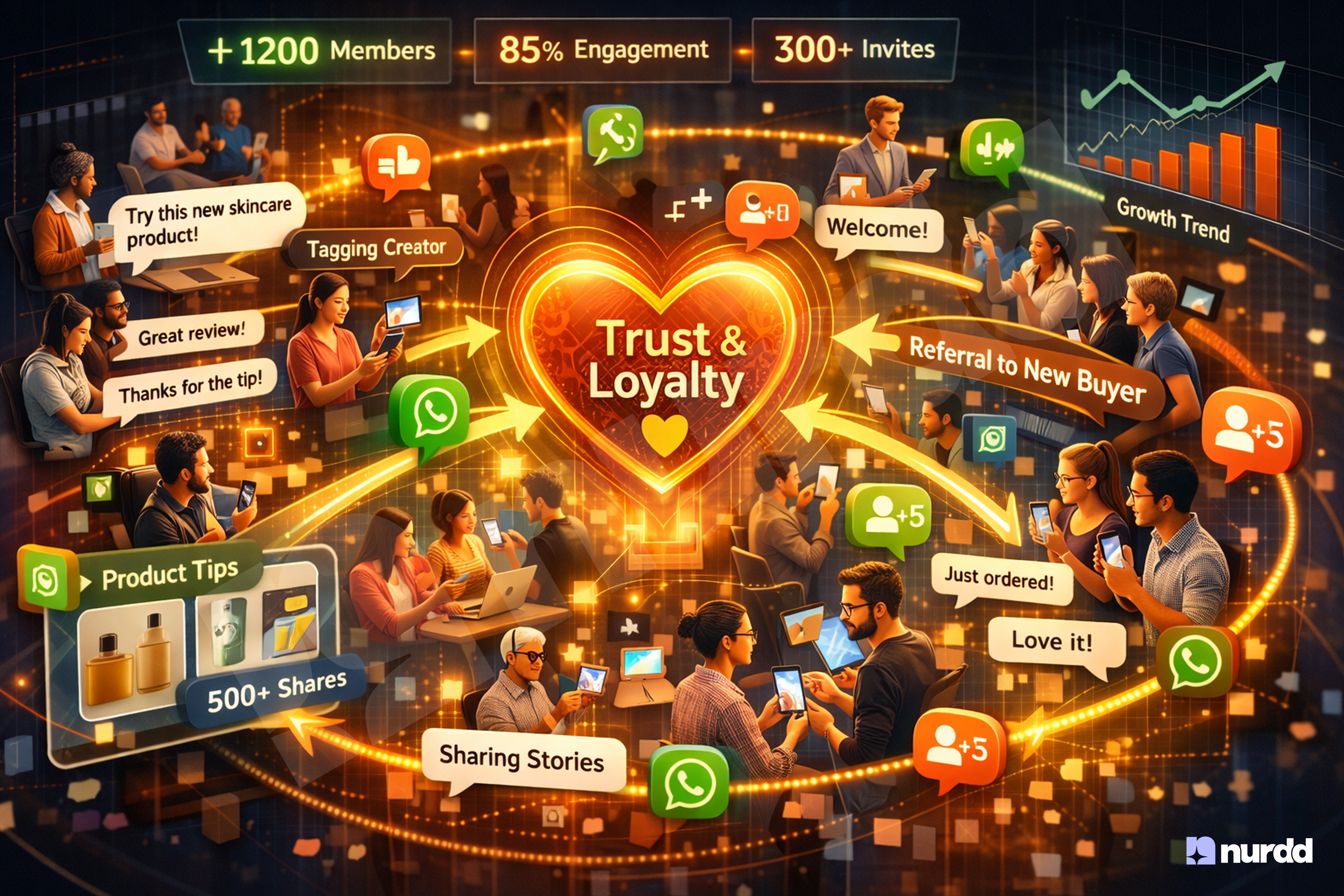
Community-Led Growth (CLG) is the mechanism that converts individual customers into a self-sustaining growth engine. The cycle:
Influencer brings a lead in → Lead joins the community → Community provides support, hacks, and peer advice → Lead becomes a loyalist → Loyalist invites others → Flywheel spins faster without additional ad spend.
The brands executing this most effectively in India in 2026 are not using broad Discord servers or open Facebook groups. They are using private WhatsApp communities for fast-moving D2C categories, Slack for professional and B2B products, and Discord for gaming and tech. The community is not a support channel. It is the brand's highest-density concentration of advocates and the influencer who anchors it is a community leader, not a hired creator.
For B2B brands, Notion and Airtable provide the blueprint: Creator-Preneurs who build templates, tutorials, and use-case libraries keep users deeply embedded in the product ecosystem through ongoing value creation rather than loyalty discounts. In India, this model applies directly to any D2C brand whose product has a learning curve or recurring use case nutrition brands, fitness equipment, financial products, professional tools, parenting categories.
Creator Co-Creation: The Flywheel's Most Advanced Stage
The most advanced version of the flywheel is what Impact.com's 2026 Performance Report calls creator co-creation moving from paying creators to post, to building ongoing product, campaign, and community development with them.
A D2C skincare brand whose ambassador co-develops a new product variant with community input, launches it to their audience first, and documents the development process in a 10-part series is not running an influencer campaign. They are building a brand with their most trusted distribution partner. The community that results is the most defensible competitive asset in their category a co-created product with a creator-community audience is not just a marketing launch. It is proof of market demand, documented publicly, before the product even ships.
This is the Lululemon and Gymshark model, made accessible to Indian D2C brands at every scale. Not every brand needs a global ambassador network. A growing skincare brand with eight nano-influencers who are genuine product users, each anchoring a private WhatsApp community of 200 customers in their city, has built a retention infrastructure that compounds monthly. Each community is simultaneously a product feedback loop, a word-of-mouth engine, and a customer support resource anchored by a creator whose relationship with the brand is ongoing rather than transactional.
56% of brands already prefer to use the same influencer across multiple campaigns rather than constantly rotating talent. The flywheel is not a new model. It is the formalisation of what the most effective brand-creator relationships were already doing intuitively and the infrastructure to make it systematic, measurable, and scalable.
Frequently Asked Questions
What is the influencer marketing flywheel? The influencer marketing flywheel is a circular growth model in which influencer relationships extend beyond acquisition into post-purchase experience, community building, and customer advocacy. Unlike the linear funnel, which ends at conversion, the flywheel uses creator content and community to convert customers into advocates who bring the next wave of buyers compounding growth without proportional increases in ad spend.
What is the difference between the influencer funnel and the flywheel? The funnel is linear: a creator posts, a customer converts, the relationship ends. The flywheel is circular: the creator post attracts, the brand's community engages, the post-purchase content delights, and the advocate shares bringing the next customer into the cycle. The funnel's CAC rises with every platform CPM increase. The flywheel's effective CAC falls as community-driven referrals compound over time.
What is negative churn in influencer marketing? Negative churn is the state in which revenue generated from existing customers through upsells, cross-sells, and renewals exceeds the revenue lost from customers who leave. In a flywheel model, the influencer's post-purchase content and community management keep customers deepening their relationship with the brand purchasing additional products, upgrading plans, or renewing subscriptions resulting in net revenue expansion from the existing customer base rather than net revenue loss.
What is Community-Led Growth (CLG) in influencer marketing? Community-Led Growth is the mechanism that converts individual customers into advocates who attract new customers without additional ad spend. In an influencer flywheel, the creator anchors a private community (WhatsApp, Discord, Slack) where existing customers share results, receive support, and find peer validation. The community's organic word-of-mouth and member invitations generate new customer acquisition that compounds independently of the brand's paid media budget.
What is creator co-creation? Creator co-creation is the practice of involving influencers in product development, campaign ideation, and community building rather than briefing them only to post content. In a flywheel model, a creator who co-develops a new product variant with their community, documents the process episodically, and launches to their audience first is not running a sponsored post. They are serving as a co-brand partner, with community-verified product-market fit and a pre-warmed audience at launch.
How do I build a post-purchase influencer strategy for my D2C brand? Start by identifying the creator who brought in your highest-LTV customer cohort the one whose audience bought most and stayed longest. Give that creator access to your post-purchase community: a branded WhatsApp group for product owners, a "Season 2" of their series focused on product mastery, or an exclusive live commerce event for existing customers. Measure success in 180-day repeat purchase rate and NPS, not post-launch conversion rate.
How does episodic content help with retention? Episodic content keeps the brand top-of-mind through every stage of the customer lifecycle, not just the buying phase. A second season of a creator's series, focused on post-purchase product mastery, gives existing customers new reasons to engage. A third season featuring community members sharing results converts advocates into content producers. Each season serves a different lifecycle stage and the creator who anchors all three maintains a continuous relationship that deepens the customer's relationship with the brand over time.
What is the creator performance flywheel? The creator performance flywheel (Impact.com's term) is the system activated when a brand treats influencer content as high-performing media across every channel and every stage of the customer lifecycle using it as paid ads, retention content, email sequences, and community anchors simultaneously. Brands using influencer content as paid media see 2–3x higher engagement and lower CPAs than those using brand-generated creative. The flywheel's momentum builds as each piece of content works harder across multiple channels and multiple lifecycle stages.
What This Means for Indian D2C Brands Right Now
India's D2C e-commerce market is projected to grow 3x faster than traditional marketplaces, reaching USD 55–60 billion by 2030. The brands that compound through this growth window will not be the ones spending the most on acquisition. They will be the ones who understood, in 2026, that the influencer who builds a community around their product is more valuable than the one who posts about it once and built their programme infrastructure accordingly.
The four stages of the flywheel (Attract, Engage, Delight, Advocate) are available to every brand, at every scale, starting with the creators already in their programme. The question is not whether to build a flywheel. It is how quickly to start turning it.
The funnel had a good run. But it leaks.
Sources
Mordor Intelligence — India D2C E-commerce Market Analysis 2026–2031 (Jan 2026): mordorintelligence.com
Kashmir Reader / McKinsey — India's D2C E-commerce to Grow 3x Faster, Hit USD 60 Billion by 2030 (Feb 2026): kashmirreader.com
Global TroCCO — Top 10 E-Commerce Trends to Watch in 2025: global.trocco.io
Harvard Business Review / Bain & Company — Prescription for Cutting Costs: Loyal Relationships: hbr.org
Impact.com — Influencer Marketing Trends 2026: Performance Insights (Jan 2026): impact.com
HubSpot — The Flywheel Model: hubspot.com
SociallyIn — 2026 Influencer Marketing Statistics: ROI, Trends and Platform Data (Mar 2026): sociallyin.com
Kofluence — Decoding Influence: 2025 India Influencer Marketing Report (Aug 2025): kofluence.com
Influencer Marketing Hub — Influencer Marketing Benchmark Report 2026 (Mar 2026): influencermarketinghub.com
Exif Media — D2C Brand Creator Strategy India 2025: The Creator Playbook (Feb 2026):exifmedia.com