The 70/30 Rule: Why a Hybrid Macro-Micro Influencer Strategy Is the Sweet Spot for B2B SaaS Growth in 2026
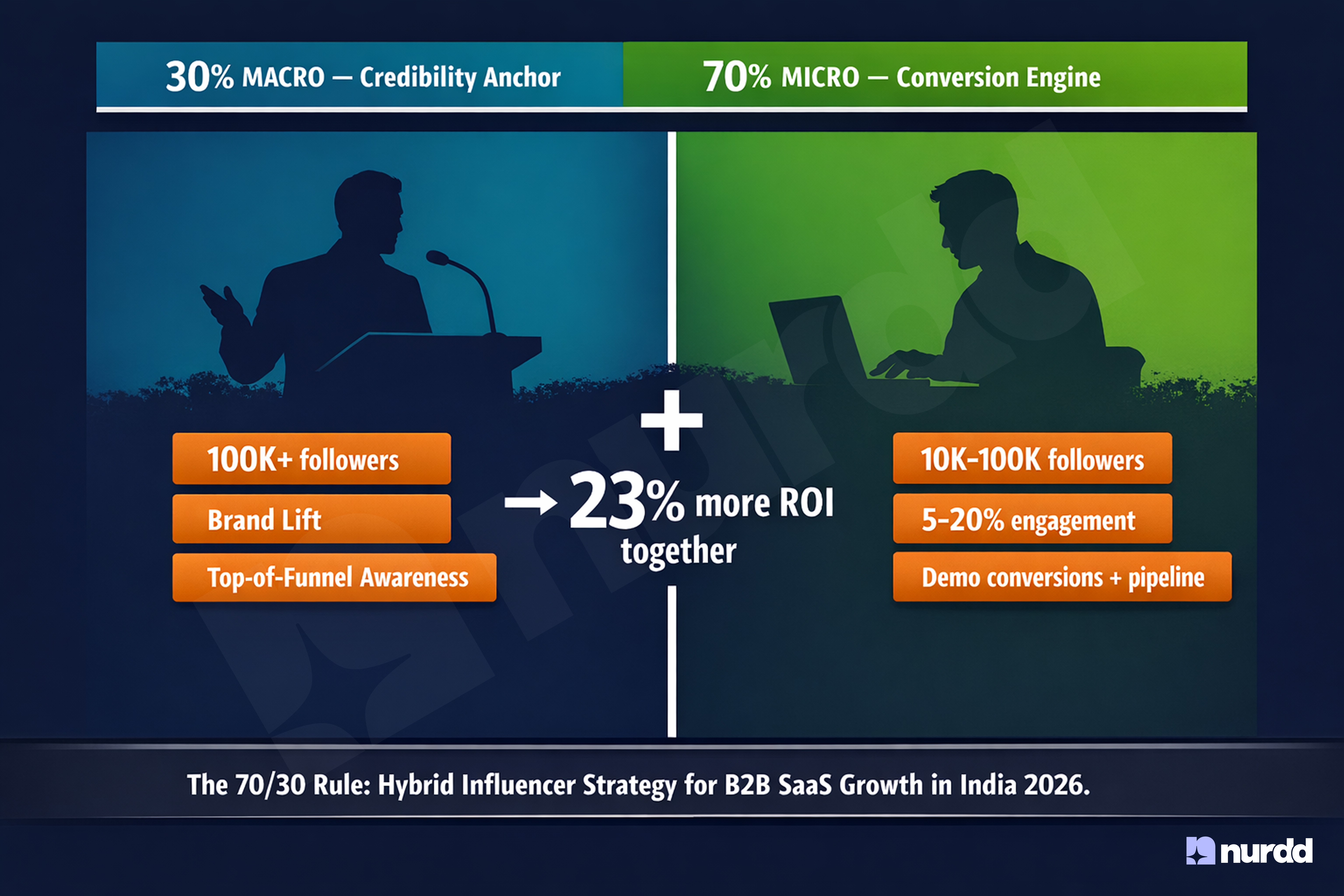
Micro/nano influencer campaigns deliver around a 20:1 ROI versus roughly 6:1 for macro-influencer campaigns — but macro content provides the brand recognition that makes micro tutorials convert. The 70/30 hybrid model — 30% of budget on macro credibility, 70% on micro conversion — delivers approximately 23% better overall ROI than either tier deployed alone. For B2B SaaS brands in India, this is not a media allocation decision. It is the full-funnel architecture that lets you close enterprise deals with credibility and convert practitioner-level leads with trust.
The False Choice Between Reach and Resonance
Every B2B SaaS marketing team faces the same allocation debate at some point. The macro camp argues for brand authority — you cannot close enterprise deals with a creator nobody in your category has heard of. The micro camp argues for conversion efficiency — you cannot justify the cost of a macro-influencer when a Senior DevOps Engineer with 40,000 LinkedIn followers converts at five times the rate.
Both camps are right. And both camps are wrong about the other.
Consider what a ₹2 lakh investment in a single macro influencer with 8.5 lakh followers actually produces: 287 link clicks and 18 confirmed purchases — numbers documented from the Indian market. The same ₹2 lakh allocated across 20 niche micro-influencers at ₹10,000 each — properly briefed, with CRM attribution and affiliate-hybrid compensation — consistently produces significantly more qualified pipeline. But without the macro tier's brand recognition, those micro tutorials land in a vacuum where the prospect has never heard of the product and has no reason to trust the context in which it is being recommended.
Justin Welsh — with 800,000+ LinkedIn followers and a popular newsletter — is Impact.com's named model for the new wave of B2B thought leaders. He operates exactly like a micro-media company, bypassing advertising entirely by building brand credibility through peer-to-peer expertise on LinkedIn, demonstrating the power of a single highly credible subject-matter expert to shape B2B buying decisions at scale. He represents both what the macro tier aspires to accomplish (category narrative shaping) and what the micro tier eventually becomes (a practitioner whose authority is commercially leverageable). The 70/30 model uses both, deliberately, as a coordinated system.
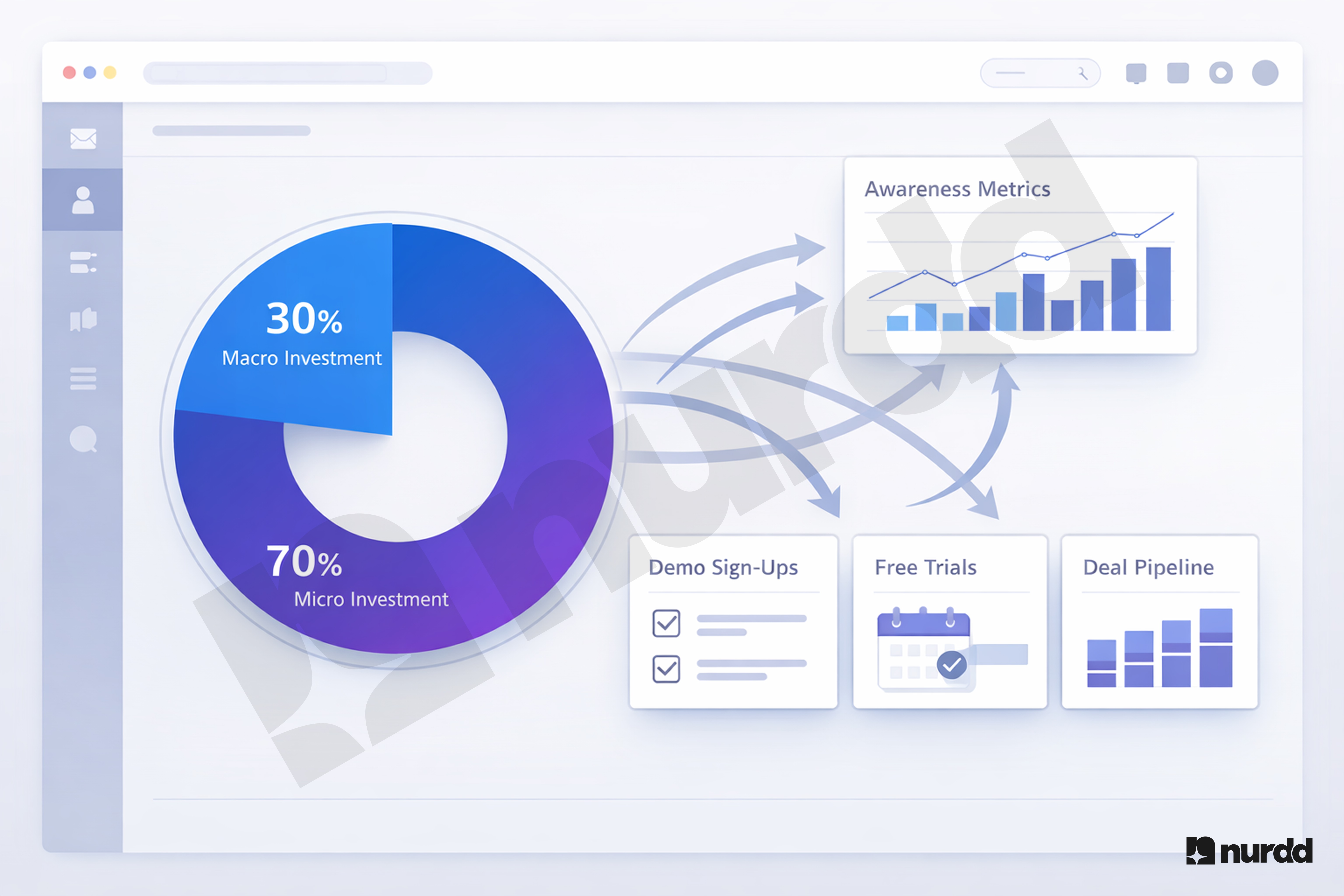
The 70/30 Framework: Roles, Rationale, and Reach
The 30% — Macro-Influencers: The Credibility Anchor
Macro-influencers — recognised analysts, sector commentators, business media personalities, and category thought leaders with 100K+ followers — serve one primary function in the hybrid model: they establish that your product exists, matters, and belongs in the category conversation before the evaluation stage begins.
In B2B SaaS, enterprise procurement does not start with a purchase. It starts with a shortlist — and shortlists are built from prior exposure. A macro-influencer's product mention does not drive immediate conversion. It creates the brand recognition that ensures the micro-influencer's deep-dive tutorial lands with a prospect who already has baseline familiarity. Celebrity brand endorsements have fallen to 22% in India in 2025, signalling that pure macro strategies are losing effectiveness as audiences fragment — but the brand lift function that macro content uniquely provides remains essential for any SaaS brand closing deals above a certain ACV.
The most effective content format for the macro tier in B2B SaaS is trend commentary and category narrative — posts that establish a problem space rather than selling a solution. The brand is named as a credible participant in the conversation, not as the subject of an ad. This is the difference between a mention that creates context and a placement that creates resistance.
The 70% — Micro-Influencers: The Conversion Engine
Micro-influencers for B2B SaaS are not creators in the traditional sense. They are industry practitioners: a Senior DevOps Engineer reviewing a deployment tool, a Head of HR explaining how a payroll SaaS integrates with an existing HRMS, a CFO walking through the finance close process in a new spend management platform. Their content — LinkedIn tutorials, honest workflow integration videos, comparison threads with direct competitors — carries the weight of a peer review.
In B2B purchasing, peer reviews are the single most trusted information source at the evaluation stage. Micro-creators consistently deliver higher engagement rates (5–20%) than macro-influencers (1–3%) while costing 60–70% less per post. Micro-influencer campaigns generate 22% more comments per post than macro campaigns of similar scope. And B2B email sign-up campaigns led by micro-influencers convert at 4.1% — nearly double the B2C rate — because the audience is professionally pre-qualified before they click.
The proof is in a specific B2B SaaS case study: a marketing analytics company partnered with eight LinkedIn and X micro-influencers to promote an industry benchmarking report, generating 600 report downloads, 150 newsletter sign-ups, and three enterprise demo requests — qualified pipeline produced through peer-level content, not paid search.
The 70/30 Comparison Table
Dimension | 30% — Macro (Credibility Anchor) | 70% — Micro (Conversion Engine) |
|---|---|---|
Follower range | 100K+ | 10K–100K |
Primary goal | Brand lift, top-of-funnel awareness | Trust, evaluation-stage conversion |
Best content type | Trend commentary, category narrative | Deep-dive tutorials, workflow reviews, honest comparisons |
Engagement rate | 1–3% | 5–20% |
ROI benchmark | ~6:1 | ~20:1 |
Cost per post (India) | ₹1L–₹10L+ | ₹5K–₹50K |
LinkedIn function | Industry narrative shaping | Peer recommendation, demo trigger |
SaaS use case | Product category launches, enterprise credibility | Feature adoption, trial conversion, renewal advocacy |
Content shelf life | Short (trend-dependent) | Long (tutorial and tutorial series remain discoverable) |
CRM attribution | Macro Assist — first-touch awareness | Micro Close — last-touch or mid-funnel conversion |
The Affiliate-Influencer Hybrid: Making the 70% Tier Accountable
The compensation model that most precisely aligns 70% micro-influencer incentives with SaaS business outcomes is the affiliate-influencer hybrid: a modest base fee plus a performance commission tied to demo sign-ups, trial activations, or qualified leads attributed through the creator's unique referral link.
Brands are increasingly structuring deals with micro-influencers to include commissions and bonus incentives — a B2B software company gives the DevOps Creator-Preneur a unique referral link and pays a percentage for every qualified demo that comes through it, aligning the creator's rewards with the brand's pipeline rather than just their posting calendar. Some brands are merging their affiliate and influencer teams entirely, creating a full-funnel approach where micro-influencers create engagement at the top and affiliate links ensure trackable, lower-funnel performance at the bottom.
For Indian B2B SaaS brands, a practical affiliate-hybrid structure for a ₹5–₹50 crore ARR company might look like:
Creator Tier | Base Fee per Episode | Commission Structure | Trigger |
|---|---|---|---|
Nano (1K–10K) | ₹2,000–₹5,000 | ₹500 per demo sign-up | Free trial activation |
Micro (10K–50K) | ₹8,000–₹20,000 | ₹1,500 per qualified demo | Sales-accepted lead |
Mid-tier (50K–100K) | ₹25,000–₹60,000 | ₹3,000 per demo + 5% ACV on close | Signed deal |
This structure gives the creator meaningful upside beyond the base fee — incentivising content depth, honest endorsement, and genuine community follow-up — while keeping the brand's cost per qualified lead significantly below paid search benchmarks.
Social SEO: The Discovery Advantage of the 70% Tier
The micro-influencer's content advantage is not just engagement rate. It is Social SEO — the practice of optimising each LinkedIn post, tutorial video, and thread for platform-internal search discovery.
A DevOps engineer's LinkedIn tutorial titled "How I automated our deployment pipeline in 3 steps using [Tool Name]" is not just a post. It is a searchable, indexable reference that appears in LinkedIn's internal search results for every procurement researcher who types those exact words. The content that converts in B2B SaaS is not the content that goes viral. It is the content that gets found by the right person at the right moment in their evaluation journey — three weeks after the macro mention planted the brand name.
Platforms like TikTok, YouTube, and LinkedIn have become search engines for professionals — and micro-influencers' format agility across LinkedIn carousel posts, explainer videos, tutorial threads, and newsletter editions allows brands to cover multiple discovery surfaces simultaneously. The episodic series format, introduced earlier in this blog series, is the Social SEO multiplier: each episode adds a new indexed keyword touchpoint to the series, compounding discoverability with every new episode published.
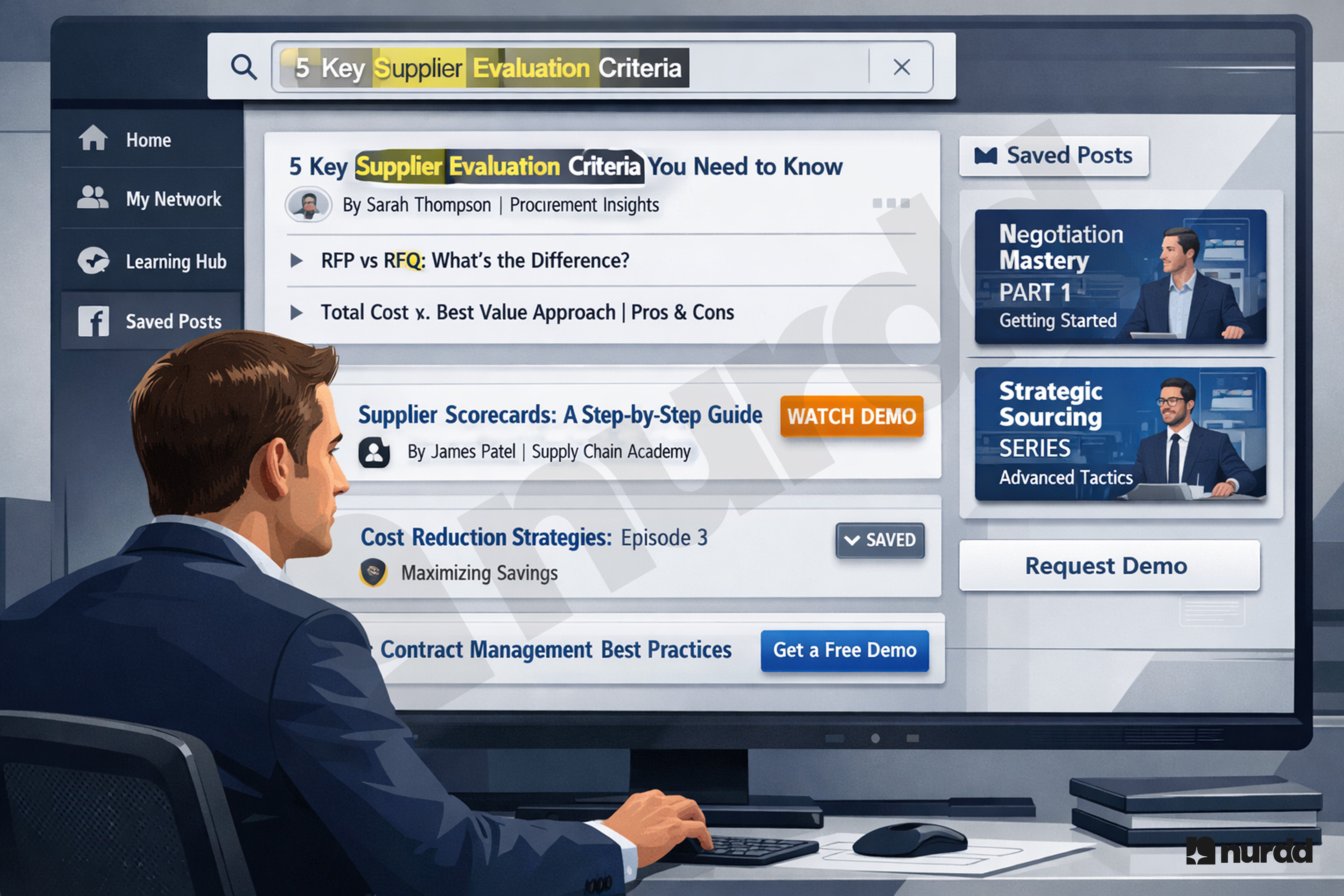
How the CRM Integration Reveals the Macro Assist
The most sophisticated brands in the 70/30 model do not treat macro and micro as separate campaigns. They treat them as a coordinated attribution system — and the CRM integration covered in the previous blog is what makes the coordination visible.
Step 1 — The Macro Assist: A procurement lead watches an industry analyst's LinkedIn video mentioning that a particular SaaS tool "solved the scale problem our team couldn't." This registers as a website visit — anonymous, dark funnel, unattributed. But it plants the brand name in the recognition layer.
Step 2 — The Micro Close: Three weeks later, the same lead searches for the brand name, finds a Senior DevOps Engineer's 10-part tutorial series, watches six episodes, and clicks through to a free trial landing page with the micro-influencer's unique UTM. The CRM records the conversion and attributes it to the micro-creator.
Step 3 — The Assist Record: The CRM's multi-touch attribution model flags the macro-influencer's content as a first-touch assist — contributing to the recognition that made the micro-content credible. The macro-influencer receives fractional credit. The hybrid model becomes visible, attributable, and fundable.
Without CRM integration, the macro-influencer's contribution is invisible and the 30% tier appears not to work. The measurement infrastructure is not optional for this model. It is what makes it legible.
The 2026 Benchmark Data
Metric | Macro (100K+) | Micro (10K–100K) | Hybrid 70/30 |
|---|---|---|---|
Average ROI | ~6:1 | ~20:1 | ~23% above single-tier |
Engagement rate | 1–3% | 5–20% | Weighted ~8–12% |
Cost per post (India) | ₹1L–₹10L+ | ₹5K–₹50K | Weighted ~₹15K |
B2B lead quality vs paid social | Moderate lift | High lift | 82% of marketers rate higher |
Enterprise deal assist rate | High — brand recognition | Lower — but closes | Combined = complete funnel |
Content shelf life | Short | Long (tutorial series) | Micro anchors retention |
Viewer/read retention | 30–40% | 60–70% | Micro anchors depth |
Email sign-up conversion (B2B) | N/A | 4.1% (vs 2.3% B2C) | Micro drives list growth |
Frequently Asked Questions
What is the 70/30 influencer marketing rule for B2B SaaS? The 70/30 rule allocates 70% of the influencer budget to micro-influencers (10K–100K followers) for high-trust, conversion-focused practitioner content and 30% to macro-influencers (100K+) for brand credibility and top-of-funnel category awareness. This hybrid allocation delivers approximately 23% better overall ROI than single-tier approaches, because the macro investment creates the brand recognition that makes micro tutorials convert more effectively.
Why do micro-influencers outperform macro-influencers for B2B SaaS conversions? In B2B SaaS, purchasing decisions are made by practitioners evaluating specific workflow problems — and peer recommendations are the most trusted information source at the evaluation stage. A Senior DevOps Engineer reviewing a deployment tool carries more evaluation-stage credibility than a business celebrity with 2 million followers. Micro-influencers achieve 5–20% engagement rates versus 1–3% for macros, cost 60–70% less per post, and produce tutorial content with long discovery shelf life.
What is an affiliate-influencer hybrid compensation model? An affiliate-influencer hybrid combines a base fee per piece of content with a performance commission tied to a verified business outcome — demo sign-ups, trial activations, or deal closes. A B2B SaaS company gives the micro-influencer a unique referral link and pays a commission for every qualified lead that comes through it, aligning the creator's incentives with the brand's pipeline rather than their posting calendar.
How do I track the macro assist in my CRM? Using multi-touch attribution in your CRM-integrated influencer platform, tag every macro-influencer's linked content with a unique UTM. Set up first-touch attribution capture alongside last-touch conversion tracking. When a lead's first website session follows a macro-influencer content event and their trial activation follows a micro-influencer tutorial, the CRM records both touchpoints and assigns fractional credit. Without this integration, the macro assist is invisible and the 30% tier appears not to work.
What is Social SEO for B2B influencer content? Social SEO is the practice of optimising micro-influencer content — LinkedIn posts, tutorial videos, and threads — for platform-internal search discovery, so that procurement decision-makers researching a specific problem find the creator's content at the right moment in their evaluation journey. Unlike viral content that peaks and fades, Social-SEO-optimised tutorials remain discoverable and trusted months after publication, compounding their influence with every new searcher they reach.
What is the ROI difference between micro and macro influencers for B2B? Micro/nano influencer campaigns deliver around a 20:1 ROI versus roughly 6:1 for macro-influencer campaigns — but combining both tiers in a coordinated 70/30 model delivers approximately 23% better overall ROI than either tier alone, because the macro investment's brand lift amplifies the micro investment's conversion rate. The tiers are not alternatives. They are a system.
How much should I pay a micro-influencer for B2B SaaS content in India? Indian B2B SaaS micro-influencers (10K–50K followers) typically charge ₹8,000–₹20,000 per episode of tutorial or workflow integration content on LinkedIn. With an affiliate-hybrid structure, a ₹1,500 commission per sales-accepted lead can supplement the base fee — giving top-performing creators meaningful upside while keeping the brand's cost per qualified lead well below paid search benchmarks in most SaaS categories.
What content formats work best for the 70% micro tier in B2B SaaS? The formats with the longest ROI shelf life are episodic tutorial series (10-part "how I use this tool for X" series remain discoverable months after publication), honest workflow integration videos (showing real use-case fit rather than scripted demos), LinkedIn carousel breakdowns of specific feature benefits, and comparison threads that include direct competitors. All of these formats optimise for Social SEO — platform-internal search discovery — rather than algorithmic virality.
The Closing Hook
In 2026, you do not choose between reach and resonance. You use 30% of your budget to buy the reach that makes your 70% resonance work twice as hard.
The macro mention is the reason the micro tutorial gets a hearing. The micro tutorial is the reason the macro mention converts into a pipeline. Together, coordinated through CRM attribution and compensated through affiliate-hybrid structures, they are not two strategies. They are one system — and the B2B SaaS brands that build it with the right infrastructure will find that influencer marketing is not a channel they are testing. It is the engine they are running.
Sources
Moburst — Influencer Marketing ROI in 2026: What the Data Actually Shows (Mar 2026): moburst.com
Exchange4media — Are Micro-Influencers Delivering Better ROI Than Macro Stars? (Feb 2026): exchange4media.com
Impact.com — Influencer Marketing Trends 2026: Performance Insights (Jan 2026): impact.com
Stack Influence — B2B Influencer Marketing Trends 2026 (Mar 2026): stackinfluence.com
Zebracat — 150+ Influencer Marketing Statistics for 2025: zebracat.ai
SociallyIn — 2026 Influencer Marketing Statistics: ROI, Trends and Platform Data (Mar 2026): sociallyin.com
Influencer Marketing Hub — Influencer Marketing Benchmark Report 2026 (Mar 2026): influencermarketinghub.com
Dataslayer — Influencer Marketing Investment 2025 Statistics and ROI: dataslayer.ai
Archive.com — 14 Influencer Marketing Growth Statistics for 2026: archive.com
Thunderbit — Influencer Marketing in 2026: Key Stats That Matter (Dec 2025): thunderbit.com