Stop Posting When Your Followers Are Online. Post When They're Ready to Act.
There's a dashboard in every social media tool that tells you the same thing: your audience is most active at 7:00 PM. So every brand, every creator, every marketing team in your niche sets their scheduler to 7:00 PM. And then they all wonder why their reach is shrinking.
The "best time to post" advice hasn't been wrong it's become a victim of its own popularity. When everyone follows the same data, the data stops working.
This is the paradox at the centre of social media strategy in 2026. And the way out isn't better guesswork. It's a fundamentally different model of thinking about time, attention, and intent.
Welcome to Predictive Engagement Windows the shift from posting when your audience is online to posting when they're ready.
The Problem With Peak Time Logic
Let's walk through exactly what breaks down.
Sprout Social's 2026 report built on an analysis of nearly 2 billion engagements across 307,000 global social profiles confirms what most marketers already "know": midday to late afternoon, Tuesdays and Wednesdays, is when social engagement is highest across almost every platform. The data is real. The insight is valid.
And therein lies the trap.
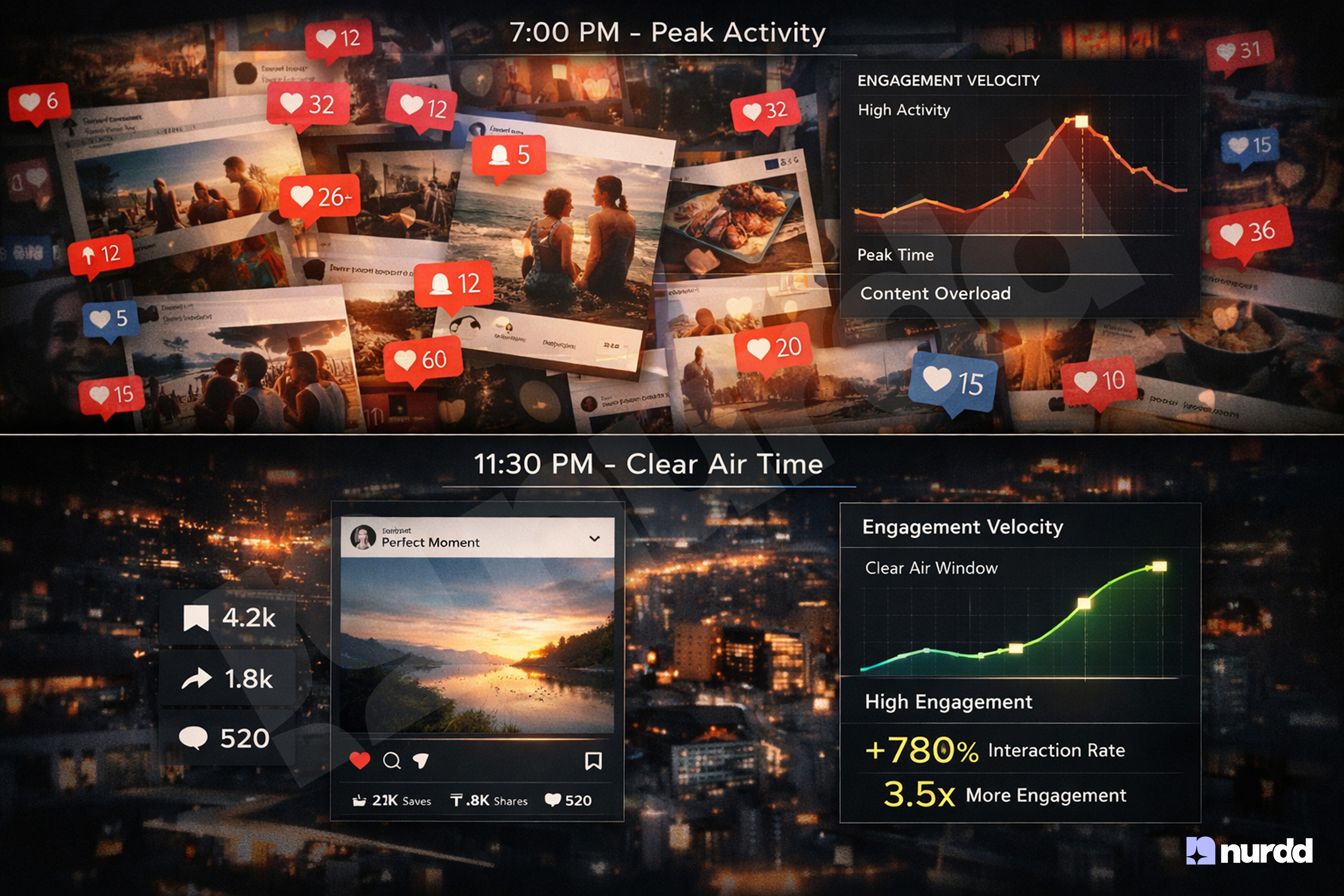
When 70% of marketers plan to increase their investment in Instagram this year, and they all read the same reports, they all converge on the same windows. The feed at 7:00 PM isn't just crowded it's a traffic jam. Your post goes live at peak time and immediately competes with every other brand that read the same Sprout Social study, every creator with the same scheduling tool, every sponsored post with a media budget behind it.
The algorithm doesn't give visibility to the post that went live at peak time. It gives visibility to the post that earns the fastest, most concentrated burst of engagement. In a saturated window, that advantage disappears.
There's a better question than "when are the most people online?" The better question is: when is the right person in the right mindset?
From Population Data to Behavioral Segments
Here's the core insight that predictive engagement logic is built on: your audience is not a single block of people who behave the same way at the same time. It's a collection of segments, each with its own rhythm and each with a specific moment when they shift from passive browsing to active participation.
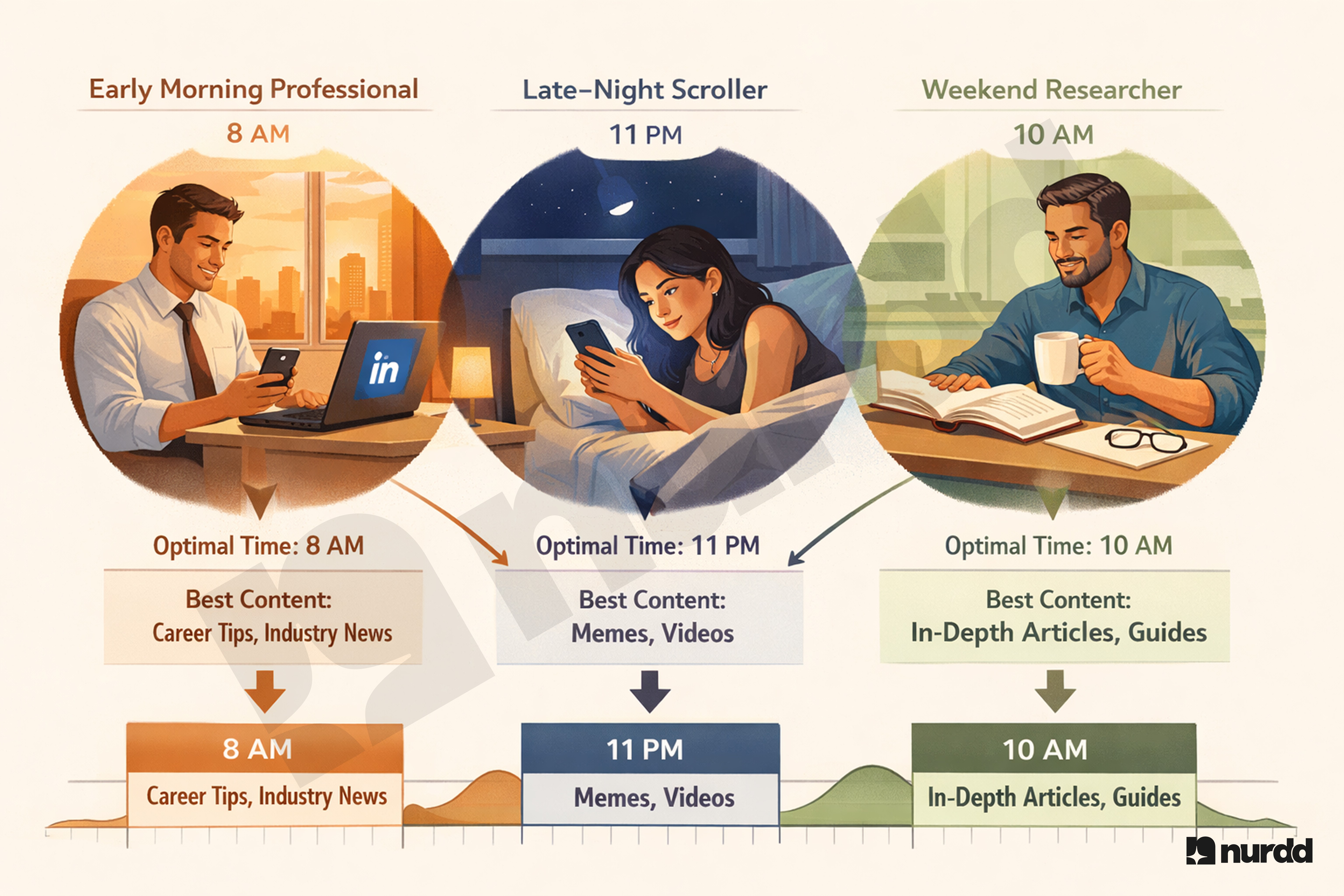
Think about three archetypes that exist in almost every brand audience:
The Early Bird Professional. Commuting by 8:00 AM, checking LinkedIn for industry news before the workday kicks in. Sprout Social's 2026 data shows a sharp engagement peak on LinkedIn right at 8:00 AM on Tuesdays and Wednesdays the pre-market scroll before the day demands full attention. This person doesn't engage at 7:00 PM. By then, they've switched off. Catch them at 8:00 AM or miss them entirely.
The Midnight Scroller. Up at 11:00 PM, moving through Instagram or TikTok in a semi-relaxed state, more susceptible to impulse decisions. Buffer's analysis of over 52 million posts across major platforms shows TikTok sees strong performance in the evening window between 6:00 PM and 11:00 PM with Saturday posting generating the highest engagement of any day on the platform. This person isn't looking for information. They're open to discovery. A product recommendation here converts at a rate that an educational post at noon never will.
The Weekend Researcher. Saturday morning, coffee in hand, longer dwell times, no time pressure. These are the readers who actually finish a carousel, watch a full video, and save content for later. This person represents some of the highest-quality engagement available if you're posting the right kind of content. A feature-heavy explainer that would get scrolled past on a Tuesday afternoon becomes a considered read on a Saturday morning.
The mistake most brands make is averaging these three people together, landing on "Tuesday afternoon" as the answer, and posting the same content to all of them at once.
The Distinction That Actually Matters: Online vs. Ready
Being online and being ready to engage are two completely different states.
A user who opens Instagram at 1:00 PM mid-meeting is technically "active." They'll tap a few likes, move on, never convert. A user who opens Instagram at 9:00 PM on their couch, having already made dinner decisions, already finished their to-do list they're in a fundamentally different state of attention. The content they interact with in that window gets saved, shared, purchased.
Predictive analytics tools in 2026 are increasingly built around this distinction. Sprout Social's ViralPost feature, for example, doesn't just look at when your audience is online it analyzes when they historically engaged with your specific content. That's a critical difference. It's the gap between passive scrolling presence and active participation behavior.
The technical underpinning comes from machine learning models that analyze historical engagement patterns, content-type performance, real-time platform trends, and even competitor activity looking for what some marketers are calling "clear air." The moments when engagement probability stays high, but feed competition drops. A mid-morning window on a Wednesday that your competitors have missed. A Sunday 9:00 AM slot on LinkedIn where your professional audience is reading before the week starts. Buffer's 2026 data actually surfaces this counterintuitive finding: posts on LinkedIn perform noticeably better on weekends than early weekdays a window most brands have left completely open.
The Half-Life Problem Nobody Talks About
There's another timing dimension that gets almost no attention: content decay.
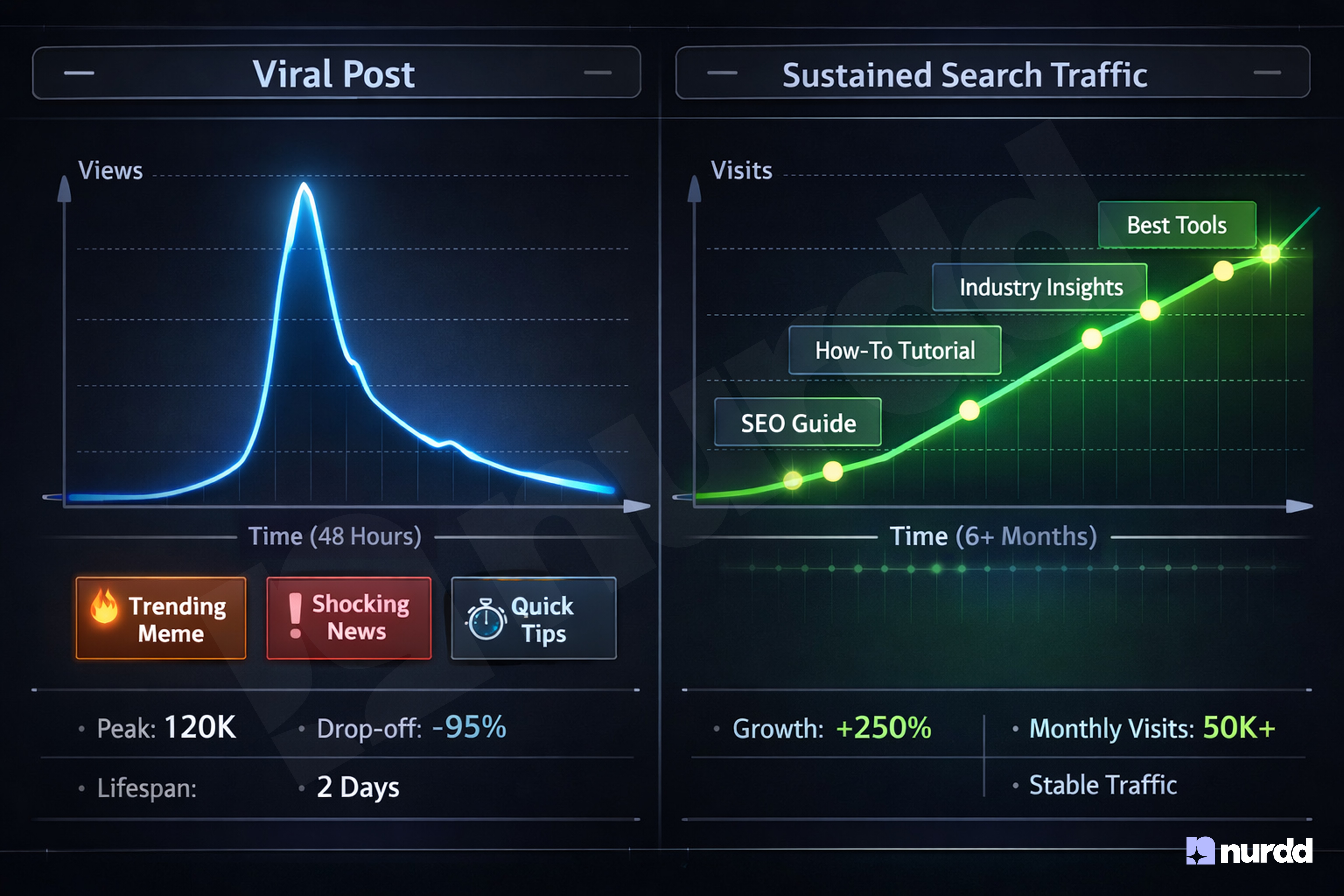
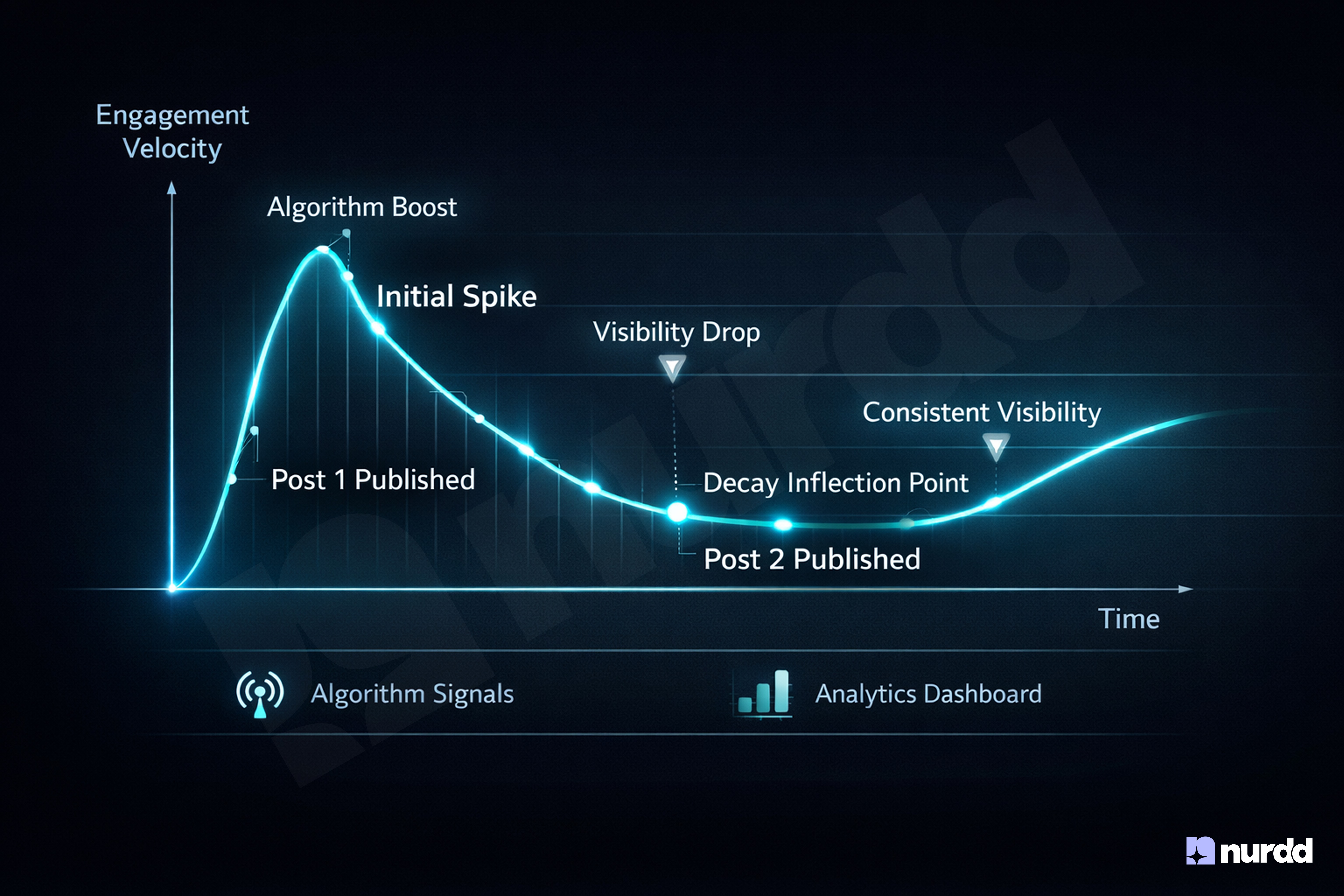
Every post you publish begins losing momentum the moment it goes live. Engagement velocity how fast the likes, comments, and shares accumulate in the first hour is one of the most important signals the algorithm uses to decide how widely to distribute your content. But that velocity doesn't just stop at hour one. It has a half-life.
AI analytics tools tracking this decay function can tell you approximately when a piece of content begins to lose significant algorithmic momentum when the initial burst of engagement has normalized and the feed is starting to move on. That inflection point is the ideal moment to publish your next piece of content.
This is what strategic scheduling looks like in practice: not posting at fixed intervals on a content calendar, but scheduling posts so that each one goes live precisely when the previous one starts declining. You maintain a continuous presence in the feed without two posts competing against each other for the same audience's attention at the same moment. You never cannibalize your own reach.
This is a meaningfully different mental model from "post three times a week." It treats your content not as individual pieces but as a cadenced system one where timing is a lever that compounds your reach, not just a box to tick.
What the Data Is Actually Telling Us
Buffer's 2026 State of Social Media Engagement report built on analysis of over 52 million posts from 200,000+ accounts across Instagram, TikTok, LinkedIn, X, Threads, Facebook, and Bluesky delivers a verdict that sounds almost too simple: the biggest gap in social media performance is not between good timing and bad timing. It's between posting and not posting.
That finding deserves to be read carefully, because it's not an argument against predictive posting it's an argument for getting the sequencing right. Buffer's own data shows that creators who post consistently across 20 or more weeks see around 450% more engagement per post than sporadic posters. Consistency builds algorithmic momentum. It trains the platform to trust your account. It trains your audience to expect you.
But once you're showing up consistently, predictive timing becomes the optimization layer. The same data shows that what you post matters most, how often you post matters a lot, and when you post determines the ceiling of how far any individual piece of content travels.
The hierarchy, in practice: show up first. Then optimize the moment.
The Three Things to Start Doing Now
Audit your audience segments before you schedule anything. Pull your analytics and look for behavioral patterns by content type, not just overall engagement time. Your educational content and your product content do not have the same audience and that audience does not peak at the same hour. Treat them as separate scheduling problems.
Stop using global benchmarks as your calendar. The Sprout Social "best times" report is a starting point, not a strategy. It's built on aggregate data from 307,000 profiles across every industry. Your skincare brand in Bangalore or your D2C snack company targeting tier-2 cities in India has a specific audience with a specific rhythm that no global dataset captures. Use platform-native insights Instagram Insights, TikTok Analytics, LinkedIn Analytics to build a picture of when your high-intent followers are actually acting, not just scrolling.
Build the decay loop into your content calendar. Look at your top five posts from the last 90 days. When did their engagement peak? When did it start dropping off? Map that decay curve and use it to anchor your next scheduling decision. You don't need an expensive AI tool to start this you need the data you already have and the discipline to read it differently.
The Bigger Shift
Every conversation about social media timing eventually circles back to the same anxiety: am I getting lost in the algorithm? The answer, in 2026, is yes if you're thinking about timing as a clock problem rather than a behavior problem.
The algorithm doesn't care that you posted at 7:00 PM. It cares that people engaged meaningfully, quickly, and that the engagement spread. Predictive posting isn't a hack to trick the feed. It's a way of ensuring that when your content goes live, it meets an audience that's predisposed to actually do something with it save it, share it, click through, buy.
Quality over quantity has been the correct instinct for years. Predictive Engagement Windows give that instinct a data structure. Post less. Post smarter. Find the clear air your competitors left behind.
In 2026, the brands winning on social aren't the ones posting the most. They're the ones whose posts are landing in the exact moment their audience was ready to receive them.
Sources & References
Sprout Social (2026) — Best Times to Post on Social Media 2026 URL: https://sproutsocial.com/insights/best-times-to-post-on-social-media/
Buffer (March 2026) — The State of Social Media Engagement in 2026: 52M+ Posts Analyzed URL: https://buffer.com/resources/state-of-social-media-engagement-2026/
Digital Kulture / WebBB.ai (2026) — Best Times to Post on Social Media in 2026. URL: https://www.webbb.ai/blog/best-times-to-post-2026
Heropost (2026) — The Best Times to Post on Social Media: 2026 URL: https://heropost.io/best-times-to-post-social-media-2026/