If Your Content Isn't Searchable, It Doesn't Exist
Nearly half of all consumers in the US now open TikTok when they want to find something. Not Google. Not a browser tab. TikTok.
That number - 49% isn't a quirky Gen Z stat you can file away and ignore. It's a structural shift in how people discover information, make decisions, and choose what to buy. And if you're still building your content strategy around the algorithm's feed, you're playing a game that's quietly being replaced by a different one.
Welcome to the era of Social Search Optimization or SSO. And no, it's not just SEO with a filter.
The Old Game Was About Going Viral. The New Game Is About Being Found.
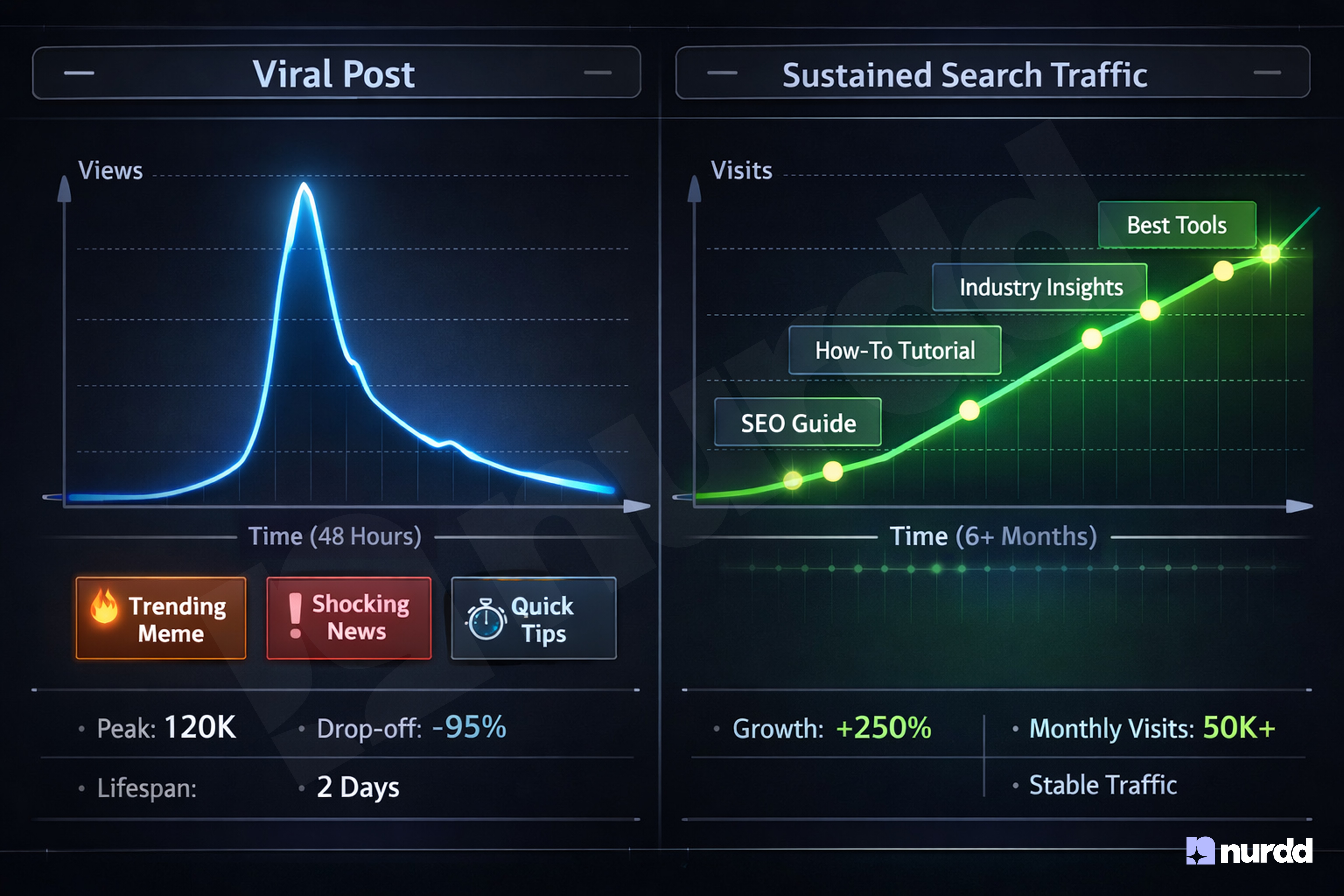
For most of the last decade, social media content operated on a simple logic: make something loud enough to get picked up by the algorithm, ride the wave for 24–48 hours, and repeat. The "For You" feed was everything. Virality was the goal.
That model favors speed. It rewards shock, humor, trend-jacking - whatever gets a spike of engagement before the content dies and disappears into the abyss.
SSO operates on a completely different principle. It's not about how many people see your content today. It's about whether someone typing "best minimalist home office under ₹20,000" three months from now finds your video at the top of the results.
The shift is simple to say and hard to internalize: from ephemeral to evergreen.
A video that's built for virality lives for 48 hours. A video that's built for search can surface for 18 months. One is a campfire. The other is a lighthouse.
Why Gen Z and Gen Alpha Went Looking on TikTok
There's a generational logic here worth understanding before we talk tactics.
Gen Z grew up watching trust erode from corporate content. Branded websites feel polished and promotional. Google results increasingly surface sponsored links and AI summaries stripped of personality. What they actually want is to see a real person, someone who bought the thing, tried the recipe, visited the restaurant explain what it was like.
According to research from Adobe Express published in February 2026 - based on a survey of 807 US consumers conducted in January 2026 - 65% of Gen Z have used TikTok as a search engine, and 25% of Gen Z find TikTok effective for finding information. The distinction matters: they're not abandoning Google (89% of Gen Z still rate it as their most helpful search platform). What they're doing is something more nuanced and more significant for marketers. They're using TikTok as a first stop for discovery, especially for anything visual, local, or peer-validated. That's not because TikTok's search algorithm is technically superior. It's because the results feel human. They carry context, emotion, and credibility that a listicle from a content farm never can.
This is why E-E-A-T - Experience, Expertise, Authoritativeness, Trustworthiness, is no longer just a Google concept. It's now calculated on social platforms through engagement signals like saves, shares, and comment depth. A creator who has documented their entire journey building a home studio earns trust that a brand's product page never will.
Gen Alpha, the cohort after them, is learning this behavior from birth. They will never know a world where you couldn't search YouTube for "how to tie a shoelace" and get twelve tutorials ranked by quality and relevance.
The platforms know this. And they've rebuilt their infrastructure around it.
The Three Pillars of Social Search Optimization
1. Your Voice Is Now a Ranking Signal
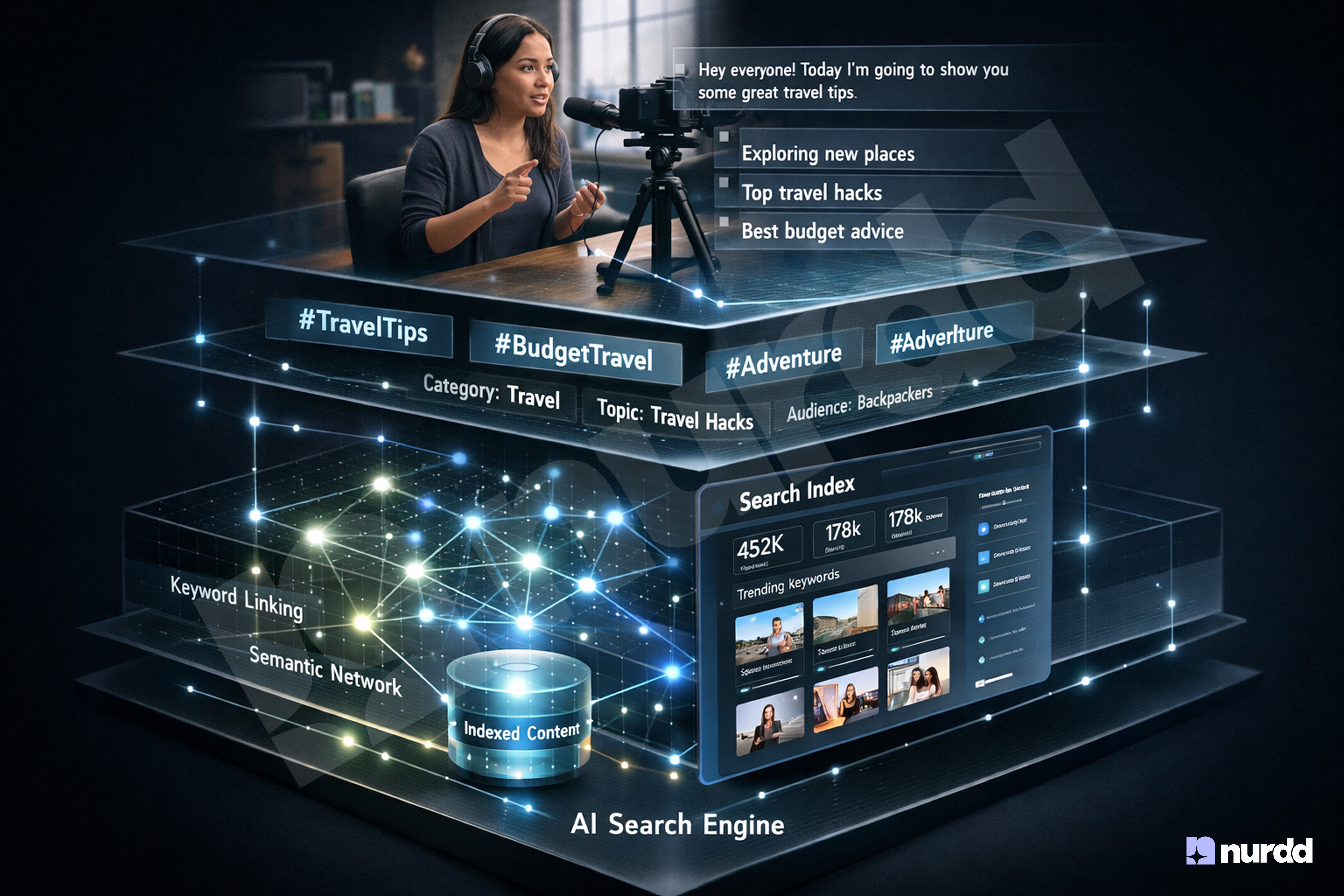
This is the piece most creators and marketers haven't internalized yet: every word you speak in a video is being transcribed and indexed.
TikTok, Instagram Reels, and YouTube Shorts all use advanced AI to convert audio to text in real time. That transcript becomes metadata. It tells the algorithm what your content is about with far more nuance than a hashtag ever could.
The implication is concrete: say your primary keyword within the first three seconds. Not because of some vague "hook" principle. Because the algorithm weights early spoken signals heavily, much the same way Google weights keywords in the first 100 words of an article.
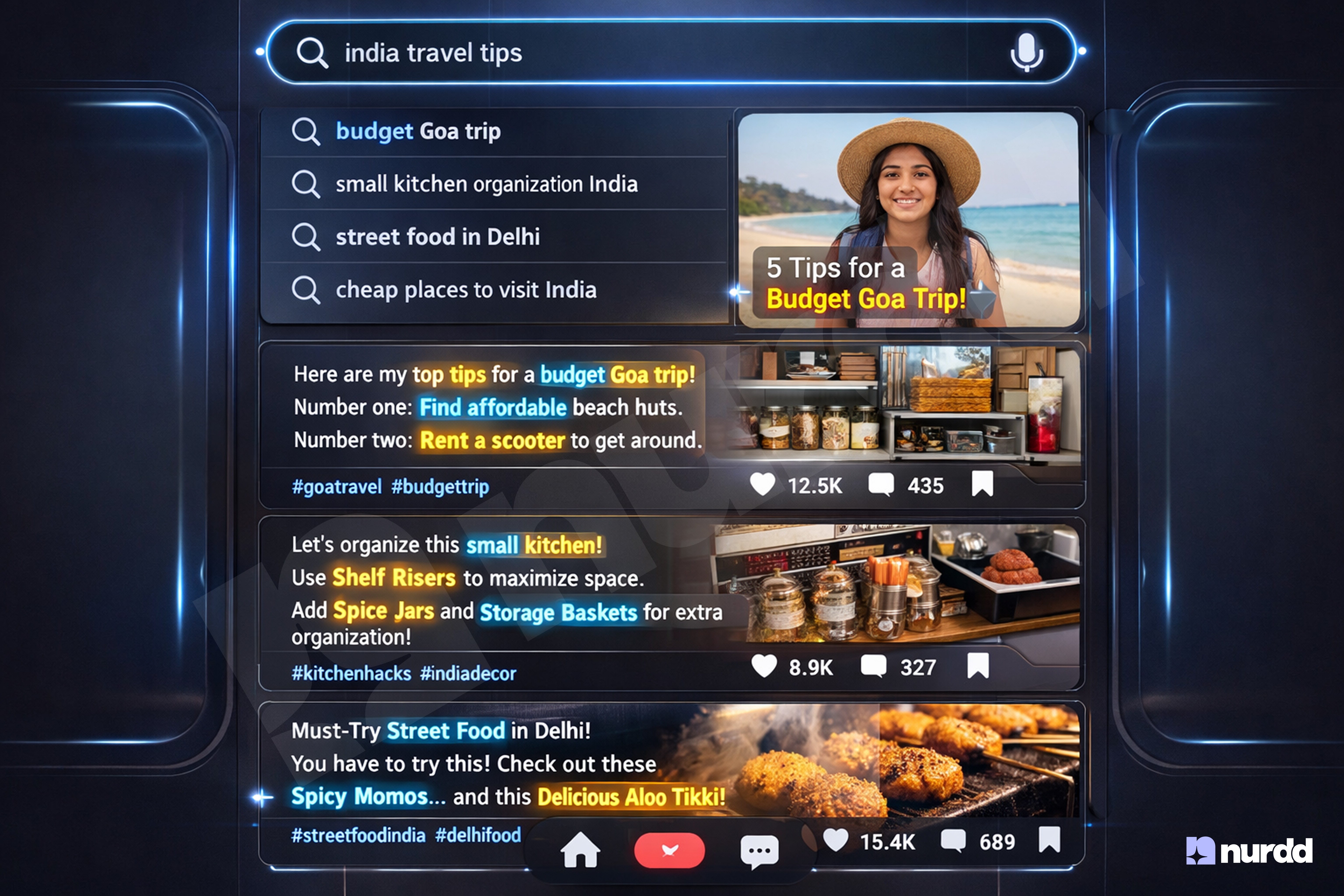
If you're making a video about budgeting for a solo trip to Goa, start with: "If you're planning a solo trip to Goa on a budget..." Not a dramatic pause. Not ambient music. The words, immediately.
On-screen text works the same way. Treat text overlays like H1 tags. They reinforce the spoken signal, they help viewers watching on mute, and they give the algorithm another data point to categorize your content.
2. Your Caption Is a Mini-Blog, Not a Mood Board
Somewhere along the way, captions became an afterthought - a place for a few hashtags, an emoji, maybe a vague "link in bio." That era is over.
In 2026, the caption is metadata. It's the equivalent of a meta description on a web page and for social search, it's one of the strongest contextual signals available to the algorithm.
The shift is to what's being called the mini-blog format: keyword-rich, intent-driven captions that read like they're answering a specific question. Not "organize your kitchen ✨" but "Here's how I organized a 90-square-foot kitchen in a Mumbai apartment - three things that actually worked and one thing I'd never do again."
That caption maps to real search intent. Someone typing "small kitchen organization India" is far more likely to land on the second caption than the first.
The important nuance: this isn't keyword stuffing. Platforms in 2026 are sophisticated enough to penalize mechanical repetition and reward natural language. Write for a human reader who's searching for an answer. The algorithm will follow.
3. Hashtags Are Context, Not Reach
The 30-hashtag block is dead. Let it go.
Hashtags have been demoted from their old role as the primary reach driver and reassigned to a narrower function: context signals. They tell the algorithm what category your content belongs to, not who it should show it to.
The effective approach in 2026 is 3–5 highly specific hashtags that precisely label your content's niche. #smallkitchenorganization over #kitchen. #solotravel plus #goatravel and #budgettravel over a shotgun of 25 generic tags.
Think of them as folder labels, not megaphones.
Platform-Specific Signals: Where You Play Matters
The underlying principle of SSO is consistent, but each platform has its own dominant ranking signal and strategy should reflect that.
TikTok is the most aggressive search engine of the three. Its auto-suggest feature in the search bar is a goldmine of keyword intelligence, type your niche and watch what the platform predicts. Those predictions are drawn from actual user searches. Build your content around them. The spoken word in the first three seconds is the most powerful ranking lever available here.
Instagram is increasingly weighting the Name field of your profile as a keyword signal. If your profile name says "Priya | Sustainable Living" rather than just "Priya," you are more discoverable for searches around sustainability. Combine this with keyword-rich captions that answer specific questions, and Instagram's search starts working for you instead of against you.
YouTube has always been a search engine, it's been the second-largest in the world for years. But the optimization logic is shifting toward Shorts. Searchable titles (not vibe titles) and keyword-rich descriptions in the first 5 words are critical. The difference between "My Morning Routine 🌸" and "5-Minute Morning Routine for Busy Professionals" is the difference between discovery and obscurity.
The Intent Behind the Search: What People Are Actually Looking For
Most social searches cluster into three broad intent buckets, and understanding them helps you create content that matches what someone is looking for, not just content that contains the right words.
Taste searches are aesthetic and exploratory. "Minimalist bedroom ideas." "Dark academia outfits." "Japandi living room." These are discovery searches, the person doesn't have a specific product in mind, they're building a vision. Content that performs here is visually driven, aspirational, and deeply niche.
Trust searches are decision-stage queries. "Is [product] worth it." "Honest review of [brand]." "Before and after [service]." The person is close to a decision and wants social proof from a real human. This is where creator authority and comment engagement matter enormously, a video with 300 thoughtful comments signals credibility.
Context searches are local and situational. "Best ramen near Bandra." "Monsoon skincare routine." "What to pack for Ladakh in July." These searches have high commercial intent and low competition, because they're hyper-specific. For D2C brands and local businesses, this is where SSO becomes a direct revenue channel.
The Comment Section Is Also an SEO Field
One underutilized lever: responding to comments with keywords.
When a creator responds to a comment about "home office setup" with a detailed reply that uses the phrase "home office setup" naturally, the platform's algorithm treats that engagement as additional topic confirmation. The post gets re-indexed with higher confidence for that keyword cluster.
This isn't manipulation, it's alignment. The comment section is a live signal of what your audience is searching for. Treat it like that.
The Checklist: Three Things to Do Before You Post
If you take nothing else from this piece, use this before your next upload:
One: Say the keyword out loud in the first three seconds. Not implied, not hinted at - spoken clearly. Think of it as your content's first word in the search index.
Two: Write a caption that answers a question. Identify the query your ideal viewer typed into the search bar before finding you. Write your caption like it's the answer to that exact question.
Three: Choose 3–5 specific hashtags, not 30 broad ones. Ask yourself: if someone was searching for this exact content, what labels would define it? Use those. Delete the rest.
The Bigger Picture
Search behavior is consolidating around social platforms because social platforms deliver what traditional search increasingly cannot: human proof, emotional context, and genuine expertise in a format that's immediate and watchable.
This is not a trend that will reverse. It will deepen. Gen Alpha will grow up treating YouTube search as naturally as their parents treated Google. TikTok will build out its search infrastructure further. Instagram will keep investing in keyword indexing.
The creators and brands that understand this now will have an enormous structural advantage in 12 months. They'll have a library of searchable, evergreen content working for them continuously while their competitors keep making content that lives for 48 hours and disappears.
In 2026, the most important question you can ask before hitting record isn't "will this go viral?"
It's "will someone find this in six months when they're looking for exactly this?"
If the answer is yes - you're building something that lasts.
Sources & References
Adobe Express (February 2026) — Using TikTok as a Search Engine: Consumer and Business Perspectives URL:https://www.adobe.com/express/learn/blog/using-tiktok-as-a-search-engine
Evergreen Media (February 2026) — SEO Trends 2026: Developing Strategies for the AI Era URL: https://www.evergreen.media/en/guide/seo-this-year/
Metricool (2026) — Social Media SEO Guide: Strategies for Every Platform URL: https://metricool.com/social-media-seo/
MAD Social Agency (January 2026) — Social SEO: How to Make Instagram, TikTok, and YouTube Content Rank URL: https://www.madsocialagency.com/blog/social-seo-how