What Is 'True Attribution' in Influencer Marketing? The 2026 Guide for Indian D2C Brands
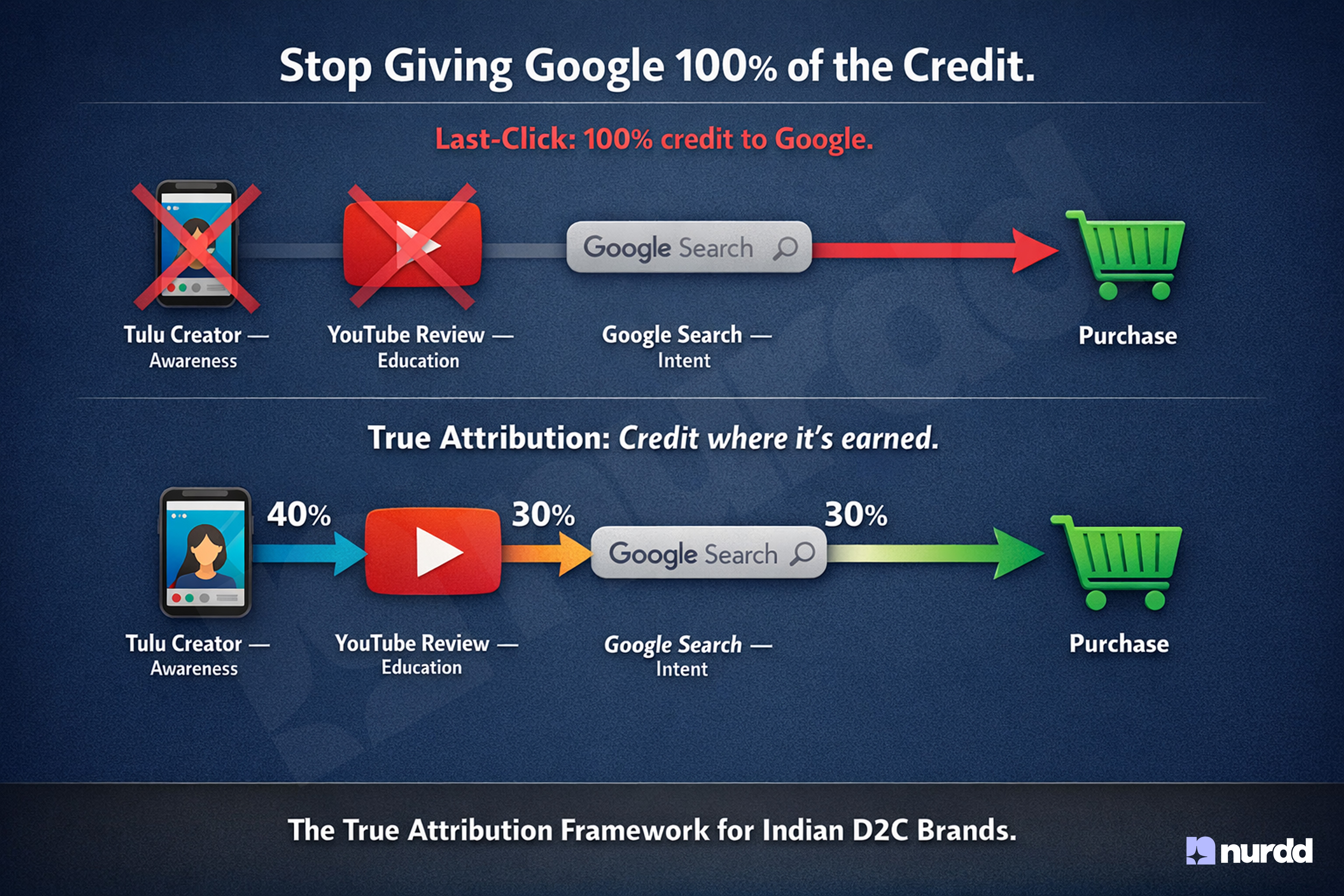
Last-click attribution gives 100% of the credit for a sale to the final touchpoint, usually a Google Search ad while ignoring every influencer who built the awareness and desire that made that click happen. True Attribution fixes this by distributing credit across the entire customer journey. In 2026, it is the difference between brands that know where their budget is working and brands quietly defunding their best channels.
The Lie Your Dashboard Is Telling You
Picture this. A consumer in Lucknow watches a Haryanvi creator's Reel about your skincare brand on a Thursday afternoon. Four days later, she watches a detailed YouTube review from a Mumbai beauty creator. The following week, she Googles your brand name, clicks a search ad, and buys.
Your attribution dashboard gives 100% of the credit to Google.
The Haryanvi creator gets nothing. The YouTuber gets nothing. Your next planning meeting concludes that influencers aren't driving conversions and your Google Search budget goes up while your influencer budget gets cut.
This is not a measurement error. It is a systemic distortion. Last-click attribution systematically undervalues the influencer content that creates awareness and intent earlier in the funnel and over-rewards the bottom-of-funnel channel that simply harvests the demand that creators built. Most Indian D2C brands are making budget decisions on data that is structurally wrong.
What True Attribution Actually Measures
True Attribution is not a single tool. It is a framework that asks one question at every stage of the customer journey: who actually influenced this purchase?
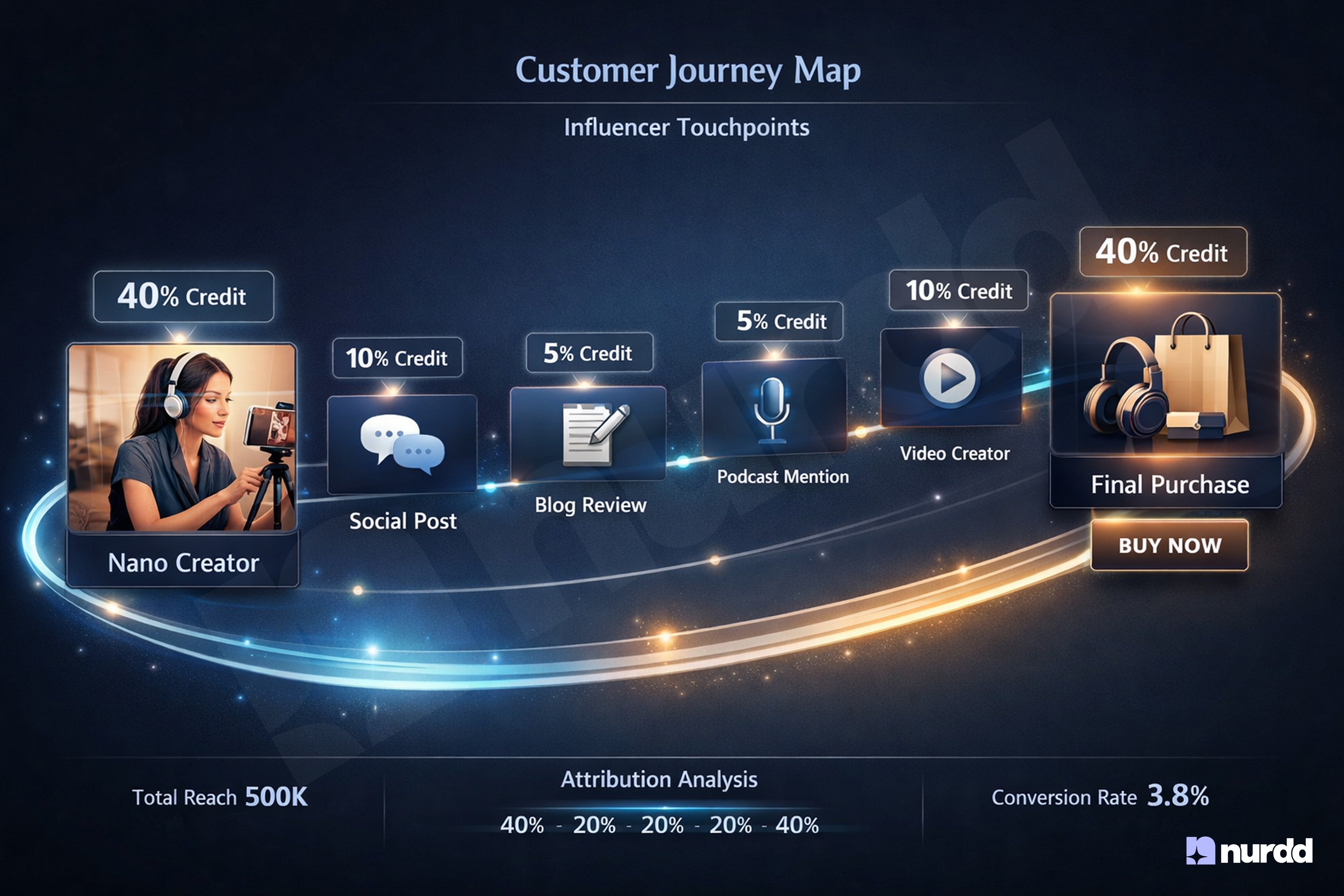
It distributes credit fractionally across every touchpoint, the nano creator who sparked the first curiosity, the mid-tier reviewer who explained the product in depth, and the search ad that captured the final intent. The result is a complete picture of how your marketing actually works, not just which channel got to the customer last.
In practice, it operates through three distinct methods each solving a different piece of the measurement problem.
Method 1 - Multi-Touch Attribution: Mapping the Full Influencer Path
Multi-Touch Attribution (MTA) is a model that distributes purchase credit across all touchpoints in the customer journey recognising that a consumer rarely buys after one exposure and that every interaction contributes fractionally to the final decision.
For Indian D2C brands, the most practical starting model is U-Shaped (Position-Based) attribution: 40% credit to the first touchpoint that introduced the brand, 40% to the final conversion event, and 20% distributed across the middle touchpoints. This structure honours both the influencer who first made someone aware and the channel that ultimately closed the sale while acknowledging the education, trust-building, and comparison stages in between.
The operational implication is immediate: if your Haryanvi creator consistently appears as a first-touch on journeys that eventually convert through Google, their value to your business is demonstrably higher than your last-click dashboard shows. MTA makes that visible.
Method 2 - Incrementality Testing: The Proof That Changes Budget Conversations
Incrementality testing is a causal measurement method that determines whether a campaign produced additional sales that would not have happened without it isolating the actual revenue impact of influencer activity from purchases that would have occurred anyway.
The test structure is straightforward. Divide your target audience into two groups: Group A is exposed to your influencer campaign; Group B is not. The difference in purchase rates between the two groups is your Incremental Lift, the percentage of sales that exist solely because of the creator. If Group A converts at 30% higher than Group B, that 30% is the verified, isolated value of your influencer programme.
This is the number that changes CFO conversations. Not engagement rate. Not reach. The percentage of revenue your brand would not have generated if the influencer had never posted.
Top D2C brands are now adopting incrementality testing alongside multi-touch models — not as alternatives to each other, but as complementary tools that answer different questions. MTA tells you how credit was distributed across a journey that already happened. Incrementality testing tells you whether the journey would have happened at all.
Method 3 - Dark Social and Post-Purchase Surveys: What Analytics Cannot See
Attribution technology, however sophisticated, has one blind spot it cannot close: the conversations that happen before a person ever clicks anything.
India has over 650 million WhatsApp users, and 75% of Indian consumers say they would purchase from companies available on messaging apps [1]. The platform's private, encrypted environment means that when a consumer in Nagpur sees a creator's post, forwards it to a family WhatsApp group, and three family members buy the product the next day, none of those sales have a trackable UTM. They appear in your dashboard as direct traffic. Your attribution model gives the credit to no one, or to whatever the customer clicked last.
This is Dark Social and approximately 84% of all outbound sharing from brand and publisher websites happens via dark social channels like private messaging, versus just 16% via public social platforms [2]. In India's Tier-2 and Tier-3 markets, where WhatsApp recommendations travel faster than any algorithm, the dark social share of real influencer impact is likely even higher.
The fix is low-tech and high-signal: a mandatory post-checkout survey with one question — "How did you first hear about us?" When 40–60% of customers who technically converted through a Google ad write a specific influencer's name in that box, you have qualitative attribution data that no dashboard will ever produce on its own. Merge those survey responses with your digital tracking data, and the picture of how your influencer marketing actually works becomes complete.

The True Attribution Tech Stack
Three categories of tools make this operational without requiring an enterprise-level data team:
MMP (Mobile Measurement Partners) - AppsFlyer and Branch track conversions across walled gardens like Instagram and YouTube, where platform privacy restrictions prevent standard pixel tracking. For any D2C brand with a mobile app, an MMP is non-negotiable.
MMM (Marketing Mix Modelling) - AI-driven statistical modelling that analyses historical spend data across all channels to identify how influencer investment correlates with revenue over time. With 38% of consumers now accepting cookies less often than three years ago and iOS privacy restrictions limiting pixel tracking, MMM has become the only model that works across all channels without requiring user-level data. Almost half (46.9%) of global marketers are increasing MMM investment in 2025–26 [3] in India, it is the attribution layer that ties influencer spend to revenue in a way that neither Google Analytics nor Meta Ads Manager can.
Conversion API (CAPI) - Server-side tracking that bypasses ad-blockers and iOS cookie restrictions, ensuring every completed purchase is captured regardless of browser or device. In a market where the majority of Indian consumers browse on mobile and where device-switching between discovery and purchase is common, server-side tracking closes the attribution gap that client-side pixels increasingly cannot.
The Triangulation Principle: Why No Single Method Is Enough
The most sophisticated measurement brands across FMCG, fashion, and D2C have converged on one conclusion: no single attribution method is sufficient on its own.
MTA is powerful but models correlation, not causation. Incrementality testing is causal but requires controlled experiments that cannot run continuously. MMM is holistic but cannot attribute individual sales. Post-purchase surveys are high-signal but self-reported.
The answer is triangulation using all three methods simultaneously, cross-referencing their outputs, and making budget decisions only where multiple methods agree. When your MTA model shows high first-touch value for a creator, your incrementality test shows 25% lift from that campaign, and your post-purchase survey shows their name appearing in 40% of "how did you hear about us" responses, that is not a coincidence. That is proof. And proof is what moves the budget.
The One Question That Changes Every Planning Meeting
Before your next influencer budget review, ask one question: are we measuring who captured the last click, or who built the desire that led to it?
The brands that answer that question correctly with MTA, incrementality testing, Dark Social surveys, and triangulated proof will allocate influencer budgets with a precision their competitors cannot match. The brands that don't will keep under-investing in the creators who are actually driving their growth, and over-rewarding the search ads that simply arrived at the finish line after everyone else had already done the work.
Sources
WapiKit — WhatsApp D2C Commerce Boom in India & Brazil (Sep 2025): wapikit.com
LinkDrip — Dark Social, Visible Results: How to Track WhatsApp, Slack & DMs (2025): linkdrip.com
SegmentStream — Marketing Mix Modeling: Complete Guide for 2026: segmentstream.com
Impact.com — Creator Marketing Attribution Models: 2025 Guide (Sep 2025): impact.com
Improvado — Marketing Attribution Models: The Ultimate Guide for 2026: improvado.io
LayerFive — Marketing Attribution Guide 2026: Models, Tools & Results: layerfive.com
Digital Applied — Influencer Marketing ROI: Measurement Framework 2026 (Jan 2026): digitalapplied.com
Admetrics — Social Media Marketing Trends 2026: What DTC Brands Need to Know Now:admetrics.io