Episodic Content Strategy 2026: Why Creators Are Ditching One-Off Reels
 30 Jan 202610 min read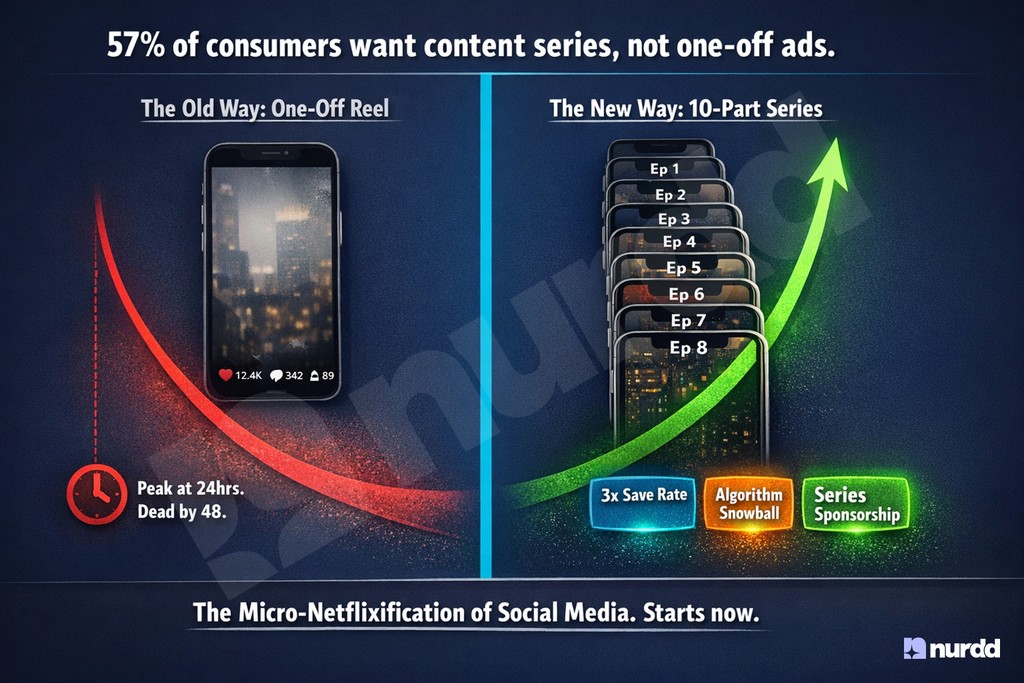
Episodic Short-Form Series: Why Creators Are Abandoning the One-Off Reel in 2026
57% of consumers now prefer brands that post original content series over one-off ads. Micro-series in-app revenue is projected to hit USD 7.8 billion in 2026, more than doubling from USD 3.8 billion in 2025. The "Micro-Netflixification" of social media is not a future trend it is the dominant content strategy of 2026. For Indian D2C brands and creators, the 10-part vertical mini-series unlocks series sponsorships, algorithmic snowballs, and audience loyalty that standalone Reels structurally cannot produce.
The End of the One-Hit Wonder Cycle
Every creator who has spent three years on Instagram or YouTube Shorts knows the trap. You make a Reel that pops. The algorithm rewards you briefly. Then the decay begins reach drops, the platform moves on, and you are back to chasing the next hook, the next audio trend, the next format that might stick for 48 hours.
This is not a failure of individual creativity. It is the logical output of a platform architecture that rewarded novelty above everything else. In 2026, that architecture has changed.
Social media has shifted from the social graph content distributed to people who explicitly followed you — to the interest graph, where content is served based on behavioural signals across the platform. This is what Rachel Karten, author of the Link in Bio newsletter, calls "New Social" or "post-social media": a landscape where recommendation algorithms now favour episodic intent over social connections. The question is no longer "who follows you" but "does the platform believe your audience will want to see what comes next?" Episodic content is the format most precisely engineered to answer that question with a yes.
If a user watches Part 1 of a series, the algorithm treats their completion as a strong interest signal and becomes significantly more likely to serve them Part 2. The engagement loop becomes self-sustaining. You do not need a new viral hook every time you need a strong enough Part 1 to activate the snowball.
The Format: What a 10-Part Vertical Mini-Series Looks Like
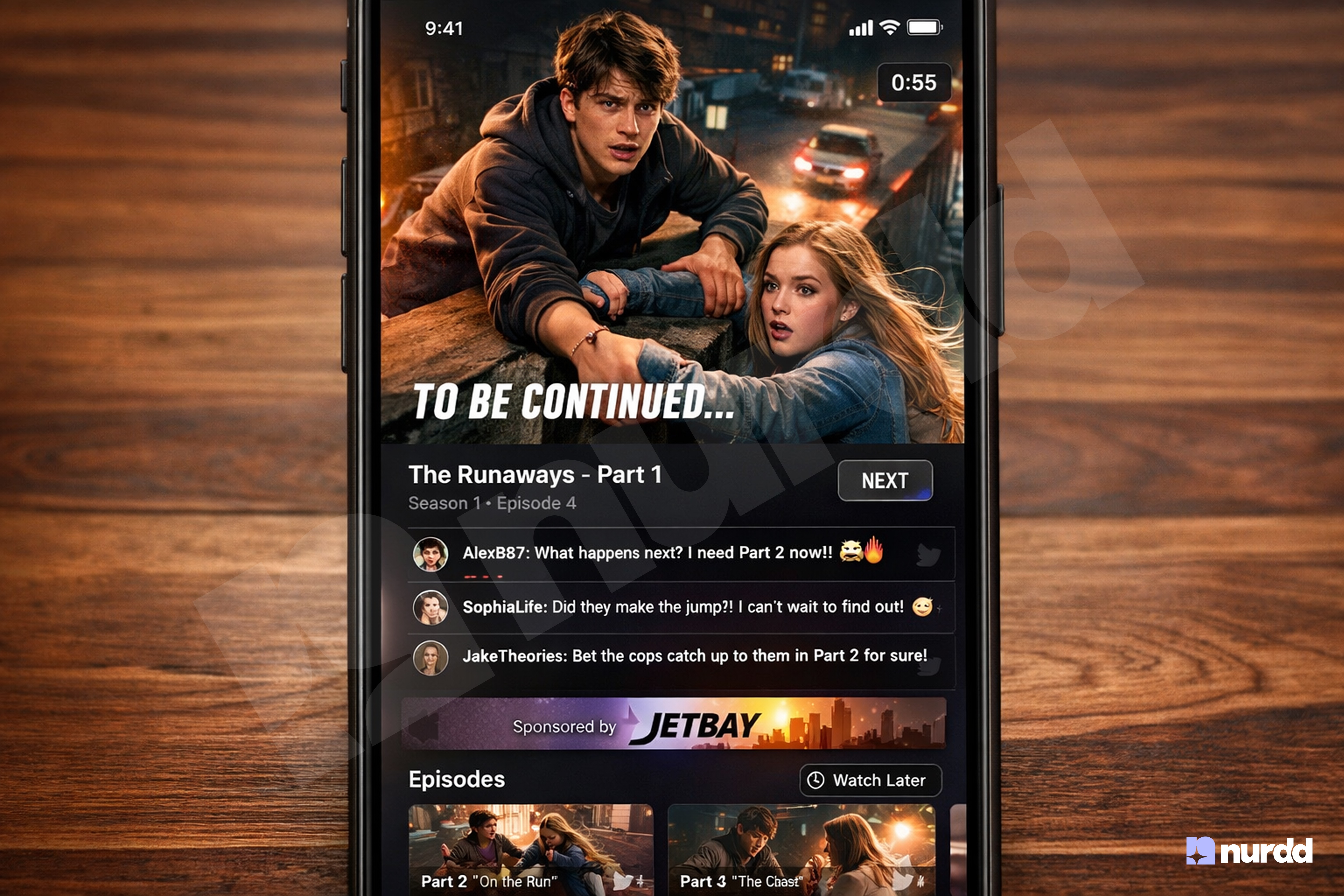
A short-form series is a scripted or semi-scripted video series told in episodic format, designed for vertical mobile viewing, with each episode typically running 60–90 seconds and ending on a cliffhanger that compels the viewer to return. In-app revenue for micro-series content is forecast to reach USD 3.8 billion in 2025. In 2026, Deloitte predicts that the revenue growth of in-app micro-series will more than double, reaching USD 7.8 billion.
The genre breadth of what works is wider than most brand teams expect. Office sitcoms from corporate accounts the Duolingo approach of giving a brand persona recurring characters and narrative arcs have proven that even brands with no conventional entertainment credentials can build loyal viewership through consistent storytelling. Product quest series, where an influencer builds, tests, or transforms something over 10 episodes, generate save rates three times higher than standalone Reels because viewers save Part 1 to ensure they can find the rest of the story. Micro-documentaries following a founder, a sourcing story, or a customer transformation give D2C brands storytelling credibility that no single post can achieve.
Under Armour's launch of Lab96 Studios a dedicated in-house content studio for episodic athlete storytelling signals how seriously major brands now treat this format as infrastructure, not campaign. The studio is explicitly designed to deliver athlete stories in episodic and cinematic ways, shifting production away from traditional ads toward entertainment-driven content. For Indian D2C brands, the lesson is not to replicate Under Armour's scale it is to recognise that building episodic capability is now a brand infrastructure decision, not a one-off creative experiment.
Platforms are building the corresponding infrastructure. Instagram's Series feature, YouTube Shorts playlists, and TikTok's Minis section allow creators to group episodic content into binge-watchable arcs, dramatically increasing dwell time on a single creator's profile. In the US, micro-drama platform ReelShort averages 35.7 minutes of daily mobile viewing outperforming Netflix and Disney+ on daily mobile viewing time. That is not a marginal engagement metric. That is appointment viewing behaviour compressed into a mobile interaction pattern.
The Algorithm Logic: Why Part 2 Is Easier Than Part 1
The cliffhanger at the 55-second mark is not a gimmick. It is a precise piece of platform engineering.
Every major short-form platform in 2026 weights completion rate as the primary algorithmic signal for content distribution. A series episode that ends mid-tension does two things simultaneously: it maximises the current episode's completion rate (viewers watch to the cliffhanger because they want to resolve the tension), and it creates a direct behavioural prompt — follow for Part 2 — that converts passive viewers into active subscribers. Platforms reward sequential viewing, episode-to-episode retention, and comment speculation — and the algorithm adjusts content distribution based on all three.
Short Video SEO (SVSEO) compounds this algorithmic advantage with organic discoverability. SVSEO is the practice of optimising each episode's caption, on-screen text, audio transcript, and hashtag set around the series' core keyword phrase — so that when a new viewer searches "Bhojpuri skincare tips" or "D2C brand founder story" within the platform, your Part 1 appears as the entry point to a series the algorithm then serves in full. Each new episode published adds another indexed keyword touchpoint to the series, building compounding organic discoverability that no standalone Reel can replicate.
The Batching Advantage: 10 Episodes in One Day
The single most underappreciated operational benefit of episodic content is the batching advantage, and it is the reason creators who adopt this format rarely go back.
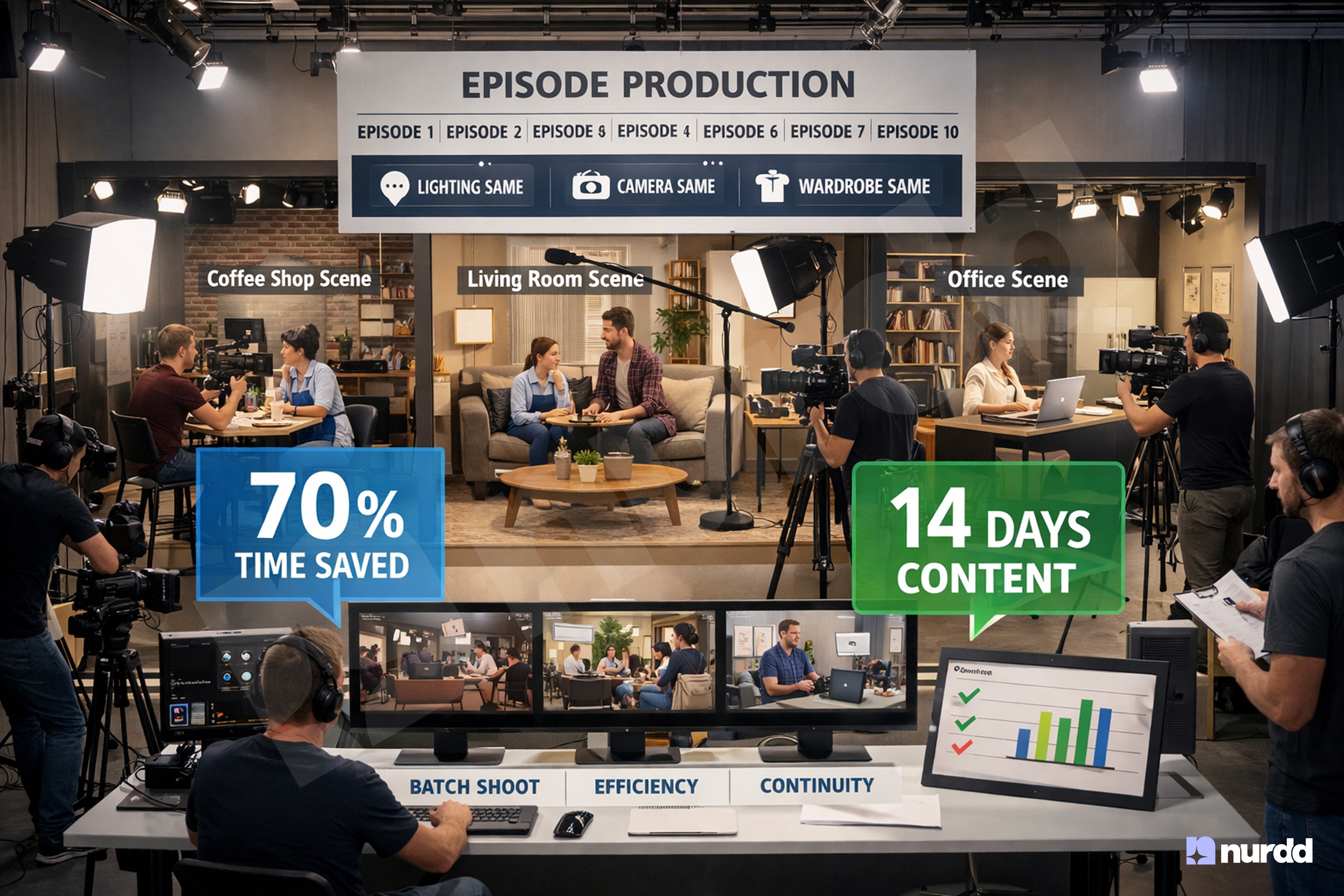
A 10-episode series can be filmed in a single day: one location, one lighting setup, one costume, one production session. What emerges is two weeks of high-retention, algorithmically optimised content produced in eight hours. Compared to the daily grind of standalone Reels each requiring a fresh concept, setup, hook, and post-production pass batching a series is a productivity breakthrough that most creators calculate as a 60–70% reduction in content production time per published episode.
The quality benefit is equally significant. Consistency of character, location, and visual language across 10 episodes creates the coherence that builds audience loyalty. Viewers who watch Episode 3 recognise the setting from Episode 1. The brand integration feels organic because it exists within an established world. The storytelling earns the engagement that algorithmic amplification then extends.
How Brands Integrate Without Breaking the Story
The most common mistake brands make when entering episodic creator content is the same mistake they make everywhere else: over-scripting. Excessive colour grading, slow-motion product shots, and perfect lighting feel clinical. Natural lighting and handheld movement build relevance and creator-led authenticity the aesthetic grammar of episodic content depends on production imperfection as a trust signal.
Three sponsorship models are working for D2C brands specifically. The series sponsorship "This 10-part travel series is powered by Samsung" buys narrative association rather than a moment of visibility. The brand becomes part of the story's context rather than an interruption to it, and the value compounds across every episode in the arc. Tower28 Beauty's The Blush Lives of Sensitive Girls series, Maybelline's five-part romcom mystery Maybe This Christmas, and Oatly's nine-episode Café con el Abuelo a grandfather experimenting with drinks in Chicago all demonstrate what product plot integration looks like when it is executed with the story in mind rather than the brief.
The gated finale model is the most financially direct: build a 9-episode arc with full organic distribution, then lock Episode 10 behind a newsletter signup, an Instagram Subscription, or a branded landing page. The audience has invested nine episodes of attention. The conversion rate on that final gate is dramatically higher than any cold lead magnet because the audience is asking to complete a story they are already inside.
India Is Not Waiting
India's micro-drama infrastructure is already being built at significant scale and the brands that understand it will be early to the most compelling vertical content opportunity in the country.
Kuku FM launched Kuku TV in February 2025, pioneering vertical serialised microdramas in India the first platform of its kind in the Indian OTT landscape. Each episode runs up to 2 minutes, with 50+ episodes per series, available in Hindi, Telugu, Kannada, and Bangla. With over 5 million paying subscribers, Kuku aims to surpass Netflix's paid subscriber base in India within the year expanding to the US, Indonesia, Philippines, and South Korea as its first markets for global distribution. ZEE Entertainment has partnered with content startup Bullet to launch a dedicated micro-drama app, and VCs are actively funding micro-drama platforms in India.
India's platforms are experimenting with micro-payment options for individual episodes while others are rolling out hybrid models that blend subscription fees with advertising income viewers can watch the first few episodes for free, then pay to watch the story unfold.
India's specific conditions make the episodic format more powerful here than in any other market. 90% of Indians consume vertical videos on social media, yet until Kuku TV there was no dedicated premium OTT platform for this format. A 10-part cooking series produced in Bhojpuri for the eastern Gangetic belt with recurring characters, local food culture references, and product integration from a relevant D2C brand is not competing with national Instagram content. It is the only content of its kind in its language, for its audience, on its platform. The episodic format, with its recurring characters and WhatsApp-forward cliffhangers, maps directly onto India's existing oral storytelling culture and family-group sharing patterns.
The Micro-Netflixification of social media is not arriving in India from the West. It is being built here, by Indian platforms, for Indian mobile audiences, in Indian languages. The brands that show up in that story now as series sponsors, as plot partners, as gated-finale destinations will occupy content territory that late entrants will find fully claimed.
Sources
- Deloitte TMT Predictions 2026 — Tiny Episodes, Massive Appeal: Short-Form Serials Gain Viewers (Nov 2025): deloitte.com
- Finshots — Will India Binge on Micro Dramas? (Aug 2025): finshots.in
- Business News Week — Kuku FM Secures Entry into India's Video Streaming Market with Kuku TV (Feb 2025): businessnewsweek.in
- CXO Today — Kuku Takes Flight to Global Markets with Its Audio & Video OTT Platforms (May 2025): cxotoday.com
- LBBOnline — The Micro Drama Gold Rush: Stop Advertising, Start Entertaining (Mar 2026): lbbonline.com
- Digiday — The Rise of Micro Dramas That Are Attracting Big Ad Dollars (Nov 2025): digiday.com
- WebProNews — TikTok's Minis: Micro-Dramas Revolutionize Engagement and Revenue (Dec 2025): webpronews.com
- VML — Micro-Dramas Go Mainstream (2025): vml.com
- Firework — Short-Form Video Stats & Why It's a Game-Changer in 2026 (Dec 2025): firework.com
- Afaqs — Kuku FM Launches Vertical Microdrama OTT Platform Kuku TV (Feb 2025): afaqs.com

Find the right creators — and verify they're real.
Nia gives D2C brands access to 10M+ Indian creator profiles, TruAI fake follower detection, pre-spend ROI forecasting, and product-level sales attribution. Completely free.