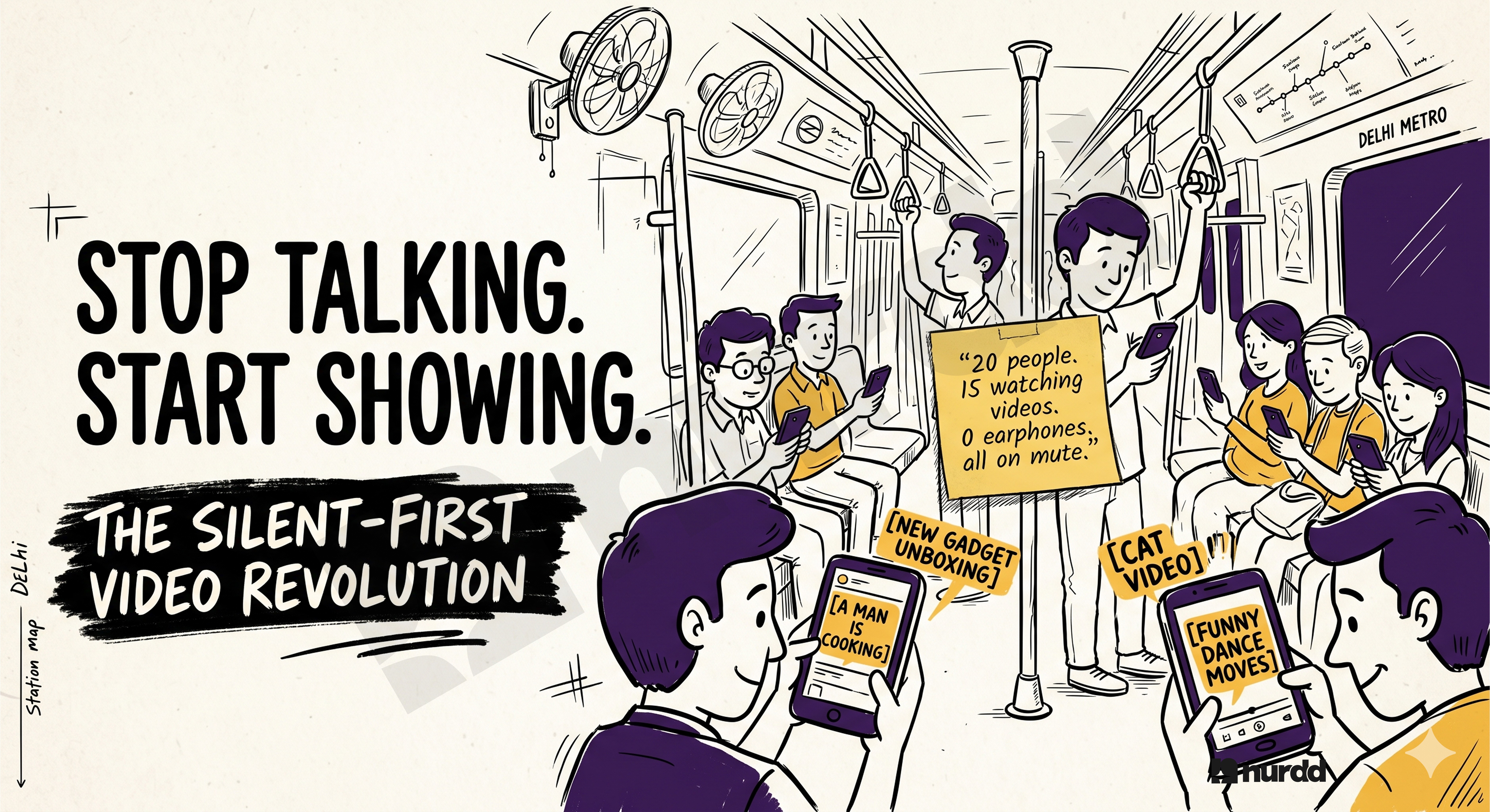
Stop Talking. Start Showing. The Silent-First Video Revolution.
Picture this: a crowded Delhi Metro at 8:45 in the morning. Twenty people are on their phones. Fifteen of them are watching videos. Not a single pair of earphones in sight.
That scene isn't a trend. It's the default reality of how video is consumed today and it should be the single biggest design constraint behind every piece of video content you create in 2026.
Because if your video depends on sound to make sense, you have already lost the majority of your audience before they finish the first two seconds.
The Mute Reality of Modern Video
The data on this is older than most people realize, and it's only gotten more extreme over time.
Research consistently shows that 85% of Facebook videos are watched without sound, a figure that's been cited so widely because it keeps proving itself true across every subsequent measurement. The reason is structural, not behavioral. Facebook autoplays videos in the news feed with the sound off by default. So does Instagram. So does TikTok in many contexts. The platform itself has trained users to consume video silently, and users have adapted.
The consequences of this shift are more significant than most brands acknowledge. A separate analysis found that only 24% of video ads on Facebook could be understood without sound. Which means roughly three in four branded video ads, the ones companies paid to create and paid to place are functionally invisible to the majority of people watching them.
The problem isn't the platform. The problem is that most video content is still being made as if audio is the primary communication channel, with visuals as decoration. That assumption is backwards. And the brands that figure this out first are going to own the feed in a way their competitors won't be able to replicate quickly.
This is the premise of the Silent-First Video Strategy: design your video so the visual tells the entire story, independently, with no reliance on audio to carry meaning.
Beyond Subtitles: The Rise of Active Captions
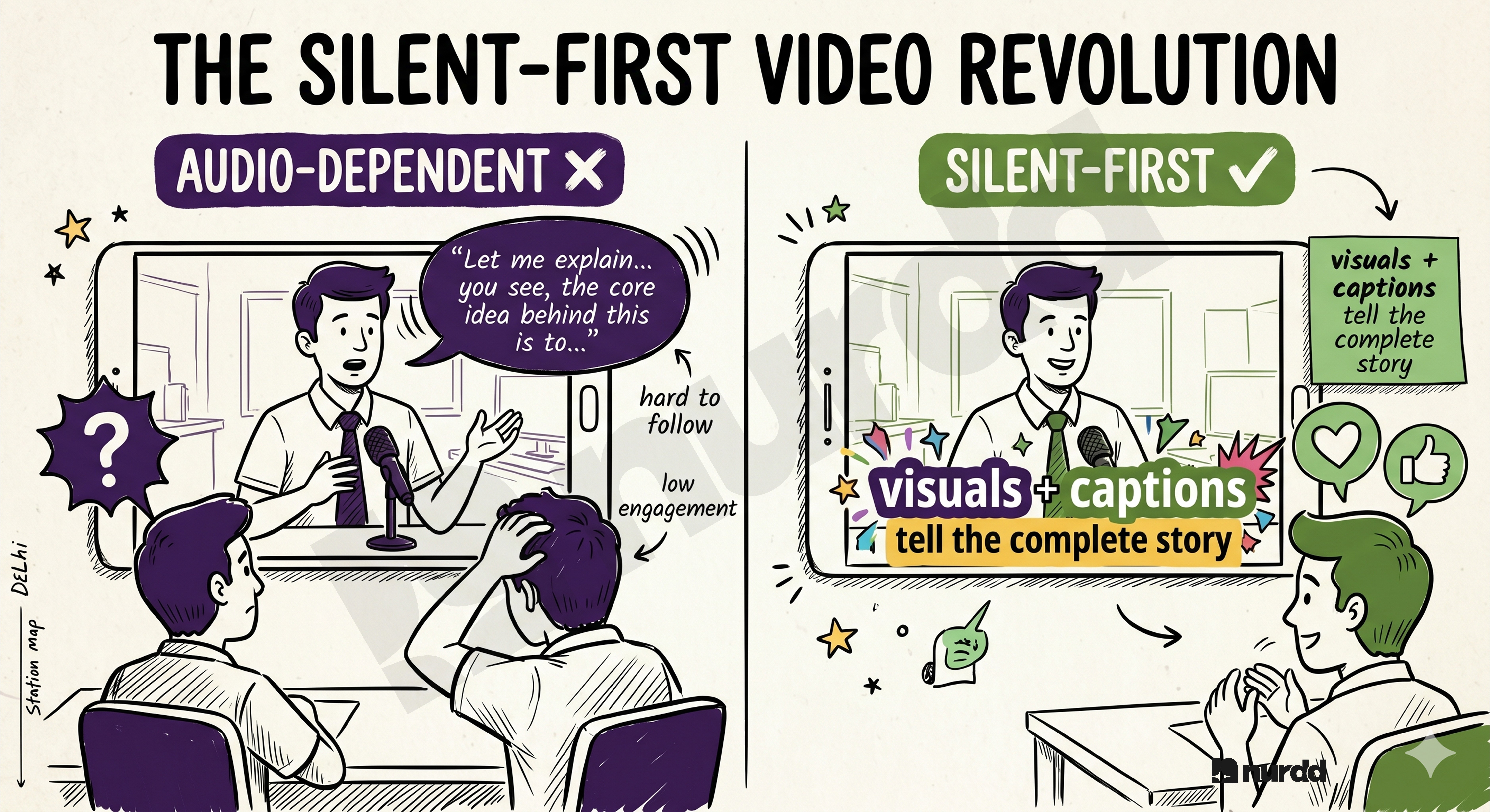
The first instinct when someone hears "silent-first" is usually: "So I just add subtitles?" That instinct is right in direction but wrong in execution.
Traditional subtitles exist at the bottom of the frame, in a uniform typeface, as a functional accessibility tool. They translate what's being said. They're useful. They're not strategic.
Active Captions, also called Kinetic Typography are something fundamentally different. They treat the caption as a design element, not an afterthought. Words pop onto the screen in rhythm with speech. Key phrases change color, scale up, or animate to punctuate the punchline. Text appears directly over the visual action, not in a fixed lower-third bar. The caption becomes part of the creative direction, not a layer placed on top of it at the end of the editing process.
The functional difference is significant. A traditional subtitle tells you what was said. An active caption performs what was said. When a speaker emphasizes a word, the text emphasizes it too. When the energy of the video peaks, the typography peaks with it. The viewer who's watching on mute doesn't just follow the words, they feel the rhythm of the content. They experience the intent behind it.
Think of it this way: a news ticker at the bottom of a screen is a subtitle. The opening sequence of a Zomato ad where the food's name explodes onto the screen as the narrator says it, that's an active caption working as a brand asset.
Accessibility as Strategy, Not Compliance
This matters beyond design aesthetics. Silent-first is a Universal Design principle, and that's where its strategic depth comes from.
When you build a video that works without sound, you're not just capturing the Metro commuter or the office scroller trying not to disturb a colleague. You're also reaching:
The hard-of-hearing community, over 430 million people worldwide according to the WHO, many of whom have never been well-served by audio-first content and represent an engaged, loyal audience when brands actually accommodate their needs.
Non-native speakers, for whom following fast, idiomatic, accent-laden English audio is cognitively exhausting. A well-captioned video levels the playing field entirely. Sonix's 2026 subtitle research notes that 75% of consumers prefer content in their native language, captions that can be translated extend your reach across linguistic markets without re-recording a single word.
People in sensory-sensitive environments: libraries, offices, clinics, bedrooms. The 69% of users who watch video with sound off in public spaces aren't a niche. They're the majority use case.
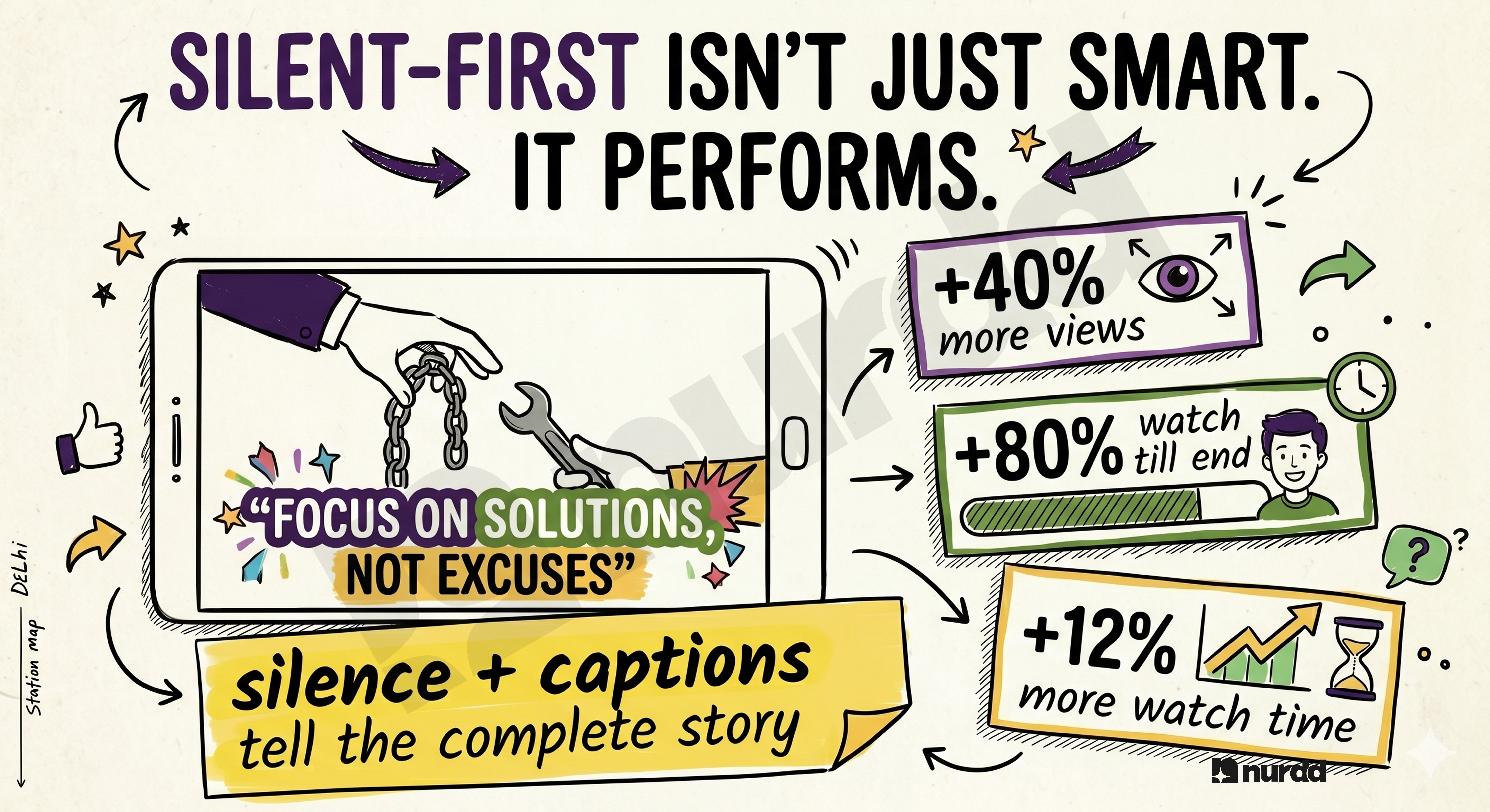
The research on cognitive retention is also worth taking seriously here. Multiple studies confirm that viewers who both see and read text simultaneously retain more information than those relying on audio alone. Active captions don't just serve the audience that can't use sound, they improve the experience for the audience that can. Verizon and Publicis Media's study found that captioned videos make viewers 80% more likely to watch until the end. Facebook's own internal research documented a 12% increase in video view time when captions were added. And across multiple studies, the headline figure consistently emerges: subtitled videos can boost viewership by up to 40%.
That's not an accessibility stat. That's a reach and ROI stat.
The Visual Narrative Framework
Silent-first isn't just a caption decision. It's a production philosophy that needs to inform every stage of how a video is conceived and shot.
Lead with the visual hook, not the verbal one. The most common mistake in social video is opening with a spoken statement, "Hey guys, today we're going to talk about...", that means nothing on mute. The opening two seconds of a silent-first video must communicate something visually: a striking image, an unexpected juxtaposition, text that asks a question the viewer can read without sound, a visual pattern-interrupt that stops the thumb from scrolling.
Structure the visual arc. In audio-first video, the narrative is carried by the voiceover or the interview subject. In silent-first video, the sequence of images has to carry the story. That means thinking in three-act visual terms: what does the viewer see first, what changes, what's the resolution? If you removed every word from your video, would the story still make sense? It should.
Use on-screen text as chapter markers, not just captions. Active captions can signal transitions, introduce new sections, and guide the viewer's attention in the way chapter headings guide a reader through an article. Text like "Here's the problem →" or "And then this happened", animated and timed to the cut, gives the muted viewer a navigational scaffold that keeps them oriented without audio.
Design for vertical. The primary viewing context for silent-first content is mobile, in portrait orientation. This has design implications: on-screen text needs to occupy the vertical space of the screen intelligently, faces need to be centered in the upper portion of the frame, and captions need to avoid blocking the subject. Here's where the latest generation of AI tools becomes genuinely useful.
The AI Tools Making This a 5-Minute Task
Active Captions used to require a video editor, a motion graphics artist, and a brief that was specific enough to translate intent into design. That workflow still exists at the premium end. But in 2026, the barrier to entry has collapsed almost entirely.
Captions.ai and VEED.io allow creators to generate animated, styled captions from a video upload in minutes. The AI transcribes the audio, syncs the text to the timeline, and applies visual styling: font weight, color, size changes automatically. Brand kits can be pre-loaded, so the captions use your exact typeface and color palette without manual configuration on each video.
Descript takes this further by offering scene intelligence: the AI detects where the speaker's face is in the frame and automatically repositions the caption so it doesn't overlap with the eyes or mouth. This sounds like a small thing until you've seen a video where the caption bar sits permanently across the speaker's lower face for four minutes.
CapCut, widely used by creators across India and Southeast Asia, offers similar functionality with additional motion effects that let captions "pop" or "slide" in sync with speech rhythm, adding the kinetic dimension that separates an active caption from a static subtitle.
The practical workflow for a 60-second video with professional-grade active captions now takes roughly 10–15 minutes: upload, auto-transcribe, apply brand kit, review and adjust timing on key emphasis words, export. What previously required a full post-production session is now a finishing step.
The Business Case in Three Numbers
85% - the share of Facebook videos watched without sound. If your video isn't designed for this, it isn't designed for the real-world consumption context.
40% - the increase in viewership for videos that include subtitles, according to research cited by Sonix (2026). This is the ROI number. Captioning isn't a cost centre; it's a distribution multiplier.
91% - the share of businesses that now use video as a marketing tool, according to Wyzowl's 2026 State of Video Marketing report. The competition is fierce. Silent-first design is one of the few remaining ways to be meaningfully differentiated in a feed where everyone is posting video.
Where to Start
If you're building your first silent-first video, the checklist is short:
Watch your last five videos on mute. Actually do this. Does the story still make sense? Does anything communicate emotion, urgency, or value without the audio track? What you find will tell you more than any framework.
Move your captions into the creative. Stop treating them as the last step in post-production and start treating them as a core design element, decided alongside the color grade, the music, and the graphic overlays.
Audit your opening two seconds. The first frame is the make-or-break moment for muted viewers. If it's a black screen, a logo sting, or a talking head saying "so today we're going to..." you've already lost them. Replace it with the visual hook.
Use AI tools to remove the production barrier. There is no reason in 2026 for a brand to publish an uncaptioned video on any social platform. The tools are fast, affordable, and increasingly intelligent. The only missing ingredient is the habit.
The Closing Thought
Sound is a gift. When a viewer unmutes your video and they will, if the silent experience compels them enough, you get to deliver a second layer of meaning, a richer emotional experience, a dimension of production that text and image alone can't carry.
But sound is an opt-in. It's something the viewer chooses to grant you after the visual has earned their trust. Design for the muted majority first. Let sound be the reward for the viewers who decide your video is worth it.
In 2026, silent-first isn't a workaround for a technical limitation. It's a content philosophy built for how humans actually consume media: in motion, in public, in the spaces between other things they're doing.
The brands that internalize this won't just get more views. They'll get watched.
Sources & References
Wyzowl (2026) — State of Video Marketing 2026. URL: https://wyzowl.com/video-marketing-statistics/
Sonix (January 2026) — 11 Subtitle Generation Trends: Key Statistics Every Content Creator Should Know in 2026 URL: https://sonix.ai/resources/subtitle-generation-trends/
3Play Media — Studies Find Captions Can Improve Focus on Video Content URL: https://www.3playmedia.com/blog/studies-find-captions-improve-engagement/
Social Shepherd / Cropink (2026) — Facebook Video Statistics URL: https://cropink.com/fb-media-statistics
Kapwing — Subtitle Statistics: How Many People Use Subtitles? URL: https://www.kapwing.com/resources/subtitle-statistics/