The "Made by Humans" Movement: How Brands Are Using Authenticity to Beat AI Slop in 2026
TL;DR: AI-generated content has saturated digital feeds to the point of audience exhaustion — a phenomenon now broadly known as "AI slop." In response, a counter-movement has formed in 2026 around radically transparent, visibly human content. Brands are using AI for the heavy lifting (research, outlines, transcription) while reserving final voice, perspective, and emotional truth for humans. New labels like "Made by Humans" badges and the C2PA Content Credentials standard are giving consumers a way to verify who actually created what. This blog explains the shift, the data behind it, and the practical workflows brands can adopt today.
What Is "AI Slop" and Why Did the Backlash Start?
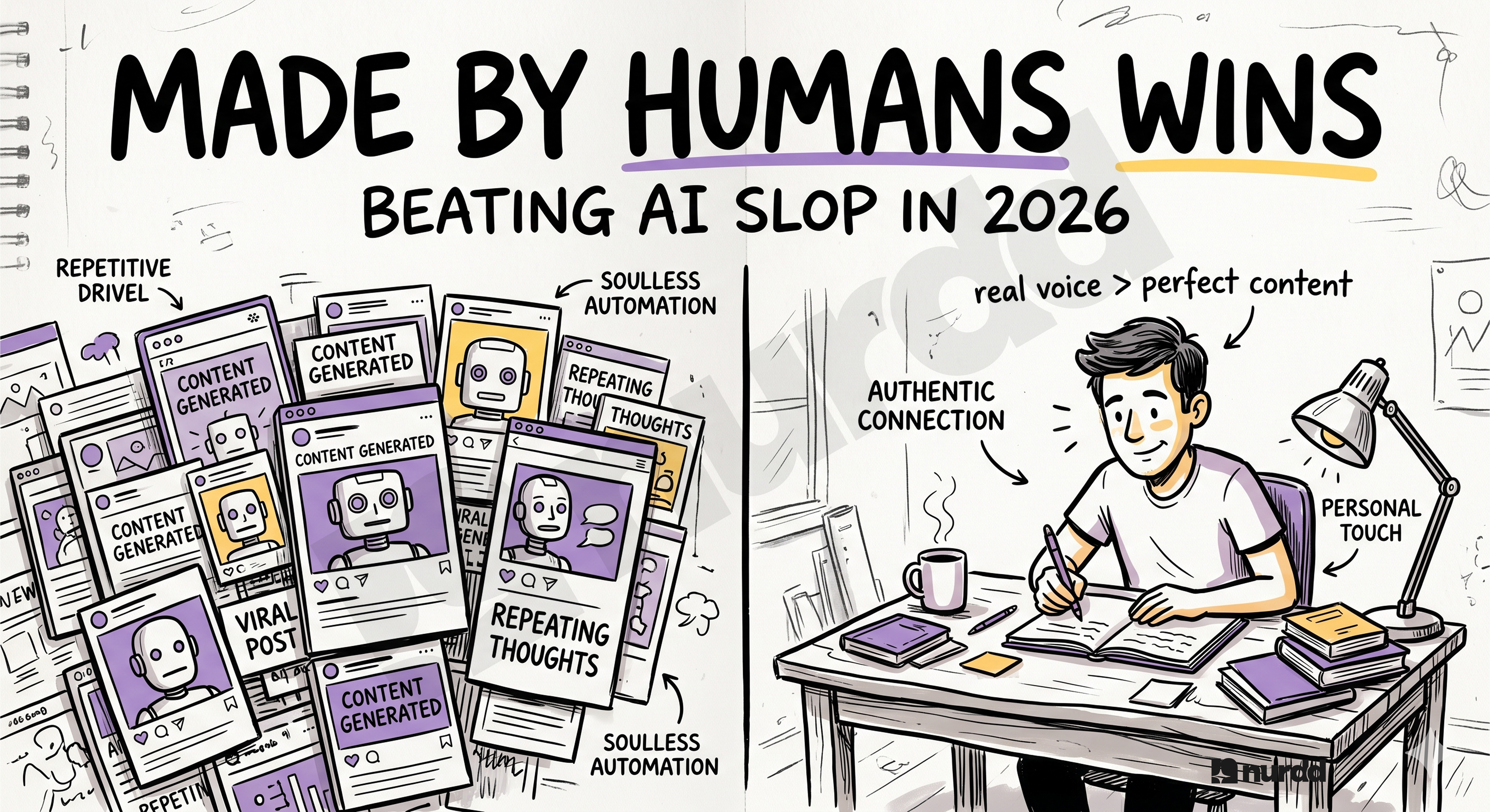
AI slop is the term — chosen as Merriam-Webster's 2025 Word of the Year — for low-quality, high-volume, machine-generated content that floods social feeds, search results, and even product packaging. It's the LinkedIn post that reads like polished nothing, the AI-generated children's video on YouTube with oddly-proportioned horses, the Christmas ad pulled by McDonald's Netherlands after audiences called it "ruined my Christmas spirit."
The backlash isn't theoretical. It's measurable and accelerating. iHeartMedia's internal research found that 90% of its listeners — including those who actively use AI tools themselves — want their media created by humans. Deloitte's 2024 Connected Consumer Survey reported that nearly 70% of respondents are concerned AI-generated content will be used to deceive them. CNN Business has predicted that 2026 will be "the year of 100% human marketing," with brands like Apple TV's "Pluribus" credit explicitly stating "This show was made by humans" as a deliberate trust signal.
The cultural inflection point came in March 2026 when a Hacker News post titled "Your AI Slop Bores Me" went viral, spawning a website where humans roleplay as AI to "reclaim authenticity." It captured the fatigue precisely: audiences aren't anti-technology, they're anti-blandness. They want voice, opinion, specificity, and visible human effort — the exact qualities AI defaults away from.
Why Authentic, Human-Made Content Outperforms AI Content in 2026
The performance data on this is unambiguous, even though it cuts against the productivity narrative AI tools were sold on.
Audiences detect AI content even when they can't articulate why. Research published in the Journal of Business Research found that when consumers believe emotional marketing communications are written by AI rather than humans, they judge them as less authentic, feel moral disgust, and show weaker engagement and purchase intentions — even when the content is otherwise identical to human-written material. The "AI-authorship effect" is real and statistically significant.
Imperfection is now a trust signal. Benchmarks from creator analytics in 2026 indicate that human-curated or hybrid content with deliberate imperfection outperforms pure AI content by 40–60% in dwell time and shares. Typos, off-script moments, regional slang, contrarian opinions — the things AI is trained out of producing are exactly the markers audiences now use to identify trustworthy content.
Premium pricing is emerging for human-made content. Industry analysts are predicting that brands will be able to charge a premium for verified human content the way organic certifications transformed food sales. Adweek's trend forecast suggests CTV and YouTube may boost premiums by up to 50% for human-verified video. Luxury houses like Louis Vuitton are already trialing artisan-only campaign credentials.
The conclusion is direct: in a content economy where AI has made volume free, visible humanity has become the scarce asset. And scarce assets command attention.
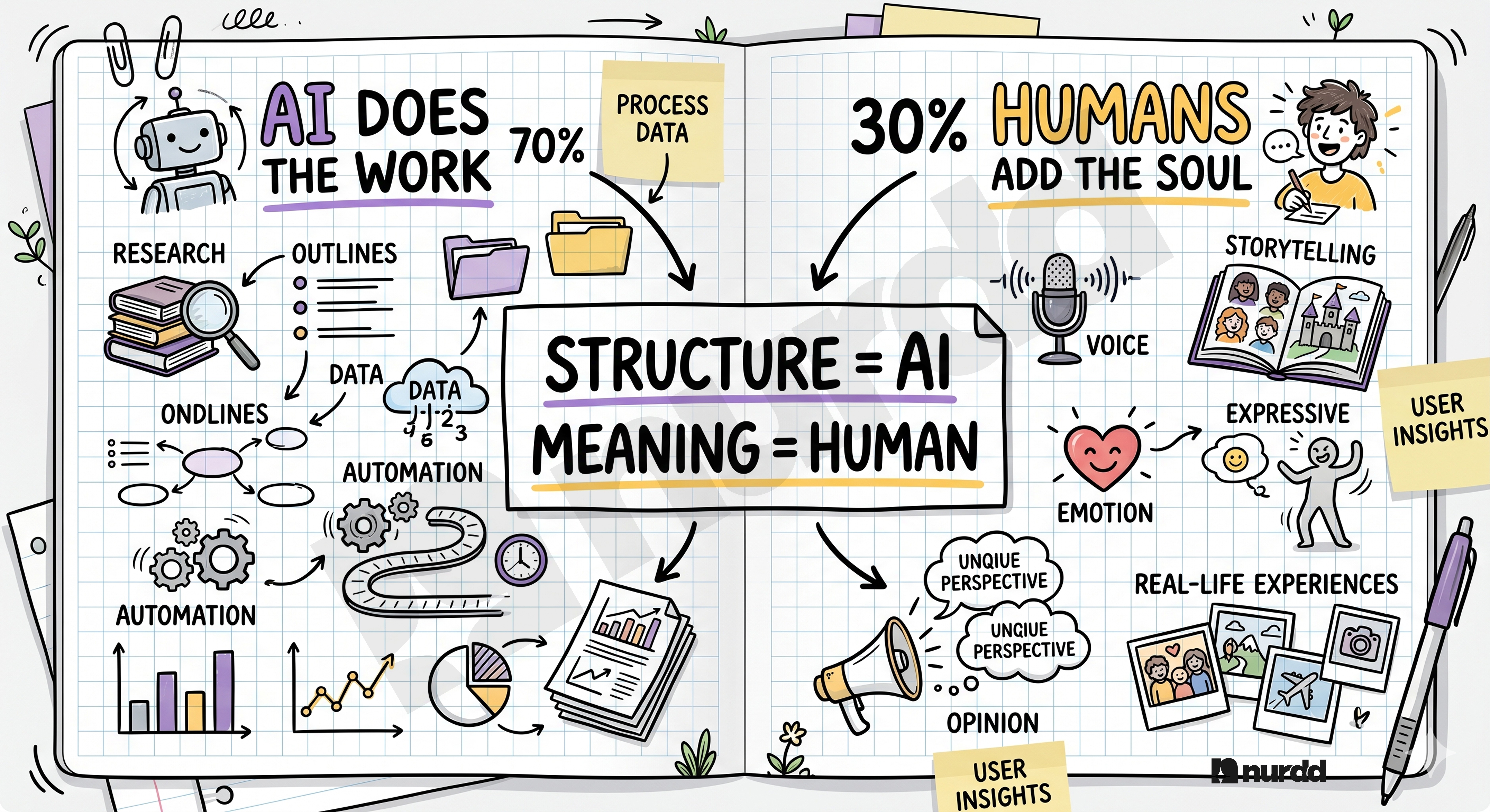
The 70/30 Rule: How to Use AI Without Losing the Human Soul
The brands navigating this shift well are not refusing AI. They're using it differently. The framework that has emerged is what content strategists are calling the 70/30 Rule.
70% of the labor goes to AI. Research, transcription, outline generation, data analysis, first-draft scaffolding, SEO keyword mapping, image upscaling, video editing automation, brainstorming variations. Anything that's structural, repetitive, or pattern-based is exactly what AI is good at — and exactly what doesn't carry the soul of the content anyway.
30% of the process is reserved exclusively for humans — and it's the 30% that matters. Final voice. Emotional truth. Specific anecdotes. Polarizing opinions. The phrasing of the punchline. The decision of which insight to lead with. The texture of how something is said, not just what is said.
This is not a productivity hack. It's a quality framework. The brands seeing the strongest results in 2026 are running AI for the parts of the work that don't require humanity, and protecting the parts that do.
A practical test for whether your output passes the threshold: read it out loud. Does it sound like you? Does it have a turn of phrase you'd actually use? Does it take a position you'd defend at a dinner party? If the answer is no — if it sounds "professional but approachable" in the way every LinkedIn post sounds — you're publishing slop with your name on it.
What Are "Made by Humans" Badges and the C2PA Standard?
Beyond editorial workflow, the 2026 authenticity movement is being formalized through technical and visual labeling systems. There are three you should understand.
Not By AI Badges
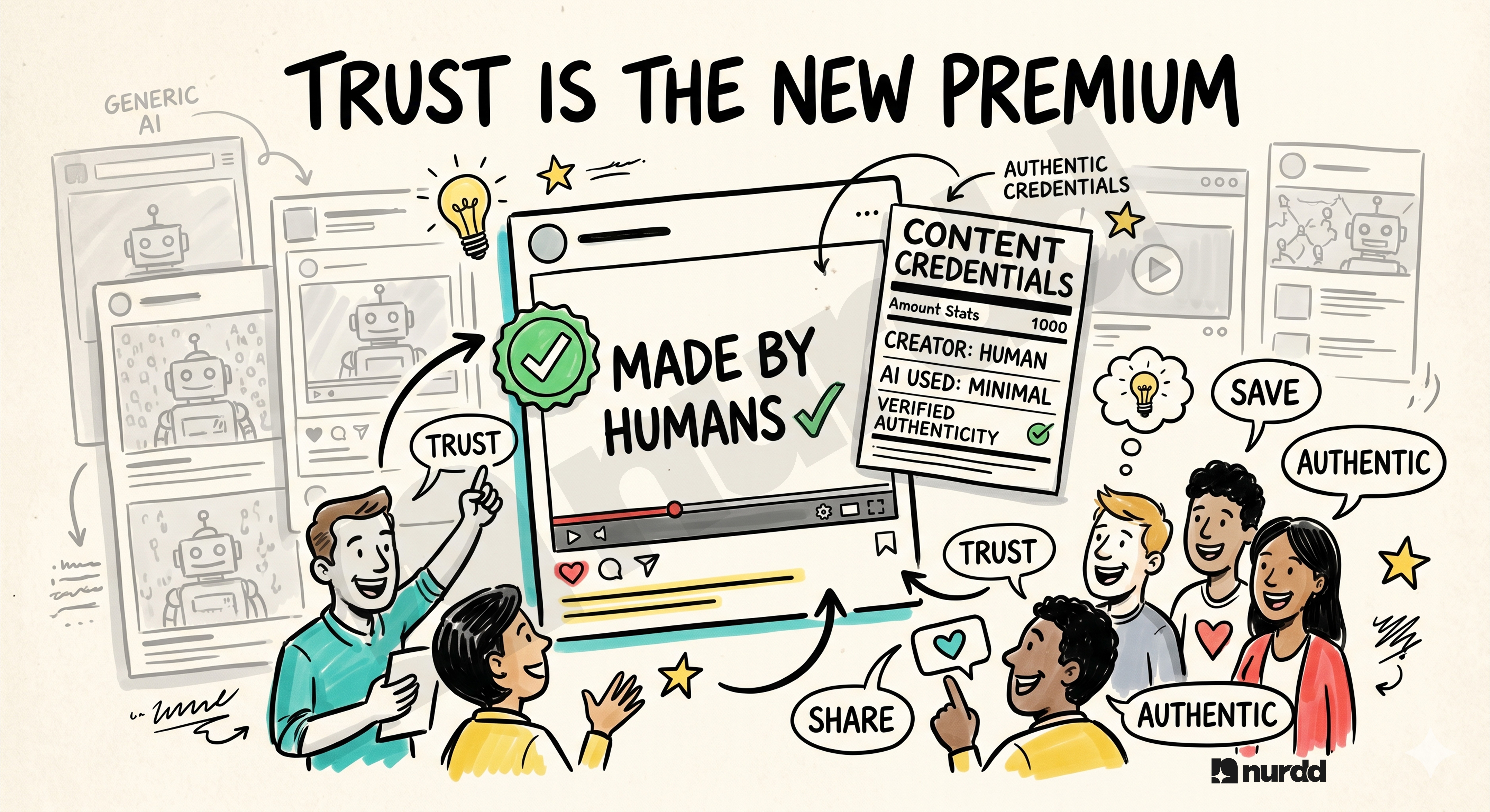
Not By AI is a movement and badge system that allows creators to certify that the substantial majority of their work was created by humans, not AI. It functions like a "Fair Trade" or "Organic" label for digital content — voluntary, displayed visibly on websites or content, and signaling to audiences that real human effort was behind the work. Adoption has accelerated through 2026 as a low-cost trust signal for independent creators, agencies, and editorial publications.
C2PA Content Credentials
C2PA (Coalition for Content Provenance and Authenticity) is the technical infrastructure layer underneath the authenticity movement. Founded in 2021 by Adobe, Microsoft, Intel, BBC, and Truepic, C2PA has grown to over 6,000 members as of January 2026 — including OpenAI, Google, Meta, Sony, Nikon, Canon, the Associated Press, Reuters, and the New York Times.
C2PA Content Credentials work like a "nutrition label" for digital media. Cryptographically signed metadata is embedded into a file — image, video, audio, document — recording who created it, what tools were used, what edits were made, and whether AI was involved. The credential travels with the content as it's shared, edited, and republished. Any tampering breaks the cryptographic signature, making manipulation visible.
By early 2026, TikTok had labeled over 1.3 billion videos with C2PA AI provenance data. Google's Pixel 10 became the first smartphone to achieve C2PA Conformance Program certification. Microsoft began embedding C2PA metadata into M365 content in February 2026. Adobe Photoshop, Lightroom, and Firefly automatically apply Content Credentials.
EU AI Act Article 50 — The August 2026 Deadline
The regulatory side of this shift is sharper than most marketers realize. Under EU AI Act Article 50, machine-readable marking of AI-generated content becomes legally mandatory beginning August 2, 2026. Providers of AI systems that generate synthetic audio, image, video, or text must mark their outputs as AI-generated. Deployers of AI systems creating deepfakes must disclose that the content was artificially generated.
C2PA is the leading technical standard for meeting these requirements. Companies that don't implement content credentials by August 2026 risk fines of up to 3% of global annual revenue under the EU AI Act.
For brands operating in or selling to European markets, this is no longer a "nice to have" trust signal. It's a compliance requirement with real financial consequences.
The "Raw Aesthetic": Why Brands Are Going Phone-Shot on Purpose
Parallel to the technical labels, the visual language of trust has shifted. The hyper-polished brand video, lit and color-graded to perfection, now reads to younger audiences as suspect — too clean, too produced, too likely to be either AI-augmented or designed to manipulate.
The counter-aesthetic is the raw look: phone-shot footage, natural lighting, unscripted dialogue, visible imperfections in the frame. This isn't laziness. It's a deliberate trust signal that says "what you're seeing is real." Indian D2C brands like boAt and Sleepy Owl have leaned into this aesthetic for years; in 2026, they have global company. Even legacy brands are now commissioning content that looks less commissioned — UGC-style creative that retains the texture of being made by an actual person, not a production team.
The principle is straightforward: if your content looks like it could have come from a stock generator, your audience will assume it did.
Practical Workflow: How to Build Human + AI Co-creation in Your Brand
If you're operating a content function in 2026, the workflow that wins looks something like this:
1. Concept Partnering, Not Concept Outsourcing. Use AI to brainstorm 50 variations of a campaign idea, headline, or hook. Then have a human select the one with the most emotional truth — the one that takes a position, that risks something, that feels like it came from a specific person rather than a probability distribution. Discard the safe averages.
2. Outline with AI, Voice with Humans. Let AI generate the structural skeleton of a piece — research synthesis, key points to cover, sub-headings. Then a human writes the draft from scratch using that scaffold, in their own voice. Do not let AI write the prose, then "humanize" it with edits. The texture of human writing has to come from the first draft, not be retrofitted on top.
3. Soul Audits Before Publishing. Before any piece of content goes live, run it through a "soul audit": Are there specific names, places, or numbers? Is there at least one opinion that someone could disagree with? Does the piece take a stance, or does it hedge? Is there a sentence that only this writer would have written? If it fails any of these, send it back.
4. Strategic Rule-Breaking. AI is trained on patterns. Patterns are predictable. Predictability reads as AI. The fastest way to sound human is to break a rule on purpose — start a sentence with "And." Use a contraction in a formal piece. Drop a regional phrase. Make a confident claim without three hedges around it. The friction is the signature.
5. Hyper-Personalization with Human Final Layer. Use AI to analyze customer data, segment audiences, and generate personalized variants. But have a human write or approve the actual outbound message. Hyper-personalization without human oversight is the fastest route to the "creepy line" — where consumers feel surveilled rather than understood.
Frequently Asked Questions
Is using AI for content creation unethical in 2026?
No — using AI for research, structure, transcription, and editing is widely accepted and increasingly standard practice. What audiences and regulators object to is undisclosed AI generation of emotional or persuasive content presented as if it were authored by a human. Transparency about how AI was used is now the ethical baseline, and in the EU it's becoming a legal one.
What is the C2PA Content Credentials standard in simple terms?
C2PA is a technical standard that attaches a cryptographically signed "history" to digital content — including who created it, what software was used, and whether AI was involved. Think of it as a tamper-evident nutrition label for images, video, and audio. It's backed by Adobe, Microsoft, Google, Meta, OpenAI, BBC, the New York Times, and over 6,000 other organizations.
Do "Made by Humans" badges actually influence purchase decisions?
Early evidence suggests yes. Research cited by industry analysts shows human-made labels can increase perceived content value by up to 3x in blind tests. iHeartMedia found 90% of its audience prefers human-made media. As AI saturation increases, human verification is shifting from a niche claim to a competitive differentiator.
Will AI eventually become indistinguishable from human content?
Possibly — but the audience response in 2026 suggests that even when AI output is technically high-quality, the perception that it's AI-made causes audiences to disengage. The "AI-authorship effect" documented in academic research means that authenticity is partly a label problem, not just a quality problem. Provenance and disclosure may matter more than detection capability.
How do I start applying the 70/30 Rule in my content workflow?
Begin with a clean separation: AI handles research, outlining, transcription, and first-pass editing; humans write the actual prose and make all final voice, structure, and opinion decisions. Run a "soul audit" before publishing — does the content have specific examples, a clear point of view, and at least one moment that sounds unmistakably like the author? If yes, ship it. If no, revise.
The Bottom Line
In 2026, the dividing line in content marketing isn't between brands that use AI and brands that don't. Almost everyone is using AI. The dividing line is between brands that hide it and brands that build trust around it.
The winning approach is not anti-AI. It's pro-human-final-layer. Use AI for the labor that doesn't carry meaning. Reserve the parts that do — voice, perspective, emotional truth, lived specificity — for actual humans. Disclose where you've used AI. Adopt C2PA Content Credentials before the EU AI Act deadline forces you to. Wear "Made by Humans" not as a slogan, but as a verifiable claim.
The brands that figure this out are not just complying with new norms. They're earning a kind of trust that, in a feed full of slop, is rapidly becoming the most valuable asset a brand can own.
Sources & References
CNN Business (December 2025) — Why 2026 could be the year of anti-AI marketing URL: https://www.cnn.com/2025/12/16/business/anti-ai-backlash-nightcap
Kate O'Neill / KO Insights (January 2026) — The Authenticity Premium: Why Consumers Are Rejecting AI-Generated Content URL: https://www.koinsights.com/the-authenticity-premium-why-consumers-are-rejecting-ai-generated-content/
Coalition for Content Provenance and Authenticity (C2PA) — Content Credentials Official Specification URL: https://contentcredentials.org/
RightsDocket (March 2026) — What Is C2PA? The Complete Guide to Content Provenance and Authenticity URL: https://www.rightsdocket.com/insights/what-is-c2pa
Liinks Blog (April 2026) — The 'AI Slop' Tipping Point: Why Authenticity Just Got 10x More Valuable in Your Marketing URL: https://www.liinks.co/blog/the-ai-slop-tipping-point
Wikipedia / Merriam-Webster — AI slop URL: https://en.wikipedia.org/wiki/AI_slop
Not By AI — Human Content Certification Movement. URL: https://notbyai.fyi/
WebProNews (December 2025) — AI Slop Sparks Premium Push for Human Touch in 2026 Ads URL: https://www.webpronews.com/ai-slop-sparks-premium-push-for-human-touch-in-2026-ads/