The Funnel Is Dead. Welcome to the Zero-Click Economy.
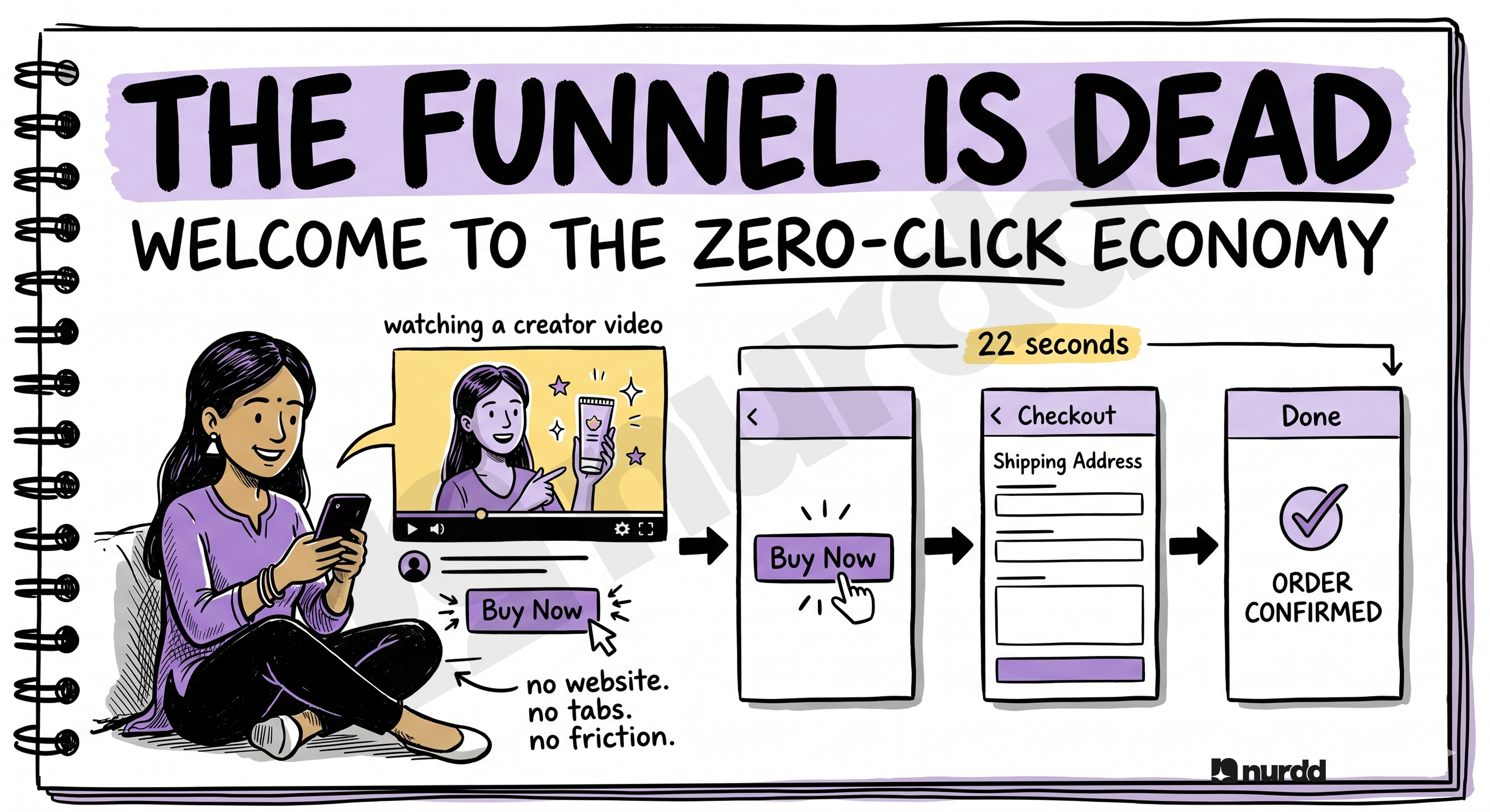
Somewhere in Mumbai right now, a 24-year-old is watching a creator demonstrate a ₹799 serum on her phone. She taps the pinned product card below the video. A checkout sheet slides up. She authenticates with her thumb. The serum is paid for and on its way to her apartment.
Elapsed time: 22 seconds.
She never visited a website. She never typed a URL. She never left the app. The entire purchase happened inside the scroll.
This is not a glimpse of the future. This is social commerce in 2026 and it's quietly demolishing every marketing funnel diagram built in the last fifteen years.
The Linear Funnel Doesn't Fit This World
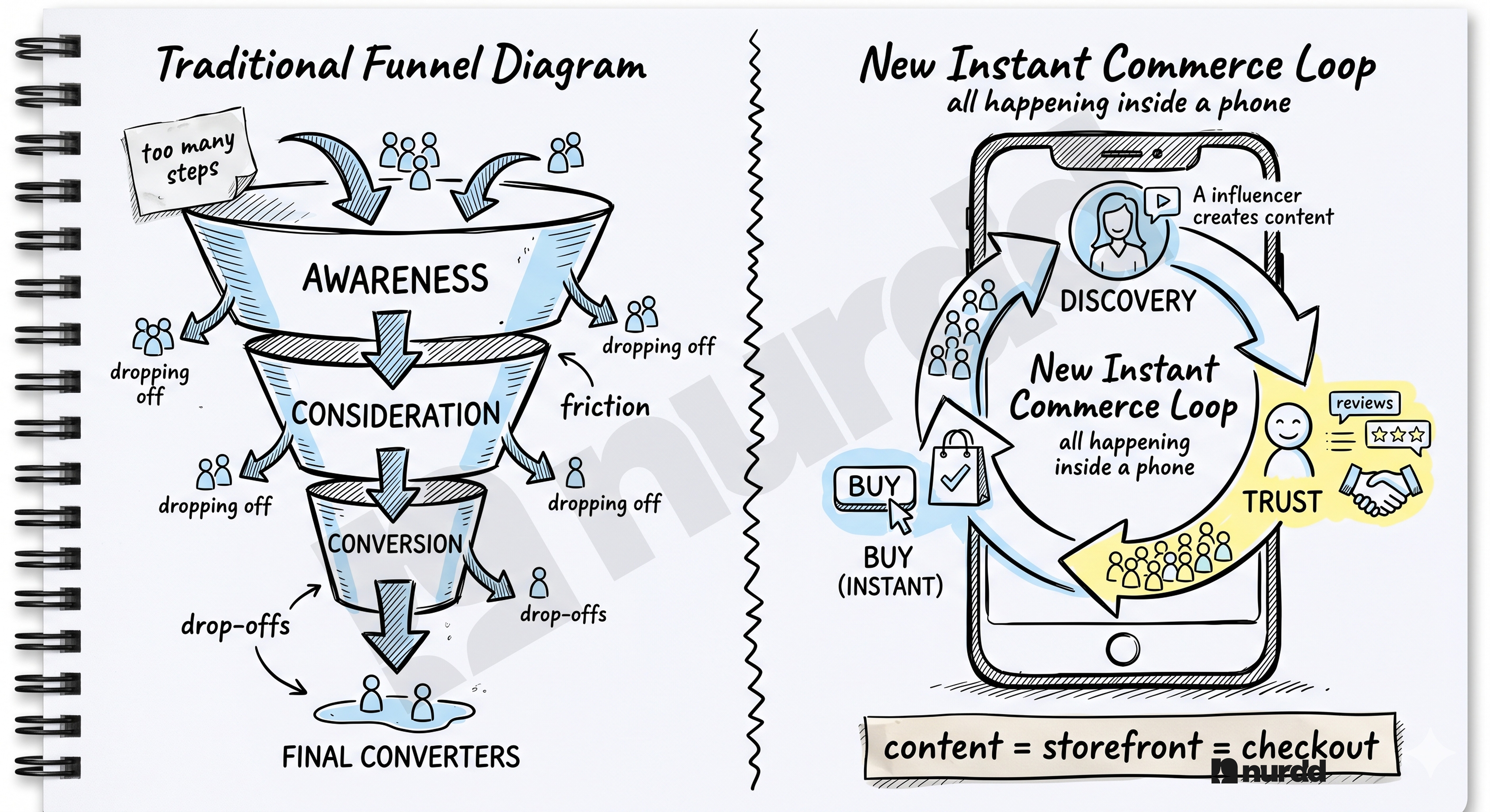
For most of modern marketing's history, we've been drawing the same picture. Awareness at the top. Consideration in the middle. Conversion at the bottom. A customer moves through the stages in order, from Google search to product page to cart to checkout. Marketing teams are organized around it. Budgets are allocated along it. Attribution models are built to measure it.
That picture was designed for a desktop internet where the user had to leave one context (a search result, an ad) to enter another (a brand's website, a payment processor). The funnel was a description of that necessary journey.
2026 doesn't work that way anymore.
The new model is what industry observers are calling "Discovery-to-Checkout" - a single, continuous moment in which the user sees a product, trusts the creator recommending it, taps a button, and pays. No page transitions. No mental load of switching apps. No "let me search for this later." The friction that the traditional funnel was built to manage has been engineered out of the experience entirely.
The technical term for this is zero-click commerce. The strategic implication is much bigger than the term suggests: every piece of content you publish now has to educate, persuade, and convert simultaneously. You don't get a landing page to handle objections. You don't get a product page to surface reviews. Whatever the creator says in 45 seconds of video is the entire sales process.
If your marketing strategy still assumes the user is going to visit your website, you're strategising for a world that no longer exists for a large portion of your audience.
The Scale of What's Actually Happening
The numbers give this shift a weight that's hard to argue with.
US social commerce has surpassed $100.99 billion in 2026, representing 7.2% of all US ecommerce sales - an 18% year-over-year jump from 2025, according to eMarketer's forecast. Globally, Ecosire's 2026 research places social commerce at over $1.2 trillion in 2025, projected to reach 22% of all ecommerce revenue worldwide by end of 2026.
But the macro numbers hide the more interesting story, which is where the growth is concentrated.
TikTok Shop alone is projected to generate $23.4 billion in US ecommerce sales in 2026, an 87.3% year-over-year revenue growth rate that's larger than the entire US ecommerce businesses of Target, Costco, or Best Buy. Its US buyer base expanded from 35 million to over 65 million in a single year. For context on how fast this is: TikTok Shop only launched in the US in late 2023.
The performance gap between platforms is what makes this interesting for marketers making real allocation decisions.
Platform Wars: TikTok Shop vs. Instagram Checkout
If you're deciding where to put your social commerce budget in 2026, the conversion rate data tells the clearest story.
TikTok Shop converts at 4.7% - more than double Instagram Shopping's 2.1%, and nearly triple Facebook Shops at 1.8%. The global average ecommerce conversion rate is around 1.9%. TikTok Shop converts at roughly 2.5 times the rate of a standalone ecommerce store.
The mechanical reason for this is structural, not marketing-driven. TikTok Shop is a closed ecosystem. A viewer watches a video, taps a product tag, reviews details, and purchases, all without leaving the app. Instagram's current model, even after its late-March 2026 launch of native affiliate tagging on Reels, still redirects viewers to an external brand checkout for most purchases. Every redirect is a dropout point. Every new browser tab is a chance to abandon.
This doesn't make Instagram irrelevant. It makes Instagram a different kind of weapon.
Instagram's strength is in premium discovery and aspiration. For luxury, lifestyle, fashion, and beauty brands where the consideration phase matters; where users scroll, save, compare, and only commit after deeper evaluation - Instagram's feed and Reels remain unmatched. The average order value on Instagram is higher. The brand-building capacity is deeper. Instagram is where a product becomes desirable; TikTok Shop is where desire becomes a purchase.
The smartest brands aren't picking between them. They're running both with different briefs: Instagram for brand equity and consideration-stage content, TikTok Shop for conversion and impulse commerce. Each platform is being used for what it does structurally best.
The Quiet Death of "Link in Bio"
For roughly a decade, "link in bio" was social media's reluctant compromise. Platforms wouldn't let you link from a post, so creators and brands sent people to a bio link, usually a Linktree or a custom landing page and hoped they'd find their way to the actual product.
In 2026, that compromise is starting to look like a liability.
Direct-buy buttons on TikTok videos and Reels have replaced "link in bio" as the standard conversion path. TikTok's Video Shopping Ads format keeps users within the platform at every stage, which is why those ads convert at 2–3x higher rates than traditional TikTok Ads that drive to external sites. "Link in bio" still works for content where the primary goal is sign-ups or long-form consumption. But for product sales, it's quietly become a friction point.
Think of it this way: when a user has already decided to buy, every tap between decision and checkout is a chance for them to unchoose. "Link in bio" introduces at least three taps. A direct-buy button is one. That difference is where the conversion gap lives.
For Indian D2C brands, this shift has specific strategic implications. Platforms like Meesho, Nykaa, and Flipkart have built their ecommerce infrastructure on the traditional model: discovery on social, purchase on a dedicated app or website. As TikTok Shop (and eventually Instagram Shopping India, if and when it expands fully) matures in the Indian market, the brands that built their entire funnel around that "click out" moment will need to rebuild. The ones that started native will have a head start.
UGC Is the Storefront Now
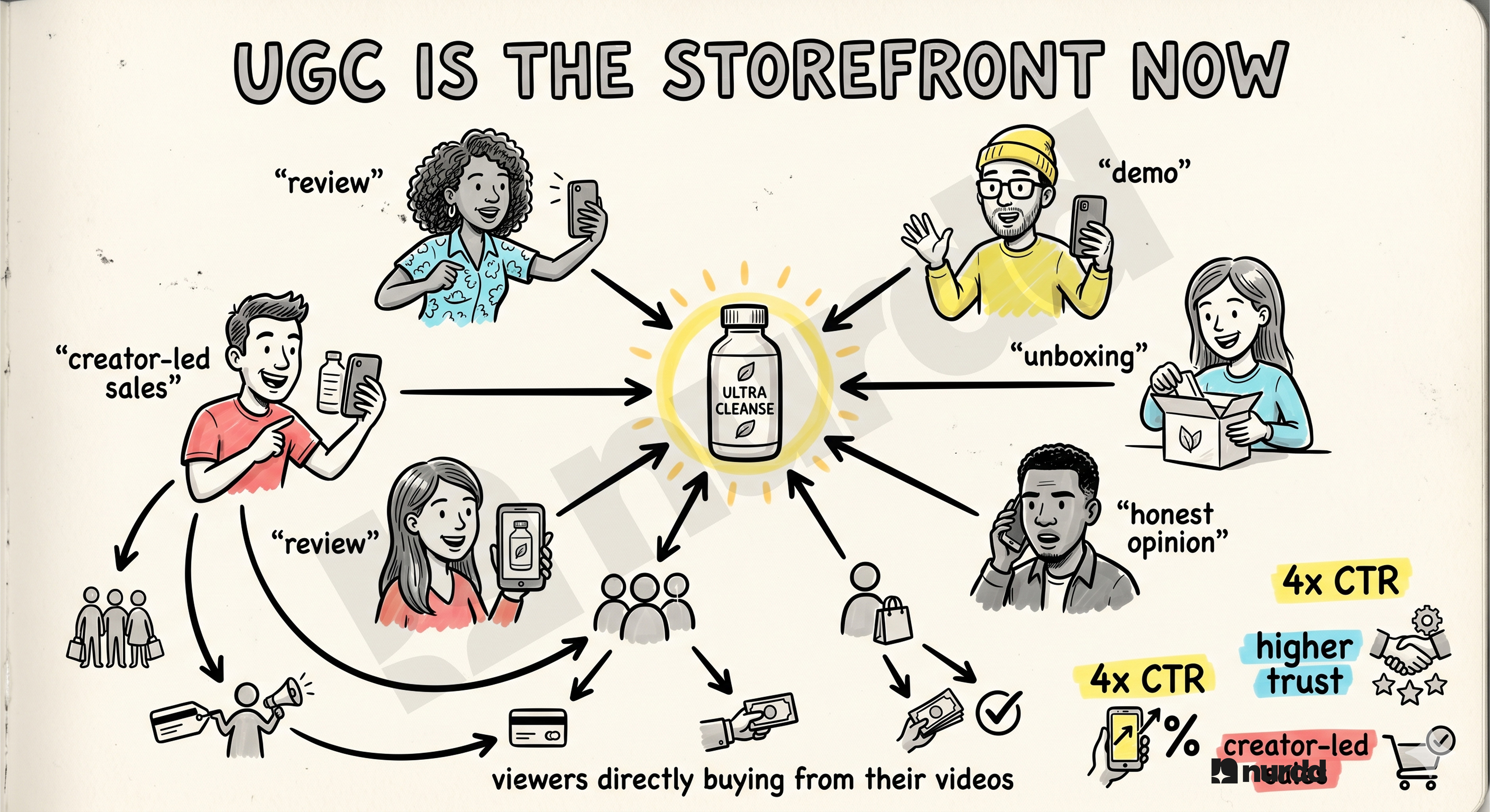
There's an even more fundamental shift happening underneath all of this: the creator's video is the storefront.
For years, UGC was a marketing tactic - a way to augment brand content with "authentic" customer voices. In 2026, UGC has become the primary sales asset. The brand's polished product video isn't what converts. The creator's unboxing in their cluttered bedroom is what converts.
The data on this is unambiguous:
92% of consumers trust peer recommendations over brand advertising. This isn't a soft sentiment. It's a direct conversion signal.
UGC-based ads generate 4x higher click-through rates and a 50% reduction in cost-per-click compared to traditional brand ads, according to Meta's own Performance Advertising Benchmark Report for 2026.
80% of Gen Z consumers rely specifically on user-generated videos for purchase decisions.
61% of Gen Z prefer UGC over all other content formats, including polished brand creative.
On TikTok Shop, between 84% and 95% of revenue in the best-performing shops comes from independent creators selling on commission, not from brand-led content. The average best-selling product on TikTok Shop is promoted by 65 different creators. It's this repetition across dozens of authentic voices, not a single big-budget campaign, that drives trust and purchase.
This changes what "brand content strategy" means in practice. The goal is no longer to make the most beautiful brand video. The goal is to activate a network of creators whose videos - imperfect, platform-native, in their own voice - become the distributed storefront for your product.
What This Actually Means For How You Work
If you're building a social commerce strategy for 2026, the mental model has to shift in three specific ways.
Every post is a potential checkout. Stop thinking about content and commerce as separate streams. Every creator video, every Reel, every live stream should have a tagged product and a direct-buy path. Content that doesn't have a commerce hook attached is leaving money on the table in a context where users are expecting to buy.
Build a creator network, not a content calendar. The single highest-leverage thing a brand can do in 2026 is build and maintain a roster of 20–50 creators who genuinely know the product. Not one big-name influencer. A network of small and mid-sized voices, each generating their own native content, each taking a commission, each contributing to the "65 creators promoting the same product" dynamic that drives purchase trust.
Treat your social profile as a commerce node. In the old model, a brand's social profile was a marketing surface that pointed to a website. In the new model, the social profile is the store. Product catalogs, pinned videos, tagged posts, direct-buy buttons, the Instagram or TikTok profile has to be designed as if it's the only place the customer will ever see your brand. Because for a growing share of buyers, it is.
The Closing Insight
The old funnel was a description of how the internet forced customers to move. When the internet changed, the funnel became a description of a world that no longer exists but we kept using it because the diagrams were already drawn.
Zero-click commerce isn't a new technique. It's the new default. The brands that understand this are already building their operations, their content, and their creator partnerships around a simple premise: the customer doesn't need to go anywhere to buy from you.
Everything they need to see, to trust, and to click is inside the scroll. Your job is to make sure your brand is there when the thumb stops.
In 2026, the question isn't "how do I drive traffic to my website?" The better question, the only question that actually matters is: "when someone discovers me in the feed, can they buy me in 30 seconds without ever leaving?"
If the answer is no, you're losing to a brand that answered yes.
Sources & References
eMarketer / Short Form Nation (2026) — US Social Commerce Forecast URL: https://www.shortformnation.com/blog/social-commerce-trends-2026-what-s-actually-working-on-tiktok-shop-and-what-s-not
GenAIembed (April 2026) — Social Commerce Strategy 2026: How Retail Brands Win on TikTok, Instagram, and Beyond URL: https://www.genaiembed.ai/blog/social-commerce-strategy-retail-2026
Ecosire (March 2026) — Social Commerce: Selling on TikTok, Instagram & Facebook in 2026 URL: https://ecosire.com/blog/social-commerce-selling-tiktok-instagram-2026
Taggbox (2026) — User-Generated Content (UGC) Stats and Facts URL: https://taggbox.com/blog/user-generated-content-facts-and-stats/
Archive / Backlinko (2026) — UGC Marketing Statistics 2026 URL: https://archive.com/blog/ugc-marketing-statistics
JoinBrands (April 2026) — Instagram Reels Now Has Native Affiliate Commerce: What It Means for Brands and Creators in 2026 URL: https://joinbrands.com/blog/instagram-shop-2026/