The "Infrastructure First" Approach: Why the Spreadsheet Is the Biggest Threat to Your 2026 Influencer Campaigns
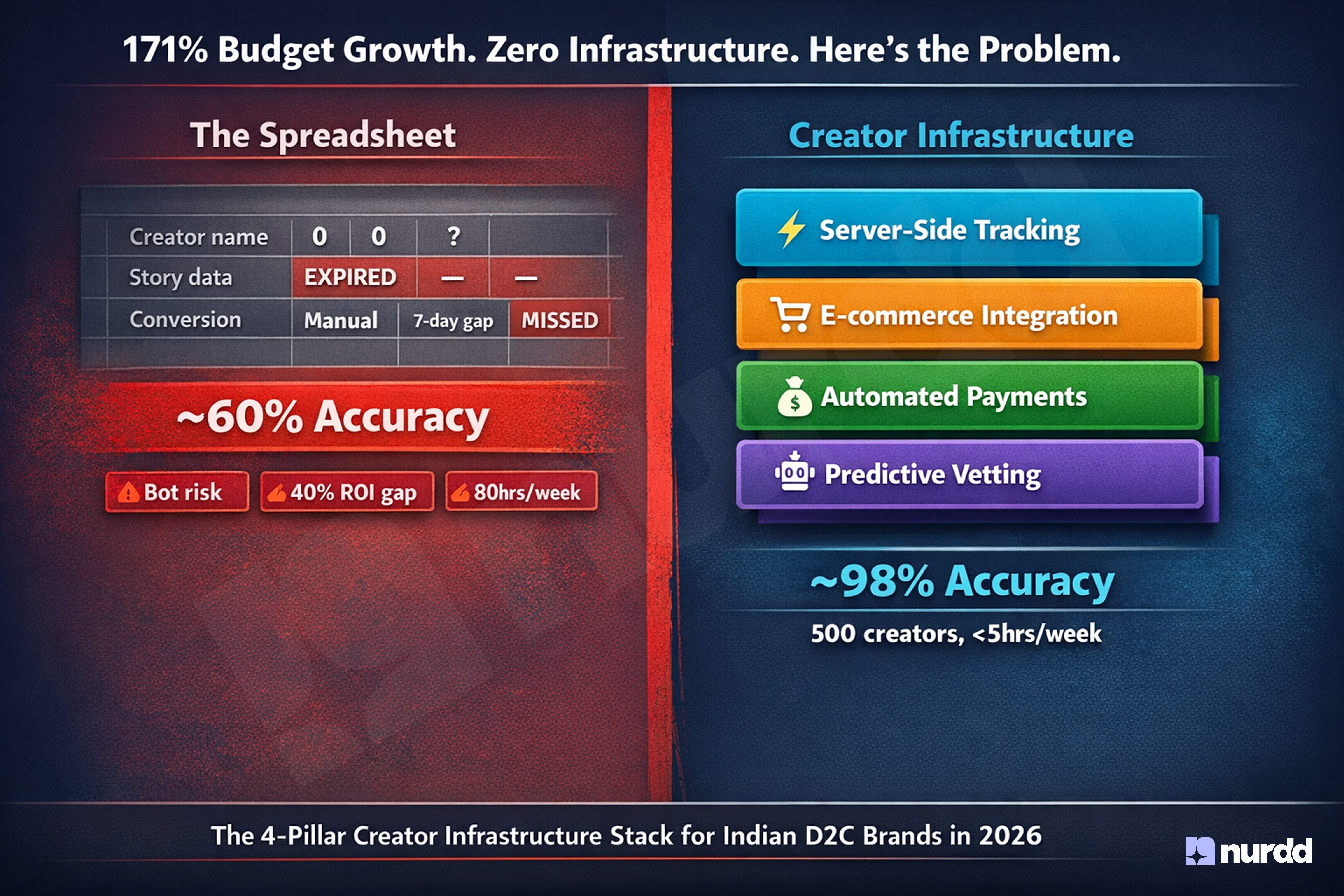
Influencer marketing budgets have grown 171% year over year. 71% of brands are increasing investment. Nearly two-thirds are reallocating from traditional digital channels. And a significant proportion of that spend is being tracked in a Google Sheet that cannot see a Story before it disappears, cannot detect a bot before the contract is signed, and cannot tell you whether the purchase that showed up in direct traffic on Thursday came from the creator's Reel on Monday. In 2026, the spreadsheet is not a budget-friendly alternative to a platform. It is an ROI liability and this is exactly what it is costing you.
The Spreadsheet Is Not a Strategy
There is a version of influencer marketing that most mid-sized Indian D2C brands are still running. A shared Google Sheet with creator names, follower counts, post dates, and manually entered engagement numbers. A marketing coordinator spent three days after every campaign copying data from Instagram Insights, TikTok Analytics, and YouTube Studio into cells that were already outdated before she filled them in.
This is not a measurement system. It is a documentation system and documentation is not the same as intelligence. A spreadsheet captures what already happened, imprecisely. Infrastructure captures what is happening, accurately predicts what will happen, and tells you which variable to change to get a different outcome.
The influencer marketing ecosystem now supports 6,939 specialised service providers and platforms, up from just 1,120 in 2019. This expansion reflects the complexity brands are trying to manage: TikTok Shop links, Instagram SecureCodes, YouTube Shopping integrations, Stories that disappear in 24 hours, cross-device attribution windows that stretch seven days beyond a post. A spreadsheet cannot capture real-time server-side data. It cannot process a Story view before the window closes. It cannot tell you whether the purchase that showed up in direct traffic on Thursday came from the nano-influencer's Reel on Monday. The data is cold before it is entered, and cold data produces decisions made on fiction rather than fact.

What the Spreadsheet Is Actually Costing You
The financial case against manual tracking is measurable across three specific cost centres.
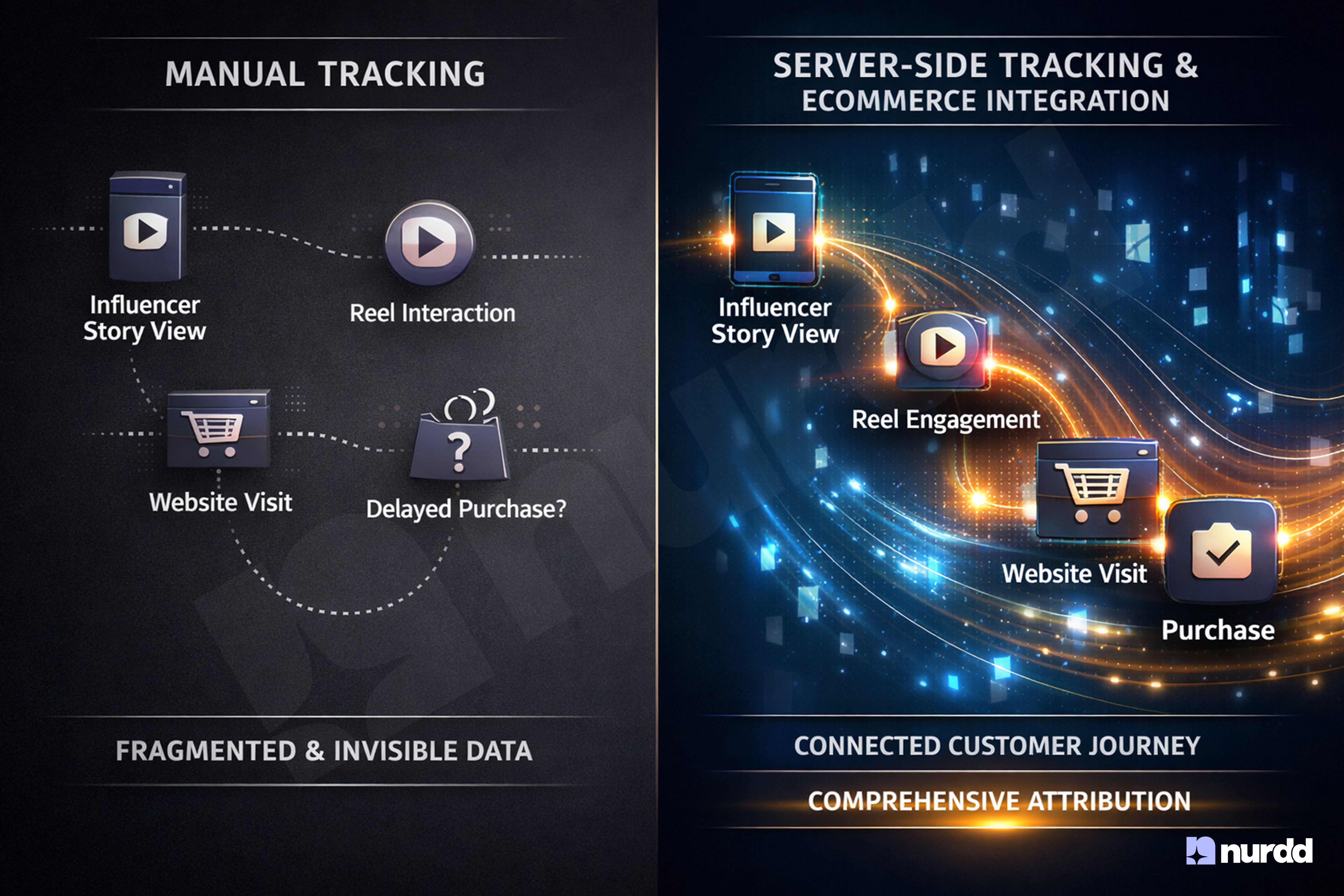
Attribution gaps. Manual tracking cannot capture the full-funnel journey from a Story tap to a website visit three days later to a purchase on day seven. Without server-side tracking and multi-touch attribution, brands systematically under-report influencer ROI by 30–40%. They see the Google Search conversion at the end of the journey and credit it to paid search. They do not see the Instagram Story tap that initiated it. The result: influencer budgets get cut in favour of performance channels — not because influencers are underperforming, but because the infrastructure cannot see what they are doing.
Maintenance hours. Teams using manual processes spend up to 80 hours per week on UGC management and tracking alone. One platform allows a single manager to handle 600+ influencers in the same time a spreadsheet user manages 20. The cost is not the platform licence — it is your most expensive marketing talent spending 40 hours a week on copy-paste instead of strategy and relationship building.
Fraud exposure. A spreadsheet cannot tell you whether an influencer's engagement is coming from a bot pod, whether their reach has been shadow-banned, or whether their follower growth spiked artificially three months before you found them. Fake engagement costs brands over USD 1.3 billion annually. Advanced vetting examines engagement velocity, comment quality, and follower growth patterns to distinguish authentic influence from manufactured metrics. None of this is available in a cell.
The 2026 Infrastructure Comparison
Dimension | Manual Tracking (Spreadsheet) | Creator Infrastructure Platform |
|---|---|---|
Attribution Accuracy | ~60% - misses cross-device, cross-time, offline conversion | ~98% - server-side tracking captures the full journey |
Fraud Vetting | Manual and intuitive - high bot risk | AI-driven - detects fake engagement before contracts are signed |
Manager Capacity | 40+ hours/week for 20 creators | Under 5 hours/week for 500 creators |
Story and Ephemeral Content | Missed - data disappears before manual capture | Captured in real-time via platform API integration |
E-commerce Attribution | UTMs and discount codes only misses 30–40% of conversions | Direct Shopify/WooCommerce integration tracks every sale to creator |
Payment Processing | Manual invoices, GST collection, TDS calculations per creator | Automated payouts with compliance documentation centralised |
Predictive Capability | None - decisions on historical data two weeks old | AI forecasts creator ROI before campaign launch |
What "Creator Infrastructure" Actually Means
Creator Infrastructure is the systems, tools, and processes that help brands manage creator partnerships at scale: centralising creator sourcing, briefing, content workflows, performance tracking, payouts, and content reuse in a single platform. It is, more precisely, an IRM - Influencer Relationship Management system: what a CRM is to your sales pipeline, an IRM is to your creator pipeline.
Where a CRM manages contacts, deal stages, and revenue attribution, an IRM manages creator discovery, campaign briefing, content approvals, rights management, payment, and performance tracking. Brands that have made this transition report managing 600+ creators with the same operational overhead a spreadsheet user allocates to 20. The distinction is not about having more tools. It is about owning the system and when you own the system, you own the outcomes.
The Four Infrastructure Pillars Every Indian D2C Brand Needs
Pillar 1 — Server-Side Tracking. Server-side Conversion API (CAPI) integration bypasses iOS privacy restrictions, ad-blockers, and third-party cookie deprecation to capture every completed purchase regardless of device or browser. In India's mobile-first market where consumers discover on Instagram, research on desktop, and purchase on a mobile app client-side pixel tracking misses a significant proportion of the attribution chain. Server-side tracking closes that gap. It is the single most important data infrastructure investment any D2C brand managing influencer campaigns can make in 2026, and it is the foundation on which every other measurement capability depends.
Pillar 2 — E-commerce and Social Commerce Integration. A direct API connection between your influencer platform and your Shopify, WooCommerce, or marketplace store ties every creator's content to a sales outcome in real time, allowing brands to see, at the creator level, not just clicks but purchases, average order value, and return rate.
Social commerce has added a third attribution layer that spreadsheets cannot handle: in-app purchases triggered directly by a creator's live stream or shoppable post, completed without the viewer ever visiting the brand's website. TikTok Shop, Instagram Shopping, and YouTube Shopping each have distinct attribution APIs requiring platform-specific integration. Brands that have connected their influencer platform to these social commerce channels are attributing creator-driven sales that would otherwise appear as direct traffic, closing an attribution gap that can account for 20–25% of total creator-driven revenue.
Pillar 3 — Automated Payments and Compliance. Manual invoicing for a programme with 50 creators across multiple states, each with different GST implications, payment structures, and TDS requirements, is not just a time cost. It is a compliance risk. Under India's GST framework, creators whose annual turnover exceeds ₹20 lakh must register for GST and issue compliant invoices for every brand collaboration. A new Income Tax profession code for content creators, mandatory from FY 2024–25 onwards, adds a further documentation requirement. Automated payment infrastructure handles creator payouts, GST invoice collection, TDS documentation, and payment timelines in a single workflow rather than leaving each brand to manage compliance paperwork across hundreds of individual relationships independently.
Pillar 4 — Predictive Vetting. AI-powered pre-campaign analysis forecasts a creator's likely ROI based on historical performance on comparable briefs, audience authenticity score, engagement quality, and content alignment with the brand's category. By 2026, 63% of marketers are actively incorporating AI into their influencer selection process. The brands using predictive vetting are not just protecting their budget from fraud. They are identifying the nano-influencer in Nagpur whose save rate, comment sentiment, and conversion history make them the most efficient creator in their category before they are obvious to any competitor.
The India Platform Landscape: What to Use at Every Scale
The right platform depends on your programme's scale and primary constraint, not the most impressive feature set in a sales demonstration.
For first-structured campaigns and growing D2C brands: Winkl is the platform built for the vast segment of Indian businesses: D2C brands, regional companies, funded startups - for whom enterprise influencer technology is designed for organisations considerably larger than themselves. Its defining quality is operational simplicity: a marketing team member with no prior influencer specialisation can run a complete campaign from creator discovery through content approval to performance reporting without external support. In 2026, Winkl added creator rate benchmarking and built-in ASCI compliance prompts that help brands stay within India's advertising disclosure guidelines without a separate legal review step.
For scaling programmes with high creator volume: Influencer.in occupies a distinctive position in the Indian market because it has been operating long enough to develop genuine institutional knowledge about how influencer campaigns actually run at scale. Its creator payment infrastructure is a practical differentiator that brands repeatedly cite as the reason they stay: rather than chasing dozens of individual GST invoices and managing TDS documentation across hundreds of creators independently, brands process all payments through the platform, which handles the compliance paperwork centrally. For a campaign involving 200 micro-influencers, the time saved by centralised payment management across one campaign cycle can run to hundreds of hours of marketing operations time.
For brands prioritising India-native data depth: Qoruz is the most comprehensively India-native influencer management platform in the market. Its dominance in 2026 reflects a decade of investment in understanding what the Indian creator ecosystem actually looks like regional language creator populations, Tier-2 and Tier-3 audience geography, vernacular engagement benchmarks rather than what a Western platform assumes it looks like.
For enterprise programmes:CreatorIQ operates at the most institutionally demanding end of the spectrum, serving the India operations of global consumer brands that need their creator programmes to integrate with existing enterprise marketing technology stacks and satisfy procurement and legal compliance requirements. Its content compliance module automatically screens published creator content against brand safety guidelines and ASCI disclosure requirements particularly important for regulated sectors including financial services and pharmaceuticals, where a non-compliant creator post carries regulatory consequences rather than merely reputational ones.
Own the System, Own the Outcomes
The principle is simple: break down silos, unify your data, and prioritise measurable outcomes. Your brand needs to own the relationships, data, and content pipelines that drive measurable ROI. When you own the system, you own the outcomes.
The brands building the most efficient influencer programmes in India right now are not the ones with the biggest creator budgets. They are the ones who have invested as heavily in measurement infrastructure as in creator relationships who know, at the individual creator level, what their programme is producing, what it is costing, and which variable to change to make it work harder.
The spreadsheet had its moment. That moment is over.
Sources
Inventiva — Top 10 Influencer Management Platforms in India 2026 (Feb 2026): inventiva.co.in
Inventiva — Top 10 Influencer Marketing Platforms in 2026 (Feb 2026): inventiva.co.in
TechBullion — Influencer Marketing ROI: Measurement Frameworks and Platform Analytics in 2026 (Mar 2026): techbullion.com
Impact.com — Influencer Marketing Trends 2026: Performance Insights (Jan 2026): impact.com
Archive.com — 14 Influencer Marketing Growth Statistics for 2026: archive.com
CreatorIQ — State of Creator Marketing Report 2025–2026: creatoriq.com
FilingPro — Tax Guide for Social Media Influencers in India (Oct 2025): filingpro.io
Influencer Marketing Hub — Staying Ahead of the Regulators: An Influencer Marketer's Watchlist for 2025 (Nov 2025): influencermarketinghub.com
Fortune Business Insights — Influencer Marketing Platform Market Report 2026–2034: fortunebusinessinsights.com
SociallyIn — 2026 Influencer Marketing Statistics: ROI, Trends and Platform Data (Mar 2026):sociallyin.com