Why D2C Brands in India Must Switch from ROAS to POAS
A high ROAS does not mean you are profitable. POAS - Profit on Ad Spend accounts for COGS, shipping, RTO, and creator fees that ROAS ignores entirely. For Indian D2C brands, this difference is the gap between scaling confidently and scaling into bankruptcy.
The "Losing Money While Growing" Trap
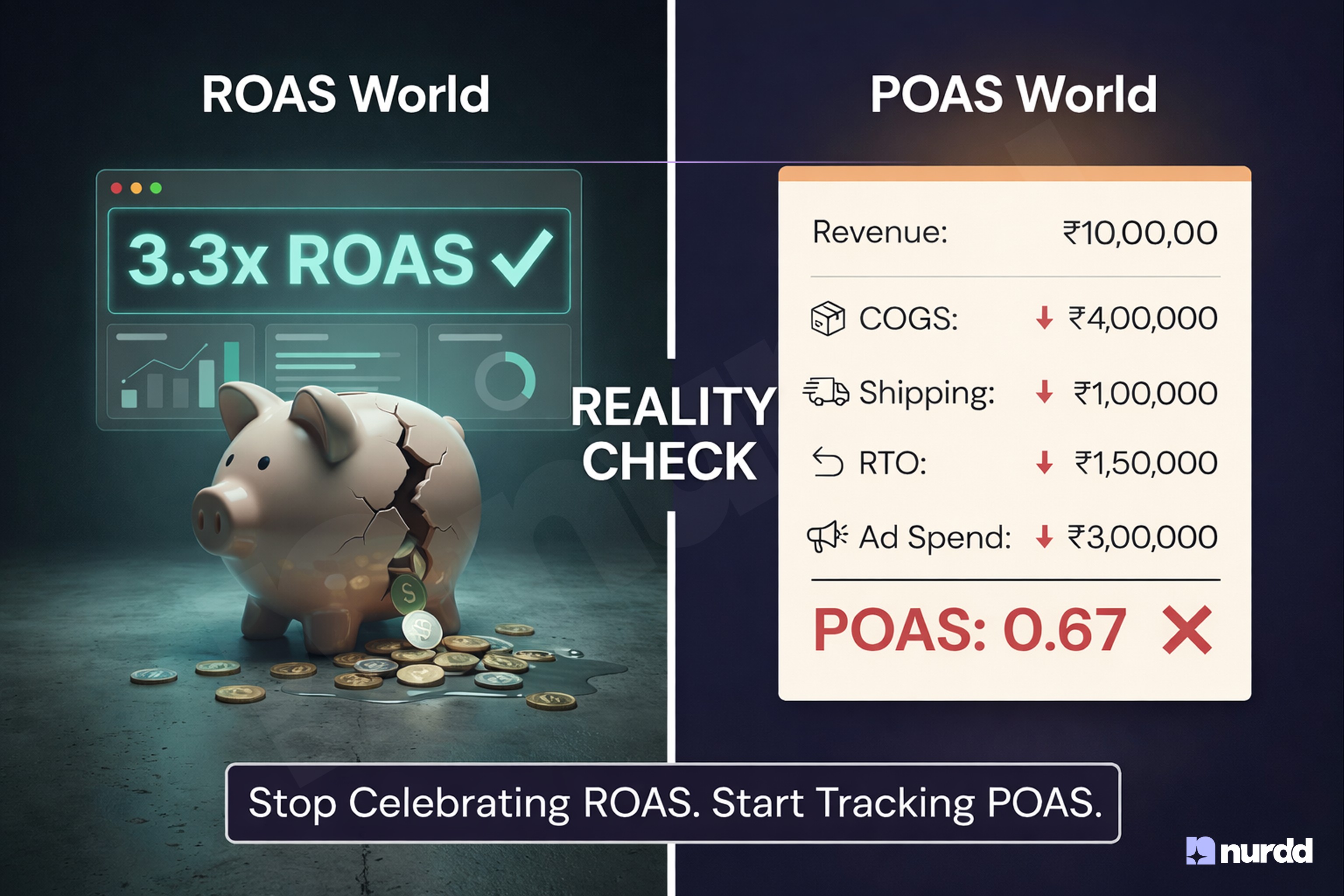
Picture this. A creator campaign drives ₹10 lakhs in sales on a ₹3 lakh spend. The dashboard glows: 3.3x ROAS. The team celebrates. The founder screenshots it for their investor update.
Then the accountant runs the actual numbers.
COGS takes ₹4 lakhs. Shipping takes ₹1 lakh. Platform commissions - Amazon, Blinkit, and the rest take another cut. And then there's India's silent margin killer: RTO. RTOs accounted for nearly 25–30% of failed orders across mid-size Indian D2C brands in 2024. Each returned COD order costs brands ₹180–240 in forward shipping, reverse logistics, and processing overhead whilst generating zero revenue.
The ₹10 lakh in revenue? It left ₹2 lakhs in gross profit. The brand spent ₹3 lakhs to make ₹2 lakhs. A 3.3x ROAS. A -33% return on reality.
Why ROAS Is a Vanity Metric for D2C India
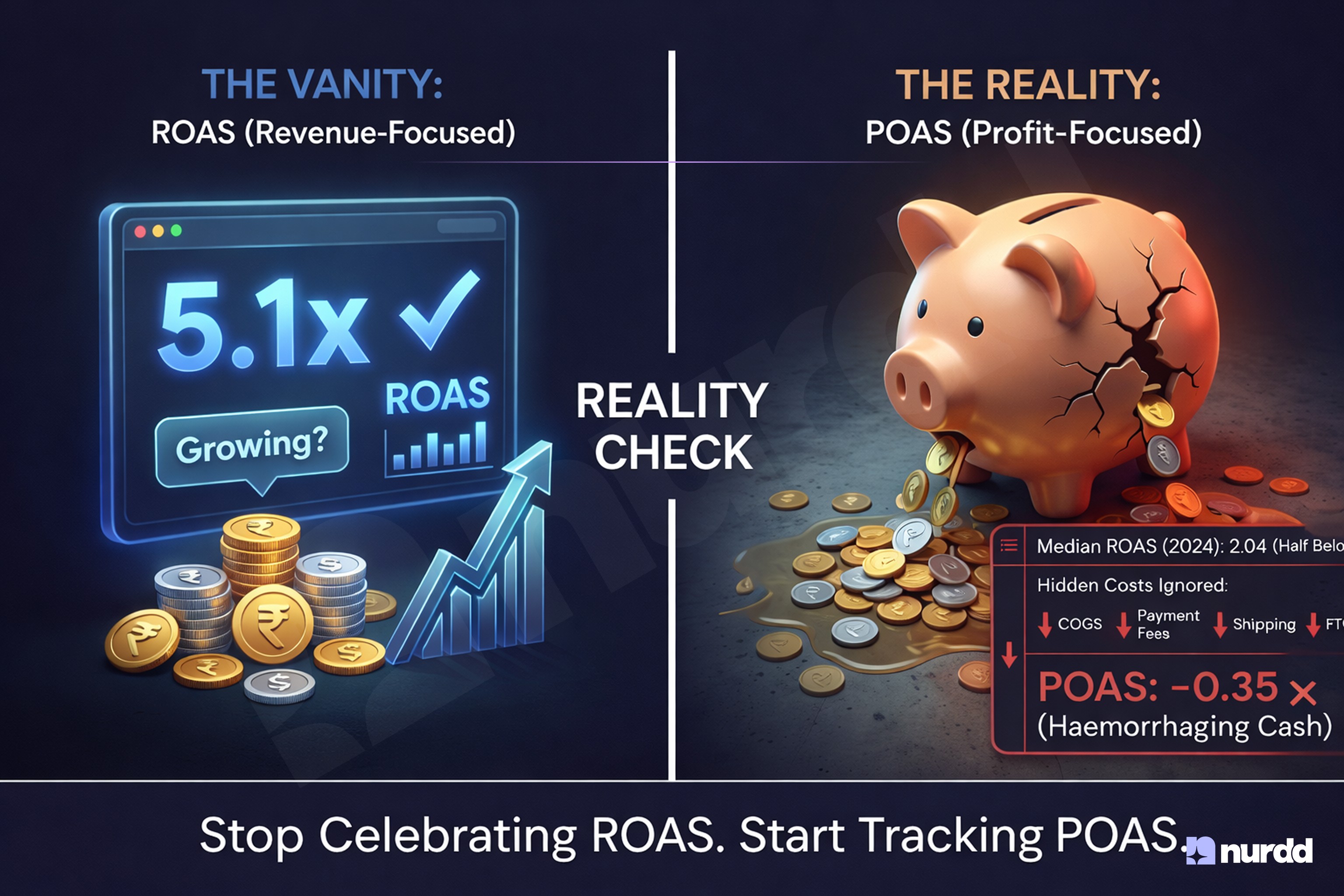
ROAS measures how much revenue was generated from an ad campaign but revenue provides little insight into fixed costs, payment fees, margins, or shipping costs. When Google and Meta built ROAS, they didn't have access to your COGS. So they swapped "return" for "revenue" and the metric has misled founders ever since. The median ROAS for ecommerce brands in 2024 was just 2.04, meaning half of all brands are operating below a 2:1 ratio. Many of those brands think they're growing. Some are just haemorrhaging cash at scale.
What Is POAS and Why It's the Better North Star
POAS (Profit on Ad Spend) measures the actual gross profit generated for every rupee spent on advertising, after all variable costs are stripped out.
The formula:
POAS = Gross Profit from Campaign ÷ Total Ad Spend (where Gross Profit = Revenue − COGS − Shipping − RTO − Platform Fees − Creator Fees)
A POAS above 1.0 means you are profitable after variable costs. A POAS below 1.0 means you are burning cash regardless of what your ROAS says.
ROAS vs POAS: The Math That Changes Everything
Cost Factor | Ignored by ROAS | Captured by POAS |
|---|---|---|
Cost of Goods Sold (COGS) | ❌ | ✅ |
Shipping & Reverse Logistics | ❌ | ✅ |
RTO Losses (25–30% of COD) | ❌ | ✅ |
Creator Gifting & Agency Fees | ❌ | ✅ |
Platform Commission (Amazon etc.) | ❌ | ✅ |
Actual Profit | Hidden | Visible |
How POAS Transforms Your Creator Strategy
POAS doesn't just fix your reporting, it rewires how you evaluate creators. Under ROAS, a creator who drives ₹5 lakhs in revenue looks better than one who drives ₹3 lakhs. Under POAS, what matters is margin quality. POAS reveals that some campaigns which look brilliant on ROAS are actually costing you money with every sale.
Some creators drive high volume but bring in COD-heavy, high-RTO customers buying discounted SKUs. Others drive less volume but bring full-price buyers with prepaid orders and low return rates. POAS tells you which is which and tells you to double down on the latter.
Sustainable Scaling: What POAS >1.1 Actually Means
A POAS of 1.1 means for every ₹1 spent on ads, you keep ₹1.10 in gross profit. It's not glamorous — but it is the foundation every sustainable D2C brand is built on. Once you hit consistent POAS >1.1 across your nano-influencer pool, you can scale with confidence. You're not buying revenue. You're buying profit.

FAQs
What is a good POAS for a D2C brand in India? A POAS above 1.0 means you are profitable after variable costs. Most early-stage D2C brands should target a POAS of 1.1–1.5 before scaling spend. Anything below 1.0 means every rupee of ad spend is destroying margin, regardless of ROAS.
Why is ROAS misleading for D2C brands in India? ROAS only measures revenue against ad spend. It ignores COGS, shipping, RTO losses, creator gifting, and platform commissions, all of which are significant in Indian D2C. A 3x ROAS can easily translate to a POAS below 1.0 once these costs are included.
How do I start tracking POAS for my D2C brand? Begin by calculating it manually for your top three campaigns. Pull revenue, subtract COGS, shipping, RTO losses, and all creator fees. Divide by total ad spend. Tools like Admetrics, Triple Whale, and Klaviyo can automate this once your product cost data is integrated.
Does POAS replace ROAS completely? Not entirely. ROAS is still useful for quick campaign-level comparisons and new customer acquisition contexts. But POAS should be your north star for budget allocation, creator selection, and scaling decisions, especially in a high-RTO, high-COD market like India.
Sources
Admetrics - Why DTCs Should Focus on POAS Instead of ROAS: admetrics.io
Funnel.io - POAS: A Metric All E-commerce Marketers Should Know (Jun 2024): funnel.io
JudeLuxe - POAS vs ROAS: Which Is Better for Your Ecommerce Growth? (Sep 2025): judeluxe.com
JENTIS - POAS vs ROAS: The Key to Profitability in E-Commerce: jentis.com
Upcounting - Average eCommerce ROAS Dropped to 2.87 in 2025 (Oct 2025): upcounting.com
eShipz - NDR Management Strategies to Cut RTOs in Logistics (Jul 2025): eshipz.com
BePragma - How to Reduce RTO in Indian E-commerce Without Hurting COD Orders (Oct 2025): bepragma.ai
Dazeinfo - Over 25% of COD Orders Fail: A Major Dent in India's E-commerce Business (Jun 2024): dazeinfo.com
Salience - Introducing POAS: The Only Metric That Actually Matters (Jun 2025): salience.co.uk
Adcore - What Is Profit on Ad Spend (POAS) and Why You Should Be Aware of It (Nov 2024): adcore.com