How to Pick Influencers Based on Predicted Sales, Not Follower Count
 12 Mar 20268 min read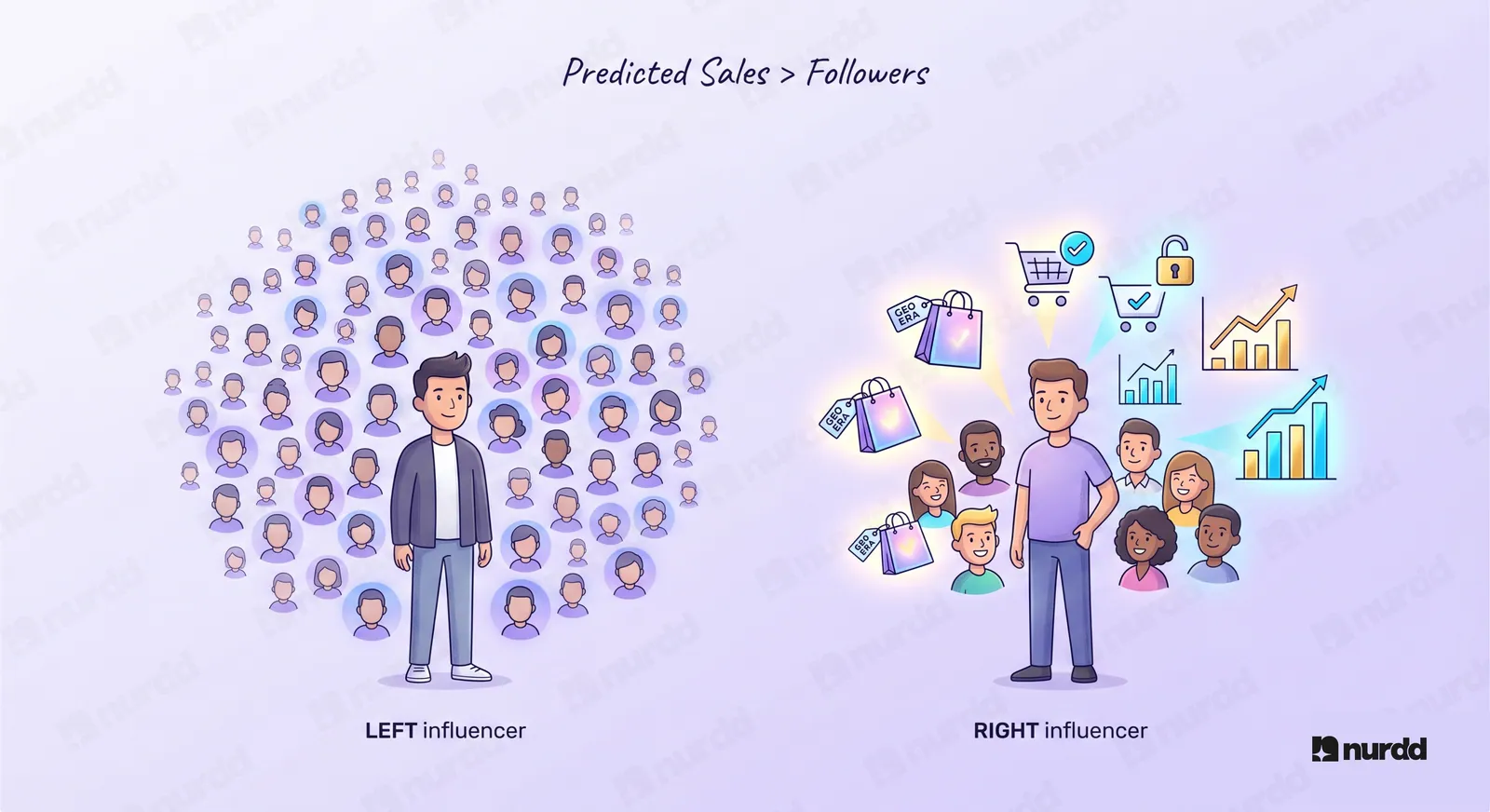
Pick influencers by forecasted sales and ROI, not follower count: score brand-audience match, engagement quality, fake-follower rate, content-format fit, and historical product-level sales attribution. Define your target buyer, forecast ROI for shortlisted creators before spending, then measure SKU-level sales to improve future predictions.
The most common influencer marketing mistake is picking creators by follower count. A creator with 2 million followers who has never driven a purchase is worth nothing to a D2C brand. A creator with 80,000 highly engaged followers in your exact target segment who regularly converts — is worth considerably more.
The shift from reach-based to sales-based influencer selection is the single most important evolution in influencer marketing. Here is how to do it.
Why Follower Count Is the Wrong Metric
Follower count is an input metric, not an output metric. It measures audience size — not audience quality, engagement authenticity, or purchase intent. Brands that optimise for reach are essentially buying the possibility of attention, not attention itself.
- Fake followers are widespread. Industry estimates suggest 15–40% of followers on major platforms are bots or inactive accounts. A creator with 500,000 followers may have an effective audience of 200,000.
- Reach does not equal relevance. A creator followed by 2 million people interested in travel is a poor match for a protein supplement brand, regardless of reach.
- Engagement rates vary enormously. Micro-influencers (10K–100K followers) consistently outperform mega-influencers on engagement rate — the metric that actually drives action.
The Metrics That Actually Predict Sales
Brand Match Score
Brand match is a measure of how well a creator's audience overlaps with your target buyer. A high brand match score means the creator's followers are genuinely in your addressable market — by age, income, interest category, and purchase behaviour. This requires AI analysis of audience composition, not just profile review.
Engagement Quality (Not Just Rate)
Engagement rate (likes + comments ÷ followers) is a proxy metric. What matters is engagement quality — are people commenting "where can I buy this?" or leaving generic emoji responses that may be generated by engagement pods? Authentic engagement is a strong predictor of conversion.
Fake Follower Rate
Before any campaign brief, verify what percentage of a creator's following is real. A creator with a 12% fake follower rate is manageable. A creator with a 43% fake follower rate is taking your budget and delivering it to bots. This should be a hard filter, not a soft consideration.
Historical Sales Attribution
The best predictor of future sales is past sales. Has this creator driven real purchases for similar brands? Attribution at the product level — not just traffic or clicks — is the gold standard. Brands that track product-level revenue per creator hold the most predictive data available.
How Pre-Spend ROI Forecasting Works
Modern influencer marketing tools can forecast expected ROI before you commit budget. The forecast model factors in:
- Brand match score between creator and brand
- Historical engagement rate (last 90 days)
- Fake follower percentage
- Category conversion benchmarks
- Creator content format (Reel vs Story vs post)
- Seasonality and campaign timing
The output is a projected return range — for example, "this creator is forecasted to generate ₹3.2L–₹5.8L in attributed sales for a ₹1.2L campaign." You can compare this forecast across multiple creator options before spending anything.
This is the core function of Nia by Nurdd — a free influencer marketing app that generates brand match scores, runs fake follower detection via TruAI, and produces pre-spend ROI forecasts. D2C brands use it to make evidence-based decisions before any brief goes out.
Building a Sales-Prediction Process
Step 1: Define your target buyer precisely
The more specifically you describe your buyer — age range, income band, geographic cluster, purchase triggers, platform behaviour — the more accurately you can score creator-audience match. "Women aged 25–40 interested in skincare" is not specific enough. "Women aged 28–36, monthly income ₹80K+, active on Instagram Reels, who have purchased premium skincare in the last 3 months" gives your matching algorithm something to work with.
Step 2: Build a creator evaluation scorecard
Before shortlisting creators, agree on the metrics you will score and their weightings:
- Brand match score (40%)
- Engagement quality (25%)
- Fake follower rate — minimum threshold, not just a score (20%)
- Content format fit (15%)
Step 3: Run pre-spend forecasts
For your top 3–5 shortlisted creators, generate ROI forecasts before negotiating fees. This tells you the expected return per creator and the maximum you should pay each creator to maintain a positive return.
Step 4: Measure at the product level
Clicks and story views are vanity metrics for D2C brands. You need product-level attribution — which SKUs sold, at what volume, in what timeframe, directly attributable to which creator. This closes the loop and feeds your prediction model for future campaigns.
What This Looks Like in Practice
A D2C skincare brand using Nia shortlisted 40 creators from a database of 10M+ profiles. After filtering by brand match (minimum 75%), fake follower rate (maximum 15%), and engagement quality, they reached 8 viable creators. Pre-spend forecasts showed 3 of the 8 projected positive ROI at their standard creator fee. They ran campaigns with those 3. Post-campaign attribution confirmed 2 of the 3 delivered within forecast range — and those 2 creators became recurring campaign partners.
This is the difference between influencer marketing as a brand awareness exercise and influencer marketing as a measurable revenue channel.
The Bottom Line
Follower count is a discovery filter, not a selection criterion. Sales prediction requires brand match scoring, fake follower detection, engagement quality analysis, and pre-spend ROI forecasting. Brands that build this process consistently outperform brands that pick by reach — and they build a proprietary dataset of creator performance that compounds in value over time.

Find the right creators — and verify they're real.
Nia gives brands access to 10M+ Indian creator profiles, TruAI fake follower detection, pre-spend ROI forecasting, and product-level sales attribution. Completely free.