Influencer Marketing CRM Integration: The Complete API Guide for Full-Funnel Attribution
What is Influencer Marketing CRM Integration? It is the API-based connection between an influencer management platform and a brand’s CRM that automatically logs every creator touchpoint clicks, form fills, promo code uses, and purchases against contact records, attributes them to the right creator, and triggers performance-based payouts.
The Visibility Problem That Attribution Alone Cannot Solve
Every attribution framework covered in this series - True Attribution, the 3-Pillar measurement model, server-side CAPI tracking addresses a version of the same problem: the journey that leads to a purchase or a signed deal is longer, more fragmented, and less visible than any single platform's analytics can capture.
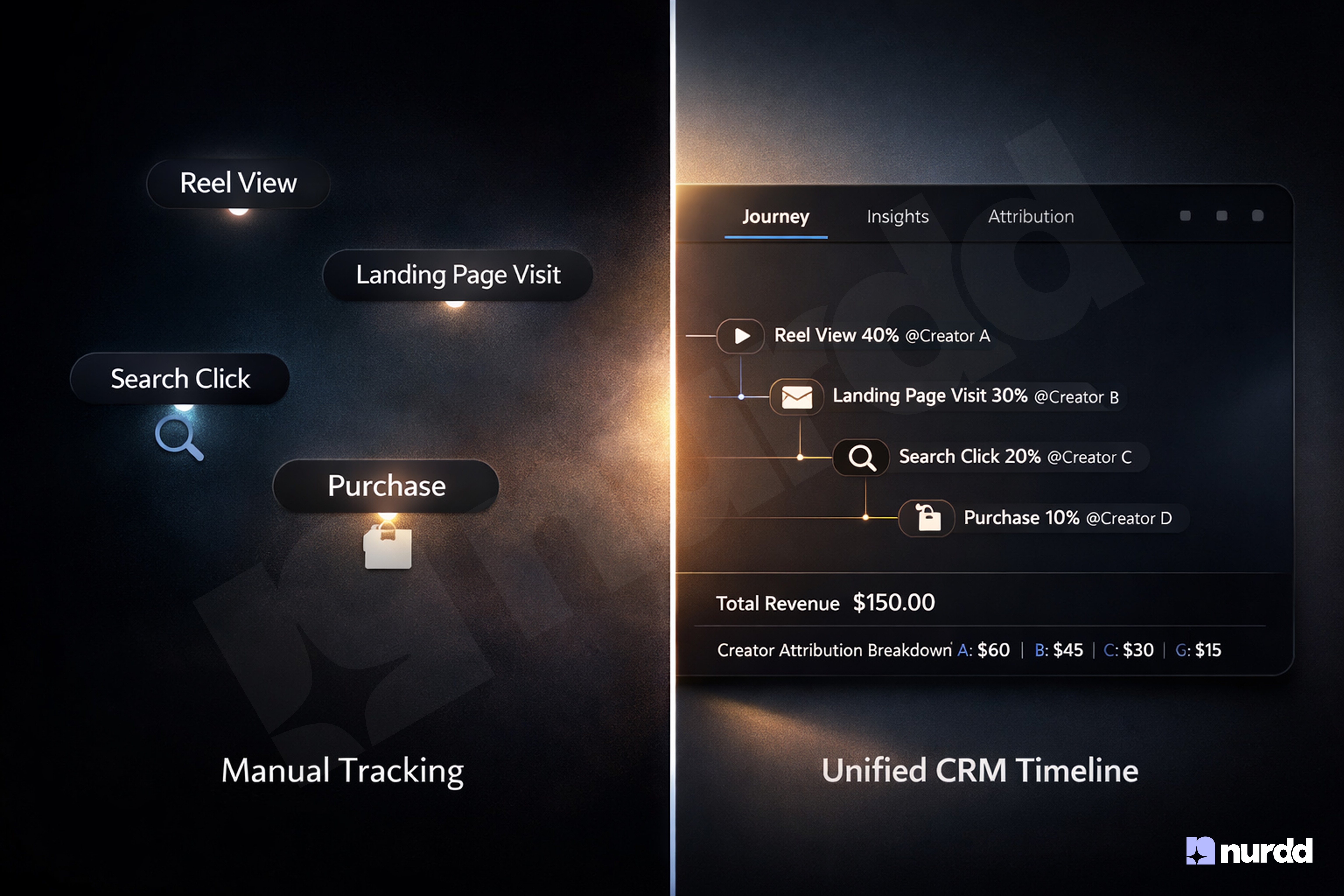
A D2C consumer discovers your brand through a nano-influencer's Reel on Monday. She visits your website via SEO on Wednesday. She adds to cart after clicking a Google ad on Friday and completes the purchase on Saturday. Your attribution dashboard gives 100% of the credit to Google.
A B2B procurement manager reads a LinkedIn article by a doctor-turned-Creator-Preneur on the first of the month. He downloads a compliance checklist from that creator's custom landing page on the fifth. His colleague fills out a demo request on the tenth. The deal closes sixty days later. Your influencer programme gets zero credit.
In both cases, the influencer created the first moment of genuine consideration and is invisible in the data because the data systems are not connected. Attribution parity - measuring influencer campaigns with the same accuracy and accountability as paid search, paid social, or any other performance channel is the standard the industry is converging on. And CRM integration is the infrastructure that makes attribution parity operationally possible.
Creator Commerce: Why This Shift Is Happening Now
Creator Commerce - Impact.com's term for the shift from paying creators for potential reach to paying them for verified results is what CRM integration makes operationally possible. During Cyber Week 2025, influencer-driven spend jumped 51% while commission costs stayed flat. That efficiency gain is not accidental. It is the output of systems that can verify, at the creator level, which sale a given post actually drove.
Brands with CRM-integrated attribution see 22% higher forecasting accuracy and 27% less wasted ad spend. Companies with data-driven attribution achieve 1.7x faster revenue growth and scale winning campaigns 2.1x faster. The gap between these outcomes and the outcomes of brands still managing influencer data in a spreadsheet is not a measurement gap. It is a system gap and the system that closes it is the API integration between creator platform and CRM.
The Closed-Loop Architecture: Five Steps
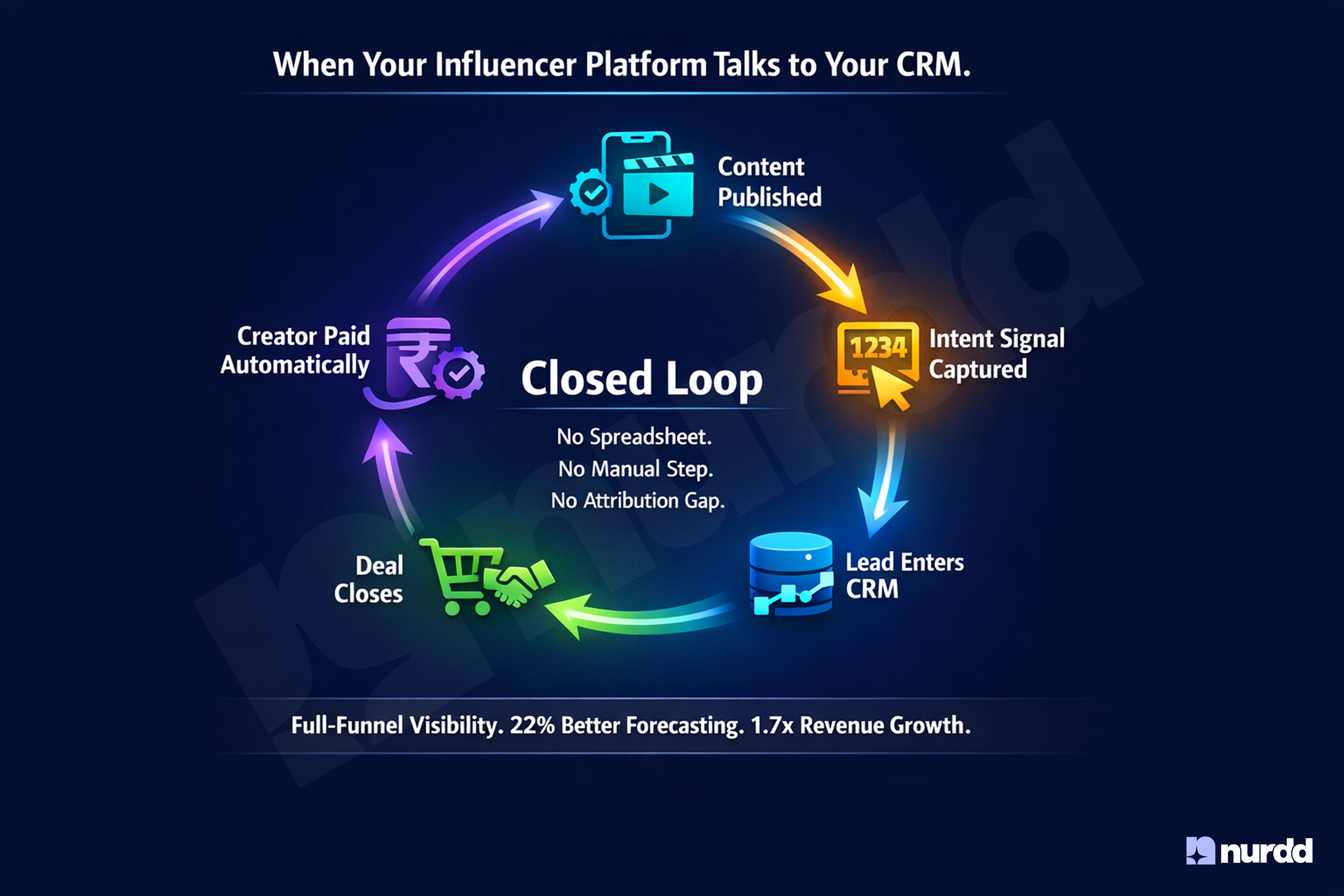
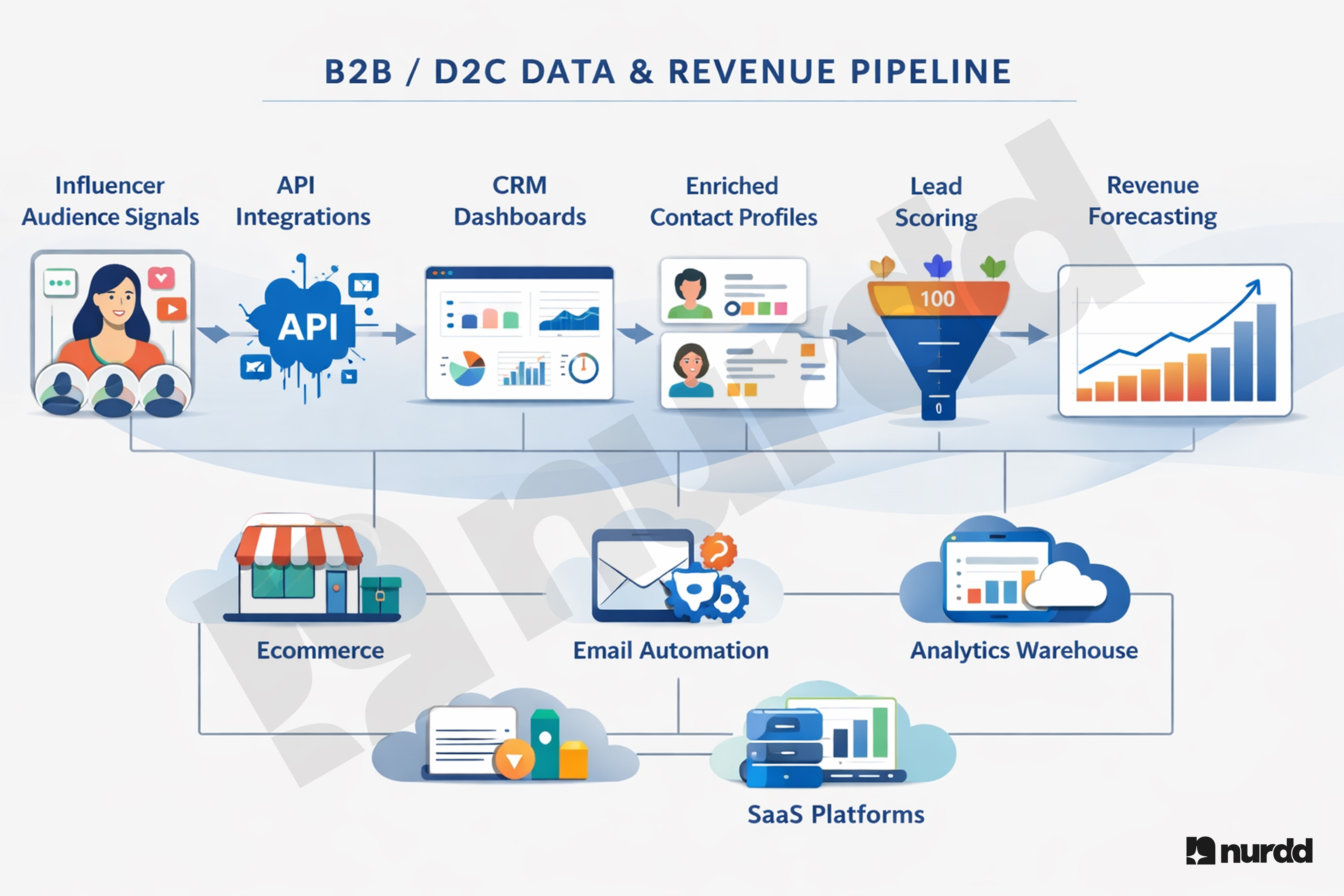
A closed-loop influencer system is an integration architecture in which every signal generated by an influencer - content views, link clicks, landing page submissions, promo code uses, and purchases flows automatically into the brand's CRM, where it is matched to a contact record, assigned to a deal stage, and attributed to the creator who generated it. The loop closes when the CRM sends a signal back to the influencer platform confirming a qualified lead, a deal stage progression, or a completed sale and triggering the corresponding automated payout.
Step 1: Tag Every Creator Link with a Unique API Identifier
The influencer publishes a product demo, a series episode, or a thought leadership post. Every link and code in that content is API-tagged with a unique creator identifier.
Step 2: Capture Intent Signals via API to Your CRM
The user clicks a trackable SecureCode or lands on the creator's custom landing page. The API pushes the click event, the session data, and any contact information directly into the CRM creating or updating a contact record in real time, with the creator's identifier attached.
Step 3: Track the Full CRM Journey with Multi-Touch Attribution
The CRM tracks the contact from the first influencer touchpoint through website sessions, email opens, retargeting ad clicks, and eventual conversion. Each touchpoint is logged against the contact record. Multi-touch attribution distributes fractional credit to every creator who contributed to the journey not just the last click.
Step 4: Send Outcome Signals Back to the Influencer Platform
When the contact reaches a defined CRM stage - Qualified Lead, Proposal Sent, Purchase Completed, the CRM sends an automated webhook back to the influencer platform, confirming the outcome.
Step 5: Trigger Automated Creator Payouts
The influencer platform receives the success signal and triggers the creator's payout. No manual invoice. No payment delay. No reconciliation spreadsheet. Partner-Led Growth in action.
The B2B Dark Funnel Problem: Why Influencer Attribution Fails Without a CRM
The most profound consequence of non-integrated influencer data is invisible in real time and only apparent in retrospect. B2B buyers complete 70–80% of their purchasing journey before they ever speak to a sales rep and in that invisible phase, creator content is doing its most important work.
HubSpot's Breeze Intelligence uses reverse-IP lookup to identify anonymous visitors and match them to company accounts, meaning that when a procurement manager reads a Creator-Preneur's article and visits the brand's website without filling out any form, the visit can still be connected to the originating creator content. Roughly 90% of B2B marketers either ignore anonymous visitor behaviour entirely or fail to unify it across systems, leaving the majority of creator-driven dark funnel influence unattributed and therefore unfunded in the next planning cycle.
When a lead fills out a form on an influencer's custom landing page requesting a demo, downloading a compliance guide, signing up for a webinar, the API pushes that lead directly into the CRM with the creator's identifier attached. The sales team opens the contact record and sees the full journey: which articles the lead read, which episodes they watched, which landing pages they visited, and how long they spent on each. By the time the sales call happens, the lead has been warmed for weeks. And the creator who built that warmth is credited with the deal assist that actually reflects.
Audience Enrichment: How to Match Creator Audiences Against Your CRM Before Spending
One of the least-discussed but most strategically valuable capabilities of CRM-influencer integration is audience enrichment, the ability to cross-reference an influencer's follower audience against the brand's existing CRM database before the campaign begins.
Platform APIs can match a creator's follower list against a brand's CRM contact database using privacy-compliant hashed identity matching. The output: a specific percentage, how many of this creator's followers are already existing customers. That single number transforms the creator selection decision entirely.
If Creator A has 80,000 followers with 12% overlap with the existing customer database, they are a retention and upsell partner. Brief them around loyalty, product expansion, and re-engagement, not new acquisition. If Creator B has 45,000 followers with 2% overlap, they are a pure acquisition partner. Brief them around first-time purchase incentives, cold-audience hooks, and onboarding. Two different briefs. Two different measurement frameworks. Two completely different definitions of a successful campaign, all determined by data that exists in the CRM before the first rupee is spent.
Data Hygiene: The Single Source of Truth
One of the most significant but least glamorous benefits of API integration is what it does to data quality, the principle the industry calls the Single Source of Truth.
In a non-integrated environment, creator data exists simultaneously in the influencer platform, the marketing team's spreadsheet, the finance team's payment records, and the CRM's manually entered contact notes. Each version has slightly different information, updated at different times, by different people with different field definitions. The result is shadow data: contradictory records that make campaign analysis unreliable and financial reconciliation painful.
Only 16% of RevOps professionals report trusting the accuracy of their CRM data. API integration fixes this structurally: if the data is not in the CRM, it did not happen. Every creator interaction, every lead generated, every payment triggered, and every content asset delivered is logged automatically. The human error layer is removed from data entry. The result is a dataset that is not just more accurate, it is structurally more trustworthy. 78% of sales leaders say their CRM improves sales-marketing alignment when used as a unified platform and for influencer marketing teams whose work has historically been invisible to the sales function, CRM integration is the infrastructure.
SUGGESTED FAQ CONTENT (add as H3 questions + paragraph answers):
Q1: What is influencer marketing CRM integration?
A: Influencer marketing CRM integration connects your creator campaign data - outreach status, content deliverables, performance metrics with your brand's CRM system. This allows marketing and sales teams to track influencer ROI alongside other revenue channels in one place.
Q2: Why do D2C brands need to integrate influencer marketing with their CRM?
A: Without CRM integration, influencer campaigns live in spreadsheets disconnected from revenue data. Integrating them lets brands see which creators drive actual purchases, not just traffic - closing the attribution loop between marketing spend and bottom-line results.
Q3: Which CRMs are compatible with influencer marketing platforms?
A: Most modern influencer platforms can integrate with HubSpot, Salesforce, Zoho, and Leadsquared via API or Zapier/Make automations. Native integrations vary by platform. Nurdd supports direct creator data sync for brands managing influencer pipelines at scale.
Q4: How does influencer CRM integration help with attribution?
A: When a creator's campaign data is linked to your CRM, you can track which influencer touchpoint appeared in a customer's journey before purchase. Combined with UTM tracking and cookieless attribution methods, this lets brands assign revenue credit to specific creators.
Q5: Can small D2C brands benefit from influencer CRM integration?
A: Absolutely. Even brands running 10-20 creator campaigns per month benefit from CRM integration because it replaces manual tracking in spreadsheets. Platforms like Nurdd are designed for growing D2C brands that need creator attribution without an enterprise-level tech stack.
The India Compliance Layer: Phyllo and DPDP
For Indian brands building creator programme infrastructure, there is a third consideration beyond attribution and efficiency: compliance with India's Digital Personal Data Protection (DPDP) Act, 2023, whose operational requirements are now being phased in through 2027.
India's DPDP Rules, published November 2025, require explicit, specific, and freely given consent for every category of personal data collected including the contact information, behavioural signals, and purchase history that CRM-integrated influencer platforms collect from creator campaign traffic. Pre-checked consent boxes, bundled consents, and implied consent all violate DPDP standards. Every brand collecting Indian consumer data through influencer campaign landing pages must implement verifiable consent workflows compliant with these requirements.
Phyllo - a Bengaluru-founded API infrastructure company that has raised USD 17.8 million and processed over 330 million API calls, provides the consent-based creator data layer that makes this possible. Phyllo is the universal API for social data intelligence: a unified API pipeline offering secure, authenticated connections to 20+ social media and creator platforms. It provides APIs for influencer marketing, creator tools, creator fintech, and social KYC enabling brands to verify the identity and skills of creators and access deep insights into their fan following and engagement metrics, with the creator's explicit, logged consent attached to every data access event.
For Indian brands connecting influencer data to their CRM under DPDP obligations, Phyllo's consent-based architecture is not just operationally efficient. It is structurally aligned with a regulatory framework that will impose penalties up to ₹250 crore per violation for non-compliant data handling. The companies building compliant creator data infrastructure today are not just solving a current technical problem. They are building the trust infrastructure that will determine their operating licence in India's digital economy through the next decade.
What is the best influencer marketing CRM integration?
Stack | Platforms | What It Does | Best For |
|---|---|---|---|
D2C Stack | GRIN + Shopify + Klaviyo | GRIN's native Shopify integration ties every creator's affiliate link and promo code to a real-time product sale. The Klaviyo connection triggers a branded post-purchase "thank you" email from the creator's identity to every customer who purchased through their link extending the creator-brand relationship beyond the transaction. | D2C brands building creator ambassador programmes with direct e-commerce attribution |
B2B Stack | Impact.com + Salesforce / HubSpot | Impact.com's partner API lets B2B brands treat Creator-Preneurs as channel partners with custom landing pages, lead submission workflows, deal stage tracking, and commission structures that activate when a partner-attributed lead hits a defined CRM milestone. HubSpot's Custom Object Sync mirrors Salesforce Campaign data directly within HubSpot, enabling unified attribution across both CRMs without custom development. | B2B and high-ticket D2C brands running Partner-Led Growth programmes with Creator-Preneurs |
Enterprise Stack | CreatorIQ + Snowflake / Salesforce / BigQuery | CreatorIQ's ExchangeIQ API pulls creator performance data directly into Snowflake or BigQuery for custom attribution modelling alongside all other marketing and sales data. GA4's Data Manager integrates natively with HubSpot, Salesforce, BigQuery, and Shopify creating a single attribution environment where influencer data, ad spend, organic traffic, and deal pipeline feed one analytical model. | Enterprise brands needing board-level visibility and data warehouse integration across all channels |
The Zero-Party Data Dividend
The final compounding advantage of CRM-integrated influencer infrastructure is the one that becomes more valuable every year: the collection and ownership of zero-party data from creator campaigns.
Zero-party data is information a consumer intentionally shares with a brand, their email address in exchange for a creator's exclusive discount, their product preferences on a creator's custom quiz, their dietary needs on a landing page linked from a vernacular creator's Reel. When this data flows through an API into the CRM rather than sitting in a spreadsheet, it becomes a permanent, owned asset, a growing first-party database of high-intent prospects who self-identified through creator content.
Third-party cookie instability - Google’s ongoing Privacy Sandbox changes continue to affect 78% of attribution setups make zero-party data increasingly valuable. Under India's DPDP framework, this data collected with explicit, specific consent is the only category that carries zero compliance risk for future marketing use. The brands building CRM-integrated influencer programmes today are not just solving a measurement problem. They are building the first-party data infrastructure that will determine their marketing effectiveness and their regulatory compliance in every year that follows.
The loop is closed. The system is connected. The data is clean, owned, compliant, and compounding.
Sources
Whitehat SEO — Marketing Attribution in 2026: B2B, HubSpot-Salesforce, and the Dark Funnel (Feb 2026): whitehat-seo.co.uk
Marketing LTB — Marketing Attribution Statistics 2025: 99+ Stats (Nov 2025): marketingltb.com
HubSpot — 2026 State of Marketing: Data from 1,500+ Global Marketers: blog.hubspot.com
HubLead — Essential HubSpot Statistics 2026 (Feb 2026): hublead.io
Phyllo — Universal API for Social Data Intelligence: getphyllo.com
Phyllo — G2 Reviews 2026: g2.com
SecurePrivacy — India DPDP Act Phase 1: Complete Compliance Guide 2026: secureprivacy.ai
Deloitte India — India's DPDP Rules 2025: Leading Digital Privacy Compliance: deloitte.com
RevBlack — How to Use HubSpot and Salesforce Campaigns Together in 2026: revblack.com
Impact.com — Influencer Marketing Trends 2026: Performance Insights (Jan 2026): impact.com
Heeet — 15 Best Multi-Touch Attribution Platforms 2026 (Sep 2025): heeet.io