How to Set Up a Full-Funnel Google Ads Strategy for a D2C Brand Under Rs 5 Lakh Per Month
 19 Apr 20268 min read
For a D2C brand spending under Rs 5 lakh monthly, run Brand Search, Standard Shopping, tightly matched non-brand Search, and remarketing with the article’s recommended allocations. Use exact and phrase match, build negative keywords, review search terms weekly, and track ROAS, new-customer acquisition cost, and brand impression share.
Most Google Ads advice assumes unlimited budgets. Scale your bids. Expand your audiences. Run YouTube, Display, Search, and Shopping simultaneously. For a D2C brand with Rs 5 lakh per month, this advice will drain your budget in three weeks with nothing to show for it. This is the full-funnel Google Ads strategy built for Indian D2C brands with real budget constraints.
The Budget Allocation That Works at This Scale
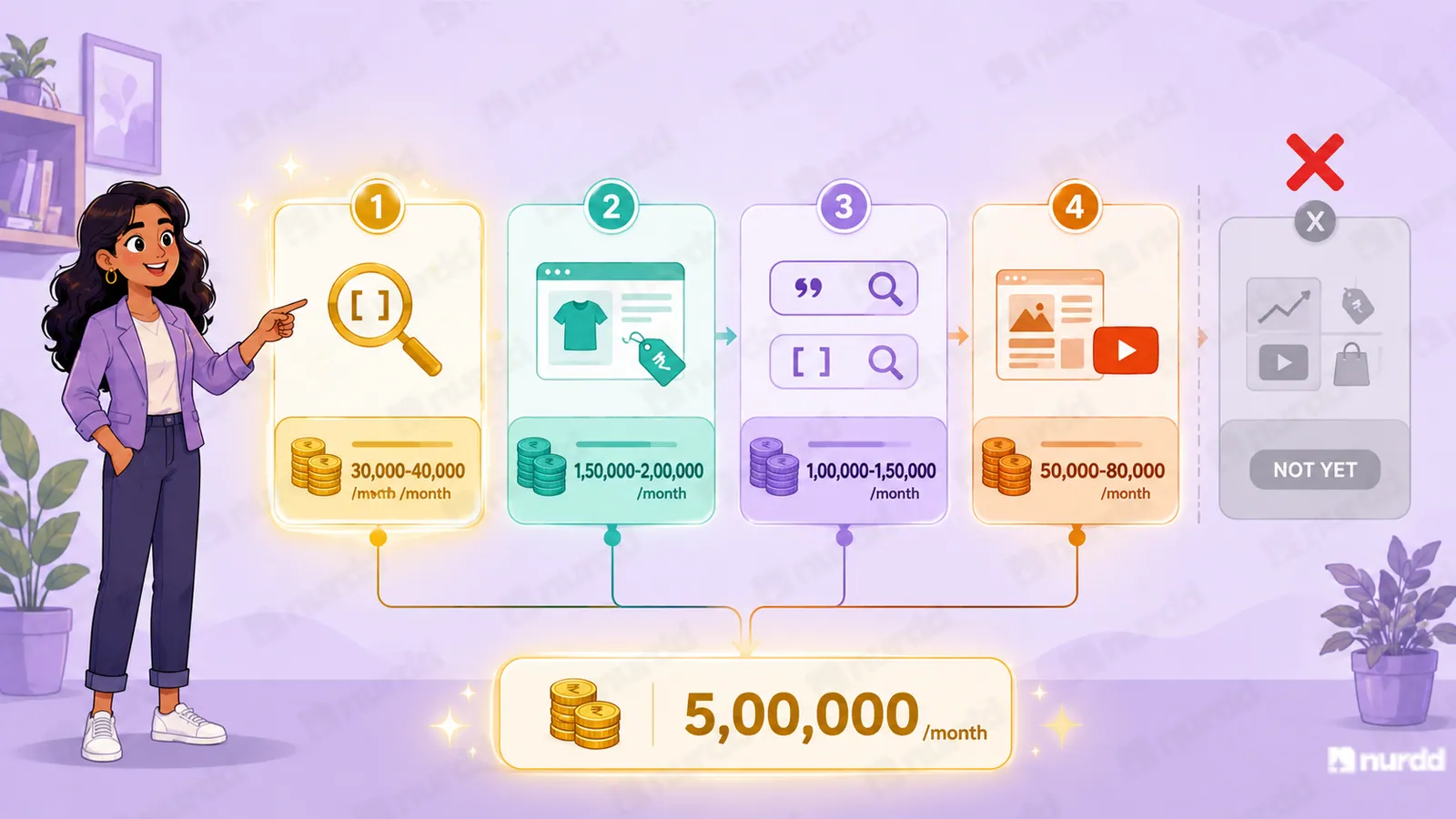
At Rs 5 lakh per month, you cannot run everything. You need to sequence your funnel investment based on where the money works hardest first.
Start with Brand Search: Allocate Rs 30,000 to 40,000 per month to branded keyword campaigns searches for your brand name and product names. These are the highest-intent searches in existence, conversion rates are highest, and the cost per click is lowest. If you are not protecting your brand terms, your competitors might be running ads against them.
Shopping Campaigns second: Allocate Rs 1,50,000 to 2,00,000 per month. Shopping campaigns show your product image, price, and brand name directly in search results. They capture high-intent commercial queries ‘buy whey protein India,’ ‘sunscreen SPF 50 under Rs 500’ at the moment of purchase intent.
Non-brand Search third: Allocate Rs 1,00,000 to 1,50,000 per month to non-brand exact match and phrase match keywords. Not broad match. At this budget level, broad match will burn your money on irrelevant searches before the algorithm learns.
Remarketing last: Allocate Rs 50,000 to 80,000 per month to Google Display Network remarketing and YouTube skippable ads to website visitors. This is a retention and conversion amplification layer, not a new customer acquisition channel.
The Campaign Structure
Four campaigns. Not more. Brand Search (exact match only). Shopping (Standard Shopping, not Performance Max at this budget level). Non-Brand Search (exact and phrase match, tightly themed ad groups by product category). Remarketing (Display + YouTube for website visitors in the last 30 days).
Why not Performance Max? PMax requires significant conversion data to learn effectively and gives you almost no visibility into what it is doing with your money while it learns. At Rs 5 lakh per month, you need accountability. Standard Shopping and manual Search campaigns give you that.
Revisit PMax when your monthly purchase conversion volume exceeds 80 events per month, consistently, across two months. That is when PMax has enough signal to learn efficiently.
Keyword Strategy at This Budget Level
Use modified phrase match for non-brand search. Do not use broad match until your daily budget per campaign exceeds Rs 3,000. The algorithm needs room to explore, and at constrained budgets, broad match exploration comes at the expense of efficiency.
Build a negative keyword list before you launch. Include: all competitor brand names, informational intent phrases (‘how to,’ ‘what is,’ ‘difference between’), international variants of your product that are not available in India, and any product categories adjacent to yours that you do not carry.
Review your search term report every Monday morning. In the first month, you will find several irrelevant match types that are costing you. The earlier you build your negative keyword list, the more efficient your spend becomes.
Measuring What Matters
At Rs 5 lakh per month, the only metrics that matter: ROAS by campaign type, Cost per new customer acquisition (not just cost per conversion repeat purchasers skew this number), and Brand search impression share (are you winning your own brand terms?).
Do not optimise for click-through rate or impressions at this stage. Every rupee needs to be traceable to a revenue outcome. Pulse shows you Google Ads performance at the campaign, ad group, and keyword level with ROAS and new vs returning customer breakdown without requiring a media buyer to interpret the data.
A small budget spent with discipline will always beat a large budget spent with assumptions. Start with four campaigns, earn the data, then scale.

Sources and References
Google Ads Help (2025) – Shopping Campaigns Setup Guide | support.google.com/google-ads
Think with Google India (2025) – D2C Brand Google Ads Benchmarks India | thinkwithgoogle.com/intl/en-in
Search Engine Land (2025) – Google Ads Strategy for Small Budgets | searchengineland.com

Your ads are spending. Are they actually performing?
Pulse connects to Google Ads and Meta Ads to explain performance in plain language, diagnose what changed, and recommend specific actions — no data analyst needed.