How to Appear in Google's AI Overview for Your Product Category
 9 Apr 20268 min read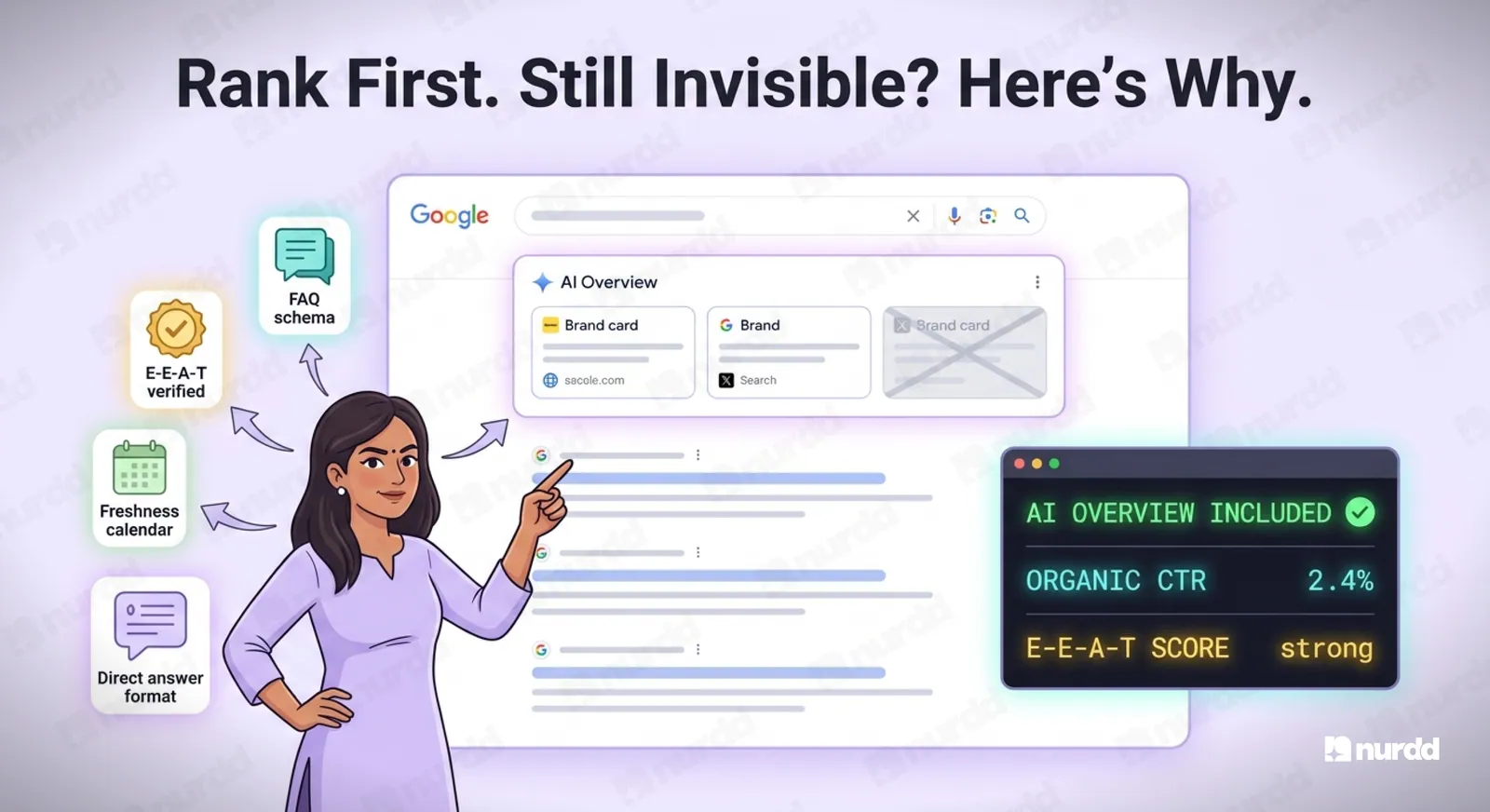
To appear in Google’s AI Overview for your category, create authoritative, experience-based product and comparison content that answers target queries directly, uses FAQ schema, and stays current. Build external citations and a clear brand entity, then monitor priority queries weekly and update content as competitors change.
Google's AI Overview began appearing for commercial queries in late 2023 and has expanded aggressively through 2024 and 2025. By early 2026, AI Overview is visible for an estimated 40 to 50 percent of queries with commercial intent, including direct product category searches like best protein powder for weight loss India or natural face wash for oily skin.
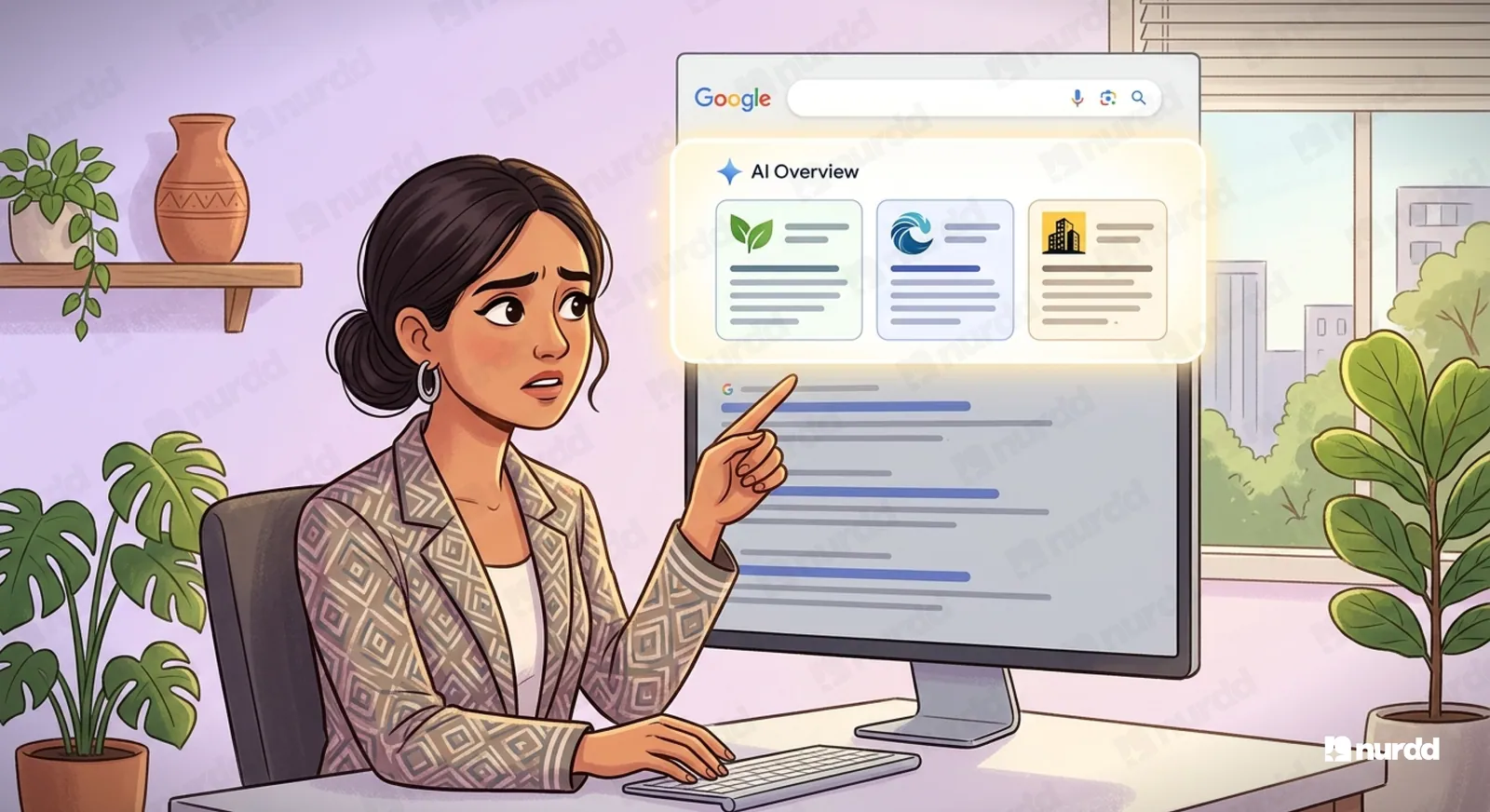
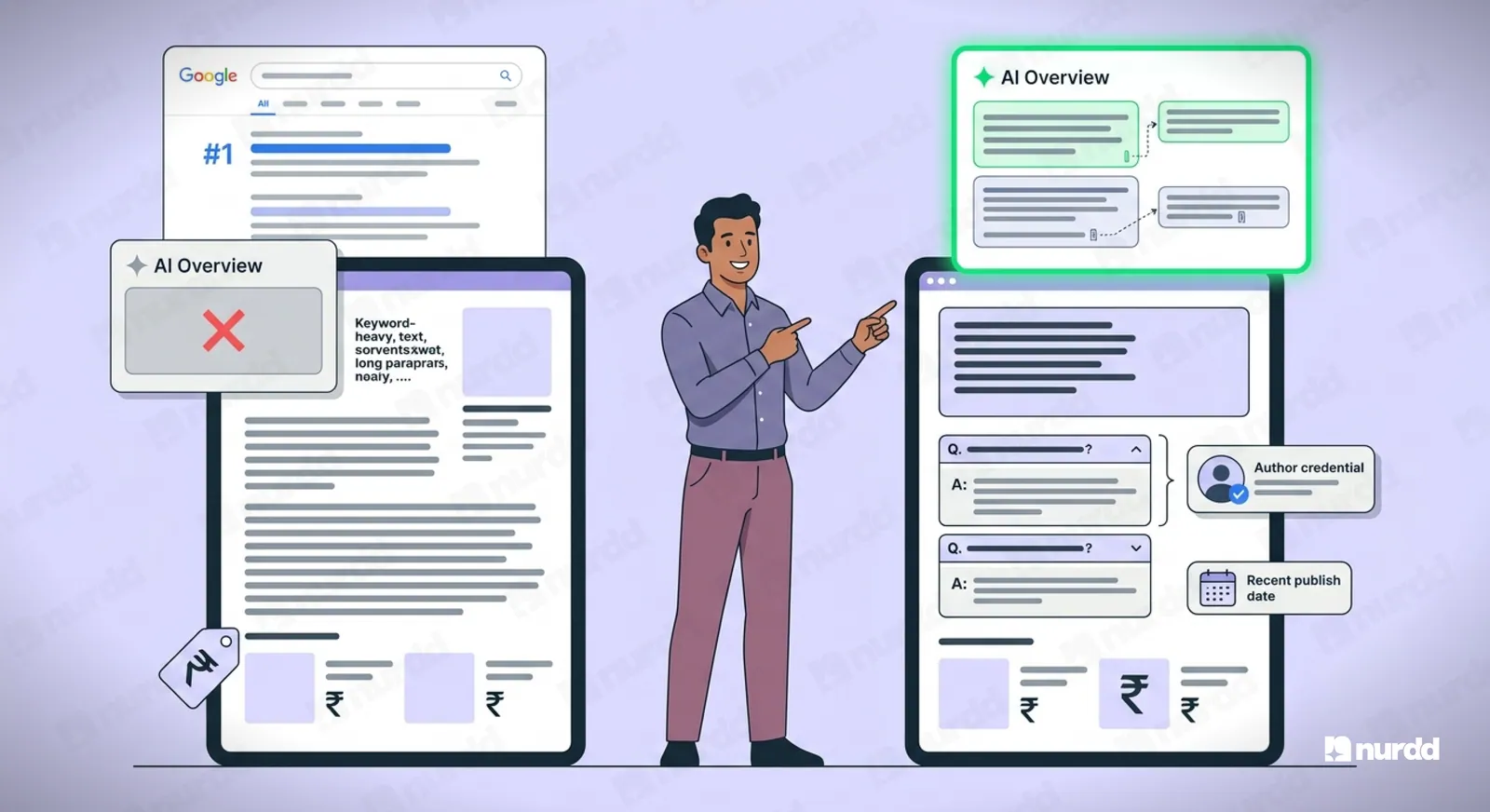
The problem for D2C brands: AI Overview does not pull content from whoever ranks number one. It synthesizes information from multiple sources and selects the brands and content it considers most authoritative and relevant to the query. You can rank in position one for a keyword and still be completely absent from the AI Overview above it.
This guide covers how AI Overview selects sources and what you need to do to be included.
How Google's AI Overview Decides What to Include
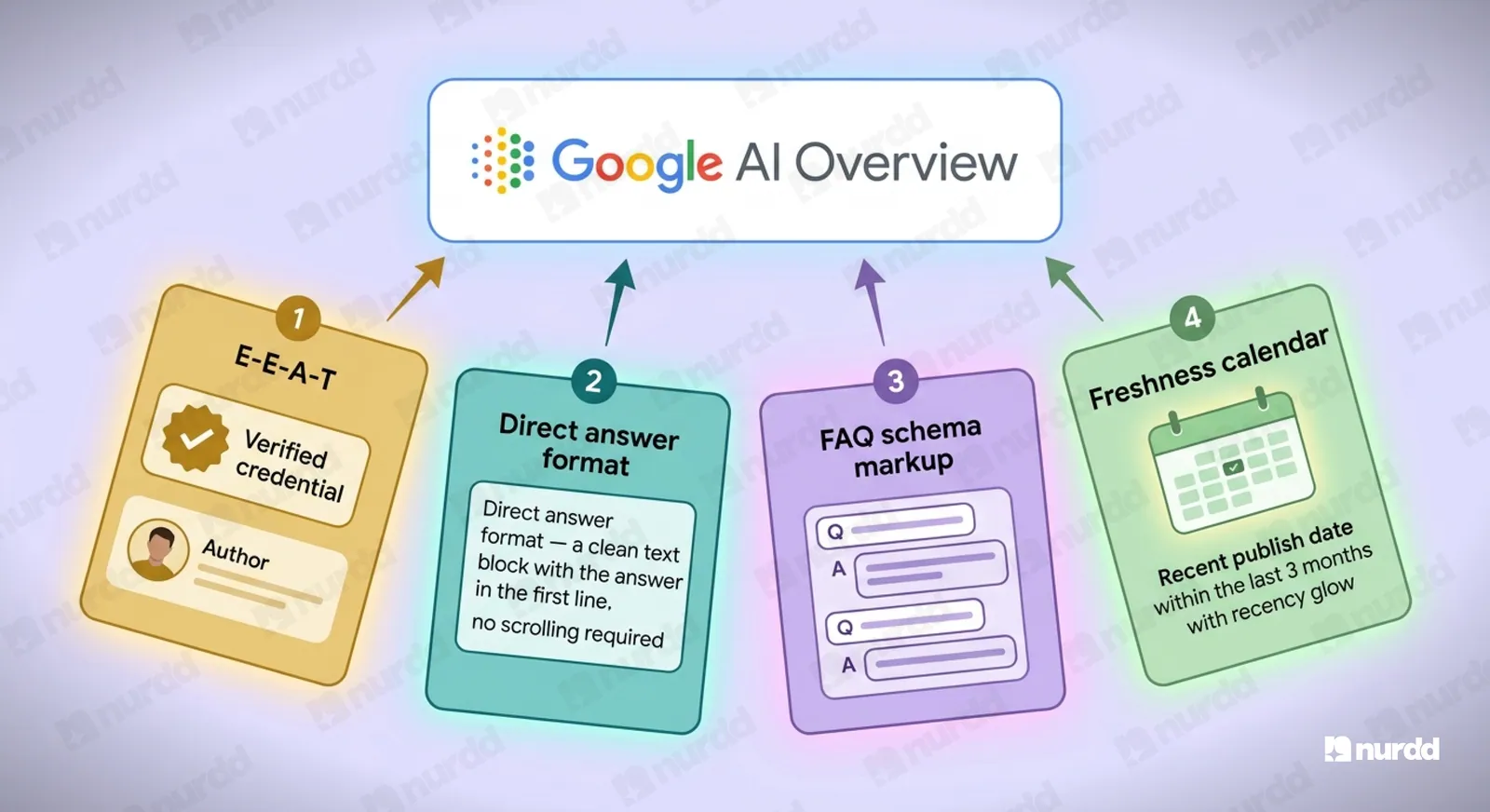
AI Overview uses Google's Gemini models to synthesize a direct answer to a query from across the web. Its source selection prioritizes:
E-E-A-T signals
Experience, Expertise, Authoritativeness, and Trustworthiness remain the dominant criteria for AI Overview source selection. For D2C product brands, this means:
• Product pages and blog content authored by identified experts with demonstrated credentials
• Content that demonstrates first-hand product experience, not generic category information
• Brand pages with clear About Us information, founder credentials, and external press mentions
• Content that has been cited or linked to by established health, nutrition, or lifestyle publications
Structured and direct answers
AI Overview favors content that directly answers the user's question without requiring interpretation. If a user asks what is the best protein powder for beginners in India, a page that has a dedicated section with a clear direct answer, rather than burying the answer inside a 3,000-word generic guide, will be selected more often.
FAQ and structured data
Pages with FAQ schema markup give Google explicit signal that the page contains question- and-answer format content. AI Overview draws heavily from FAQ schema when constructing its synthesized responses.
Freshness
AI Overview shows a strong recency preference for commercial queries. A page published or substantially updated within the last 3 to 6 months is significantly more likely to be included than an older page, even if the older page has more backlinks.
A Seven-Step Plan to Get Into AI Overview for Your Category
Step 1: Map the queries AI Overview is triggering for
Use Google Search Console. Filter for queries where your site appears in position 1 to 5. Search for those queries manually and check whether AI Overview is appearing. These are your priority targets.
Step 2: Audit your existing content for answer density
For each priority query, does your current page answer the question directly in the first 100 words? Does it have a summary section or a direct recommendation? If not, add one. AI Overview is looking for the answer, not the journey to the answer.
Step 3: Add FAQ schema to all product and category pages
For each product page, identify the top 5 questions your target customer asks about that product. Add them as FAQ markup directly in the page schema. Use real questions from your customer service tickets, from Google's People Also Ask, and from Reddit and Quora threads in your category.
Step 4: Publish authoritative comparison content
AI Overview frequently draws from comparison content when answering category queries. Create genuinely useful comparison pages: your product vs competitor A vs competitor B, honestly positioned. These pages attract AI Overview citations because they synthesize category information rather than just promoting one option.
Step 5: Build external citations
AI Overview trusts pages that other authoritative pages link to. For D2C brands, this means:
• Get featured in Hindi and English health, food, or lifestyle publication roundup articles
• Participate in comparison roundups on category review platforms
• Earn coverage in startup and business press that links to specific product pages, not just your homepage
Step 6: Ensure your brand entity is fully established
Google's Knowledge Graph is an input into AI Overview selection. If your brand does not have a clear entity presence, with consistent Name, Address, Phone (NAP) data, a Google Business Profile, and Wikipedia or Wiki data entries, AI Overview may not treat you as a named entity eligible for citation.
For D2C brands, at minimum: ensure your Google Business Profile is complete, your Crunchbase page exists, and your brand appears in at least one industry directory relevant to your category.
Step 7: Monitor and iterate weekly
AI Overview content changes frequently. A brand that is included this week may be excluded next week if a competitor publishes more direct answer content. Set up weekly tracking of your target queries and check AI Overview inclusion manually or via a monitoring tool.
What Not to Do
• Do not try to keyword-stuff your way into AI Overview. The algorithm is looking for quality, not density.
• Do not publish thin AI-generated content hoping it will rank. AI Overview's source selection actively down weights content that appears to be algorithmically generated without original insight.
• Do not ignore your product pages in favor of only publishing blog content. AI Overview frequently cites product pages directly for commercial queries.
AI Overview is the most significant shift in organic search visibility since featured snippets. Brands that build their content architecture around direct-answer formats, strong E-E-A-T signals, and FAQ schema will capture it. Brands that continue optimizing for traditional blue-link rankings will be invisible above the fold for an increasing share of commercial queries.
Sources and References
BrightEdge (2026) – AI Overviews Appear on 48% of All Tracked Search Queries | sqmagazine.co.uk
Seer Interactive (2026) – AI Overviews: 53-Brand Organic CTR Study | seerinteractive.com
Search Engine Journal (2026) – Google AI Overviews Surges Across 9 Industries | searchenginejournal.com
Semrush (2025) – AI Overview Prevalence Growth Report | semrush.com
Google Search Central (2025) – E-E-A-T and Quality Rater Guidelines | developers.google.com/search
Exposure Ninja (2026) – AI Search Statistics: AI Overviews for 18% of Commercial Queries | exposureninja.com

Is your brand showing up in AI search answers?
Noma tracks whether ChatGPT, Perplexity, Gemini, Claude, and Grok mention your brand when customers ask category questions — and shows you exactly how to improve your AI visibility.