Meta Advantage+ vs Manual Campaigns: The D2C Brand Decision Framework
 17 Apr 20268 min read
Choose Advantage+ when you have over 50 weekly purchases, diverse creative, and a broad category; choose manual campaigns for low volume, precise segmentation, new launches, or premium niches. A hybrid setup can use Advantage+ for prospecting and manual retargeting, with customer exclusions to protect warm-audience performance.
Meta gives you two ways to run ads. Advantage+ Shopping Campaigns, where the algorithm handles almost everything. And manual campaigns, where you control creative, audience, placement, and budget. Both have produced extraordinary results for D2C brands. Both have produced expensive disasters. The difference is knowing when to use which.

What Advantage+ Shopping Campaigns Actually Do
Advantage+ Shopping (ASC) is Meta's fully automated campaign type for product sales. You provide a product catalogue, a creative library, and a budget. The algorithm handles audience selection, placement, bidding, and creative combination.
Meta claims ASC delivers 17 percent lower cost per purchase on average compared to manual shopping campaigns. This claim is based on Meta's internal A/B tests and has been validated by several large-scale D2C advertisers globally.
What ASC actually does well: it finds buyers outside your defined audience, it automatically tests creative combinations at a scale no manual campaign manager can match, and it optimises bid strategy in real time across all Meta placements simultaneously.
Where ASC Fails Indian D2C Brands
ASC requires a large enough conversion history to learn effectively. Meta recommends a minimum of 50 purchase events per week for ASC to exit the learning phase. Many Indian D2C brands spending Rs 30,000 to Rs 1,00,000 per month do not generate this volume, and their ASC campaigns never learn properly.
ASC also removes creative control. If you are in a category where brand narrative matters premium skincare, luxury D2C, culturally specific fashion letting the algorithm choose which creative to show which audience can damage brand perception. The algorithm optimises for conversion, not for brand building.
ASC cannibalises retargeting. The algorithm's audience selection will inevitably include your warm audiences website visitors, past purchasers, email subscribers and it will not show you the breakdown. If your retargeting ROAS is much higher than your prospecting ROAS, ASC may be reporting inflated performance by over-indexing on warm audiences.
The Decision Framework
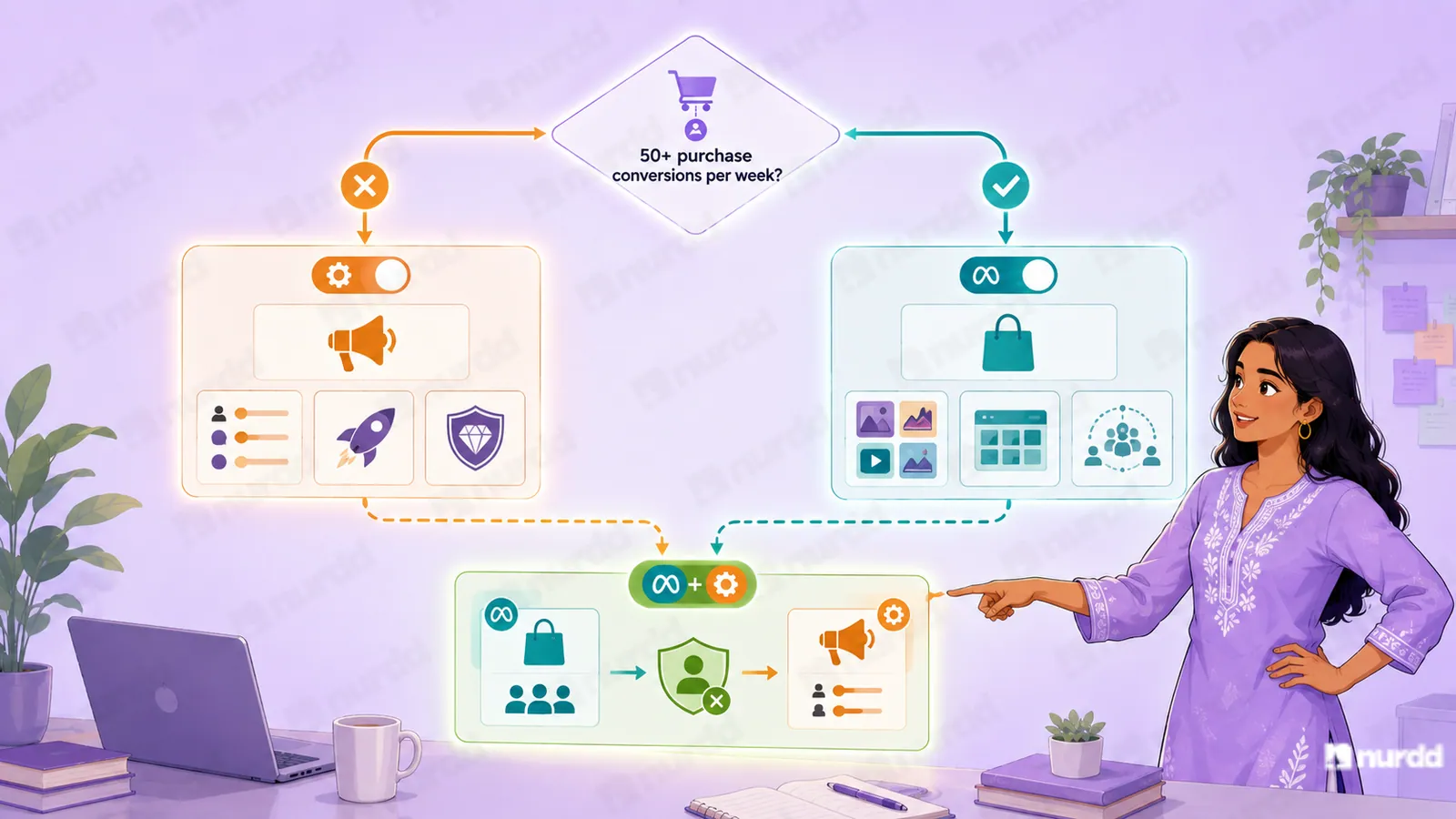
Use ASC when: You have more than 50 purchase conversions per week. Your creative library has at least 10 diverse creative assets. You are in a broad consumer category where audience targeting is less important than creative optimisation. You have a large product catalogue.
Use manual campaigns when: You are spending less than Rs 1,50,000 per month and conversion volume is low. You need precise audience segmentation excluding past purchasers, targeting specific demographics, suppressing competitor audiences. You are launching a new product where brand narrative control matters. You are in a premium or niche category where broad algorithmic targeting creates brand misalignment.
The hybrid structure: Run ASC for prospecting with a broad creative library. Run a separate manual campaign for retargeting with tailored creative for warm audiences. Use ASC's customer exclusion feature to prevent it from touching your retargeting audience. This gives you algorithmic scale for new customer acquisition and manual control for high-value warm audiences.
How to Read Advantage+ Performance Reports
ASC does not give you full transparency into audience or placement breakdown by default. Demand the following custom breakdowns: Age and gender breakdown, Placement breakdown (Facebook Feed vs Instagram Feed vs Reels vs Stories vs Audience Network), and New vs existing customer spend split.
The new vs existing customer split is the most important number in an ASC campaign. Meta will report this in the ASC-specific reporting columns. If more than 40 percent of your ASC spend is going to existing customers, the campaign is not doing its primary job of new customer acquisition.
Advantage+ is a power tool, not a shortcut. It does serious damage in the wrong hands and serious work in the right ones. Know which situation you are in before you hand over the keys.

Sources & References
· Meta Business (2025) – Advantage+ Shopping Campaigns: Performance Benchmarks | business.meta.com
· Social Media Examiner (2025) – Meta Advantage+ vs Manual: Real-World D2C Results | socialmediaexaminer.com
· Tinuiti (2025) – Advantage+ Shopping: When It Works and When It Doesn't | tinuiti.com/blog
· Pulse, Nurdd (2026) – Meta Advantage+ Performance Analysis: Indian D2C Brands | nurdd.club/blogs

Your ads are spending. Are they actually performing?
Pulse connects to Google Ads and Meta Ads to explain performance in plain language, diagnose what changed, and recommend specific actions — no data analyst needed.