When to Pause a Meta Campaign vs Let It Optimise: A Decision Framework for D2C Brands
 3 Apr 20267 min read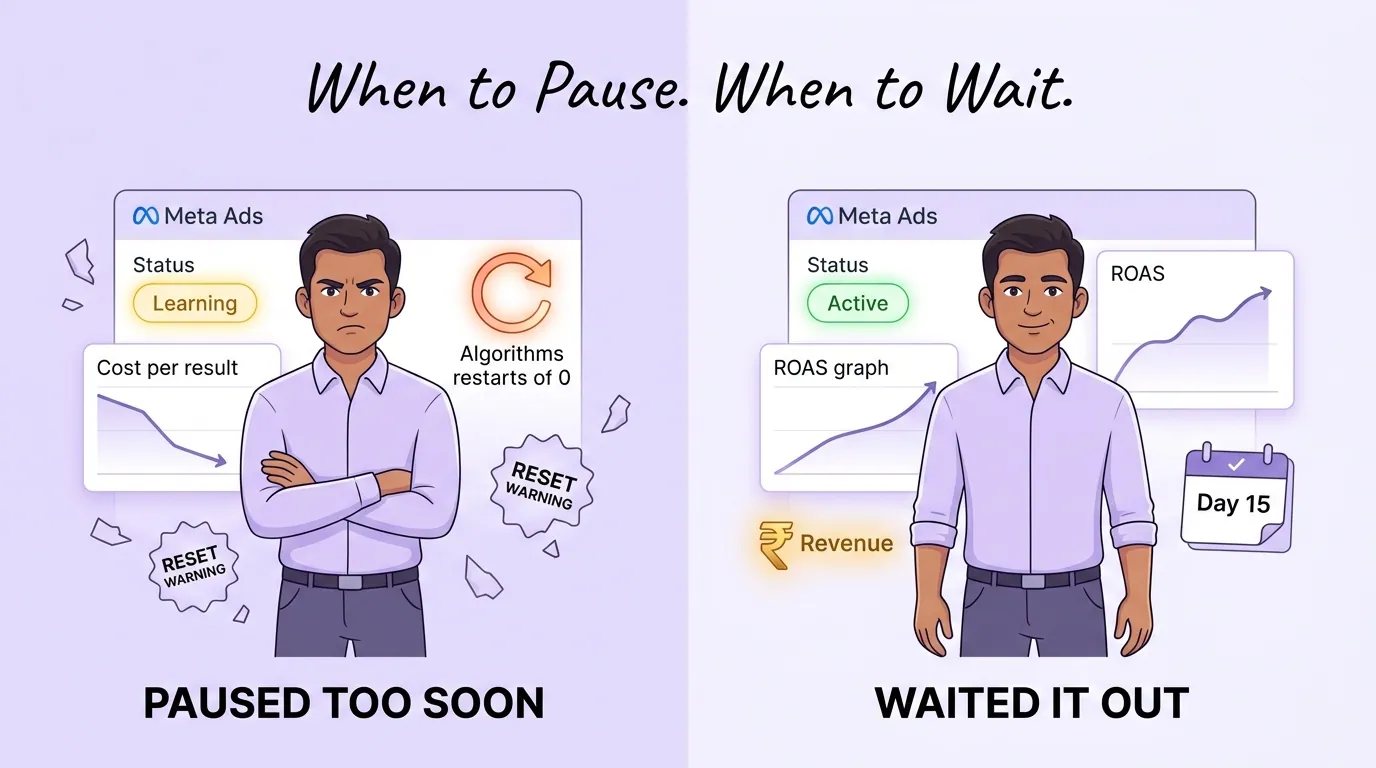
Let a Meta campaign optimise through its learning phase and first 7 days; evaluate trends from days 8–14 before making decisions. Pause for policy violations, site outages, urgent budget reallocation, or sustained poor performance after learning, such as cost per result at 3x target for 14 days or ROAS below 1 for 5 days.
The most expensive mistake in Meta advertising is not running bad campaigns. It is pausing good campaigns before they have had a chance to work.
The second most expensive mistake is keeping bad campaigns running in the hope that they will improve.
The difference between these two mistakes is the learning phase, understanding it, respecting it, and knowing when it has ended and a genuinely poor campaign is just a poor campaign.
Understanding Meta's Learning Phase
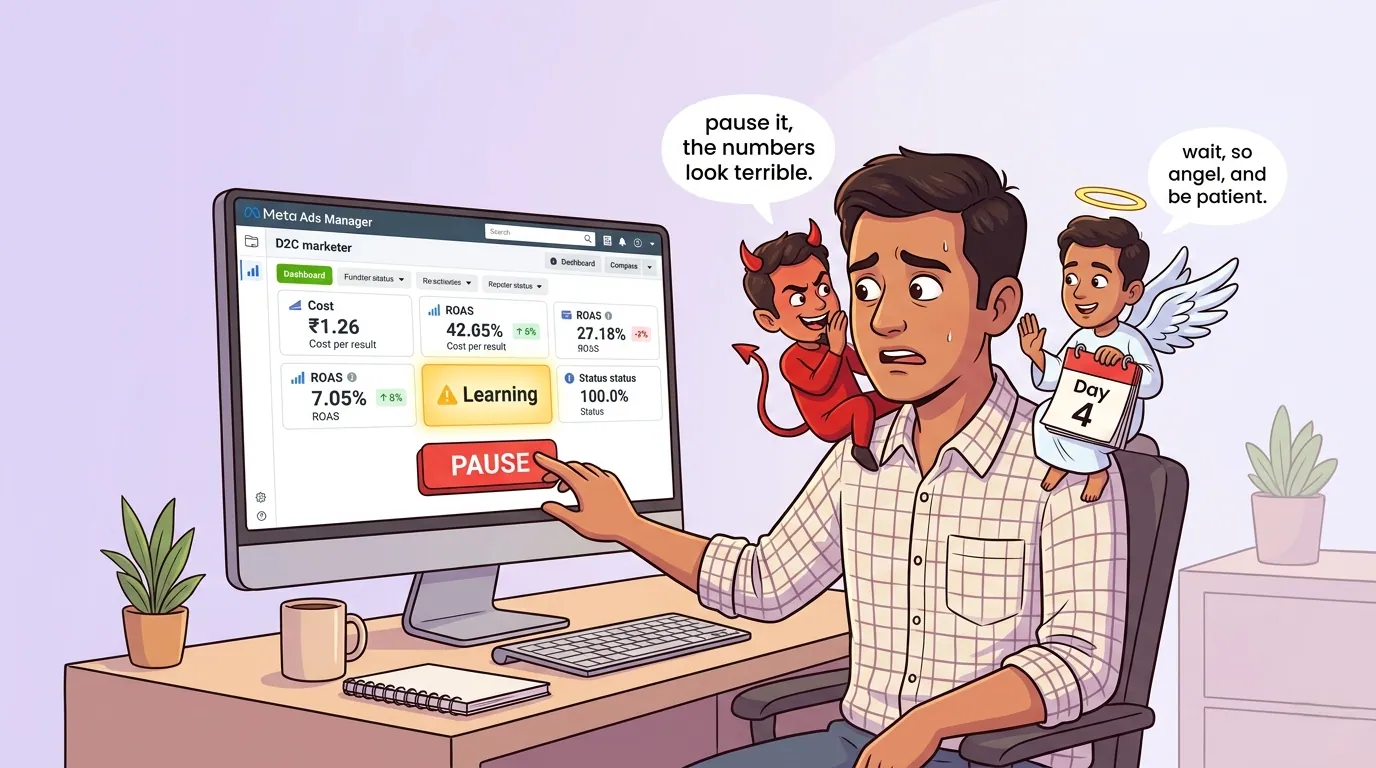
When you launch a new ad set, Meta's algorithm needs time to learn which users are most likely to take your desired action. During this period, delivery is less stable, costs are higher, and performance is erratic. This is the learning phase.
The learning phase typically requires 50 optimization events (conversions, for conversion campaigns) within a 7-day period. Until this threshold is reached, the algorithm is still exploring.
Cost per result will be higher than your eventual steady-state performance. This is normal. This is expected.
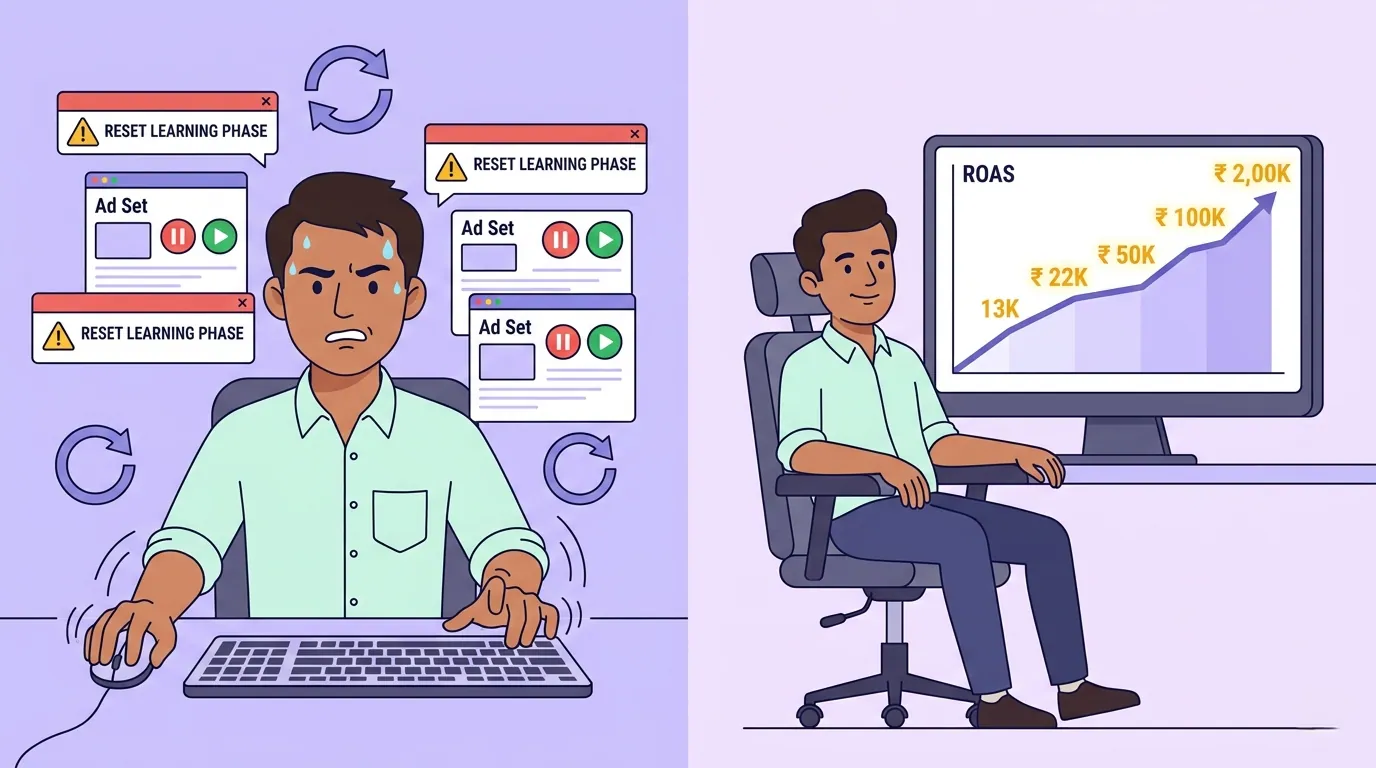
Most brands pause campaigns during the learning phase because the numbers look bad and the impulse to act feels responsible. It is not. Pausing during the learning phase resets the algorithm's learning. Your next attempt starts from zero again.
The Four Questions to Ask Before Pausing Any Campaign
Question 1: Is the ad set still in the learning phase?
Check the Delivery column in Ads Manager. If it reads Learning, do not pause. Wait until it reads Active or Learning Limited.
If it reads Learning Limited, this means Meta cannot reach 50 optimization events in 7 days. This is a signal that either your budget is too low, your audience is too narrow, or your bid cap is too restrictive. Address the root cause rather than pausing.
Question 2: How many days has this ad set been running?
Day 1 to Day 3: Do not evaluate performance. Ignore the numbers entirely.
Day 4 to Day 7: Look only at learning phase status and spend pacing. Do not make creative or audience decisions.
Day 8 to Day 14: Start evaluating cost per result trend. Is it decreasing, stable, or increasing?
Day 15 onwards: Make definitive performance decisions based on consistent data.
Question 3: What is the cost per result trend, not the absolute cost?
An ad set with a cost per result of INR 450 on Day 8 is not necessarily a bad ad set. An ad set with a cost per result of INR 450 on Day 8 that was INR 380 on Day 6 and INR 410 on Day 7 is showing upward trend. That is a signal to watch.
An ad set with a cost per result of INR 450 on Day 8 that was INR 520 on Day 5 and INR 480 on Day 6 is improving. Do not pause it.
Trend matters more than absolute number, especially in the first two weeks.
Question 4: Is the creative showing fatigue signals?
Creative fatigue is the primary cause of campaign degradation after a strong start.
Signs of creative fatigue:
• CTR declining week-over-week by more than 15 percent
• Frequency above 4 on cold audiences
• CPC increasing while audience size is unchanged
• CPM increasing without obvious market competition reason
Creative fatigue is fixed with new creatives, not with pausing the campaign. Introduce new ad mvariants into the ad set. If performance recovers with new creative, you have confirmed fatigue.
If performance continues to decline with fresh creative, you have an audience problem.
When to Pause: The Definitive Triggers
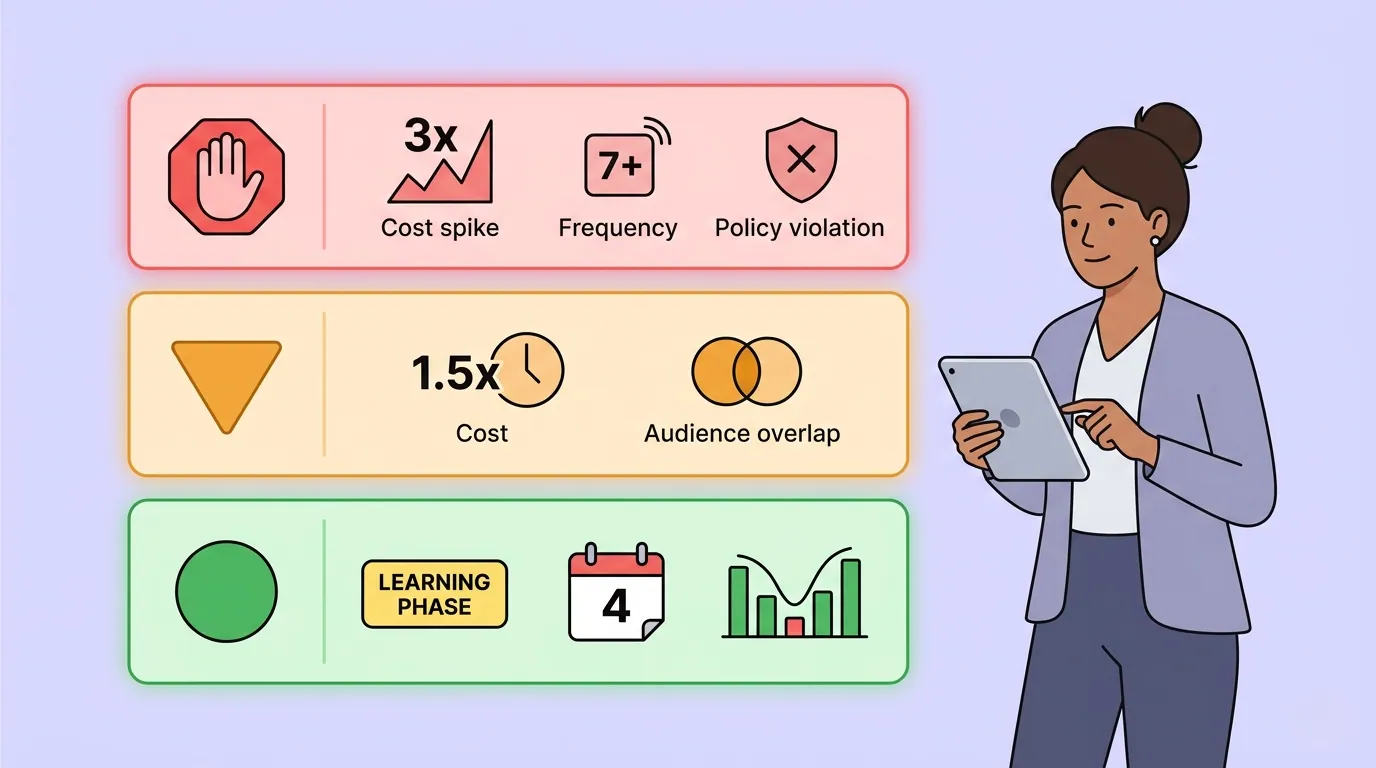
Pause immediately if:
• Your ad account receives a Policy Violation notice for the specific ad
• Cost per result is 3x your target and has not improved after 14 days of active status
• Frequency has exceeded 7 on a cold audience with no new creative available
• Your website or landing page is down
• You are running out of budget and need to reallocate urgently
Pause with a 7-day observation period if:
• Cost per result is 1.5x to 2x your target after 10 days of active status
• ROAS has been below 1.0 for 5 consecutive days after the learning phase
• Audience overlap with a better-performing ad set is above 50 percent
Do not pause, investigate instead if:
• You are in the learning phase
• You are in the first 7 days post-launch
• One bad day follows a string of good days (check for external factors: holiday, site outage, payment gateway issue)
• CPM has spiked during a known competitive period like Diwali, Eid, or Valentine's Day
The 48-Hour Rule for New Creative Testing
When you introduce new creative into an existing ad set, give it a minimum of 48 hours before comparing it to existing ads. Meta's algorithm takes time to allocate delivery to new creatives, especially when an existing creative has strong historical data in the same ad set.
If you pause a new creative after 24 hours because it has lower CTR than the established ad, you are comparing a fresh creative with no delivery history against a battle-tested one. The comparison is unfair.
The best Meta advertisers are the ones who make fewer decisions, not more. They set up correctly, let the algorithm learn, intervene only at clear trigger points, and resist the daily impulse to adjust something. Discipline in not touching campaigns is as valuable as skill in setting them up.
Sources and References
Meta Business Help Center (2025) – About the Learning Phase | facebook.com/business/help
Lebesgue (2025) – Facebook Ads Learning Phase | lebesgue.io
Modern Marketing Institute (2026) – How to Exit the Meta Ads Learning Phase Fast | modernmarketinginstitute.com
Jon Loomer Digital (2024) – Is the Learning Phase Changing? | jonloomer.com
Code3 (2025) – Understanding the Meta Learning Phase | code3.com
Best Ever AI (2025) – Facebook Learning Phase: 8 Tips to Exit Faster | bestever.ai

Find the right creators — and verify they're real.
Nia gives brands access to 10M+ Indian creator profiles, TruAI fake follower detection, pre-spend ROI forecasting, and product-level sales attribution. Completely free.