

When you are running Meta Ads, Google Ads, and Quick Commerce listings on Blinkit or Zepto simultaneously, each platform reports its own ROAS. These numbers cannot be added or averaged they use different attribution windows and may double-count some revenue. Blended ROAS cuts through all of this with one honest number.
The Formula

Blended ROAS: What Goes In and What Does Not
Blended ROAS = Total Business Revenue ÷ Total Marketing Spend (all paid channels combined).
Include | Do Not Include | |
|---|---|---|
Revenue (numerator) | Shopify revenue for the period · Quick Commerce GMV (net of returns) | Revenue from offline retail channels you did not pay to acquire · Wholesale revenue |
Spend (denominator) | Meta Ads spend · Google Ads spend · Quick Commerce listing/promotional fees · Any other paid acquisition channel | Organic content costs · Platform subscription fees (Pulse, Nia, Noma) · Salaries · Agency retainer for strategy (not media buying) |
A Worked Example
Blended ROAS Across Three Channels
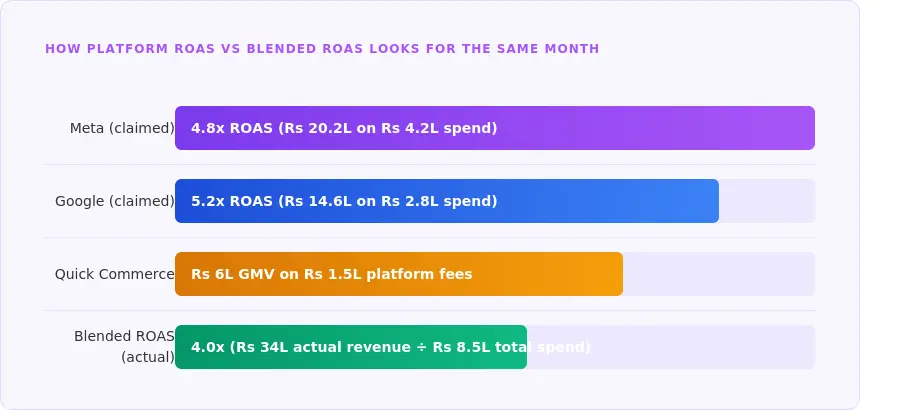
Meta and Google together claim Rs 34.8L in attributed revenue. Actual Shopify + QC revenue: Rs 34L. Platforms claim 102% of actual revenue already inflated before double-counting is factored in.
What Your Blended ROAS Should Be
The Profitable Blended ROAS Minimum
Minimum viable blended ROAS = 1 ÷ Contribution Margin %
At 40% contribution margin: minimum viable blended ROAS is 2.5x
At 50% contribution margin: minimum is 2.0x
At 60% contribution margin: minimum is 1.67x
Most profitable Indian D2C brands in beauty, health, and fashion operate at blended ROAS of 2.8 to 5.5x. Below 2.5x warrants immediate investigation. Above 6.0x may indicate under-investment in growth relative to available margin.

Quick Commerce: The Attribution Edge Case
How to Handle Blinkit and Zepto in Your Blended ROAS
Quick Commerce platforms (Blinkit, Zepto, Swiggy Instamart) present a specific attribution challenge: you pay listing fees and promotional placement fees, but the revenue appears in the platform's own reporting, not in Shopify. Your Shopify revenue figure is therefore understated relative to your total marketing spend.
Three approaches to handle this:
Separate blended ROAS calculation: Calculate Shopify-only blended ROAS and Quick Commerce blended ROAS independently. Compare each channel's efficiency on its own terms before building a combined view.
Include QC GMV in your numerator. Add Quick Commerce net revenue (GMV minus platform commission minus returns) to your Shopify revenue when calculating blended ROAS. This gives a true all-channel efficiency number. Use net revenue, not gross GMV, to avoid overstating the denominator.
Exclude QC from blended ROAS entirely if Quick Commerce is a distribution channel driven by in-app discoverability rather than paid ads. If you are not paying incremental fees to drive Quick Commerce sales (no Blinkit Ads, no placement fees), those revenues should not be in a paid marketing efficiency metric.
Pulse can ingest Quick Commerce GMV data manually and incorporate it into your weekly blended ROAS calculation alongside Meta and Google Ads data giving you one consistent efficiency number regardless of which mix of channels is driving revenue that week.
"Platform ROAS tells you what each channel wants you to believe. Blended ROAS tells you what your business actually earned per marketing rupee. These numbers are not the same."
Sources and References
Triple Whale – Blended ROAS: calculation and benchmarks resources
Northbeam – Multi-channel ROAS and attribution resources
Shopify Blog – Revenue attribution for multi-channel ecommerce brands
Nurdd / Pulse – Blended ROAS calculation resources for Indian D2C brands

Your ads are spending. Are they actually performing?
Pulse connects to Google Ads and Meta Ads to explain performance in plain language, diagnose what changed, and recommend specific actions — no data analyst needed.