What Is Share of Voice in AI Search and How Do You Actually Measure It?
 23 Aug 20266 min read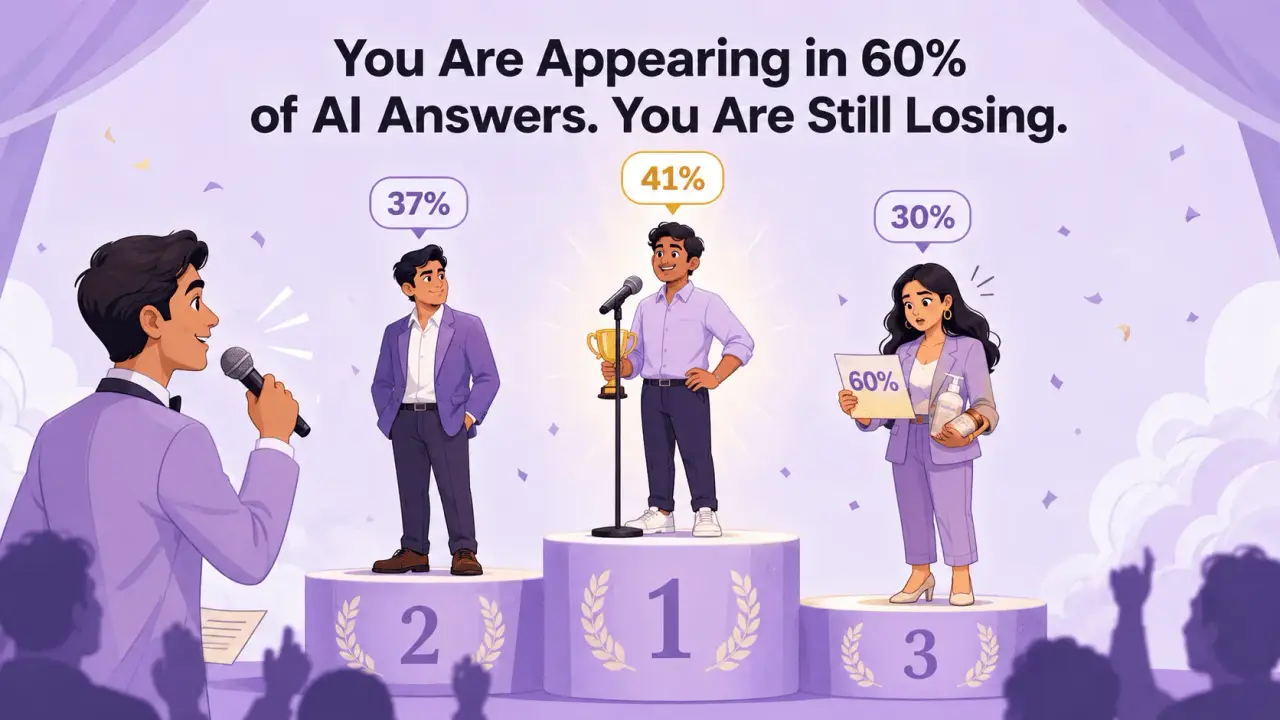
Share of Voice in AI search is the percentage of all brand citations in your category that go to your brand. Calculate it by dividing your citations by total citations across all competitors for the same query set, then multiplying by 100.
Share of Voice in AI search measures how often your brand appears — relative to competitors — when AI engines answer questions about your category. It is the metric that tells you whether you are winning the recommendation game, not just whether you are playing it.

Two Metrics, Two Different Answers
Citation Rate vs Share of Voice
Citation Rate (absolute): What percentage of my tracked queries do I appear in?
A brand appearing in 18 out of 30 queries has a citation rate of 60%. This tells you whether your content and media programme is working in absolute terms.
Share of Voice (relative): Of all brand citations in my category, what percentage go to me?
Formula: (your brand's citation count) ÷ (total citations across all competitors for the same query set) × 100.
A worked example: You track 30 queries across Perplexity and ChatGPT 60 query-engine combinations total.
Your brand: 18 citations
Competitor A: 22 citations
Competitor B: 12 citations
Total: 60 citations
Your Share of Voice: 30%
You are third in this category by AI Share of Voice. That is the competitive reality a citation rate alone cannot reveal.
When to Use Each
How to Apply oBth Metrics
Use citation rate to evaluate your programme in isolation. If your citation rate is rising month-on-month, your content and media investment is working.
Use Share of Voice to evaluate your competitive position. If your citation rate is flat at 55% but your Share of Voice is falling from 35% to 28%, competitors are improving faster than you are.
The most dangerous scenario: a rising citation rate with falling Share of Voice. It feels like progress. The competitive gap is widening.
Three Levers to Grow It
How to Improve Your AI Search Share of Voice
Lever 1: Content that answers your gap queries. If you appear in 18 out of 30 queries and your lead competitor appears in 22, those four gaps are your highest-priority content and media opportunities. Find the source type the AI is drawing from for your competitor and build to match or exceed it.
Lever 2: Editorial mentions in Tier 1 publications. A new feature in a major publication typically improves Share of Voice by 3 to 7 percentage points within 4 to 8 weeks. AI engines weight authoritative publication coverage heavily. One high-quality media placement often outperforms ten mid-tier mentions for AI visibility purposes.
Lever 3: Review volume and quality on high-authority platforms. Google Reviews and Amazon product page reviews with specific outcome language are cited by AI engines in product recommendation responses. This is the slowest lever — typically 3 to 6 months to show measurable Share of Voice improvement. But also the most durable.
A 90-Day Programme
Building Share of Voice Growth Systematically
Month 1: Run the competitor audit. Identify your top 5 query gaps. Update all entity descriptions across owned surfaces. Write and publish the first 2 content gap pieces.
Month 2: Reach out to 2 to 3 Tier 1 publications with editorial angles tied to your product's differentiator. Simultaneously build a review programme encouraging buyers to post specific outcome reviews on Google and Amazon.
Month 3 onwards: Weekly Noma report shows which query gaps are closing and which remain. Allocate content and outreach resources to remaining gaps in priority order. Brands that maintain this programme consistently for 6 months typically see Share of Voice improvements of 15 to 25 percentage points from their starting position.
Reading Week-to-Week Movements
What Share of Voice Shifts Actually Mean
Sudden drop of 8 to 15 percentage points in one week: Check competitor content publication dates and media coverage from the preceding 10 days. New competitor content or a major media placement is the most common cause.
Gradual erosion of 2 to 3 percentage points per month over three months: A structural content gap accumulating. A competitor is consistently publishing content you are not, or is accumulating review volume faster. Run the competitor audit from Blog 05.
Sudden spike of 10 or more percentage points: Identify the cause immediately — a media placement, a viral content piece, or a significant review accumulation event. Document it so you can understand which actions produce the fastest Share of Voice response for your brand and replicate them.
"Share of Voice in AI search tells you whether you are winning the recommendation game — not just whether you are playing it."

Sources & References
Noma, Nurdd – AI Search Share of Voice Calculation Methodology | nurdd.club
Share of Voice in AI Search: Methodology and Benchmarks| sparktoro.com
AI Search SOV Tracking: Enterprise Brand Repo| brightedge.com

Is your brand showing up in AI search answers?
Noma tracks whether ChatGPT, Perplexity, Gemini, Claude, and Grok mention your brand when customers ask category questions — and shows you exactly how to improve your AI visibility.