

Divide every cost of acquisition by new customers acquired, not just ad spend. The standard calculation ignores influencer fees, agency retainers, tooling, discounts and content production, which together add 30 to 80% for most Indian D2C brands and make CAC look far cheaper than it actually is.
CAC — Customer Acquisition Cost — is the single most important financial metric for a D2C brand because it determines whether your business model works at scale. Most Indian D2C brands calculate it incorrectly, in a way that makes it look significantly cheaper than it actually is.
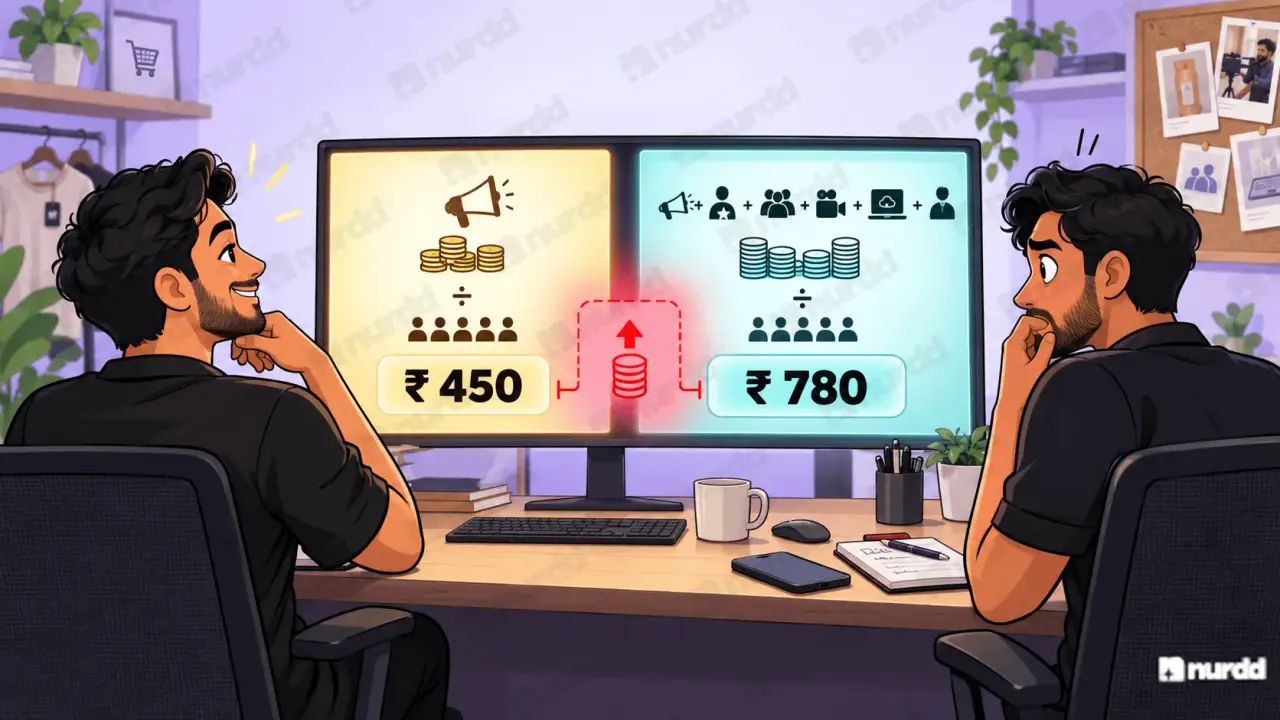
The Wrong Way Most Brands Calculate CAC
Two Problems With the Standard Calculation
Problem 1 — Incomplete costs: Total monthly ad spend ÷ total new customers. This ignores every other cost that contributed to acquiring those customers. For most D2C brands, these non-ad costs add 30 to 80% to the true cost of acquisition:
Influencer and creator fees
Product cost of gifted creator inventory
Agency fees for campaign management
Content creation costs for ad creative
Platform subscription fees for marketing tools
Prorated marketing headcount cost
A brand reporting Rs 450 CAC using ad-spend-only calculation may have a true CAC of Rs 700 to Rs 800. The difference between a business building toward profitability and one that is further from it than it appears.
Problem 2 — Wrong denominator: New customers in Shopify includes buyers from all channels — email, organic, referral, direct — not just paid acquisition channels. If 40% of your new customers came from organic or email channels that required no specific acquisition spend, dividing total marketing spend by this larger number understates your paid CAC.
The Correct Formula
True CAC: The Formula and Monthly Template
True CAC = Total marketing and sales costs for the period ÷ Total new customers acquired in the same period.
Cost Line | Where to Find It | Your Monthly Amount |
|---|---|---|
Meta Ads spend | Meta Ads Manager → Billing | Rs ___ |
Google Ads spend | Google Ads → Billing | Rs ___ |
Influencer and creator fees | Nia or payment records | Rs ___ |
Creator gifted product cost | COGS for gifted units | Rs ___ |
Agency fees | Agency invoice | Rs ___ |
Content production | Freelancer/studio invoices | Rs ___ |
Platform subscriptions | All marketing tool subscriptions | Rs ___ |
Marketing headcount (prorated) | Salary × % time on acquisition | Rs ___ |
Total Acquisition Costs | Sum of all above | Rs ___ |
New Customer Count | Shopify → Customers → New | ___ |
True CAC | Total Costs ÷ New Customers | Rs ___ |
Pull new customer count from Shopify Analytics, Customers, then New Customers, filtered to the same calendar period. The bottom row is your True CAC.
What Your CAC Should Be
The CAC-to-LTV Relationship
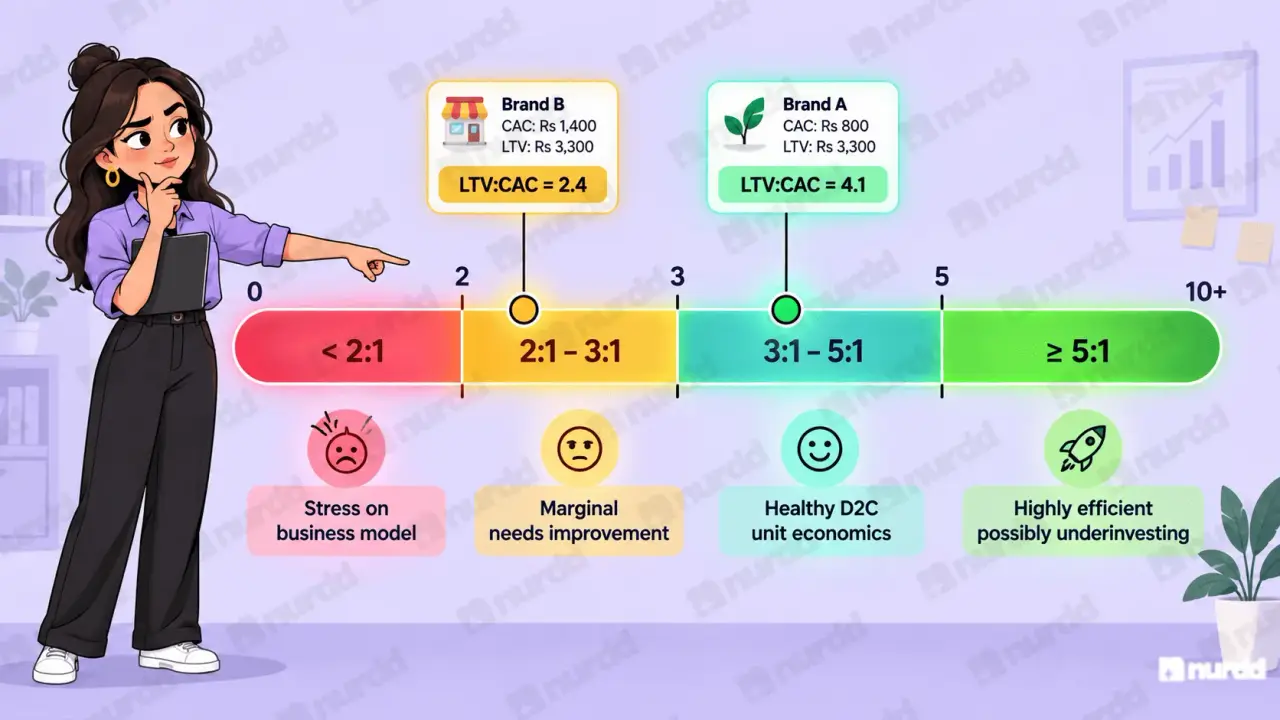
Your CAC has no absolute target it is only meaningful relative to your Customer Lifetime Value.
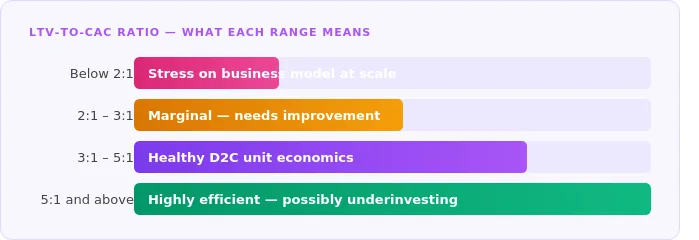
LTV formula: AOV × Average purchase frequency per year × Average customer lifespan in years × Gross margin %.
Example: AOV Rs 1,200, frequency 2.5x per year, 2-year lifespan, 55% margin = LTV of Rs 3,300. If True CAC is Rs 800, LTV-to-CAC is 4.1 healthy. If True CAC is Rs 1,400, ratio is 2.4 needs immediate attention.
Reducing CAC Without Cutting Spend
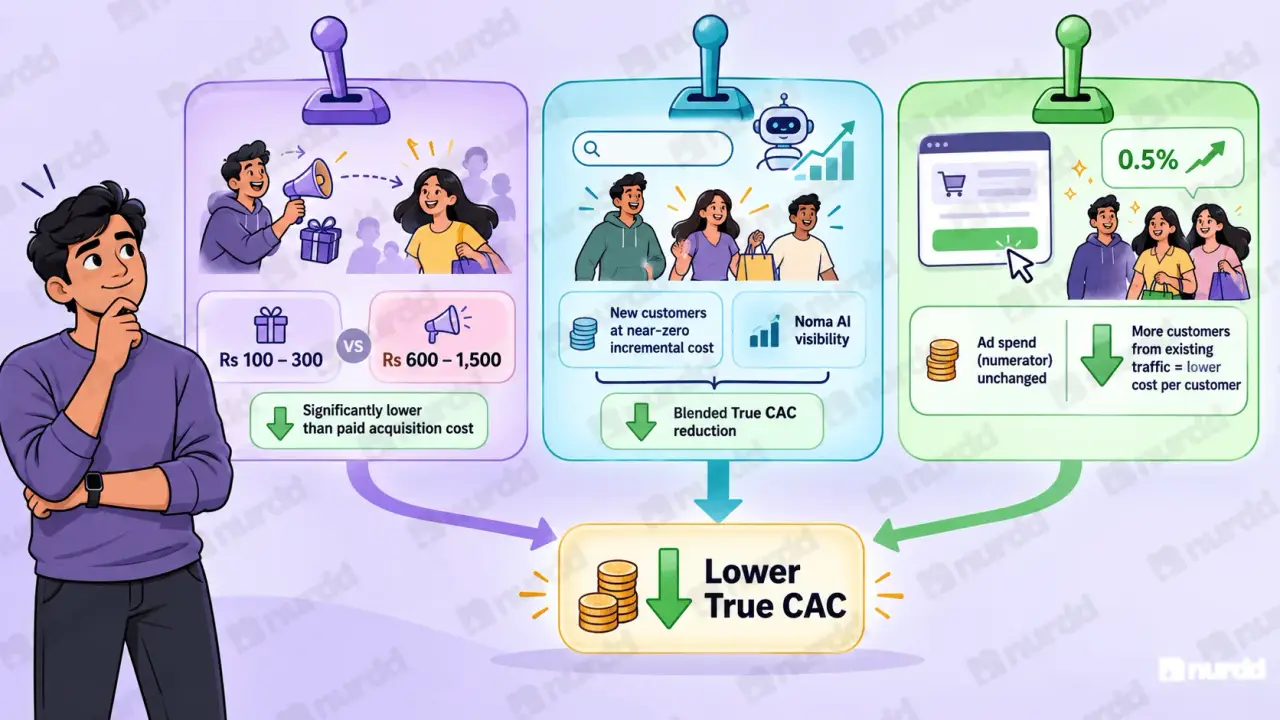
Three Levers That Lower True CAC
Referral programme design: A well-designed referral programme produces new customers at marginal cost significantly below paid CAC. The cost of the referral reward is typically Rs 100 to Rs 300 per referred customer versus Rs 600 to Rs 1,500 in paid CAC.
Organic and AI search investment: Every new customer acquired through organic search traffic is acquired at near-zero incremental cost, reducing blended True CAC across all acquisition channels simultaneously. Investing in AEO and AI search visibility is a CAC reduction strategy, not just a brand visibility strategy.
Checkout conversion rate optimisation: Every 0.5% improvement in your checkout conversion rate converts more of the traffic your current marketing spend is already generating into customers reducing the cost-per-customer calculation without changing the numerator.
CAC Across Business Stages
What Is Acceptable at Each Revenue Level
Early stage (below Rs 1 crore annual revenue): CAC may be significantly above sustainable levels because brand awareness is low and conversion rates are below mature levels. An LTV-to-CAC ratio of 2:1 is not ideal but may be acceptable if the trajectory shows CAC declining as brand awareness and review volume build. The key question is direction, not just current level.
Growth stage (Rs 1 to 10 crore annual revenue): LTV-to-CAC of 3:1 or above should be achievable and sustainable. If it is not, the business model needs review before further investment in growth. Scaling a business with sub-3:1 LTV-to-CAC using capital injection means the losses per customer compound as volume grows.
"The CAC number that feels comfortable is usually the wrong one. Include every cost, include only new customers, and then see if the number still feels comfortable."
Sources and References
Shopify Blog – Customer Acquisition Cost: What It Is and How to Calculate It
Investopedia – Customer Acquisition Cost (CAC)
Inc42 – D2C coverage and reports
Nurdd – True CAC calculation resources for Indian D2C brands

Find the right creators — and verify they're real.
Nia gives brands access to 10M+ Indian creator profiles, TruAI fake follower detection, pre-spend ROI forecasting, and product-level sales attribution. Completely free.