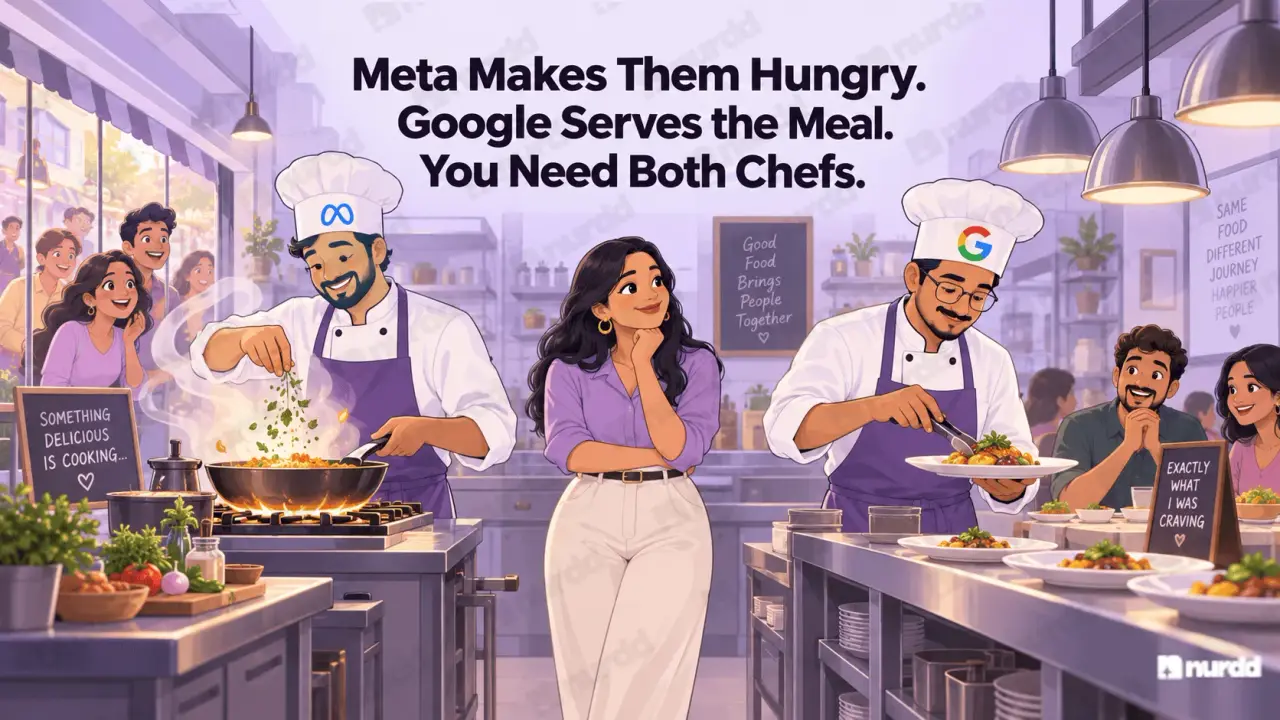
Neither wins outright, because they do different jobs. Meta creates demand by interrupting people who were not looking for you; Google captures demand from people already searching. The right split depends on whether your category has existing search volume and where your funnel is currently weakest.
Meta vs Google is one of the most common budget allocation questions in Indian D2C marketing. The answer is not which platform is better it is which is better for your specific brand, product, category, and funnel stage.
The Fundamental Difference
Demand Creation vs Demand Capture
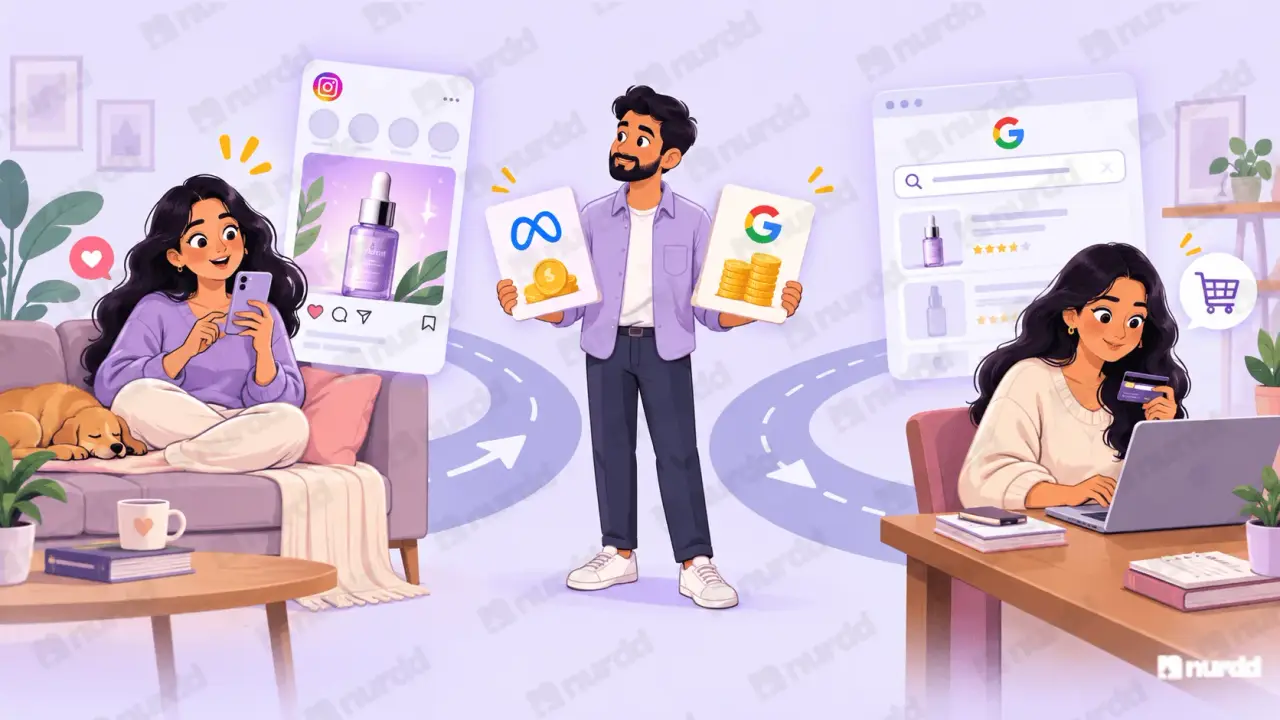
Meta creates demand. People on Instagram are not actively looking for your product. They are consuming content. Meta's job is to interrupt this with something compelling enough to create purchase intent where none existed before.
Google captures demand. People on Google Search are actively looking. Google Ads intercept buyers at the moment of explicit purchase intent best protein powder India, buy niacinamide serum online India. The buyer came to the platform to find something. Your ad is a relevant answer to an active question.
That is why conversion rates from Google Search clicks are typically 2 to 4 times higher than from Meta clicks for the same product.
📱 Meta — Demand Creation
Product discovery in new audiences who have never heard of your brand
Visual categories- beauty, fashion, food, lifestyle products that need to be seen
Audience compounding- pixel builds warm retargeting and lookalike pools over time
Video and Reels- ideal for showing how a product works before the click
🔍 Google — Demand Capture
High-intent moments- buyers who typed "best whey protein India" are already decided
Functional categories - health supplements, specific ingredient products, clinical claims
Google Shopping- product visual comparison format works well for fashion and food
Conversion rate- typically 2 to 4× higher than Meta for the same product
Budget Allocation by Stage
How to Split Your Budget at Each Stage
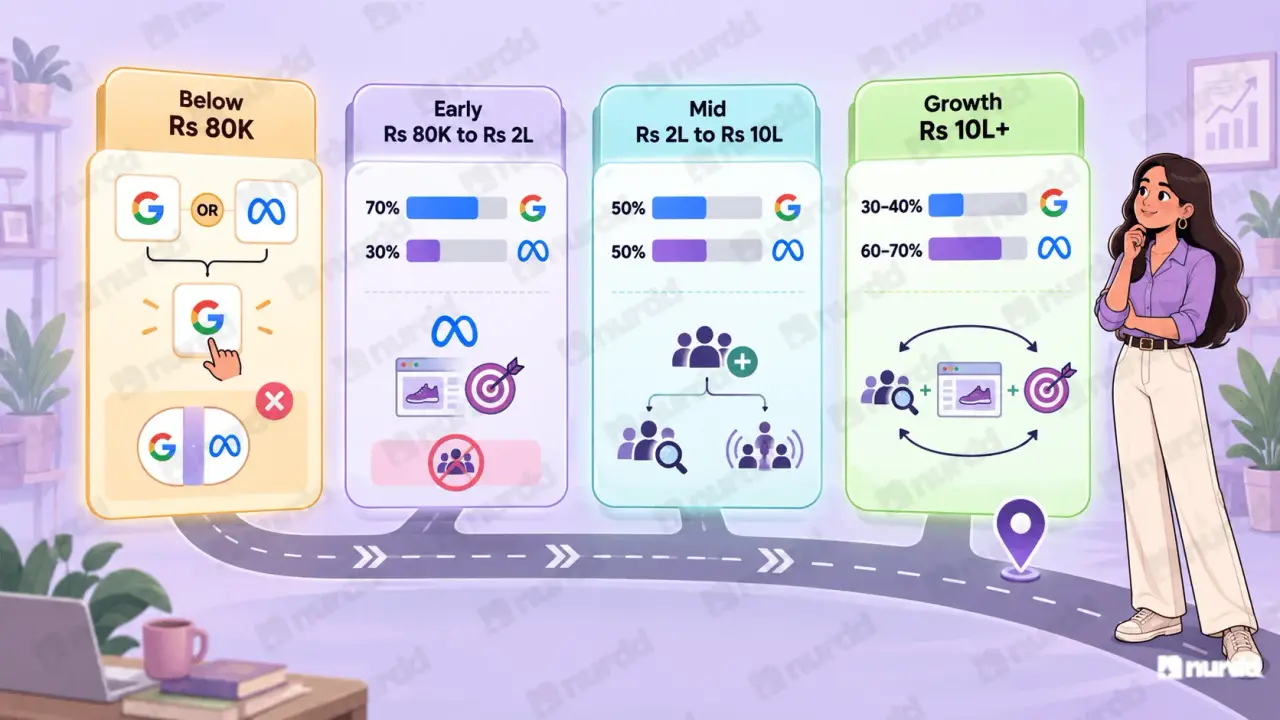
Spend Stage | Google Split | Meta Split | Meta Strategy |
|---|---|---|---|
Below Rs 80K/month | Pick one platform only. Split kills both. | Start with demand capture (Google) unless your product requires discovery | |
Early (Rs 80K – 2L) | 70% | 30% | Retargeting only- no prospecting yet |
Mid (Rs 2L – 10L) | 50% | 50% | Add prospecting- lookalikes + broad |
Growth (Rs 10L+) | 30–40% | 60–70% | Full funnel- prospecting + retargeting |
Creative Capability Changes the Equation
When to Override the Budget Framework
The budget allocation framework above assumes equivalent creative quality across both platforms. In practice, creative capability is the most important factor in determining where your marginal marketing rupee should go.
If your brand has strong video production capability-a content team, a creator programme producing quality Reels, Meta's visual formats will produce significantly above-average results. Every additional Meta budget rupee can be used for a new creative iteration. This iterative creative learning is a compounding advantage.
If your team does not have strong visual creative production capability but your product solves a specific problem buyers actively search for Google Search captures that intent without requiring great creative. A well-structured Search campaign with relevant landing pages produces results proportional to search intent, not creative quality.
"Meta and Google are not competitors for your budget. They are partners at different stages of the buyer journey. The brand that treats them as an either-or choice is leaving money on both tables."
Sources and References
Think with Google India – Consumer insights and market research
Meta for Business – Advertising on Facebook and Instagram
Google Ads Help – About Smart Bidding
Nurdd / Pulse – Meta vs Google Ads allocation resources for Indian D2C brands

Your ads are spending. Are they actually performing?
Pulse connects to Google Ads and Meta Ads to explain performance in plain language, diagnose what changed, and recommend specific actions — no data analyst needed.