Influencer Marketing
Sync Influencer Drops with Quick-Commerce Inventory in 2026
Creator spikes are wasted when the nearest dark store is empty. Market data on Instacart, DoorDash, Uber Eats and Gopuff, plus the three-move Precision Drop Framework for syncing creator posts with stock.
 Yashasvi Sharma12 Jan 202610 min read
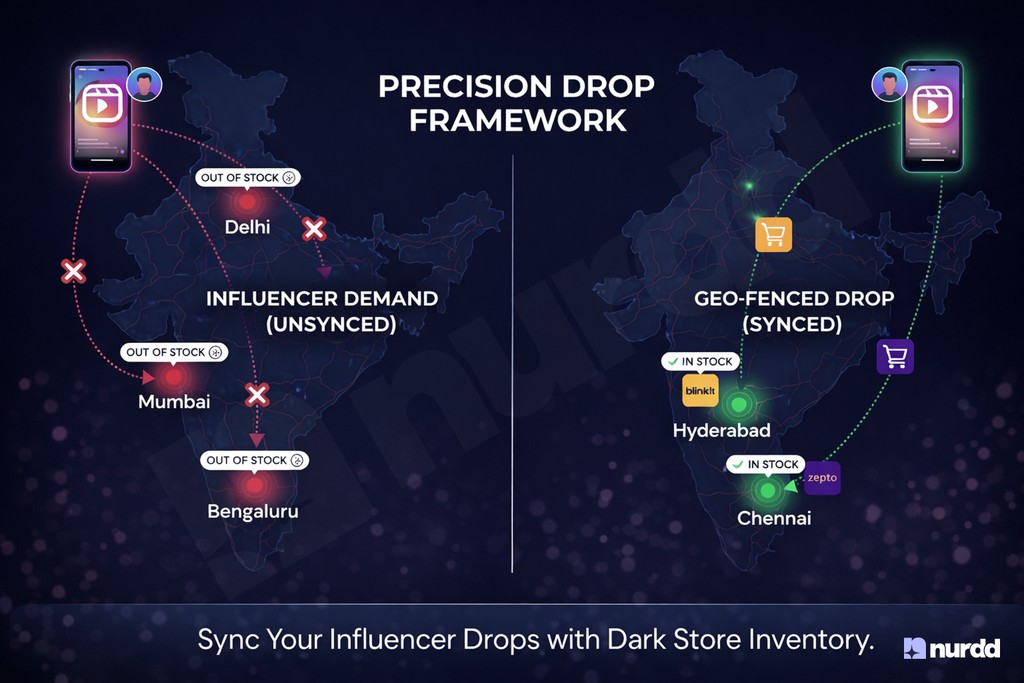
To sync influencer drops with quick-commerce inventory, activate creators only in cities where dark-store stock is strong, pause paid boosts automatically when campaign stock runs low, and send every click to a page that checks local availability first. In a 2026 TELUS study, 45% of shoppers switch brands when a product is out of stock.
Quick commerce only converts creator demand when the product is on the shelf of the dark store closest to the viewer. Sync the two by casting creators only where local stock is strong, pausing paid boosts automatically when stock drops, and sending every click to a page that checks availability first.
Paying for an influencer post while your dark store is understocked is like running a sale with the shutters down. The Precision Drop Framework below aligns creator drops with live inventory so every click has somewhere to land. First, the market context, because the scale of quick commerce and creator commerce is what makes the mismatch expensive.
Quick commerce in 2026: how big, and who runs it
Analysts disagree on the size of the market because they define it differently, so treat any single figure as an estimate. Two 2025 to 2026 global estimates:
| Source | Global market, 2025 | Forecast | Growth rate |
|---|---|---|---|
| Research and Markets, 2025 | $110.6 billion | $570.7 billion by 2034 | 20.0% CAGR, 2025 to 2034 |
| Fortune Business Insights, 2026 | $184.55 billion | $385.36 billion by 2034 | 8.55% CAGR, 2026 to 2034 |
Fortune Business Insights puts North America's share at 33.43% of the market in 2025, the largest of any region. Research and Markets defines quick commerce as delivery of everyday items, typically within 30 to 60 minutes, from local dark stores.
The players a brand is most likely to sell through, and what their latest disclosures say:
| Platform | Latest public data point | What it means for a creator drop |
|---|---|---|
| Instacart (US, Canada) | Orders up 17% year over year in Q2 2025; more than 40 new retail partners added in the first half of 2025 (Grocery Dive, 2025) | Your stock sits on the shelves of many retail partners, so availability varies store by store. |
| DoorDash, including DashMart and Deliveroo | 903 million total orders in Q4 2025, up 32% (20% excluding Deliveroo); over 30% of US monthly active users engaged with grocery and retail in December 2025 (DoorDash Q4 2025 release, 2026) | Grocery and retail is now a mainstream behaviour on the app, not a niche, so a creator spike can reach a large installed base. |
| Deliveroo (owned by DoorDash) | Acquisition completed 2 October 2025; Deliveroo operates in nine countries including the UK, France, Italy, the UAE and Singapore, with about 176,000 restaurant, grocery and retail partners (DoorDash 8-K, 2025) | One parent company now spans the US, Europe, the Middle East and Asia, but stock is still held locally. |
| Uber Eats grocery and retail | Non-restaurant deliveries at a $10 billion annual gross bookings run rate in May 2025, expected to reach $12.5 billion by the end of 2025; Uber says it sees heavy use for last-minute or urgent orders (Transport Topics, 2025) | Urgent, last-minute intent is exactly what a creator post triggers, and exactly what an out-of-stock kills. |
| Gopuff | Fulfils from its own micro-fulfillment centers; its Starbucks pilot in Philadelphia delivers in about 30 minutes (Grocery Dive, 2024) | Each hub serves its own delivery zone, so one hub running dry blanks out every shopper in that zone. |
| Getir | Exited the UK, Germany and the Netherlands in April 2024 to focus on Turkey; non-Turkish business was 7% of revenue (Grocery Gazette, 2024) | Platform footprints change. Re-check where each partner actually operates before you brief creators. |

Why creator spikes and dark-store stock collide
Creator content is increasingly built to drive an immediate purchase. Meta's 2026 holiday guidance claims 71% of consumers make a purchase within days of seeing creator content on its platforms (JCK, citing Meta, 2026); that is Meta's own figure, not an independent study. eMarketer forecasts social commerce sales passing $87 billion in 2025, more than $100 billion in 2026 and nearly $119 billion in 2027, with TikTok Shop making up nearly 20% of social commerce in 2025 (Retail Dive, citing eMarketer, 2025).
Brands are leaning in. In Influencer Marketing Hub's 2026 benchmark survey of 600+ respondents, 87.49% expect their influencer budget to increase; 53.33% are not yet using social commerce and 46.67% plan to test it in 2026 (Influencer Marketing Hub, 2026).
Quick commerce fulfils from dark stores that each serve a small radius, so your inventory is split across many micro-warehouses and no creator's audience maps neatly onto one of them. When the spike lands on an empty shelf, the cost is more than one lost order. In a 2026 study of 3,000 consumers by TELUS Consumer Goods, 45% said they switch to a different brand when their desired product is out of stock (TELUS via The Grocer, 2026; sponsored content). You paid for the demand, and a rival collects it.
The Precision Drop Framework: three moves that fix it
The thresholds below are suggested starting rules for you to tune against your own sell-through data. They are not industry benchmarks.
Move 1: Geo-fenced casting
Stop selecting creators on national reach alone. Before briefing anyone, pull a city-level fill-rate report from each quick-commerce seller dashboard you use. Treat any city where your SKU is available in fewer than about 85% of dark stores as a no-go zone for creator activation, and prioritise cities where you hold clear surplus stock.
If your dashboard shows strong inventory in two cities, activate creators whose audience is concentrated there. Most creator platforms report audience location, so match that report to your stock map before you sign.
Move 2: The OMS pause trigger
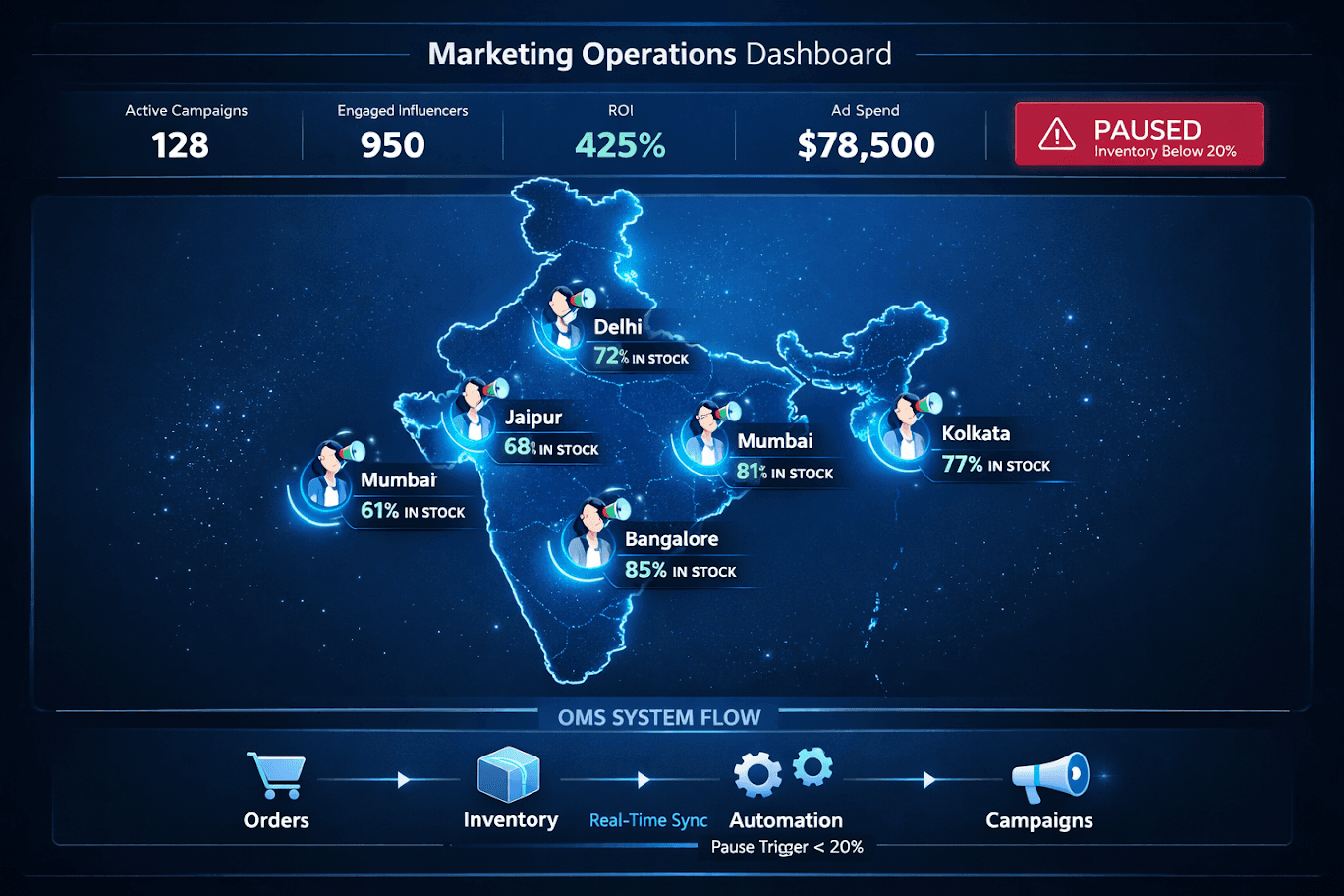
Connect your order management system (ideally one that consolidates every quick-commerce channel you sell on) to your ad workflow. Set one hard rule: if stock in a live campaign city falls below about 20% of the campaign allocation, the paid boost on that creator's content pauses automatically.
That turns your OMS into the campaign's circuit breaker. No manual monitoring, and no spend on clicks that cannot convert.
Move 3: The dynamic stock CTA
Replace static "Buy on [app]" links with a location-aware landing page that checks availability before it shows a link. If the shopper's nearest dark store is out of stock, the page sends them to another retailer that has it, your own store, or a "notify me when back in stock" email capture instead of a dead end.

The pre-drop checklist
| When | Check | Owner |
|---|---|---|
| Two weeks out | City-level fill rate per platform; creator audience-location report | Ops and marketing |
| One week out | Replenishment booked for every target city; campaign allocation set aside | Ops |
| Launch day | Pause trigger live; dynamic CTA tested from a phone in each target city | Marketing |
| Daily during the drop | Stock versus allocation per city; paid boosts paused or resumed | Marketing |
| After the drop | Sales by city versus creator reach by city; back-in-stock leads captured | Both |
The one metric to watch before your next drop
Pull city-level fill-rate data every week, not only before launches. The brands that win on quick commerce are not the ones with the biggest creator budgets; they are the ones whose marketing and operations teams compare stock and creator plans before anyone goes live.
Frequently asked questions
How do I sync influencer posts with quick-commerce inventory?
Activate creators only in cities where your stock is strong, using weekly city-level fill-rate data from each platform's seller tools. Automatically pause paid boosts when stock in a campaign city falls below a set share of the allocation, and route every click through a page that checks availability first.
Which quick-commerce platforms should a brand plan for?
In the US, Instacart, DoorDash (including DashMart), Uber Eats and Gopuff are the main options; in Europe and the Middle East, Deliveroo is now part of DoorDash. Footprints change, as Getir's 2024 exit from the UK, Germany and the Netherlands showed, so confirm where each partner operates before briefing creators.
What happens if a creator drives traffic to an out-of-stock listing?
You lose the order and often the customer. In a 2026 TELUS study of 3,000 consumers, 45% said they switch brands when their product is out of stock. A dynamic CTA that redirects or captures a back-in-stock email recovers part of that demand.
To pick creators whose audience sits where your stock is, Nia by Nurdd (an AI-native creative studio with influencer marketing built in and 10M+ creator profiles) shows audience data, flags fake followers with TruAI, forecasts ROI before you spend, and attributes sales at product level through the Nurdd SDK.
Sources
- Research and Markets, Quick Commerce Market Outlook 2025-2034 (Oct 2025)
- Fortune Business Insights, Quick Commerce Market (updated Oct 2026)
- Grocery Dive, Instacart reports strong Q2 results (Aug 2025)
- DoorDash, Fourth Quarter and Full Year 2025 results, SEC exhibit 99.1 (Feb 2026)
- DoorDash, completion of Deliveroo acquisition, SEC exhibit 99.1 (Oct 2025)
- Transport Topics, Uber reports leaps in grocery, retail deliveries (Sep 2025)
- Grocery Dive, Gopuff overnight Starbucks delivery pilot (Feb 2024)
- Grocery Gazette, Getir confirms UK exit (Apr 2024)
- JCK, Meta holiday 2026 planning (Jun 2026)
- Retail Dive, TikTok Shop is driving social commerce growth (Dec 2025)
- Influencer Marketing Hub, Influencer Marketing Benchmark Report 2026 (May 2026)
- The Grocer (TELUS partner feature), The out-of-stock problem (Apr 2026)