Influencer Marketing
Influencer Rate Card: What to Include and How to Build One
An influencer rate card lists a creator's prices and the terms behind them. Here is what goes on it, how brands read it, and worked examples.
 Simran Rawat29 Oct 202617 min read

An influencer rate card is a creator's price list: deliverables with a base fee, plus separate lines for usage rights, whitelisting, exclusivity, revisions and turnaround. Brands read it by checking what the base fee includes, pricing each extra on its own, and converting the total into a cost per 1,000 views before negotiating.
An influencer rate card is a creator's written price list: the content formats they offer, a base fee for each, and the terms that change that fee, such as usage rights, exclusivity, revisions and turnaround. Brands use an influencer rate card to compare quotes on equal terms and to see what is and is not included before they negotiate.
Key takeaways
- A rate card has two halves: what the creator makes (deliverables and bundles) and the terms that move the price (usage, whitelisting, exclusivity, revisions, speed).
- Ask what the base fee covers before you look at the number. Paid ad use, ad access through the creator's handle and category lockouts are usually priced as extras.
- Published benchmarks price paid usage and whitelisting as a percentage of the base fee per 30 days, so duration is the lever that most changes your invoice.
- Compare cards by total cost per deliverable and cost per 1,000 views, not by headline fee.
- Get every term in writing on the card or in the brief, including the date the usage clock starts.
- Check audience quality before you accept a fee: engagement and follower authenticity matter more than follower count.
What is an influencer rate card?
An influencer rate card is a structured pricing document. Hypefy, 2026 describes it as a document that lists a creator's deliverables, the price for each, key audience metrics and the contract terms that come attached, including usage rights, exclusivity, revisions and turnaround. In practice it is the creator's opening position in a negotiation, written down so both sides argue about the same things.
A rate card is not a contract. It states prices and default terms, and the signed agreement or brief is what binds either side. If the two disagree, the contract wins, so a brand should check that the card's terms are carried into it.
Rate card, media kit, quote and brief: how they differ
These four documents are often mixed up. Shareb, 2026 puts the split in one line each: a media kit sells a creator's credibility, and a rate card explains their pricing. It also notes the two can be combined into one document as long as the sections stay clear. The table shows how all four sit together.
| Document | Who writes it | What it answers | Binding? |
|---|---|---|---|
| Media kit | Creator | Who is the audience and why trust this creator? | No |
| Influencer rate card | Creator or manager | What do the standard formats and extras cost? | No |
| Custom quote | Creator, after a brief | What will this specific campaign cost? | No, until accepted |
| Creative brief | Brand | What must be made, shown and said? | When attached to the contract |
Brands can keep a card of their own too. Sprout Social, 2026 describes internal rate sheets that social teams use to evaluate partnerships, and advises reviewing rates against creator performance, influencer ROI and market pricing on a regular basis.
Why does an influencer rate card matter for brands?
Creator pricing is rarely uniform, and a headline fee hides a lot. A rate card turns a vague 'what do you charge?' into line items you can question, and it lets a brand put three creators side by side on the same terms.
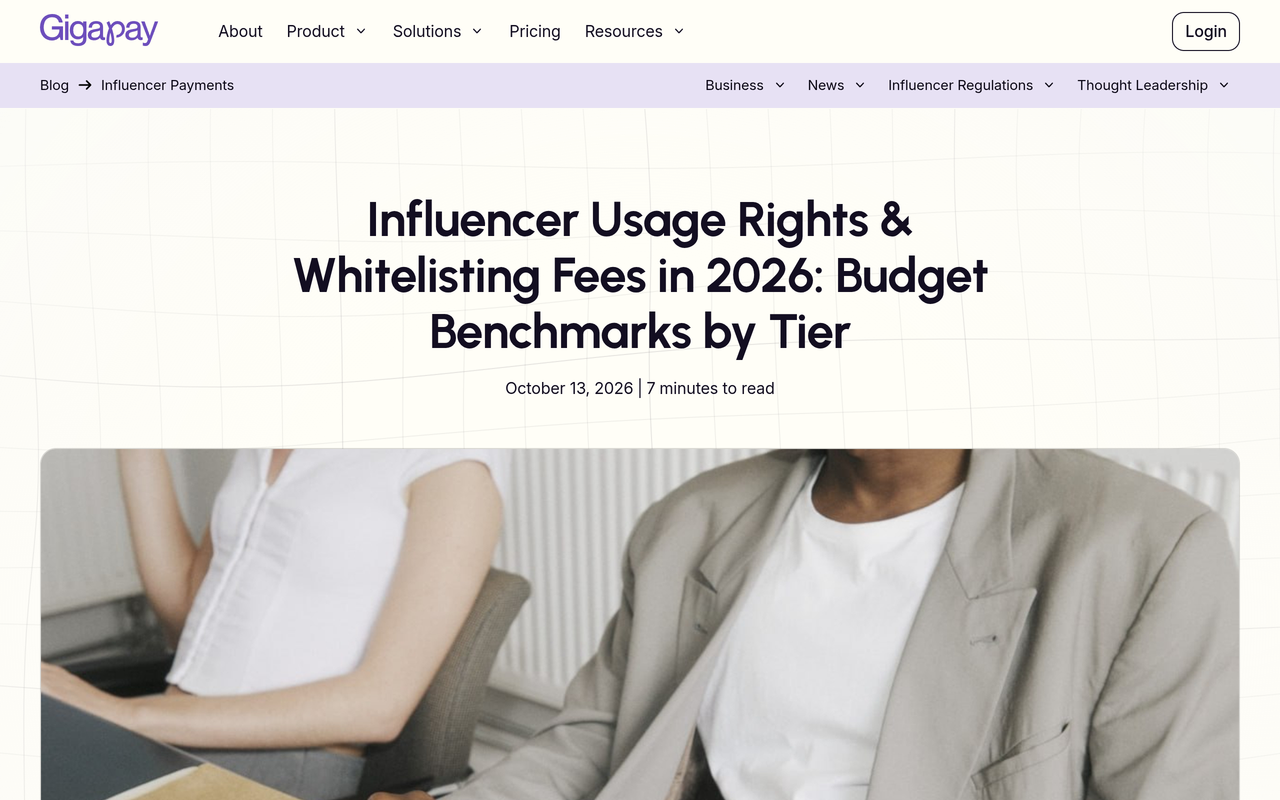
It also protects both sides from scope creep. When a card says what the base fee includes, a brand cannot quietly assume a paid ad licence, and a creator cannot quietly add a fee after posting. Gigapay, 2026 reports that 77% of marketers now reuse creator content in paid social ads, which is why the usage lines are now the part of the card most worth reading closely.
What should an influencer rate card include?
A complete card has nine parts. The first tells you who you are buying from, and the rest tell you what you are buying and under which terms. Collabstr, 2026 lists the core items as deliverables, bundles, usage rights, whitelisting, exclusivity, revisions and turnaround, and raw footage, each priced or stated on its own line.
1. Creator summary and audience snapshot
Shareb's template starts with name or brand, niche, platforms, a short positioning line and a contact email, then an audience snapshot of follower count by platform, average views, engagement rate, top audience locations and demographics. Treat these as claims to verify, not facts. You can sanity-check them with the free engagement rate calculator and the fake follower checker.
2. Deliverables and base fees
Each format gets its own line: Reel, TikTok video, feed post, Story set, YouTube integration. A good card also says what the base fee contains, such as the number of revisions and the delivery time. A fee with no scope is not comparable to any other fee.
3. Bundles and packages
Bundles combine formats at a lower per-item cost. Hypefy's nano-creator example prices one Reel, one Story set and one TikTok at $350 against $425 if booked separately, and its micro-creator example prices one Reel, one TikTok and three Stories at $1,400 against $1,650. For a brand, a bundle makes the campaign's scope one line instead of five, and the discount shows how flexible the creator is.
4. Usage rights
Usage rights define where the brand may reuse the content and for how long. Gigapay prices them as a percentage of the base rate per usage period, with separate bands for paid social, whitelisting, website and email, and perpetual buyouts. A card should name both the channel and the duration.
5. Whitelisting and ad access
Whitelisting means running content as an ad from the creator's own handle. Hypefy describes it as typically adding a monthly fee on top of the base rate. It is a different permission from usage: usage lets the brand use the file, whitelisting lets the ad appear as the creator.
6. Exclusivity
Exclusivity stops the creator working with competing brands for a stated period. Hypefy says exclusivity windows of 30, 60 or 90 days add 50 to 100%. A card should define what counts as a competitor, because 'beauty' and 'lip balm' are very different restrictions.
7. Revisions
State how many rounds are included and what an extra round costs. Collabstr lists revisions and turnaround together as the rounds of edits included and the delivery time. Without a stated limit, revision requests become a common source of friction after a draft is delivered.
8. Turnaround and rush fees
Give a standard delivery window counted from brief and product receipt, and a rush surcharge if the creator offers one. If the card is silent, ask when the delivery clock starts.
9. Raw footage and payment terms
Collabstr says raw footage, meaning unedited files, is usually priced on its own line. Payment terms such as deposit share and payment date belong on the card or in the contract, as does the licence start date: delivery, posting or payment.
Which formats do brands ask for, and what does that mean for the card?
Collabstr's 2026 report says Instagram Reels were the most requested content type on its platform in 2025, followed by Instagram posts, TikTok videos, YouTube Shorts and YouTube videos. The same chart gives each format's engagement rate. The ranking by requests is not the ranking by engagement, which is why a brand should not assume the most requested format is the best value.
| Format (2025 request rank) | Engagement rate on Collabstr | What a brand should check |
|---|---|---|
| Instagram Reels (1st) | 5% | Average Reel views, not follower count |
| Instagram posts (2nd) | 3.5% | Whether a static post is priced below a Reel |
| TikTok videos (3rd) | 2% | View count, since engagement is lowest of the five |
| YouTube Shorts (4th) | 4.5% | Whether Shorts are bundled with a long video |
| YouTube videos (5th) | 6% | Integration versus dedicated video pricing |
Collabstr also reports that UGC accounted for 35% of influencer campaigns on its platform in 2025, up from 15% the year before, and recommends a UGC line on the card. UGC means content made for the brand's own channels, so a UGC line should state whether the creator posts it or only delivers the file. Shareb's template lists 'UGC video without posting' as its own package for that reason.
How do brands read an influencer rate card?
Read it in this order: scope, extras, total, cost per 1,000 views, then fit. The table gives what to confirm, the warning sign and the question to ask for each line, so you can use it live on a call.
| Card line | What to confirm | Warning sign | Question to ask |
|---|---|---|---|
| Base fee | Format, length, revisions, delivery date | No scope stated | 'What exactly does this fee cover?' |
| Usage rights | Channel, duration, start date | 'Full rights' with no end date | 'Which channels, for how many days, starting when?' |
| Whitelisting | Monthly or one-off, who controls ad account access | A flat fee for unlimited time | 'Is this per 30 days, and what happens at renewal?' |
| Exclusivity | Category definition, period | Broad category, long period, no premium shown | 'Which competitors, and for how long?' |
| Turnaround | Days from brief and product receipt | Clock starts at signing, not at product delivery | 'When does the delivery clock start?' |
| Raw footage | Included or add-on | Not mentioned | 'Can we get source files, and at what cost?' |
Convert the fee to a cost per 1,000 views
Divide the total fee by the creator's typical views and multiply by 1,000. That gives the cost per 1,000 views, and it lets a $600 quote and a $6,000 quote sit on the same line. Pair it with the campaign benchmarker to check engagement and cost per engagement against benchmarks.
Check the tier before judging the number
Gigapay, 2026 publishes typical per-post ranges by follower tier. Use them as a rough check, not a price list, because the ranges are wide.
| Creator tier | Followers | Typical rate per post (Gigapay, 2026) |
|---|---|---|
| Nano | 1K-10K | $50-$500 |
| Micro | 10K-100K | $200-$5,000 |
| Mid-tier | 100K-500K | $1,200-$15,000 |
| Macro | 500K-1M | $5,000-$25,000 |
| Mega / celebrity | 1M+ | $25,000-$100,000+ |
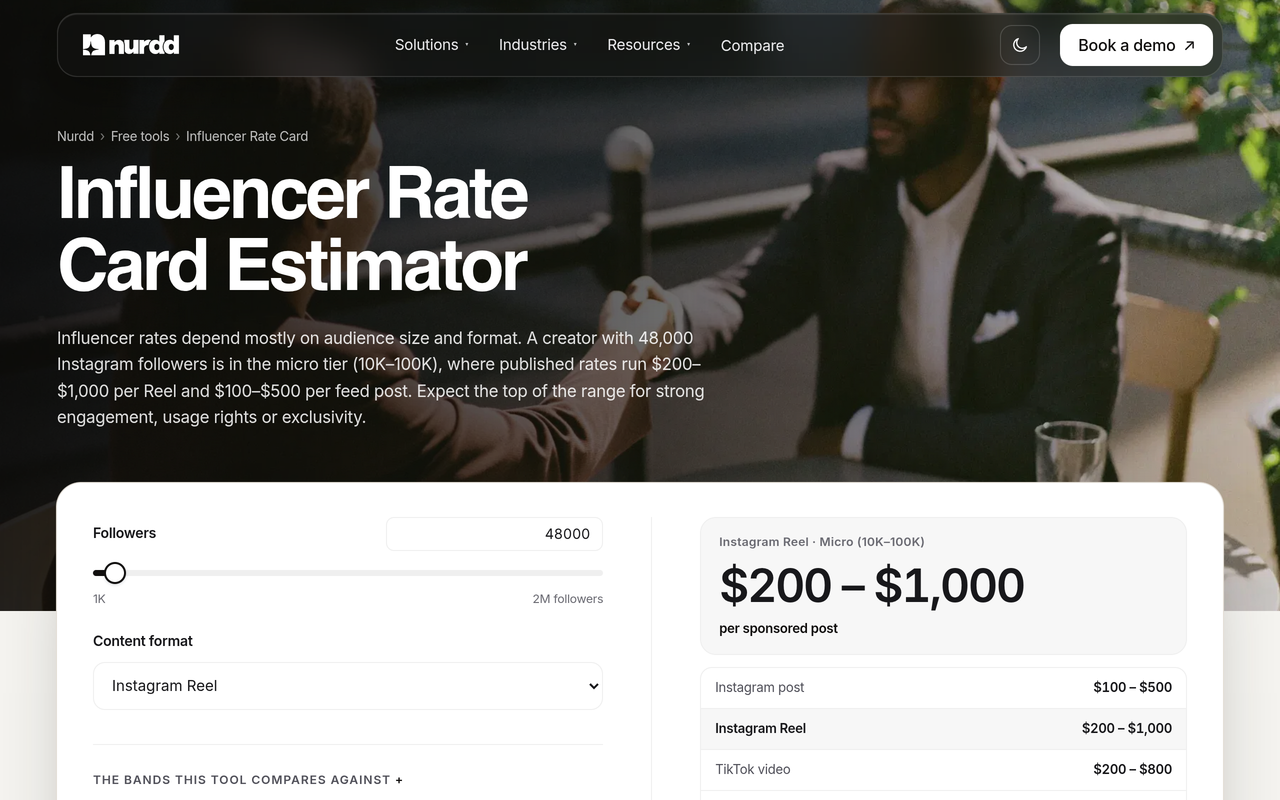
The width of those bands is the point: a fee inside a tier range tells you little on its own. Hypefy says engagement rate and audience quality, not follower count, should move a creator's price. A card that quotes a high fee for a large audience should be tested against real engagement. The influencer rate card estimator shows published USD rates by tier and format as another reference point.
How much do usage rights, whitelisting and exclusivity add?
This is where invoices grow. The percentages below are published by third parties and vary by creator, niche and market, so treat them as negotiation anchors rather than rules.
| Extra | Published range | Source |
|---|---|---|
| Paid social usage | 15% to 30% of base fee per 30 days | Gigapay, 2026 |
| Whitelisting or Spark Ads | 25% to 50% of base rate per 30-day window | Gigapay, 2026 |
| Website and email usage, 12 months | 20% to 35% of base rate | Gigapay, 2026 (citing UGC Bloom) |
| Whitelisting plus owned channels combined | 80% to 150% of base rate | Gigapay, 2026 (citing InfluencerFee) |
| Full perpetual buyout, all channels | 150% to 300% of base rate | Gigapay, 2026; UGC Bloom, 2026 |
| Exclusivity (30, 60 or 90 days) | Adds 50% to 100% | Hypefy, 2026 |
Sources differ, which is itself useful. UGC Bloom, 2026 cites a whitelisting band of 25 to 35 percent of the base fee per 30 days and 15 to 25 percent for ordinary paid social usage, and says some creator-side guidance runs higher. When a card states a percentage, ask which basis it uses: per 30 days, per campaign or as a single uplift.
Worked example: what does a $2,000 Reel really cost?
Take a hypothetical creator whose card lists a Reel at $2,000. Hypefy uses the same starting point and says a $2,000 Reel quote can become a $4,000 invoice once 90-day paid usage and 60-day category exclusivity are added. The arithmetic below applies the ranges from the table to see how that happens. The creator, the brief and the view count are invented for illustration.
- Base fee: one Reel at $2,000, posted on the creator's account.
- 90 days of paid social usage: Gigapay's 15% to 30% of base per 30 days gives 45% to 90% over three months, or $900 to $1,800.
- Category exclusivity: Hypefy's 50% to 100% uplift gives $1,000 to $2,000.
- Total: $3,900 to $5,800, which is 1.95 to 2.9 times the base fee.
The base fee can be half the contract value or less. If you only need organic posting, the card should let you buy only that.
Now test the cost per 1,000 views, assuming the Reel reaches 40,000 views. The $2,000 base is $50 per 1,000 views. The $3,900 to $5,800 package is $97.50 to $145 per 1,000 views for organic reach alone. The extras only pay off if the content runs in ads that perform, which is a decision to model before you sign, for example with the influencer ROI calculator.
A second worked example from a published source
UGC Bloom walks through a $1,200 base for one Reel plus raw files. Adding paid social for 90 days at 40 percent is $480, taking the deal to $1,680. Adding whitelisting at 30 percent per 30 days across three months is another $1,080, so the total lands at $2,760, or 2.3 times the base. Gigapay gives a similar illustration: a mid-tier creator at a $4,000 base rate with a 35% whitelisting fee costs $1,400 per 30-day window, or $4,200 for a quarter, before other extras.
Which extras should you buy? A decision table
Not every brand needs every right. Match the extra to what you will actually do with the content before you accept the line.
| If you plan to... | Buy this | Leave out | Term to fix in writing |
|---|---|---|---|
| Only let the creator post to their audience | Base fee | Usage, whitelisting, exclusivity | Posting date and disclosure |
| Repost the content on your own social accounts | Organic usage | Whitelisting | Channels and number of days |
| Run the video as a paid ad on your own page | Paid usage, per 30 days | Perpetual buyout | Start date and renewal price |
| Run ads from the creator's handle | Whitelisting, per 30 days | Long exclusivity | Who holds access and how it ends |
| Keep a rival from the same creator | Exclusivity | Nothing else needed | Named competitors and days |
| Reuse the asset for years | Buyout, only if justified by ad spend | Monthly extensions | Channels, territories and end date |
UGC Bloom suggests tying a licence fee to planned media spend on that asset. It calls a 3 to 5 percent slice of the ad budget behind the asset a defensible ask. If your planned spend is small, that framing can argue the usage fee down.
How do you build an influencer rate card step by step?
Creators build cards, but brands often ask for one in a template. Both sides benefit from the same structure, and brands that share a preferred format get comparable quotes. Follow this order.
- List your formats by demand. Collabstr advises putting the most requested formats at the top, since those are the lines brands look for first.
- Set a base fee per format. Use tier benchmarks, your own past deals and your engagement quality.
- State what the base fee includes. Revisions, delivery days and posting platform.
- Price each extra on its own line. Paid usage, whitelisting, exclusivity, raw footage, rush delivery and extra revisions.
- Define the terms behind each extra. Channel, duration, start date, competitor definition, renewal price.
- Add at least one package. Show the saving against buying items individually, as Hypefy's bundle examples do.
- Keep it short and scannable. Shareb advises adding the numbers a brand needs and not overloading the page with every metric.
A sample card layout
| Line | Example entry | Terms to print beside it |
|---|---|---|
| Reel, up to 30 seconds | Base fee | 2 revision rounds, 7 days from product receipt |
| Story set, 3 frames | Base fee | Link sticker, 24-hour live period |
| Bundle: Reel + Story set | Discounted total | Saving shown against separate prices |
| UGC video, no posting | Base fee | File format, delivery date |
| Paid usage | Percentage per 30 days | Channels, start date, renewal rate |
| Whitelisting | Percentage per 30 days | Who holds ad account access, how it ends |
| Exclusivity | Percentage uplift | Named competitors, number of days |
| Rush and raw files | Flat add-ons | Rush turnaround in days, file format |
The amounts are left as descriptions on purpose: a card should carry the creator's own numbers, and a brand should not copy placeholder prices from a template.
Checklist: what to confirm before you negotiate
- Does the base fee state format, length, revisions and delivery date?
- Are usage rights listed by channel and duration?
- Is the usage start date defined?
- Is whitelisting priced per period, with a renewal rate?
- Is exclusivity defined by competitor, not just category?
- Is a rush fee stated, and when does the delivery clock start?
- Are raw files included or priced?
- Does the card show a bundle, and what does it save?
- Have you calculated cost per 1,000 views for the base fee and the full package?
- Are disclosure requirements written into the brief?
How should a brand negotiate from a rate card?
Start by narrowing scope rather than haggling over the base fee. Asking for organic use only, a shorter licence or a smaller competitor list removes cost without disputing the creator's craft. The decision table above shows which lines to drop first.
Then trade, do not just cut. A longer relationship, a bundle of several posts or faster payment can justify a lower per-item price. Put every agreed change on the card or in the brief, with the licence start date, so the signed terms match what you discussed.
What do brands need to know about disclosure?
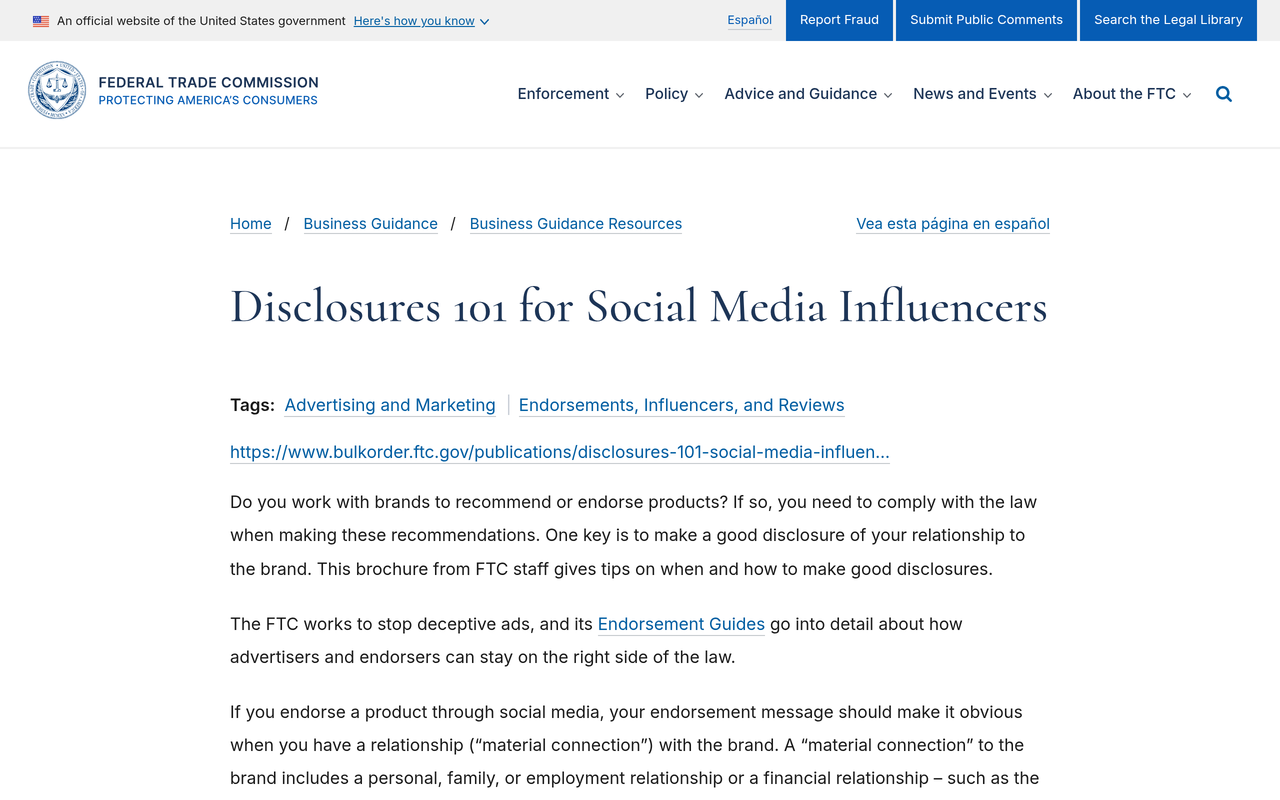
A rate card does not remove the need for sponsored posts to be disclosed. The FTC's Disclosures 101 for Social Media Influencers says an endorsement should make it obvious when the creator has a material connection to the brand, including payment or free products. It adds that disclosures are likely to be missed if they appear only on a profile page, at the end of a post or anywhere that needs a click on 'more'. Include a disclosure clause in the brief and check posts after they go live.
Common mistakes when using an influencer rate card
- Comparing base fees only. Two creators at $1,500 are not equal if one includes 90 days of paid usage and the other does not.
- Accepting 'full rights'. Without a channel and an end date, the phrase invites disputes. Perpetual buyouts sit at the top of the published ranges, at 150% to 300% of base.
- Ignoring audience quality. Check engagement and follower authenticity before agreeing a fee. Our guide on vetting an influencer's audience before paying walks through it.
- Skipping the brief. A card prices a format, and a brief defines the job. See how to brief a creator.
- Not tracking links. If you cannot attribute sales, you cannot judge whether the extras paid off. Use a clean UTM structure.
- Paying for scale you don't need. Read how many influencers you actually need before widening the roster.
How Nia by Nurdd helps brands run creator deals
Nia by Nurdd is an AI-native creative studio with influencer marketing built in. It discovers creators from a database of 10M+ profiles, detects fake followers with TruAI, generates pre-spend ROI forecasts, attributes product-level sales to specific creators after a campaign closes, and manages the full campaign workflow without needing an agency. It is priced below comparable plans.
That matters for rate cards because the card is only the start of a deal. Vetting tells you whether the audience justifies a fee, and a forecast tells you whether the extras are worth buying. Read more on the Nia overview or at getnia.studio.
Book a demo at https://www.nurdd.club/demo and we will show you creator discovery, TruAI fake follower checks and a pre-spend ROI forecast for your own brand and category.
Where does a rate card fit in your wider influencer plan?
Use the card to set prices, then work backward from budget. The marketing budget planner splits spend across creators, Meta and Google, and the guide on picking influencers by predicted sales helps you decide who deserves a premium.
Fit varies by sector. Beauty brands often buy paid usage heavily, so the beauty industry page is a good place to start, while the creator page shows the other side of the table. If a creator under-delivers, this playbook covers what to do, and influencer campaign incrementality covers wider measurement.
How we researched this
We reviewed publicly available rate card guides from creator marketplaces, a payments platform and a social software company, a usage-rights pricing guide, and FTC guidance for influencers. Figures are taken from the cited pages, and where sources give different ranges we show both. We did not run hands-on tests or interview creators or brands. The worked examples are illustrations built from the cited ranges, not real campaign data.
Frequently asked questions
What is an influencer rate card and what should it include?
It is a creator's price list. It should include deliverables with base fees, bundles, usage rights by channel and duration, whitelisting, exclusivity, revisions, turnaround, raw footage and payment terms. Each extra should be on its own line.
How do brands read an influencer rate card?
Start with what the base fee includes, then price each extra separately and add up the total. Divide the total by typical views to get a cost per 1,000 views, and compare that across creators. Finally, check that audience quality supports the price.
Is an influencer rate card the same as a media kit?
No. A media kit shows who the creator and audience are, while a rate card states prices and terms. Shareb notes the two can be combined in one document, but a brand should be able to find the pricing section quickly.
Are rate card prices negotiable?
Usually yes, especially the extras. Duration of usage, exclusivity length and bundling are the common levers. Asking for a narrower scope, such as organic use only, is often easier than asking for a lower base fee.
How much should usage rights cost?
Published ranges vary. Gigapay puts paid usage at 15% to 30% of the base fee per 30 days and whitelisting at 25% to 50% per 30-day window, while UGC Bloom cites lower bands for ordinary paid social. Ask the creator which basis they use and how long the licence runs.
What is the difference between usage rights and whitelisting?
Usage rights let a brand reuse the content on defined channels. Whitelisting lets the brand run ads through the creator's own handle. They are priced separately on most cards, and Gigapay quotes whitelisting per 30-day window.
How often should a rate card be updated?
There is no fixed rule, but creators should refresh a card whenever their audience, engagement or demand changes. Brands should ask for the current version at the start of each campaign rather than reusing an old quote.
Can Nia by Nurdd help me run influencer campaigns?
Yes. Nia by Nurdd helps brands discover and vet creators, detect fake followers with TruAI, forecast ROI before spending, manage the full campaign workflow and attribute sales afterwards. It is priced below comparable plans.
Next step
A rate card is only useful if you can compare it with other cards, with a forecast and with results. Book a demo and we will walk through creator discovery, fake follower checks and pre-spend ROI forecasts for your brand. You can also browse more guides on the Nurdd blog or try the free tools.