AI Search Visibility
AI Search Visibility Monitoring for D2C Brands
AI search share of voice is your brand's slice of all brand mentions in AI answers. Here is the formula, a worked example, and how to benchmark it honestly.
 Simran Rawat30 Oct 202616 min read

AI search share of voice is your brand's mentions divided by all mentions of the brands you track, across a fixed prompt set and several AI engines. Because AI answers change on every run, repeat each prompt and judge the trend against named competitors, not a universal good score. Noma by Nurdd automates this across 13 AI engines.
AI search share of voice is the percentage of brand mentions in AI answers that go to your brand, out of all mentions of the brands you track, across a fixed set of prompts. To measure it, run the same prompts repeatedly across several AI engines, count every brand mention, and divide yours by the total.
Want to see where AI engines place you today? Book a demo and we will run your prompts live.
That sounds simple, and the arithmetic is. The hard parts are choosing the denominator, handling answers that change on every run, and deciding what counts as a good number. This guide covers all three, with a worked example built on published figures and a four-week plan you can run this month. If you want the wider context first, start with what generative engine optimization is.
Key takeaways
- Define share of voice in writing before you measure: the prompt set, the engines, the named competitor set and the denominator are all part of the metric.
- Compute share of voice from raw mention counts across your tracked brands, and report mention rate and citation rate separately, because they use a different denominator.
- Repeat every prompt. SparkToro's research found AI brand lists almost never repeat, so a single run is an anecdote and percentage appearance across many runs is the usable signal.
- There is no universal good score. Judge your trend against the same named competitors on the same prompts.
- Split mentions by quality (recommended, neutral, qualified) so that a rising number cannot hide a weak position.
- Check your own pages in the citations, not only the brand name, so you know which content to improve.
What is share of voice in AI search, and how is it different from classic share of voice?
Classic share of voice compares your spend or visibility with competitors in a channel such as ads, search rankings or social. AI search share of voice compares how often AI assistants name your brand against how often they name your rivals when a buyer asks a category question. The unit is the mention inside a generated answer, not a ranked link.
Three related metrics are often mixed up, and the mix-up is the most common reason two tools report different numbers for the same brand. LLM Pulse, 2026 separates them cleanly: mention rate and citation rate divide by total AI evaluations, while share of voice divides by total mentions across the selected competitive set.
| Metric | Formula | Question it answers |
|---|---|---|
| Mention rate | Responses mentioning your brand ÷ total responses × 100 | How often does an AI answer name us at all? |
| Citation rate | Responses citing your domain ÷ total responses × 100 | How often is our website used as a source? |
| Share of voice | Your mentions ÷ mentions of you and your tracked competitors × 100 | How much of the conversation do we hold against rivals? |
| Position-weighted score | Sum of (100 ÷ mention position) ÷ total responses | Are we named first or last? |
The formulas are those published by LLM Pulse; the questions are our own framing. Semrush states the headline version as AI mentions divided by total AI mentions across all brands in your category, times 100, in its guide on how to measure AI share of voice.
Why do tools report different share of voice numbers for the same brand?
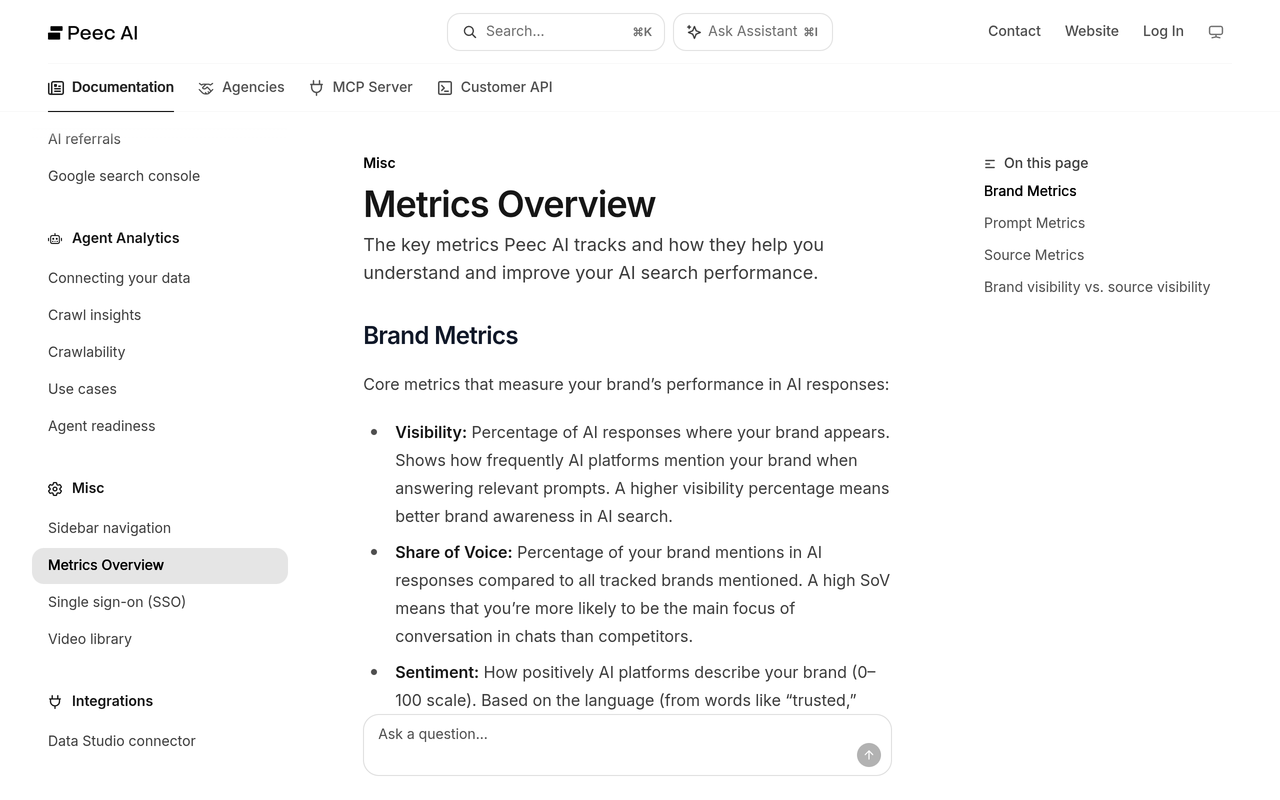
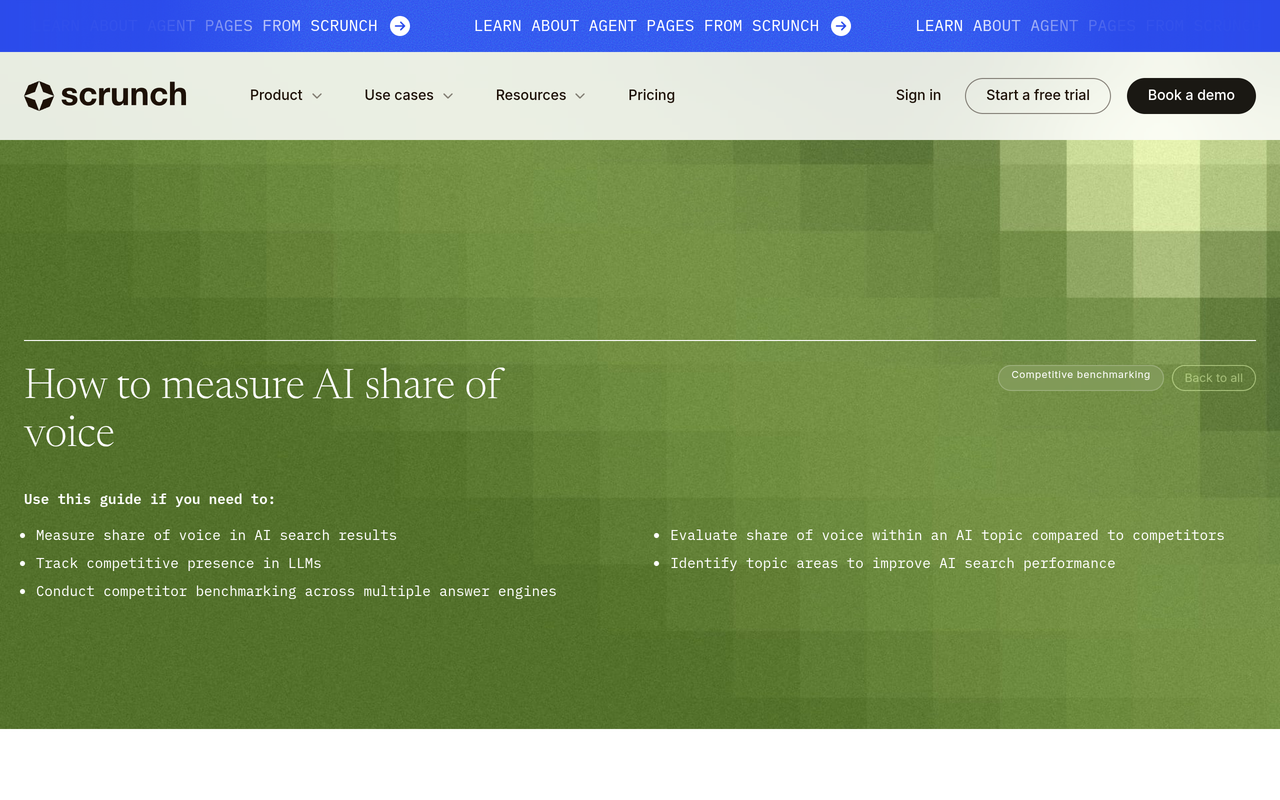
Vendors define the metric differently, so the numbers are not interchangeable. Peec AI's documentation describes visibility as the percentage of AI responses where your brand appears, and share of voice as your share of mentions compared with all tracked brands mentioned. Scrunch defines share of voice as the percentage of AI responses that mention your brand compared with competitors across tracked prompts, and tracks it across eight AI platforms, according to its how-to guide.
Semrush goes further in its enterprise product. Its AI share of voice there reflects the number of mentions and the position of your brand in the response, and for ChatGPT it also factors in the search volume of the topic. So a brand can hold a different score in each tool without any of them being wrong.
Rule of thumb: a share of voice figure is only comparable with another figure that uses the same prompts, engines, competitor set, time window and denominator.
The practical consequence is to write your definition down before the first run. A one-paragraph definition at the top of your tracking sheet saves every later argument about why the number moved.
What do the top-ranking guides cover, and what do they leave out?
We reviewed three of the pages that rank for this topic: the guides from Exposure Ninja, LLM Pulse and Scrunch. Between them they cover the definition, building a prompt bank, tracking mentions, the basic calculation, tool lists and a worked example. The Scrunch page is mostly a walkthrough of its own dashboard.
What they leave out is where this guide spends its time:
- A decision table for which denominator to use for which question.
- How to handle the randomness that SparkToro's research documented, with a repeat-run rule you can apply.
- A quality split of mentions, so a number that rises cannot hide a weak position.
- A four-week test plan with explicit decision thresholds you set in advance.
Can you trust a single AI answer? What the SparkToro research shows
No. In research published in January 2026, SparkToro, January 2026 described 600 volunteers running 12 prompts through ChatGPT, Claude and Google's AI tools, a combined 2,961 times. The finding that matters for measurement: there is less than a 1 in 100 chance that ChatGPT or Google's AI, asked 100 times, gives the same list of brands in any two responses.
The same research reaches a more useful conclusion. Rankings within a list are near random, but how often a brand appears across dozens or hundreds of runs of one prompt indicates how strongly the AI associates it with that intent. In the example SparkToro cites, one agency appeared in 85 of 95 responses from Google's AI for a consultant prompt, while a men's fashion influencer appeared in 36 of 73.
That gives the following standalone principle: SparkToro's January 2026 research indicates that AI brand lists differ in content, order and length on nearly every run, so share of voice should be calculated from repeated runs of a fixed prompt set rather than from any single answer.
It also explains why per-answer position is a weak input. If you use a position-weighted score, treat it as secondary to appearance frequency, and look at the average over many runs.
How do you calculate AI search share of voice, step by step?
This is the method we recommend, assembled from the practices described in the guides above and the SparkToro findings. Each step has an action, a result and a reason.
- Write the definition. List the prompts, engines, competitor set, time window and denominator. Result: a metric nobody can quietly change. Why: share of voice shifts with every one of those choices.
- Build the prompt set. Mix category prompts ("best X for Y"), problem prompts ("how do I fix Z") and comparison prompts ("A vs B"). LLM Pulse suggests 30 to 100 prompts for a full programme; our guide to which prompts to track shows how to choose them. Result: a representative buyer-question sample. Why: a poor prompt list produces a poor score.
- Name three to five competitors. Include the brands that appear in your category answers today, not only the rivals you worry about. Result: a defined denominator. Why: with no competitors you have a visibility score, not share of voice.
- Pick the engines your buyers use. Use at least ChatGPT, Gemini, Perplexity and Google AI Overviews, and add Claude if your audience uses it. Result: a per-engine view. Why: single-engine share of voice misleads.
- Run each prompt several times per engine. Record every brand named, and whether your domain is cited. Result: appearance frequency instead of an anecdote. Why: SparkToro found single runs almost never repeat.
- Calculate from raw counts. Add mentions per brand across all runs, then divide yours by the total for the tracked set. Calculate cross-engine share of voice from raw mention counts, as LLM Pulse advises, not by averaging percentages. Result: one headline figure plus a per-engine breakdown.
- Trend it and tag quality. Chart weekly, then split mentions into recommended, neutral and qualified (below). Result: a direction and a quality read. Why: a snapshot is not a verdict.
Worked example: share of voice, mention rate and citation rate from one dataset
LLM Pulse publishes a worked example we can use because every number comes from its page. A brand tracks 50 prompts across 5 AI models, which gives 250 evaluations in a week. The brand appears in the answer body in 38 evaluations and is cited in 22. Competitor A appears in 52 and Competitor B in 30.
| Brand | Body mentions | Share of voice (our arithmetic) |
|---|---|---|
| Brand X | 38 | 38 ÷ 120 = 31.7% |
| Competitor A | 52 | 52 ÷ 120 = 43.3% |
| Competitor B | 30 | 30 ÷ 120 = 25.0% |
LLM Pulse reports Brand X's mention rate as 38 ÷ 250 = 15.2% and citation rate as 22 ÷ 250 = 8.8%. Notice what the three numbers say together. The brand is named in roughly one of every seven answers, its site is cited less often than the brand is named, and it holds just under a third of mentions against two rivals.
Now the useful extension. Suppose a content push adds 10 mentions for Brand X and nothing else changes. The arithmetic gives 48 ÷ 130 = 36.9%, an increase of 5.2 percentage points from 10 extra mentions. This is an illustration of how the maths behaves, not a forecast. It shows that when your brand is a large part of the total, each new mention moves share of voice a little less than the one before.
The same page makes the per-engine point: a brand might score well on one engine and poorly on another, so the aggregate should never be the only figure you report.
Which denominator should you use? A decision table
This table is our own framework. It maps the question you need answered to the metric that answers it, so reports stop mixing denominators.
| If you need to know... | Use | Denominator | Watch out for |
|---|---|---|---|
| Are we visible at all? | Mention rate | All responses | Ignores competitors |
| Do AI engines use our pages as sources? | Citation rate | All responses | A brand can be named without being cited |
| Are we winning against named rivals? | Share of voice | Mentions of tracked brands | Changing the competitor set changes the score |
| Are we recommended early? | Position-weighted score | All responses | Order is highly random per answer |
| Is the mention helping us? | Quality split | Your own mentions | Needs consistent tagging rules |
What is a good AI search share of voice?
There is no universal good score. LLM Pulse states that share of voice changes with the prompt set, selected competitors, models, markets and brand density, and that the most useful benchmark is whether your share is growing or shrinking against named competitors. We agree, and we are deliberately not publishing a category percentage, because we could not find a sourced, methodologically comparable one.
Use this benchmarking ladder instead, and look at the AI search visibility benchmarks by category for published research context:
- Baseline: your first four weeks on a fixed prompt set.
- Relative: your share compared with each named competitor on the same prompts.
- Trend: change in percentage points per month, with the same definition throughout.
- Per engine: the gap between your best and worst engine, which tells you where to work.
A competitor drifting up while you stay flat is a loss even if your own number never moves. Tracking rivals is the point of the metric.
How do you separate good mentions from weak ones?
Raw share of voice counts a glowing recommendation and a throwaway mention the same way. Peec AI treats sentiment as its own brand metric for this reason. A practical version is a three-bucket tag applied to each mention of your brand.
| Bucket | What the answer does | What to do |
|---|---|---|
| Recommended | Names your brand as a fit, with a specific reason | Protect the pages and sources behind it |
| Neutral | Lists your brand alongside others without preference | Add differentiating, quotable facts to your pages |
| Qualified | Names your brand with a caveat, such as a limit or a downside | Find the source of the caveat and answer it directly |
Track all three over time. Rising recommended mentions with falling qualified mentions is a better sign than a higher total. The tagging is a judgement call, so write the rules once and apply them the same way every week.
Why does your own pages' citation data matter as much as the mention count?
A mention tells you that you won a slot. A citation tells you which page won it, and therefore what to protect and what to copy. This matters more for Google's AI features than for others, because ranking is a weaker guide to citation than it used to be. Search Engine Journal, 2026 reports an Ahrefs analysis of 863,000 keywords and 4 million AI Overview URLs, which found that 38% of cited pages also appeared in the top 10 for the same query, down from 76% in Ahrefs' earlier July study.
The implication for measurement: you cannot infer your AI Overview share of voice from your rankings. You need to observe the answers. Our guide to tracking Google AI Overviews covers that engine in detail.
How to run the manual method with a spreadsheet
A manual run is worth doing once, even imperfectly, to learn the shape of your category. It also shows you what a tool would be saving you.
- Create a sheet with columns: prompt, engine, run number, date, brands named in order, your brand named (yes or no), your domain cited (yes or no), quality bucket.
- Start with 20 prompts, split across category, problem and comparison types, and 3 engines.
- Run each prompt three times per engine in a fresh session with no logged-in history, so personalisation affects the result as little as possible. Our piece on personalisation in LLM responses explains why this matters.
- Tally mentions per brand, compute share of voice from raw totals, then mention rate and citation rate.
- Repeat weekly for four weeks and compare, using a threshold you set before you look at the data.
Be realistic about the cost. Twenty prompts, three engines and three runs each is 180 answers a week to read and tag. That is the point where most teams either shrink the prompt set until it is meaningless or move to automation.
A four-week test plan with decisions set in advance
Use this checklist to turn measurement into a test. It follows the logic in our guide to GEO experiment design.
- Week 0: write the definition, prompts, engines and competitor set. Decide in writing what change would count as real, for example a movement you will only act on if it holds for two consecutive weeks.
- Week 1: run the baseline. Do not change anything on your site.
- Week 2: repeat the baseline to measure normal noise. The gap between week 1 and week 2 is your noise floor.
- Week 3: ship one change to a defined group of pages, such as direct-answer rewrites on your category pages. Log the date.
- Week 4: re-run. Compare the movement with your noise floor and with your named competitors, then decide whether to extend, revert or change the test.
The noise-floor week is the step most guides skip, and it is the one that stops you from crediting a content change for what was ordinary variation. Pair this with the 4-week ChatGPT tracking test plan if you want a single-engine version first.
What are the most common mistakes when measuring AI share of voice?
- Counting one run. SparkToro's research shows lists differ almost every time, so one run proves nothing.
- Changing the competitor set midway. Adding a strong rival lowers your share without any change in your visibility.
- Averaging percentages across engines. Use raw counts, as LLM Pulse recommends.
- Using branded prompts only. Prompts that include your brand name guarantee mentions and inflate the score. Weight category and problem prompts.
- Treating a mention as a win. Check the quality bucket and the cited page.
- Reporting share of voice without traffic. LLM Pulse suggests cross-checking citation rate against referral traffic in analytics, to see whether exposure becomes visits.
Our AI search share of voice explainer and week-over-week visibility score guide go deeper on reporting.

How does Noma by Nurdd measure share of voice?
Noma by Nurdd is a web dashboard that tracks whether a brand appears in answers from 13 AI engines, including ChatGPT, Gemini, Perplexity and Claude, polled daily. It shows citation frequency by category, a competitor comparison and recommendations for improving AI visibility, and it records whether your brand is named and which page each citation comes from. That replaces the spreadsheet, the repeat runs and the tagging work described above. Noma offers a 3-day free trial: a card is taken at signup, billing starts on day 3, and you are not charged if you cancel before then.
Book a demo at https://www.nurdd.club/demo and we will show you your own brand's mentions, citations and competitor comparison on a prompt set built for your category.
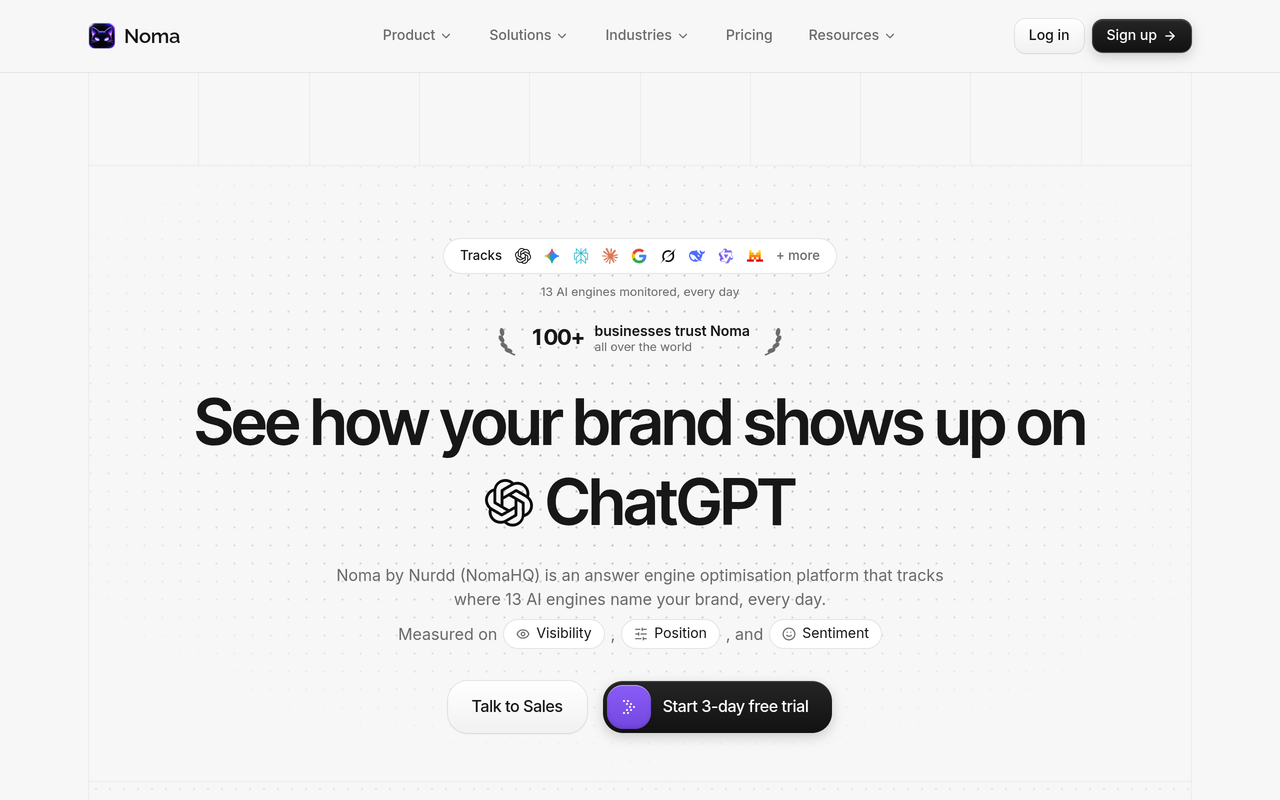
If you are comparing options, see Noma vs Peec AI, Noma vs Scrunch and Noma vs Profound, or our comparison of AI search visibility tools. Measurement is the first half of the work; the second is changing what the engines read, which Nurdd's team does through its generative engine optimization services and answer engine optimization agency, with results measured in Noma.
What should you do once you have a baseline?
Read the baseline in three layers. First, find the engines where your share is lowest, because that is where one fix has the largest effect. Second, open the pages cited for your competitors and compare them with yours. Third, test one change at a time, using the plan above.
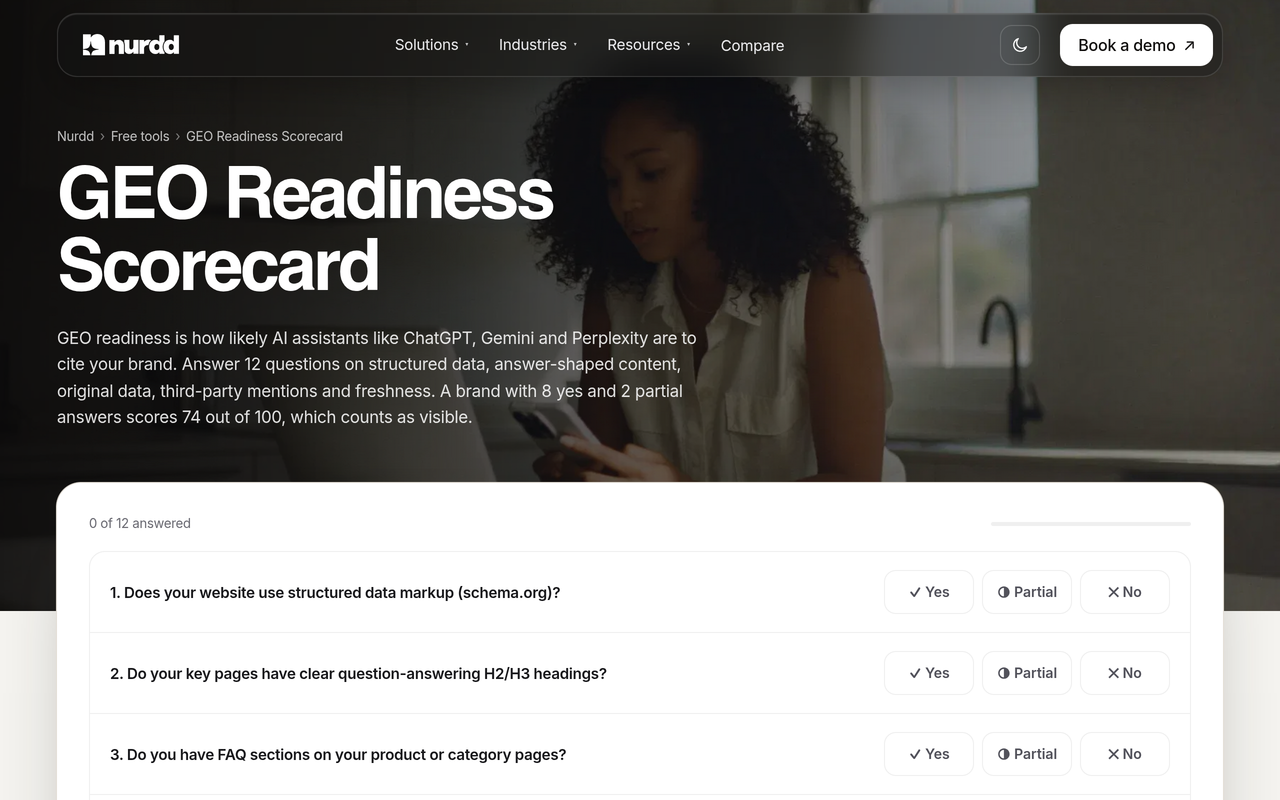
Good first changes are usually plain: answer the question in the first sentence of the page, name your brand in full rather than saying "we", and state facts a model can quote. Our guides on sentence structure that gets cited and getting ChatGPT to recommend your brand show how. You can also run the free GEO readiness scorecard to check 12 readiness factors before you start.
How we researched this
This article was written by Simran Rawat and updated from an earlier version on this page. We reviewed vendor documentation and guides from Peec AI, Scrunch, Semrush, LLM Pulse and Exposure Ninja, research published by SparkToro, and reporting on an Ahrefs study by Search Engine Journal. We checked each source and every figure against the live page on the publication date in November 2026. We did not run our own experiments, interview customers or collect proprietary data for this article; the worked example uses figures published by LLM Pulse and the arithmetic is ours. Where we could not find a sourced number, such as a category benchmark, we left it out.
Frequently asked questions
What is AI share of voice?
AI share of voice is the proportion of brand mentions in AI-generated answers that belong to your brand, compared with the competitors you track, across a fixed set of prompts and engines. It is expressed as a percentage and is best read as a trend.
What is the formula for AI share of voice?
Divide your brand's mentions by the total mentions of your brand and your tracked competitors, then multiply by 100. Semrush and LLM Pulse both publish this form. Mention rate and citation rate use total responses as the denominator instead, so keep them separate.
How many prompts do I need?
LLM Pulse suggests 30 to 100 prompts for a full programme, mixed across branded, category and comparison types. For a manual first run, 20 prompts across three engines is workable, as long as you repeat each prompt several times.
Why does my share of voice change from day to day?
AI answers vary by run. SparkToro's research found less than a 1 in 100 chance of the same brand list appearing twice across 100 asks of ChatGPT or Google's AI. Model updates, prompt wording and personalisation add further variation, which is why a noise-floor week matters.
Is share of voice the same as visibility?
No. Peec AI describes visibility as the percentage of responses where your brand appears, and share of voice as your share of mentions against all tracked brands. Visibility ignores competitors; share of voice depends on them.
Does ranking in Google predict being cited in AI Overviews?
Less than it used to. Search Engine Journal's report on Ahrefs' analysis found that 38% of cited pages also ranked in the top 10 for the same query, down from 76% in the earlier study. Measure the answers directly.
Can I measure AI share of voice without a tool?
Yes, with a spreadsheet, a fixed prompt set and repeat runs, as described above. It is slow and misses engine-level detail at scale. A tool such as Noma by Nurdd automates the polling, tagging and citation tracking across 13 AI engines.
How often should I measure it?
Weekly is a sensible cadence for a test, with a monthly summary for reporting. Daily polling helps a tool smooth out randomness, but the decision points should still be weekly or monthly trends.
Conclusion
AI search share of voice is worth tracking because it shows your position against named rivals in the answers buyers now read. It is only reliable when the definition is fixed, prompts are repeated, the denominator is stated and quality is tagged. Start with a four-week baseline, find your weakest engine, and change one thing at a time.
Ready to see your own numbers? Book a demo and we will walk through your brand's share of voice, cited pages and competitor comparison in Noma, built on prompts for your category. You can also explore Noma directly or browse the AI search glossary for terms used here.