AI Search Visibility
Agentic Search Optimisation for D2C Brands
AI shopping agents are beginning to discover, evaluate, and purchase products autonomously. What D2C brands need before agentic commerce goes mainstream.
 Simran Rawat6 Nov 20267 min read

The next evolution of AI search is not a better answer to a buyer's question. It is an AI agent that handles the entire discovery, evaluation, and purchase process on behalf of the buyer, with minimal human input. Perplexity's shopping mode, ChatGPT's Operator capabilities, and Google Gemini's agentic tasks are early versions of this. The brands whose product infrastructure is agent-readable will be discovered automatically. The brands whose infrastructure is not will be invisible by default.
How AI Shopping Agents Discover Products

What Agents Evaluate, and What They Ignore
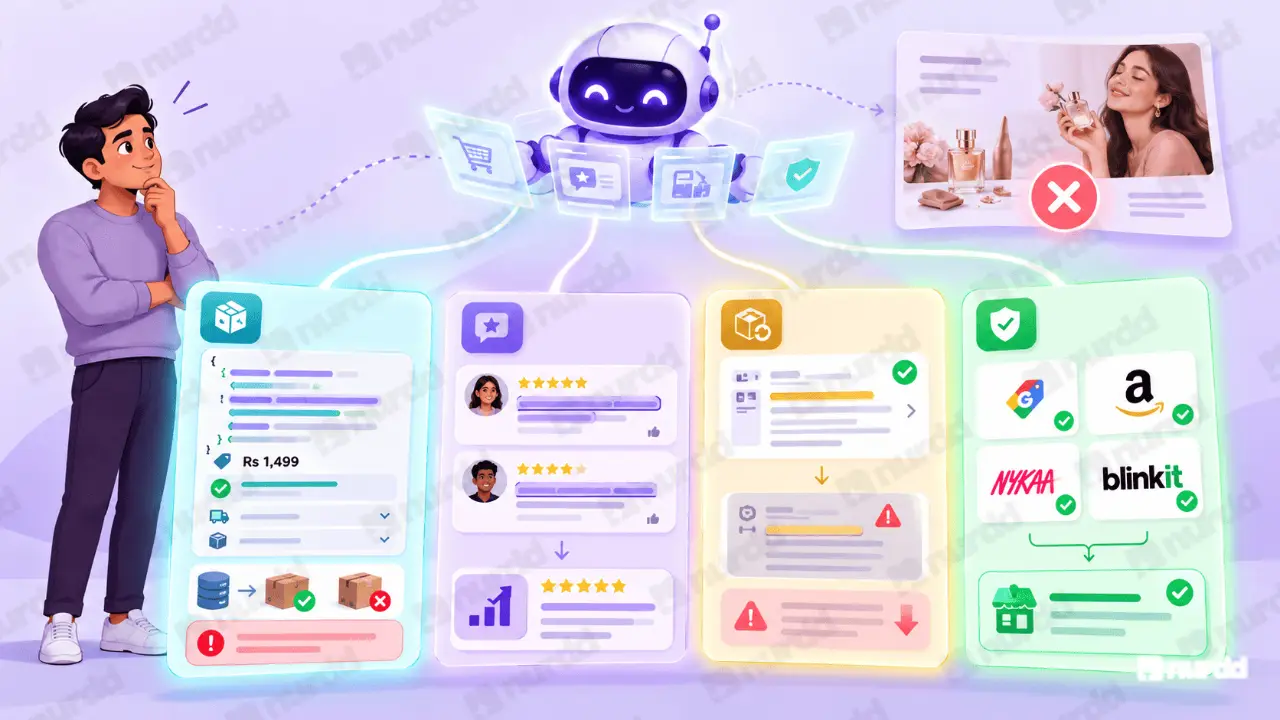
AI shopping agents do not browse the way humans do. They query structured data sources, product feeds, schema-marked pages, review aggregators, and price comparison APIs, and synthesise the results into a purchase decision.
An AI agent evaluating protein powder brands is not influenced by your brand's Instagram presence, the aesthetic quality of your homepage, or the emotional resonance of your brand story. It is evaluating: does this product have complete, machine-readable data? Does it have sufficient verified reviews with outcome specifics? Is the price and availability information accurate and current? Is the product in a trusted merchant's catalogue?
The Four Infrastructure Signals
What Agentic AI Weights Most Heavily
Structured product data. Complete schema.org Product markup on every page. For agentic commerce, the fields that matter most: price (must be current, not cached), availability (InStock/OutOfStock must update in real time), shippingDetails (delivery time and cost), and hasOffer (specific pricing conditions).
Review quality, not just volume. AI agents parse review content for outcome specificity. "Great product" is weighted less than "saw visible reduction in dark spots within 5 weeks of daily use." The ratio of outcome-specific reviews to generic reviews matters.
Return and refund policy clarity. AI agents evaluating purchase risk on behalf of users weight clear, findable, generous return policies significantly. Buried return policies may cause an agent to deprioritise your product as higher-risk.
Merchant trust signals. Presence in Google Shopping, Bing Shopping, and established marketplaces such as Amazon signals legitimacy. A D2C brand selling only on its own website has fewer trust signals available for agent evaluation.
Why This Changes the D2C Discovery Model Fundamentally
The Consideration Stage You Will No Longer Control
In the traditional D2C model, brands control the experience at every stage: awareness → consideration → purchase. In the agentic model, a buyer tells an AI agent "find me the best protein powder for muscle gain under $25 that delivers in 2 days", and the agent handles every step. The brand has no opportunity to influence the consideration stage.
Brands that over-invested in consideration-stage persuasion (beautiful product pages, strong email nurture sequences, retargeting) and under-invested in structured data infrastructure will lose disproportionately in the agentic era. Both matter, but for different audiences.
What to Build in the Next 90 Days
The Agentic Readiness Checklist
Most D2C brands are not yet in the full agentic commerce era. But the infrastructure that prepares you for agentic AI also improves your AI search citation rates right now, so the investment is not speculative. It returns value in the present and compounds into the agentic future.
Month 1, Data foundation:
Implement complete schema.org Product markup on all product pages, name, description, price, availability, aggregateRating, brand, image, shippingDetails
Ensure availability status updates in real time with inventory, a cached "InStock" on an out-of-stock product is worse than no schema at all for agent evaluation
Submit product catalogue to Microsoft Merchant Center (Bing) if not already done
Month 2, Trust signals:
Audit your return and refund policy page, ensure it is findable within one click from any product page and clearly states the terms without buried exceptions
If not listed on at least one major marketplace, evaluate a marketplace listing such as Amazon for the trust signal value alone, not just the channel revenue
Month 3, Review quality:
Begin the 30-day and 60-day post-purchase review request sequences described in Blog 04
Specifically ask reviewers to describe the outcome they experienced, not how they feel about the product. Outcome language is what agentic AI weights most heavily.
Market Differences
Why Agentic Commerce Will Look Different Market to Market
Agentic commerce will not look identical in every market. Three local factors change both the timeline and the strategic implications for D2C brands.
Quick commerce as the default fulfilment layer. In markets where quick-commerce apps are widespread, when a buyer tells an AI agent to "order the best protein powder for muscle gain, deliver today," the agent's natural fulfilment path will be through those apps, not a D2C website with 2 to 5 day delivery. This means your quick commerce listing quality, accurate inventory data, and pricing on those platforms directly affects agentic selection, not just your own website's structured data.
Payment infrastructure. Agentic purchases require seamless payment execution. Real-time payment rails and payment providers with published developer APIs make agentic transactions easier where they exist. Brands whose checkout flows are API-accessible are better positioned for agentic commerce than brands requiring human-navigated checkout sequences.
Retailer-owned AI layers. Large retailers and marketplaces are building their own shopping assistants on top of their catalogues. For brands distributed through those ecosystems, the retailer's selection criteria can matter as much as ChatGPT's or Perplexity's, and the retailer's own catalogue format may differ from the schema.org standards used on the open web.
"In agentic commerce, your brand story is not evaluated. Your product data is. The story is for humans. The data is for agents. You need both, but not for the same audience."

FAQ
Frequently Asked Questions
What is agentic search optimisation?
Agentic search optimisation is the practice of making your product data, pricing, availability, and trust signals machine-readable so AI shopping agents can evaluate, select, and purchase your products on behalf of buyers with minimal human input. It differs from traditional GEO in that it optimises for agent decision-making criteria rather than human-readable content.
How do AI shopping agents select products?
AI shopping agents query structured data sources including product feeds, schema-marked pages, review aggregators, and price comparison APIs. They evaluate product data completeness, review quality with outcome-specific language, return policy clarity, real-time inventory accuracy, and presence in trusted merchant catalogues. Brand story and aesthetic design are not evaluated.
Is agentic commerce relevant for D2C brands in 2026?
Early versions are already active. Perplexity's shopping mode, ChatGPT's Operator capabilities, and Google Gemini's agentic tasks are live in the US and expanding, and retailer-owned shopping assistants are emerging alongside them. Brands preparing now will be positioned when agentic commerce becomes mainstream in their markets.
What product data do I need for agentic AI selection?
Complete schema.org Product markup with real-time price and availability updates, aggregateRating with above 50 outcome-specific reviews, shippingDetails with accurate delivery windows, a clear and findable return policy, and presence in at least one major marketplace catalogue such as Amazon for merchant trust signals.
Sources and References
Promptwatch – Agentic search optimisation: how AI agents select products
Perplexity AI – Perplexity Shopping: product selection methodology
Google – Gemini Tasks and agentic commerce: developer documentation
Nurdd / Noma – Agentic search optimisation for D2C brands: infrastructure guide