AI Search Visibility
AI Discovery Tools for Ecommerce: How to Pick One
How to choose AI discovery tools for ecommerce: track product prompts, citation sources and competitor share across ChatGPT, Perplexity and Google AI Mode.
 Simran Rawat5 Nov 202616 min read

AI discovery tools for ecommerce show whether your products are named and linked in answers from ChatGPT, Perplexity, Gemini and Google AI Mode. Choose one that tracks your own product prompts, shows the cited source for each mention, measures competitor share and reports per engine. Noma by Nurdd does this across 13 AI engines, polled daily.
AI discovery tools for ecommerce are software that show whether your products are named, linked and recommended when shoppers ask ChatGPT, Perplexity, Gemini or Google AI Mode what to buy. Pick one by testing four things: the product prompts it tracks, the citation source behind each mention, competitor share, and whether results are split by engine. This guide gives you a scorecard and a seven-step process.
Key takeaways
- "AI discovery" means two different tool types: on-site search and recommendation engines, and off-site monitors that track your products in AI answers. This guide covers the second type.
- Choose a tool that reports per engine, not one blended score. MarketScale, November 2026 reports that Google AI Mode and Gemini sent shoppers to very different places.
- Demand the citation source for every mention. A mention without a URL tells you that you appeared, not why.
- Track competitor share on the same prompts, because an answer that names three brands is a share contest, not a pass/fail test.
- Pair monitoring with feed hygiene: ChatGPT, Google and Perplexity each take structured product data from merchants, and gaps there show up as missing products.
- Run a one-week audit with the checklist below before you buy anything, so you know what you need the tool to prove.
What are AI discovery tools for ecommerce, and which type do you need?
The phrase covers two jobs that share a name. The first is on-site discovery: search, recommendations and merchandising that help a visitor who is already in your store find a product. Vendors such as Constructor describe this as AI ecommerce search and product discovery, and Syte positions its product discovery platform for apparel stores.
The second job is off-site: finding out whether AI assistants mention your products before the shopper ever reaches your store. That is the job this guide is about, and it is the one most teams cannot see in their analytics. Triple Whale, November 2026 breaks AI visibility into three measurable parts: mentions, sentiment and citations.
| Question you are asking | Tool type | What it measures | Example outputs |
|---|---|---|---|
| Can shoppers on my site find the right product? | On-site AI search and recommendations | Search relevance, conversion on your own pages | Zero-result queries, ranking rules, merchandising |
| Do AI assistants name my products before shoppers reach my site? | AI search visibility monitor | Mentions, citations and competitor share in AI answers | Prompt-level appearance, cited URLs, share against rivals |
| Are my product data and feed accepted by AI shopping surfaces? | Feed and catalog management | Field completeness, disapprovals, sync status | Merchant Center diagnostics, product feed validation |
| Which AI answers send me traffic or sales? | Analytics and attribution | Referral sessions and orders | Referral reports, UTM segments |
Most buying guides blur these rows. If your question is the second row, a search-relevance tool will not help, and a feed tool will not tell you what ChatGPT said about your competitor. For the broader definition, see what generative engine optimization is.
The top-ranking buyer guides on this topic, from Yotpo and Alhena AI, are ranked lists of ten and twelve tools. They help you build a shortlist, but they rarely tell you how to test a tool against your own catalog. The sections below add that missing step: a scorecard, a worked example and an audit you can run first.
Why is product visibility in AI answers so hard to measure?
Because the answer surfaces behave differently, and a single number hides it. In a Findrix study of 55,198 AI answers, reported by MarketScale, November 2026, Google AI Mode sent 57% of its product-answer links to Google Shopping pages. The same report says none of the Gemini links Findrix measured went to google.com.
Findrix measured 55,198 AI answers: Google AI Mode sent 57% of product-answer links to Google Shopping pages, and ChatGPT product answers showed Walmart in 45.1% of cases and Amazon in 6.1% (MarketScale, November 2026).
Category matters as well. MarketScale, November 2026 reports that Google AI Mode linked only to Google pages in 60.4% of swimwear answers, against 7.6% for sports nutrition and 1.1% of software links. A swimwear brand and a supplement brand therefore need different readings of the same "visibility" metric.

Classic Shopping rank does not carry over either. According to Productrise data reported by MarketScale, November 2026, AI Mode showed an average of 3.9 products per query against 27.8 for the Popular products carousel, and only 1.28% of carousel products also appeared in AI Mode on average each day. That study ran from August 9 to August 31, 2026, in the U.S. and U.K.
Prices and sellers moved too. The same report says the first-listed price differed on 38.1% of matched products and that a different seller was listed first on 49.6% of them. If you sell through resellers, your product can be visible while someone else collects the sale, and only a tool that records the cited seller or URL will show it.
How do you pick an AI discovery tool for ecommerce? Seven steps
Step 1: Decide which AI surfaces matter for your catalog
Action: list the surfaces where your category is bought: ChatGPT shopping results, Perplexity, Google AI Mode and AI Overviews, Gemini, Claude and others. Result: a short list of engines the tool must cover. Why: the MarketScale, November 2026 data shows engines route shoppers to different destinations, so coverage gaps become blind spots rather than rounding errors.
Ask any vendor for the exact engine list, not a count of "models". Noma by Nurdd covers 13 AI engines, including ChatGPT, Gemini, Perplexity and Claude, and polls them daily. Compare that with the surfaces you wrote down; the Perplexity vs ChatGPT vs Gemini comparison helps you rank them for your category.
Step 2: Build a product prompt set before you open a demo
Action: write 20 to 40 prompts shoppers would type, in four groups: category ("best moisturiser for dry skin"), comparison ("brand A vs brand B"), use case ("gift under a set budget"), and problem ("sunscreen that does not leave a white cast"). Result: a test set you can hand to every vendor. Why: a tool that only tracks your brand name measures awareness, not the product-level discovery that drives a purchase.
The guide to which prompts to track covers prompt selection in more detail. Keep the set stable for at least a month so week-to-week changes mean something.
Step 3: Require the citation source behind every mention
Action: in the trial, open five answers where your product appears and five where it does not, and check that the tool shows the cited page. Result: a clear view of which third-party pages, retailer listings or feeds the engine relied on. Why: a mention with no source gives you nothing to fix, while a source tells you where to earn coverage.
The OpenAI Help Center, November 2026 says product results in ChatGPT are selected independently and are not ads, and that merchants can supply a direct product feed. Because selection is independent, the only way to learn what influenced an answer is to record the sources it shows.
Step 4: Measure competitor share on the same prompts
Action: for each prompt, count how many brands the answer names and where yours sits. Result: a share figure per prompt group, such as "named in 6 of 20 comparison prompts, competitors named in 14". Why: shopping answers usually list several options, so your absolute presence matters less than your presence relative to named rivals.
Read how to measure AI search share of voice before you fix a definition, and make the vendor show how it counts a brand named second or third. Competitor comparison is also a core part of Noma, alongside citation frequency by category.
Step 5: Insist on per-engine reporting, not a blended score
Action: ask for results split by engine and, for Google surfaces, by AI Mode versus AI Overviews. Result: a table where a gap on one engine is visible. Why: MarketScale, November 2026 says a blended score could average a surface that keeps shoppers inside Google Shopping with one that sends them to a big retailer.
Also check how Google surfaces are tracked; the guide to tracking Google AI Overviews lists what to look for.
Step 6: Check sampling, cadence and personalisation handling
Action: ask how often each prompt is run, how many runs back each reported figure, and how location and account history are handled. Result: a clear idea of how noisy the reported movement will be. Why: AI answers vary between runs, so one daily snapshot can overstate a change.
The article on whether personalization changes AI answers explains why this matters. Noma polls its engines daily, which gives you a trend line rather than a single reading.
Step 7: Connect monitoring to the fixes you can actually make
Action: list what you would change if a product were missing: feed fields, product page copy, review coverage, third-party listings. Ask the vendor which of those its recommendations address. Result: a tool judged by actions, not charts. Why: the OpenAI developer documentation, November 2026 describes required feed fields for price and availability and recommended attributes such as rich media and reviews, so the fix often lives in your data.
If you want help beyond software, Nurdd's generative engine optimization services work on the content and sources AI engines read, measured in Noma.
Which questions should you ask every vendor?
Use these in any demo. A vendor that answers each one with a screen, not a slide, has passed the first filter.
- Can I load my own product prompts, and are they run exactly as written?
- Which engines are covered, and can I see each separately?
- For one answer, can you show the full cited URL and the competitor brands named?
- How often is each prompt run, and what happens when two runs disagree?
- How do you treat a brand that is named but not linked?
- What does the trial include, what does it cost afterwards, and when does billing start?
- Which recommendations come from the cited sources and which are generic?
Pricing is the one area where vendors differ most in transparency. Record the price shown on the vendor's own page and the date you checked it, because AI visibility pricing changes often and third-party roundups go stale quickly.
How should you score tools? A 100-point scorecard
Use this scorecard to compare any two tools on equal terms. It weights the criteria above by how much each changes a buying decision for a catalog business. Score each row from 0 to the maximum, then add up.
| Criterion | Max points | Full marks means | Zero means |
|---|---|---|---|
| Engine coverage | 20 | Every surface on your Step 1 list, reported separately | Only one or two engines, or a blended count |
| Product-level prompts | 20 | Your Step 2 prompt set loads and runs as written | Brand-name tracking only |
| Citation sources | 20 | A cited URL for every answer, filterable by domain | Mention counts with no source |
| Competitor share | 15 | Named rivals per prompt group, trended over time | No competitor view |
| Cadence and sampling | 10 | Daily polling and a stated approach to run-to-run variation | Undisclosed or monthly refresh |
| Recommendations | 10 | Specific actions tied to the sources found | Dashboard only |
| Pricing clarity and trial | 5 | Published pricing and a trial you can test the prompt set on | Sales call required to see a price |
A score above 80 means the tool can answer the two questions that matter: where do my products appear, and who appears instead. Below 60, you are buying a dashboard. Tools that fail the prompt-level and citation rows rarely recover on the others, because those two rows decide whether the data is usable at all.
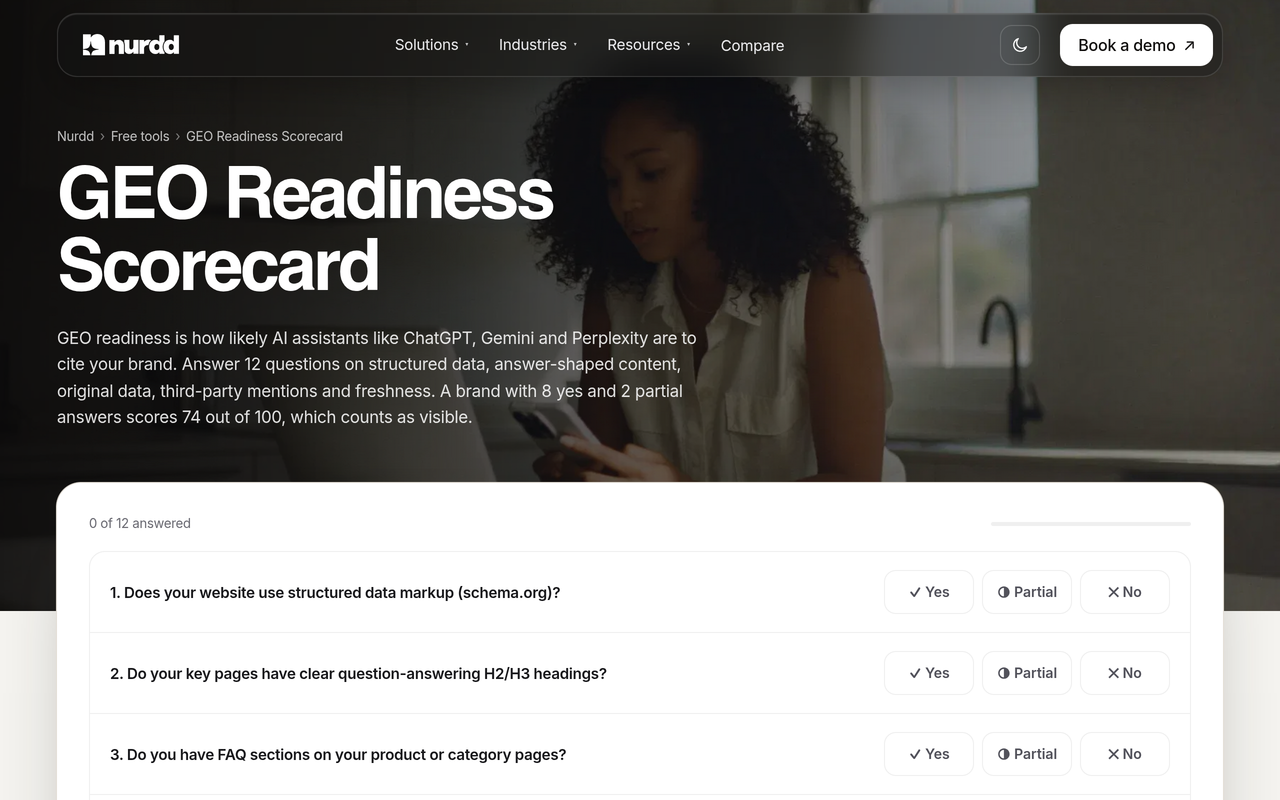
You can sanity-check your own readiness first with the free GEO readiness scorecard, which covers 12 factors on your site.
Worked example: what public numbers say about a swimwear brand and a supplement brand
Take two hypothetical brands, used only to show the arithmetic on published figures. According to MarketScale, November 2026, Google AI Mode linked only to Google pages in 60.4% of swimwear answers, so about 39.6% of swimwear answers (100 minus 60.4) included a link outside Google. For sports nutrition, the Google-only share was 7.6%, so about 92.4% of answers linked outward.
| Measure (Google AI Mode, Findrix data) | Swimwear | Sports nutrition | What it means for tool choice |
|---|---|---|---|
| Answers linking only to Google pages | 60.4% | 7.6% | Swimwear: feed quality is the lever |
| Answers with at least one outside link (calculated) | 39.6% | 92.4% | Supplements: third-party pages matter more |
| Tool feature to prioritise | Feed and Shopping data checks plus engine-level tracking | Citation source and domain reporting | Weight scorecard rows accordingly |
Now add the slot arithmetic. AI Mode showed 3.9 products per query against 27.8 in the carousel, per MarketScale, November 2026; 3.9 divided by 27.8 is about 14%, so AI Mode offers roughly one-seventh as many positions. A brand that held a mid-table carousel position cannot assume a slot, and needs a tool that checks AI Mode directly. The percentages above are calculated from the published figures; they are not Nurdd measurements.
First-week audit checklist before you buy
Run this before any demo. It takes a few hours and gives you the benchmark that every vendor result should be compared against.
- List your top 10 products by revenue and your top 3 competitors for each.
- Write 20 prompts across category, comparison, use case and problem groups.
- Run each prompt by hand in ChatGPT, Perplexity and Google AI Mode, and note which brands appear and which URLs are shown.
- Record whether each product appears with the right price and availability.
- Check your feed status in Google Merchant Center and, if you sell on Shopify, confirm which AI channels are switched on.
- Mark the five prompts with the biggest gap between you and a competitor.
- Load the same prompts into each trial and compare the tool output with your manual notes.
- Score each tool on the 100-point scorecard and record the date.
The GEO experiment design guide shows how to change one variable at a time once you have a baseline, and the four-week ChatGPT test plan gives a lightweight routine.
How do the feed rules of ChatGPT, Google and Perplexity affect what a tool should show?
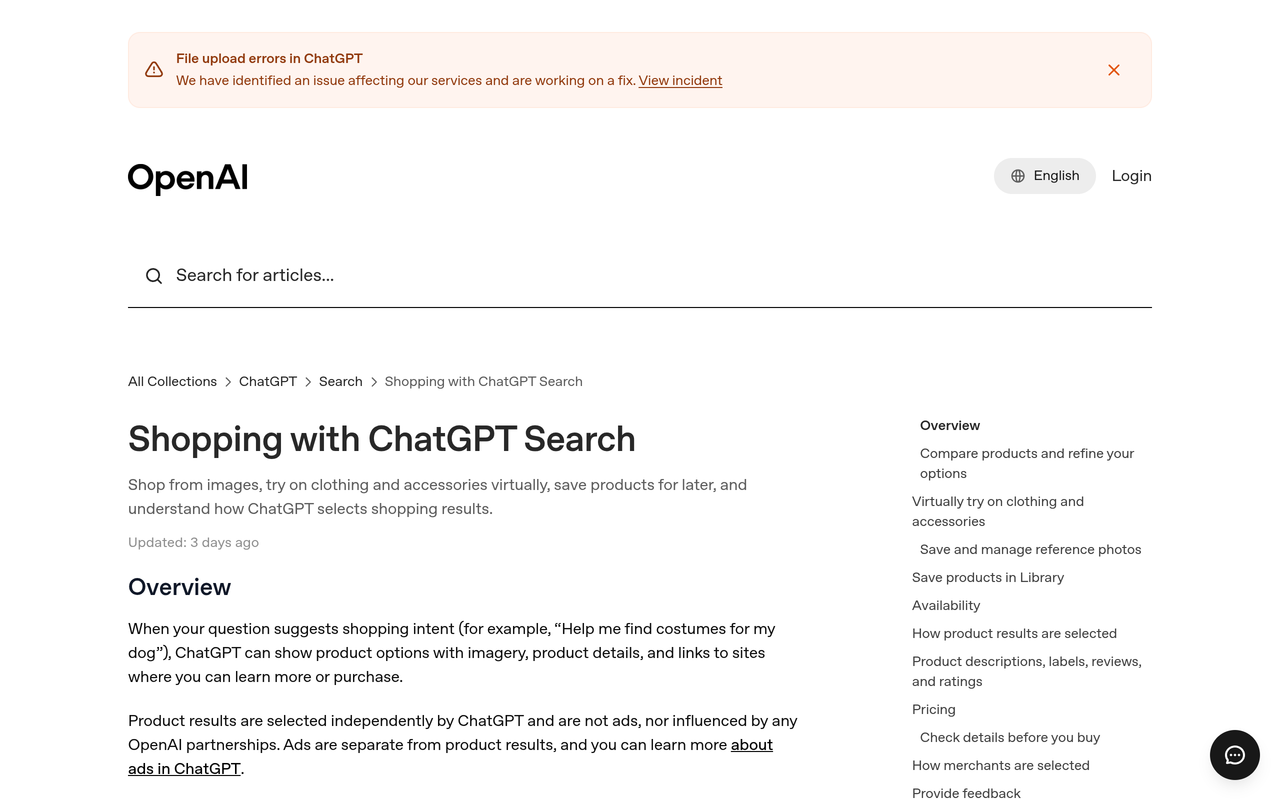
Each surface takes product data from merchants in its own way, and a good tool helps you see the result. The OpenAI developer documentation, November 2026 says merchants provide a regularly refreshed feed in CSV or JSON with identifiers, descriptions, pricing, inventory, media and fulfilment options, and that integration involves a sample feed for validation and daily snapshots. The OpenAI Help Center, November 2026 adds that Shopify merchants are already integrated through Shopify Catalog.
For Google, Shopify, November 2026 explains that AI shopping experiences rely on Merchant Center data, which feeds the Shopping Graph of more than 50 billion listings, and that listings breaching data specifications can be disapproved. For Perplexity, Shopify, November 2026 says the Perplexity Merchant Program is free, that Perplexity has not published a detailed ranking algorithm, and that Shopify merchant data can sync through Shopify.
| Surface | How merchant data gets in | What to check in a monitoring tool |
|---|---|---|
| ChatGPT | Direct product feed, or Shopify Catalog for Shopify merchants | Product named, price and availability shown, cited sellers |
| Google AI Mode | Merchant Center feed feeding the Shopping Graph | Whether answers link to Google Shopping or to your site |
| Perplexity | Merchant Program, or Shopify sync | Cited sources and competitor listings |
Feeds are the supply side; monitoring is the measurement side. For feed specifics, read ChatGPT Shopping optimization: US vs Europe feed setup and what moves a product up in ChatGPT Shopping. Traffic questions are covered in how to get traffic from Perplexity.
How do on-site and off-site tools work together?
On-site discovery tools improve what happens after a click, and AI visibility tools influence whether the click happens. Treat them as a sequence: an assistant names your product, the shopper lands on a product page, and your on-site search and recommendations take over. A weak product page can waste a strong AI mention, and a strong page cannot rescue a product that no assistant names.
That is why the buying order matters. If your products are missing from AI answers, fix visibility before investing in on-site personalisation; if they appear but the visits do not convert, the problem sits on your site. A monitor tells you which situation you are in, and the AI search metrics reporting guide shows how to report both sides together.
What mistakes do ecommerce teams make when choosing a tool?
- Buying on prompt volume. A tool that tracks 500 prompts you did not write measures someone else's catalog. Start from your own product prompt set.
- Trusting a blended score. One figure across engines hides which surface is failing.
- Ignoring the seller. A product named with a reseller's URL is a different result from one linking to your store.
- Treating referral traffic as visibility. MarketScale, November 2026 notes that referral traffic alone will not show how visible a catalog is in AI Mode.
- Skipping the baseline. Without a manual audit you cannot tell whether a trial's numbers are right.
- Counting on one statistic. See which AI search statistics you can safely cite before putting any number in a board deck.
How does Noma measure product visibility across 13 AI engines?
Noma by Nurdd is a web dashboard that tracks whether a brand appears in answers from 13 AI engines, including ChatGPT, Gemini, Perplexity and Claude, polled daily. It records whether your brand is named and which page each citation comes from, shows citation frequency by category and competitor comparison, and gives recommendations to improve AI visibility. For ecommerce teams, Noma answers the two questions this guide is built on: are we named, and who is named instead.
Book a demo at nurdd.club/demo and bring your product prompt set: you will see how your own brand and your closest competitors appear across the 13 engines, and which cited pages sit behind those answers.
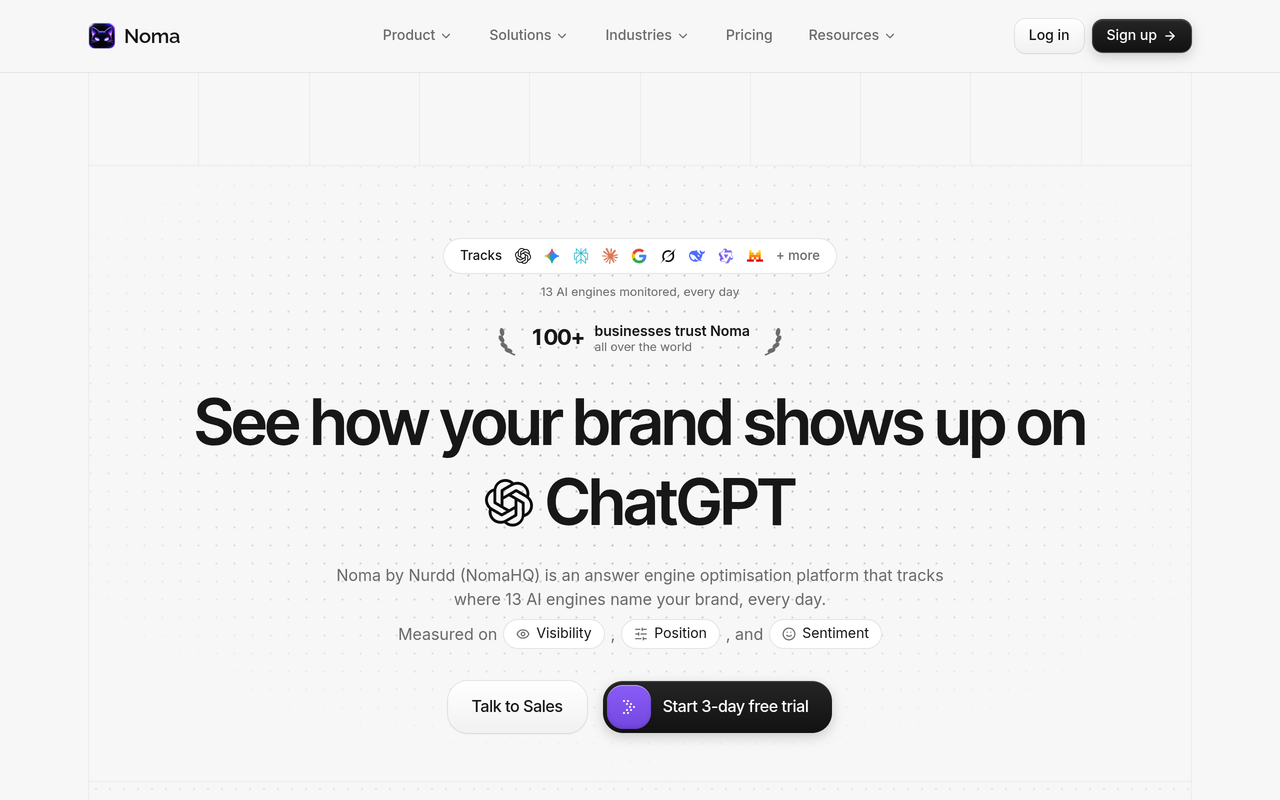
Noma has a 3-day free trial. A card is taken at signup and billing starts on day 3; if you cancel before then, you are not charged. That is long enough to load your prompt set and run Step 3 and Step 4 against your manual audit. See how it compares in Noma vs Profound, Noma vs Peec AI and Noma vs AthenaHQ.
Ask in the demo how your product-level questions map onto the category and prompt views, since the best test is your own catalog. Other pages worth reading: how to choose ecommerce GEO tools and Nurdd for ecommerce.
How we researched this
We reviewed the top-ranking articles on this keyword, including buyer guides from Yotpo and Alhena AI, which list ten and twelve tools respectively, and Triple Whale's AI visibility playbook. We then reviewed platform documentation from OpenAI, Shopify's guides to Google and Perplexity shopping, and a November 2026 MarketScale report on the Findrix and Productrise studies. All pages were checked on the publication date. We did not run hands-on tests of rival tools, so the scorecard is a framework for your own trial and not a ranking of vendors. Figures in the worked example are calculated from published numbers.
What should you do next?
Write your product prompt set, run the first-week audit, and score two or three tools on the same scorecard. Pick the one that shows a cited source for every answer and splits results by engine.
When you are ready to see your own products, book a Noma demo. You will see which of your products appear across 13 AI engines, which competitors appear beside them, and which pages the engines cite. You can also explore the product at nomahq.app, or browse the free Nurdd tools first.
Frequently asked questions
What tools show if my ecommerce products appear in AI answers?
AI search visibility monitors run shopper-style prompts across AI engines and record which brands and URLs appear. Noma by Nurdd does this across 13 AI engines, including ChatGPT, Gemini, Perplexity and Claude. Feed tools and analytics add supply and traffic views but do not show the answer itself.
How do I track product visibility in ChatGPT and Perplexity?
Write 20 to 40 shopper prompts, run them in each engine, and record which brands and links appear. A monitoring tool automates this daily and trends the result. Keep the prompt set fixed for a month so changes are comparable.
Are AI discovery tools the same as AI product search tools?
No. On-site search and recommendation tools help visitors inside your store, while AI visibility tools measure whether assistants name your products outside it. Many vendors use "AI discovery" for both, so ask which one a demo covers.
Do I need a product feed to appear in ChatGPT shopping?
Not strictly, but the OpenAI Help Center, November 2026 says merchants can supply a direct product feed so ChatGPT reflects current information, and Shopify merchants are integrated through Shopify Catalog. A clean feed improves the accuracy of price and availability.
Why does my product show in Google Shopping but not in AI Mode?
The two are different contests. According to Productrise data reported by MarketScale, November 2026, only 1.28% of carousel products also appeared in AI Mode on average each day. AI Mode also shows far fewer products per query.
How often should AI product visibility be measured?
Daily polling gives a trend, and weekly review is enough for most teams. Because answers vary between runs, judge changes over several days rather than one reading. Noma polls its engines daily.
Does Noma have a free trial?
Yes. Noma has a 3-day free trial; a card is taken at signup and billing starts on day 3, with no charge if you cancel before then.
What is a good AI visibility score for ecommerce?
There is no universal benchmark, and numbers vary by category and prompt set. Compare your share against named competitors on identical prompts instead. The published AI search visibility benchmarks show what research has reported so far.