AI Search Visibility
What AI Engines Actually Say About Your D2C Brand
AI engines don't just cite your brand, they describe it. Here's how to audit AI sentiment, spot negative characterisations, and correct them.
 Simran Rawat4 Nov 20267 min read
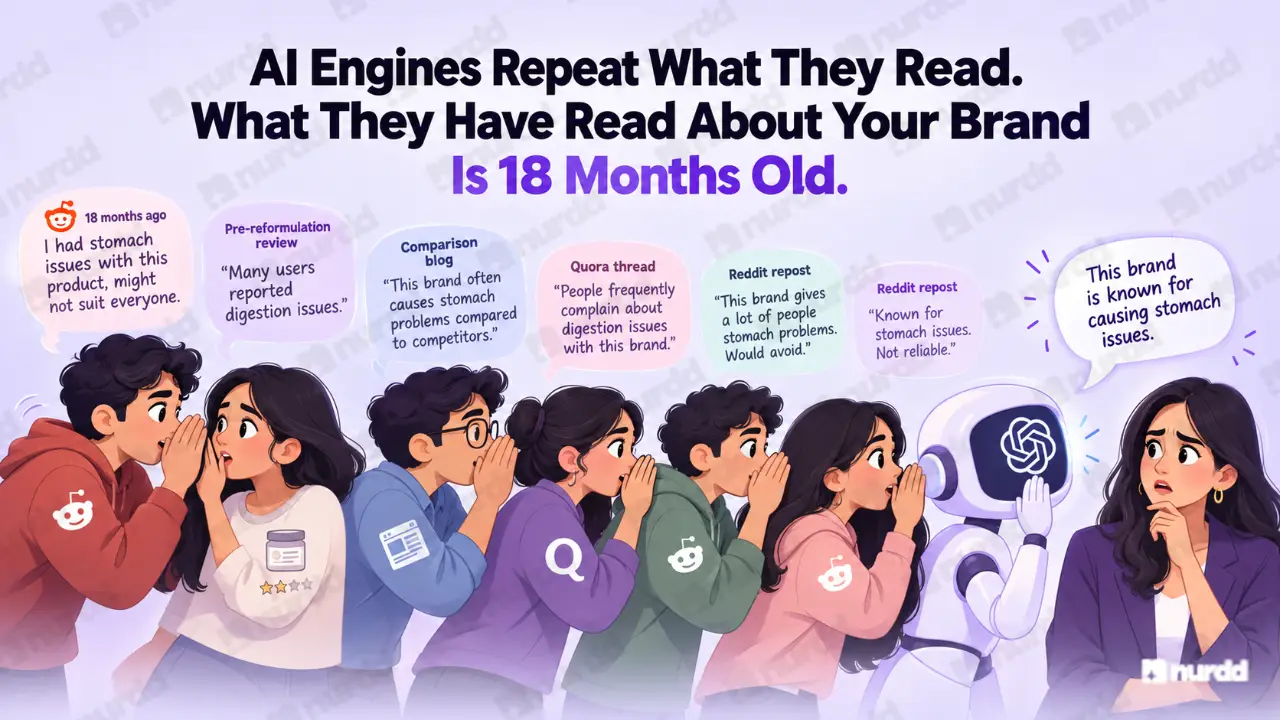
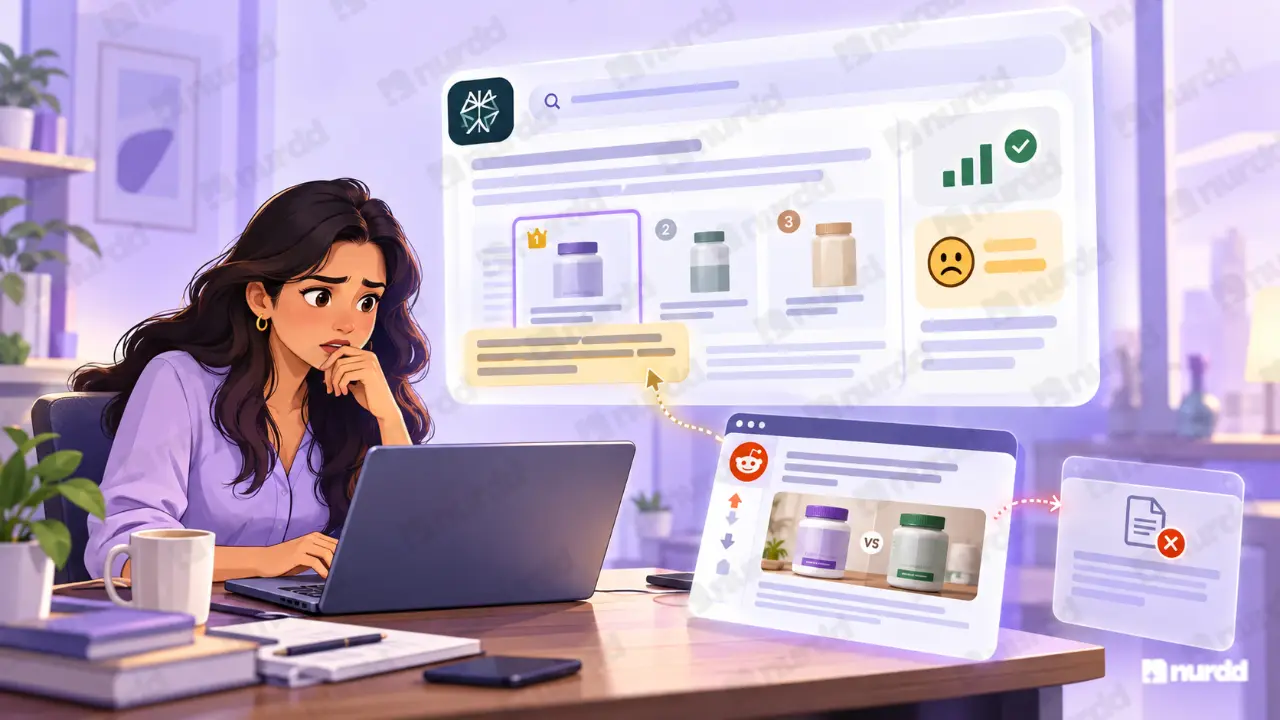
Appearing in AI search answers is not the same as appearing well. An AI engine that mentions your brand as "a budget option for price-sensitive buyers who cannot afford premium alternatives" has technically cited you, and done meaningful damage. Citation rate is the basic metric. Sentiment is the one that actually determines whether AI citations are helping or hurting your brand.
The Four Sentiment Types
How to Classify Every AI Brand Mention
Type | Example Language | Business Impact | Action |
|---|---|---|---|
Positive Endorsement | "Brand X is one of the better options for oily skin, their 2% salicylic acid formula is well-reviewed and competitively priced." | Drives discovery and purchase consideration | Identify the source and replicate the content pattern |
Neutral Inclusion | "Brands in this space include Brand X, Brand Y, and Brand Z." | Awareness value only, no conversion lift | Build more specific content to move from neutral to positive |
Qualified Mention | "Brand X is worth considering if budget is a constraint, though the formulation lacks clinical backing." | Actively positions your brand below competitors | Trace and address the source of the caveat |
Inaccurate Mention | Wrong price, discontinued product, incorrect ingredient concentration, confused with a competitor | Direct reputational damage | Correct source content, see correction actions below |
Running the Audit
Four Steps to a Brand Sentiment Audit
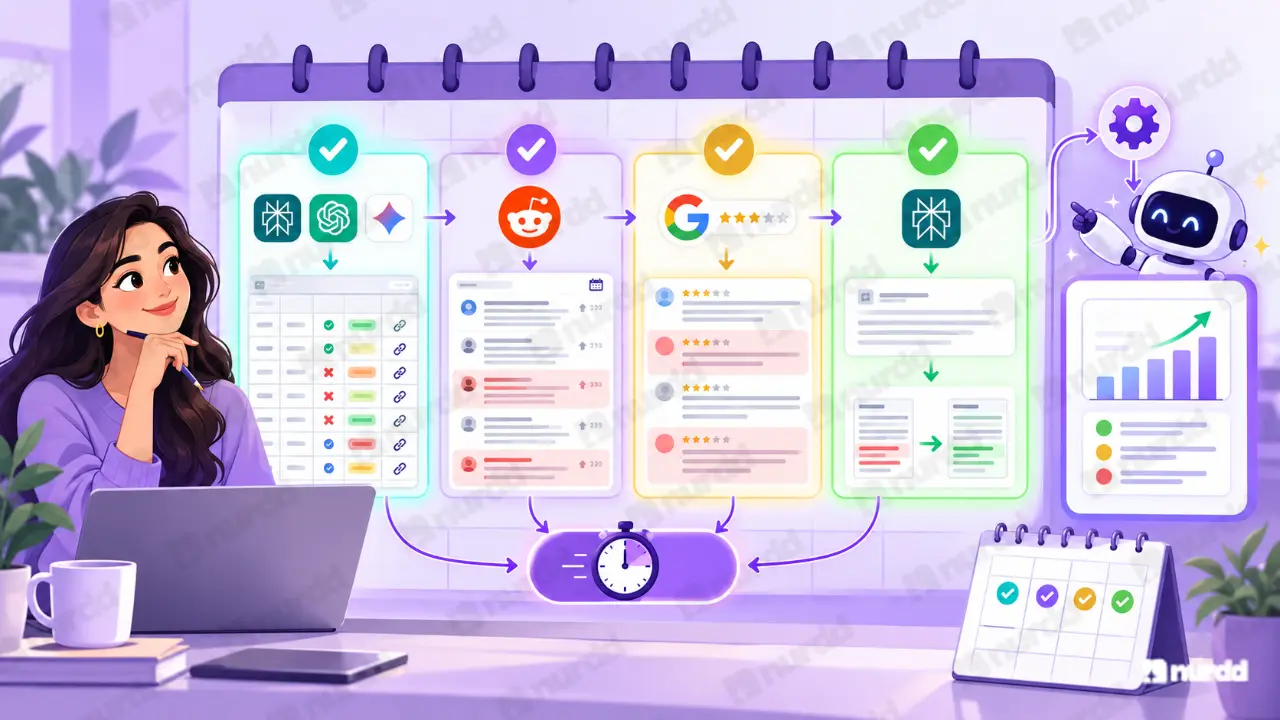
Run your full query set (minimum 20 queries) across all four AI engines. For each query where your brand is mentioned, copy the exact language the AI used, verbatim, not summarised.
Classify each mention using the four types above. Build a spreadsheet: query, engine, brand mentioned Y/N, citation type, exact language, source cited (if visible).
Group your qualified and inaccurate mentions. What specific claim is the AI making? Where is it coming from? In most cases, negative AI mentions trace to a specific source, a review article, a comparison post, a Reddit thread.
Address the source directly. If a review article describes your brand as budget-only, contact the publication for an update. If a Reddit thread has an outdated comparison, engage authentically with updated information. If the inaccuracy is on your own product page, correct it today.
Where Negative Sentiment Comes From
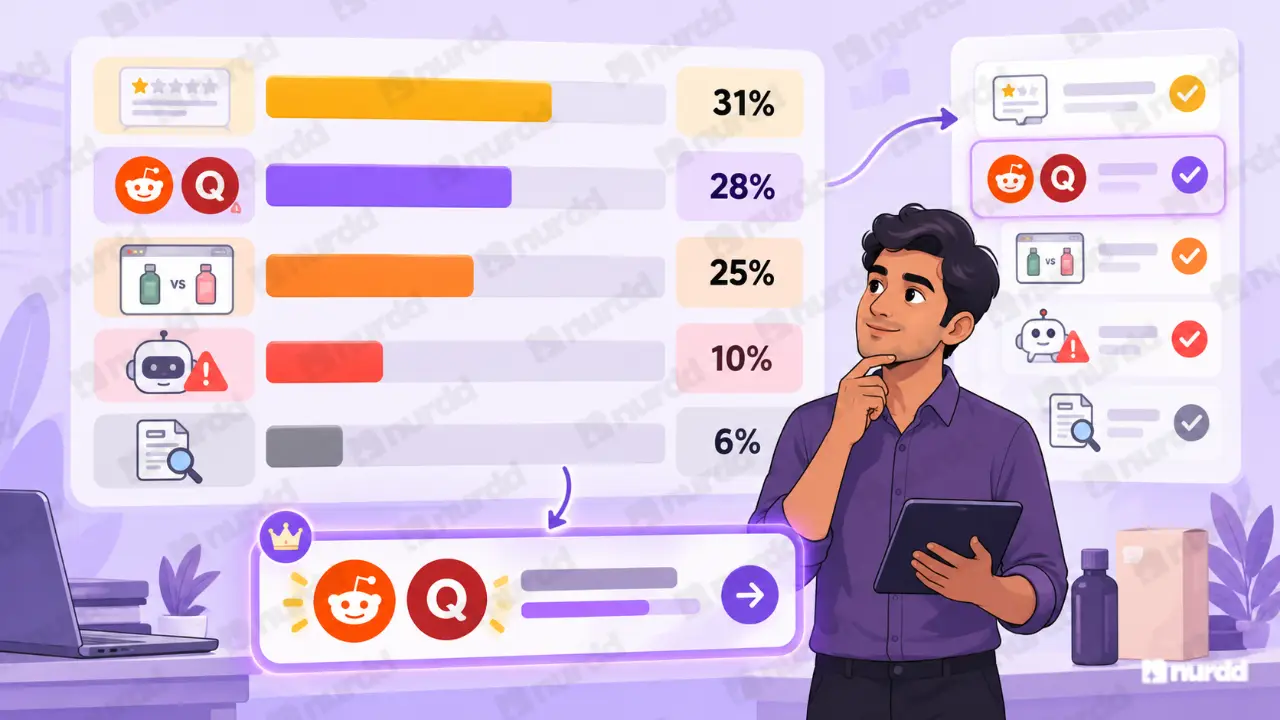
The Four Usual Sources of Negative Sentiment
Where Negative or Qualified AI Brand Sentiment Typically Comes From
Pre-reformulation reviews
Outdated reviews from before product changes
Reddit / Quora threads
Early dissatisfaction with no brand response
Competitor / affiliate posts
Comparison blogs from competing brands
AI hallucinations
No traceable source
The Reddit and Quora category is the most fixable short-term. A brand response on a thread from 18 months ago, acknowledging the issue, explaining what changed, and inviting the user to retry, updates the conversational record that AI engines draw from.
Correcting Inaccurate AI Mentions
Two Correction Paths Depending on the Source
For factual inaccuracies with a traceable source, wrong price, wrong ingredient, wrong availability on a specific article or review:
Update your own product pages and Google Business Profile first. Perplexity and Gemini retrieve real-time data and will update their responses within 1 to 3 weeks of your corrections.
Contact the publication or platform hosting the inaccurate content. For a review article, the editor's contact is usually in the byline or the publication's contact page.
ChatGPT base model updates are slower, parametric knowledge corrections take months. For ChatGPT-specific inaccuracies, create a page on your site that directly addresses and corrects the claim, structured as a FAQ.
For hallucinated inaccuracies with no traceable source: create a specific page on your site that directly addresses and corrects the inaccuracy. Structure it as a FAQ: "Is it true that [inaccurate claim]? No, [correct information with source]." This page is AI-crawlable and tends to displace hallucinations within 4 to 8 weeks of indexing, provided your page has higher authority signals than the hallucinated content it is replacing.
Monitor for inaccuracies monthly using Noma's brand sentiment tracking. Catching a new hallucination within 2 weeks of it appearing in AI responses limits its propagation across engines significantly, the longer an inaccuracy sits indexed, the more frequently it gets cited across multiple AI systems and the harder it becomes to displace.
Prevention Is Faster Than Correction
How to Build a Brand Sentiment Monitoring Routine
Correcting negative AI sentiment after it has propagated across multiple engines is significantly harder than preventing it. A monthly monitoring routine catches negative signals early, when one piece of content is responsible, rather than after it has been cited across dozens of AI responses and begun reinforcing itself through the AI engines that train on their own outputs.
The monthly routine, estimated at 90 minutes:
Run 20 category queries across Perplexity, ChatGPT, and Gemini and record every mention of your brand verbatim. Do not summarise, copy the exact language used.
Check your brand name on Reddit in the last 30 days. New threads about your brand, positive or negative, are the most likely new input into AI sentiment. Search "site:reddit.com [brand name]" on Google sorted by date.
Check Google Reviews for reviews posted in the last 30 days that contain specific negative claims. A review that says "the serum caused breakouts for oily skin types" is an extractable negative claim that will appear in AI responses within weeks of indexing.
Run your brand name through Perplexity directly. "Tell me about [Brand Name]" is the most direct way to see how Perplexity characterises your brand right now. Screenshot the response and compare it to last month's screenshot.
Noma automates this entire routine and sends a weekly brand sentiment summary, flagging new negative or qualified citations and identifying the source content driving them so you can act on the specific piece rather than guessing.
"AI engines repeat what they read. If they have only read the negative review and the outdated comparison post, that is what they will repeat. Control the record or the record controls you."
FAQ
Frequently Asked Questions
How do I find out what ChatGPT is saying about my brand?
Type 'Tell me about [brand name]' directly into ChatGPT, Perplexity, and Gemini. Screenshot each response verbatim. Compare responses across engines. Run the same test monthly and compare against the previous month's screenshot to track sentiment changes. This is the most direct way to audit AI brand characterisation.
What causes negative AI brand sentiment?
Negative AI sentiment usually traces to one of four sources: outdated reviews from before a product reformulation, Reddit or Quora threads with no brand response, competitor comparison articles, or AI hallucinations with no traceable source. The Reddit and Quora category is the most fixable in the short term.
How do I fix inaccurate information AI engines are saying about my brand?
For inaccuracies with a traceable source, update your product pages and contact the publication hosting the inaccurate content. Perplexity and Gemini update their responses within 1 to 3 weeks of source corrections. For hallucinations with no traceable source, create a FAQ page directly addressing and correcting the inaccurate claim using schema markup.
How long does it take to improve AI brand sentiment?
Source corrections on Perplexity and Gemini typically take 1 to 3 weeks to reflect. ChatGPT parametric knowledge updates take months. Community response on Reddit and Quora takes 4 to 8 weeks to influence AI characterisation. The fastest wins are always technical: correcting your own product pages and any crawlable third-party sources that contain inaccurate claims.
Sources and References
Profound – AI brand mention sentiment: enterprise GEO monitoring methodology
SparkToro – How AI engines source brand descriptions and characterisations
Search Engine Journal – Managing brand representation in generative AI responses
Nurdd / Noma – Brand sentiment in AI answers: D2C analysis