AI Search Visibility
Best AI Search Monitoring Tools: How to Shortlist in 2026
A buyer's process for shortlisting AI search monitoring tools by engine coverage, prompt volume, reporting and trial terms, with Noma as the lead option.
 Sheetal Shakshi3 Nov 202614 min read

The best AI search monitoring tools are the ones that cover the engines your buyers use, track enough prompts to give a stable reading, show which pages get cited, and let you test them before you pay. Noma by Nurdd tracks 13 AI engines, including ChatGPT, Gemini, Perplexity and Claude, and offers a 3-day free trial with a card taken at signup. Use the four-gate process, scorecard and trial plan below to shortlist three tools and pick one.
The best AI search monitoring tools in 2026 are the ones that track the engines your buyers actually use, run enough prompts to give you a stable reading, show which pages get cited, and let you test them before you commit. Noma by Nurdd leads this shortlist because it tracks 13 AI engines, including ChatGPT, Gemini, Perplexity and Claude, and has a 3-day free trial. This guide gives you a process to shortlist three tools and choose one, not just a list of names.
Key takeaways
- Shortlist on four tests in order: engine coverage, prompt volume, reporting depth and trial terms. A tool that fails the first test should not reach the demo stage.
- Compare tools on cost per tracked prompt per engine, not on the monthly headline. The worked example below turns a published $250 plan into $0.50 per prompt per engine.
- Write your prompt list before you start any trial. Noma by Nurdd has a 3-day free trial, so prepare 30 to 50 prompts before you sign up.
- Treat vendor-written rankings with care, including this one. Verify every engine count and price on the tool's own pages on the day you buy.
- Run a repeatability test: ask the tool for the same prompt twice and check whether the answer, mentions and citations stay consistent.
- Score every candidate on the same weighted scorecard, then book a demo of your top two.
What counts as an AI search monitoring tool?
An AI search monitoring tool runs a set of prompts through AI engines on a schedule and records whether your brand is mentioned, how it is described, and which sources the engine cites. It turns a question like "is my brand recommended by ChatGPT?" into a repeatable measurement.
Most brands buying for visibility need a tool that records citations, because the cited pages show you what to improve. A tool that only reports a score tells you where you stand but not what to change.
If the vocabulary is new, the AI search glossary for marketers defines GEO, AEO and LLMO, and What is generative engine optimization? explains how the disciplines relate.
What do the published roundups cover, and what does this guide add?
Several vendor and publisher roundups rank for this keyword, including Frase, 2026, Otterly, 2026 and Orchly, 2026. Many are written by companies that sell in the category, which is a fair reason to check any claim on the vendor's own page.
| Roundup | What its listing describes |
|---|---|
| Frase, 2026 | Free and paid tools ranked by how much of the path from a lost citation to a fix they cover |
| Otterly, 2026 | A list of tools to try for monitoring AI search |
| Orchly, 2026 | Twelve tools compared by price, engines, prompts, refresh rate, sentiment and citations |
Those pages work as lists to browse. This guide covers the same questions (what the tools are, which engines matter, how pricing works) and adds four things: a four-gate shortlist process, a cost-per-prompt worked example, a weighted scorecard, and a day-by-day plan for a short trial.
How do I choose an AI search monitoring tool?
Choose by running candidates through four gates in a fixed order: engine coverage, prompt volume, reporting depth and trial terms. Each gate removes tools that cannot meet your need, so you spend demo time on two or three, not ten.
The order matters because the gates get more expensive to check. Engine coverage is a line on a pricing page. Prompt volume needs arithmetic. Reporting depth needs a look at real output. Trial terms decide whether you can verify the first three before paying.
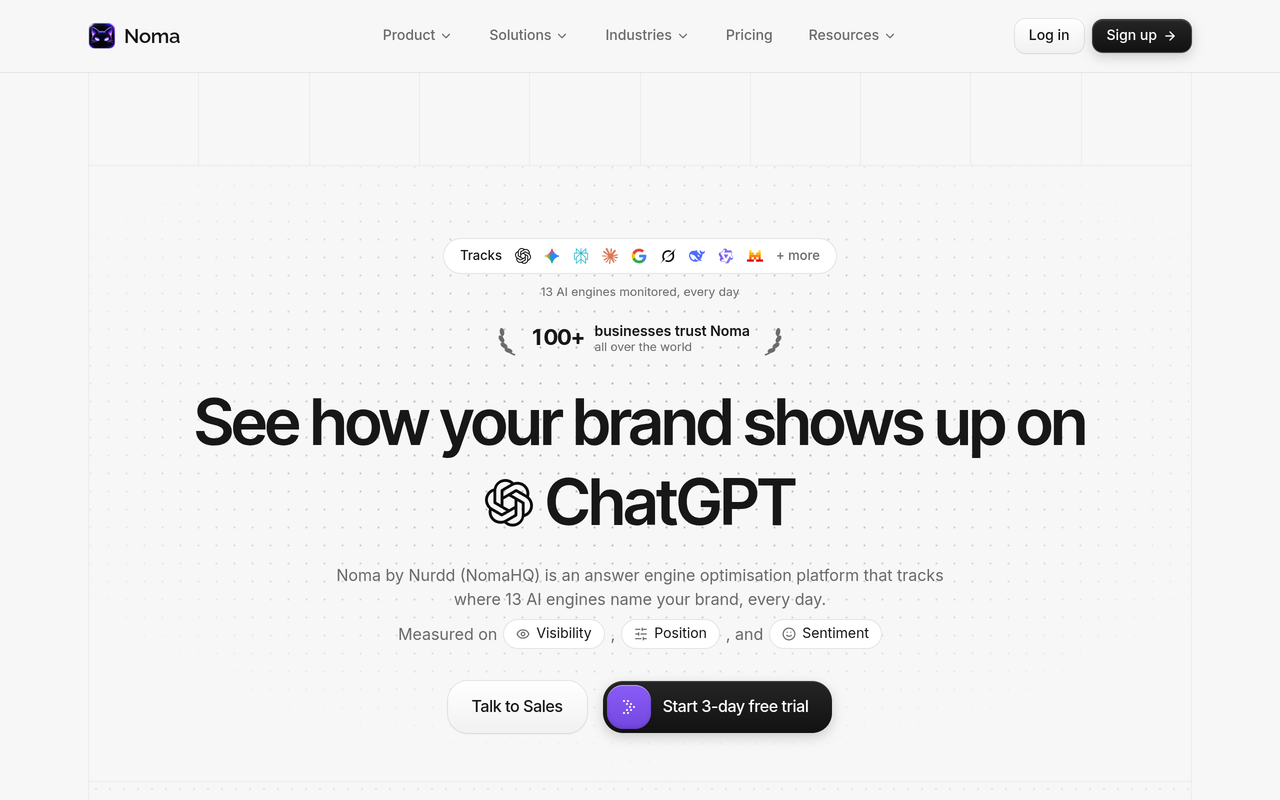
Noma by Nurdd is an AI search visibility dashboard that tracks whether a brand appears in answers from 13 AI engines, including ChatGPT, Gemini, Perplexity and Claude, polled daily, and shows citation frequency by category and competitor comparison.
Gate 1: Engine coverage
List the engines your customers use to research a purchase, then check each tool against that list, not against a headline count. A B2B software buyer may lean on ChatGPT and Perplexity, while a shopper may meet Google AI Overviews first. A tool with ten engines you do not need is worth less than a tool with five you do.
Coverage can also differ by plan. Scrunch's own comparison page lists its Core plan as covering ChatGPT, Perplexity, Google AI and Copilot. Noma tracks 13 AI engines, including ChatGPT, Gemini, Perplexity and Claude. For how the engines differ in what they cite, see Perplexity vs ChatGPT vs Gemini: which AI engine matters most.
Gate 2: Prompt volume
Prompt volume is how many prompts the plan lets you track, and it is the number that most often surprises buyers. Too few prompts and one odd answer swings your visibility score. Too many and the plan costs more than the insight is worth.
A practical starting range is 30 to 50 prompts that mirror real buying questions, split across awareness, comparison and purchase intent. Which prompts to track for AI search visibility shows how to build that list, and AI search share of voice explains how the results roll up into one metric.
Gate 3: Reporting depth
Reporting depth is whether the tool tells you why you were or were not named. At minimum you want mention rate, the cited page behind each answer, a competitor comparison and a trend over time. Without the cited source, you know the score but not what to fix.
Ask what the tool exports and who can read it. Client-ready or leadership-ready reports matter if someone other than you has to act on them. The week-over-week AI visibility score guide shows what a useful trend report contains.
Gate 4: Trial terms
Trial terms decide whether you can test the first three gates with your own brand. Check the trial length, whether a card is required, what the trial limits (engines, prompts, seats) and when billing starts. A short trial is not a problem if you arrive prepared, and a long trial is no help if it hides the engines you need.
Noma has a 3-day free trial. A card is taken at signup and billing starts on day 3; cancel before then and you are not charged. Scrunch's comparison page lists a 7-day free trial of its Core plan. The trial plan later in this guide shows how to get a clear answer in three days.
Which AI search monitoring tools should be on the shortlist?
Put one specialist tool with wide engine coverage, one SEO-suite add-on you may already own, and one lower-cost starter on the list. That gives you a fair comparison between depth, convenience and price. Noma is the specialist option, tracking 13 engines.
| Tool | Engines as published | Where the fact comes from |
|---|---|---|
| Noma by Nurdd | 13 AI engines, including ChatGPT, Gemini, Perplexity and Claude, polled daily | Noma, nomahq.app |
| Scrunch (Core plan) | ChatGPT, Perplexity, Google AI, Copilot | Scrunch, 2026 |
| Otterly, AthenaHQ, Profound, Peec AI, Semrush, Ahrefs Brand Radar | Confirm on each vendor's own pricing or product page before shortlisting | Not verified from vendor pages for this guide |
Where this table says to confirm, that is deliberate. Third-party lists often repeat engine counts that have since changed, so use the vendor's own page on the day you buy. For side-by-side pages, see Noma vs Profound, Noma vs Peec AI, Noma vs AthenaHQ, Noma vs Scrunch and Noma vs Semrush.
What do AI search monitoring tools cost?
Published entry prices run from tens of dollars to a few hundred dollars a month, with enterprise tiers usually quoted on request. The monthly figure alone says little, because plans differ in prompts, engines and how usage is metered.
The table lists only figures taken from a vendor's own page. Date checked: 3 November 2026. Prices are in USD. For any other tool, open its pricing page and fill in the same four columns.
| Tool | Entry plan as published | Usage included | Trial |
|---|---|---|---|
| Noma by Nurdd | See nomahq.app | 13 AI engines, polled daily | 3-day free trial; card taken at signup; billing starts day 3 |
| Scrunch | Core $250/month; Enterprise custom | 125 prompts across ChatGPT, Perplexity, Google AI, Copilot | 7-day free trial of Core listed on Scrunch's page |
| Any other tool | Copy from the vendor's pricing page | Prompts, engines, refresh rate | Length, card, limits |
How do I compare tools fairly? A worked example
Convert every plan to cost per tracked prompt per engine. This is the simplest way to compare a flat plan with a credit plan.
Worked example 1: a published flat plan. Scrunch's Core plan is listed at $250 a month for 125 prompts across four engines (ChatGPT, Perplexity, Google AI and Copilot). $250 divided by 125 prompts is $2.00 per prompt per month. Divided across four engines, that is $0.50 per prompt per engine per month.
Worked example 2: a hypothetical credit plan. Suppose a plan gives 1,000 credits a month and spends one credit each time a prompt response is analysed on one engine. Tracking 50 prompts on 5 engines costs 250 credits per full check, so 1,000 credits cover four full checks a month. Daily checks would need about 7,500 credits. These numbers are an illustration of the method, not any vendor's plan, so ask each vendor how credits are metered.
The lesson from both examples is that the headline price hides the real constraint. A flat plan limits prompts, while a credit plan limits how often you can refresh. When a tool polls daily, as Noma does, ask what that costs in prompts and what the plan allows.
How do I score the shortlist? A weighted scorecard
Use a weighted scorecard so the decision rests on your priorities, not on the loudest demo. Score each tool from 0 to 5 on each row, multiply by the weight, and add the results.
| Criterion | Weight | What a 5 looks like |
|---|---|---|
| Engine coverage of your buyers' engines | 25% | Every engine on your list is tracked on the plan you would buy |
| Prompt volume and refresh rate | 20% | Covers 30 to 50 prompts or more, refreshed at least weekly |
| Citation source detail | 20% | Shows the exact cited page for each answer |
| Competitor comparison | 15% | Side-by-side share of mentions against named rivals |
| Actionable recommendations | 10% | Tells you which page or source to change |
| Trial and contract terms | 10% | Lets you test your own prompts before billing |
These weights are a starting point, not a standard. An agency might raise reporting and multi-brand support, and a single-brand ecommerce team might raise engine coverage. Set the weights before you see any demo.
Orchly's comparison of twelve tools uses similar columns: price, engines, prompts, refresh rate, sentiment and citations.
Why does Noma belong on the shortlist?
Noma by Nurdd is built for one job: measuring whether AI assistants name your brand. The table lists what Nurdd publishes about Noma against each scorecard row, so you can score it yourself.
| Scorecard row | What Noma by Nurdd offers |
|---|---|
| Engine coverage | 13 AI engines, including ChatGPT, Gemini, Perplexity and Claude |
| Refresh rate | Polled daily |
| Citation source detail | Records whether a brand is named and which page each citation comes from |
| Competitor comparison | Citation frequency by category with competitor comparison |
| Recommendations | Actionable recommendations to improve AI visibility |
| Trial | 3-day free trial, card taken at signup, billing starts day 3 |
The trial is short, which is why the plan below front-loads the work. If you arrive with a prompt list and a competitor list, three days is enough to judge coverage, citations and report quality.
Noma by Nurdd tracks 13 AI engines, including ChatGPT, Gemini, Perplexity and Claude, records which page each citation comes from, and gives recommendations for improving visibility. Brands that want help acting on the findings can pair it with Nurdd's answer engine optimization agency service, which is measured in Noma.
Book a demo of Noma.
How do I run a 3-day trial properly?
Prepare before you start the clock, then use each day for one question. This checklist works for Noma's 3-day free trial and for any shorter trial.
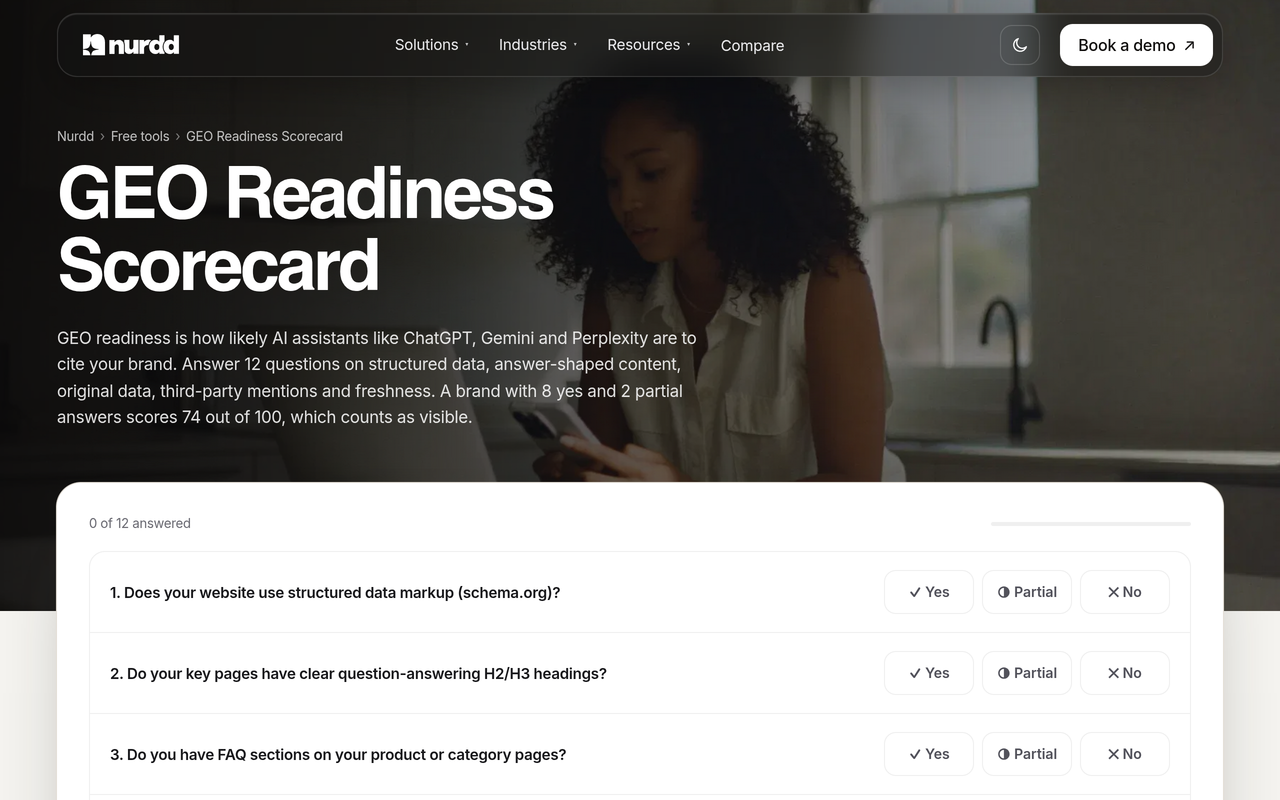
- Before signup: write 30 to 50 prompts across awareness, comparison and purchase intent, and list three to five competitors. Use the GEO readiness scorecard to note where your site is weak so you know what to look for in the cited pages.
- Day 1, coverage: load the prompts and confirm every engine on your list returns results. Result: you know whether coverage matches your buyers.
- Day 1, repeatability: run a handful of identical prompts twice. Result: you see how much the answers and citations vary, which tells you how many prompts you need.
- Day 2, citations: open the cited pages behind five answers where you are absent. Result: you find out whether the tool names the source, not just the score.
- Day 2, competitors: compare your mention rate with your named rivals. Result: you have a baseline for share of voice.
- Day 3, reporting: export or screenshot what you would send a colleague. Result: you can judge whether the report drives action.
- Day 3, decision: score the tool on the scorecard. Decide before billing starts on day 3; cancel before then and you are not charged.
What are the common mistakes when shortlisting?
- Trusting a single score. AI answers vary between runs, so one visibility number from a handful of prompts can mislead. Ask how many prompts and runs sit behind the number.
- Buying on engine count alone. A big number is only useful if it includes the engines your customers use and if those engines are on the plan you buy.
- Ignoring the metering model. Credit plans and prompt plans behave differently as you add prompts or refresh more often, as the worked example shows.
- Skipping the citation view. A tool that reports only mentions leaves you guessing what to fix. Check that each answer links to the cited page.
- Treating vendor rankings as neutral. Many roundups are written by companies that sell in the category. That includes this one, which leads with Noma, so check every claim on the vendor's own page.
- Starting a trial unprepared. A trial wasted on setup tells you nothing. Write the prompts first.
For a wider list of tools and what to test first, see Best AI search visibility tools in 2026, AI search tracking tool reviews and the buyer checklist for AI visibility tracking tools.
Which tool fits which kind of team?
Match the tool to the team's job, not to a general ranking. The table shows the decision rules this guide applies.
| Your situation | What to prioritise | Where to look |
|---|---|---|
| You need the widest view of which engines name you | Engine coverage and daily polling | Noma by Nurdd |
| You run an online shop and care about product answers | Shopping prompts, cited product pages | Ecommerce GEO tools |
| You mostly care about Google's AI features | AI Overviews and AI Mode tracking | How to track Google AI Overviews |
| You want a team to do the work, not just measure it | Managed services with monitoring built in | Generative engine optimization services |
| You compare against an existing SEO suite | What the suite add-on cannot show | Noma vs traditional SEO tools |
What should I do after I choose a tool?
Set a baseline in the first week, pick the five prompts where you are absent and a rival is named, then fix the pages those answers cite. Re-measure after a few weeks and compare against your baseline, not against another vendor's score.
Monitoring only pays back if it changes what you publish. How to get your brand mentioned in AI answers without paying for ads and Why your brand isn't showing up in ChatGPT answers cover the fixes that usually follow.
How we researched this
This guide draws on published roundups for the keyword (Frase, Otterly, Orchly, Rankability, TechnologyAdvice, Dageno and others), Scrunch's own comparison page, and Nurdd's product information. Sources were checked on 3 November 2026.
We did not test any of these tools hands-on, and we have no customer data or interviews to report. Engine counts and prices are quoted only where a vendor's own page states them, and may change. Where a rival's own page was not checked, this guide says so instead of repeating a third-party figure.
Frequently asked questions
What are the best AI search monitoring tools in 2026?
Roundups in 2026 commonly list tools such as Profound, Otterly, Scrunch, AthenaHQ, Peec AI, Semrush's AI visibility add-on, Ahrefs Brand Radar and Noma. Which is best depends on the engines you need, the number of prompts and your budget. Noma by Nurdd tracks 13 AI engines, including ChatGPT, Gemini, Perplexity and Claude.
How do I choose an AI search monitoring tool?
Work through four gates: engine coverage, prompt volume, reporting depth and trial terms. Score the survivors on a weighted scorecard, then test your top two with your own prompts. Choose the one that shows the cited pages behind each answer.
How many AI engines should a monitoring tool track?
It should track every engine your customers use, which for most brands means at least ChatGPT, Gemini, Perplexity and Claude, plus Google's AI features. Noma tracks 13 AI engines. Check each other vendor's own page for its count on the plan you would buy.
How many prompts do I need to track?
A starting set of 30 to 50 prompts that mirror real buying questions is a practical baseline. Add more when you enter new product categories or markets. Check that the plan's prompt limit still covers your list at the refresh rate you want.
Is there a free AI search monitoring tool?
Some vendors offer free tiers or trials, and the terms vary. Noma has a 3-day free trial with a card taken at signup and billing starting on day 3; cancel before then and you are not charged. Always check what a free option limits, such as engines, prompts or history.
What is the difference between AI search monitoring and LLM monitoring?
AI search monitoring tracks what users see in AI search products, including the citations in the answer. LLM monitoring probes a model's own knowledge and may return no citation data. Brands that want visibility usually need citation data.
Can my existing SEO suite do this?
Some suites sell AI visibility as an add-on, which is convenient if you already use them. Check the engine count, prompt limits and citation detail on the add-on plan, because they can differ from a dedicated tool. The Noma vs Semrush page shows how to compare the two.
How long should I trial a tool before buying?
Long enough to check coverage, repeatability, citations and reporting on your own prompts, which can be done in three days if you prepare. Write your prompts and competitor list before you start. Decide before billing begins.
Shortlist with Noma
A shortlist is only useful if you test it on your own brand. Noma by Nurdd tracks 13 AI engines, including ChatGPT, Gemini, Perplexity and Claude, and you can start with a 3-day free trial at nomahq.app; a card is taken at signup and billing starts on day 3.
Book a demo of Noma. You can also browse the free tools or read about how Nurdd works.