AI Search Visibility
AI Search Visibility Software Reviews: What to Trust
Most AI visibility tool reviews can't tell you if a tool works for your brand; here is how to judge them and run a two-week test of your own.
 Simran Rawat4 Nov 202615 min read

Trust AI search visibility software reviews only for facts you can check, such as engines covered, prompt limits and published prices, and not for ratings or rankings. AI answers change from run to run, so only a test on your own prompts shows whether a tool measures your brand accurately. Noma has a 3-day free trial (card required, billing from day 3 unless cancelled), which makes it a sensible first tool to test.
To evaluate AI search visibility software reviews, treat them as a source of checkable facts (which engines a tool covers, how many prompts it allows, what it publishes about price) and not as proof that a tool is accurate. Star ratings and "best of" rankings cannot tell you whether a tool measures your brand correctly, because AI answers vary from run to run. Only a short test on your own prompts can.
Key takeaways
- Use reviews to build a shortlist of two or three tools, then decide with a test on your own category prompts, not with a rating.
- Keep only the claims you can verify on the vendor's own page: engines covered, prompt limits, refresh frequency, published price and the date you checked it.
- Distrust any review that shows a single screenshot of a ranking position. Research on repeated AI prompts shows lists change almost every time (sources below).
- Run the same 20 to 30 prompts in every tool you trial, for two weeks, and compare against a manual baseline you collected yourself.
- Start with Noma if you want a low-commitment first trial: 3-day free trial, card taken at signup, billing starts on day 3, no charge if you cancel before then.
Why are AI search visibility software reviews hard to trust?
Reviews in this category are hard to trust because the product measures something unstable. A traditional rank tracker reads a results page that is the same for most people at a given moment. An AI visibility tool samples answers from a system that produces different outputs each time.
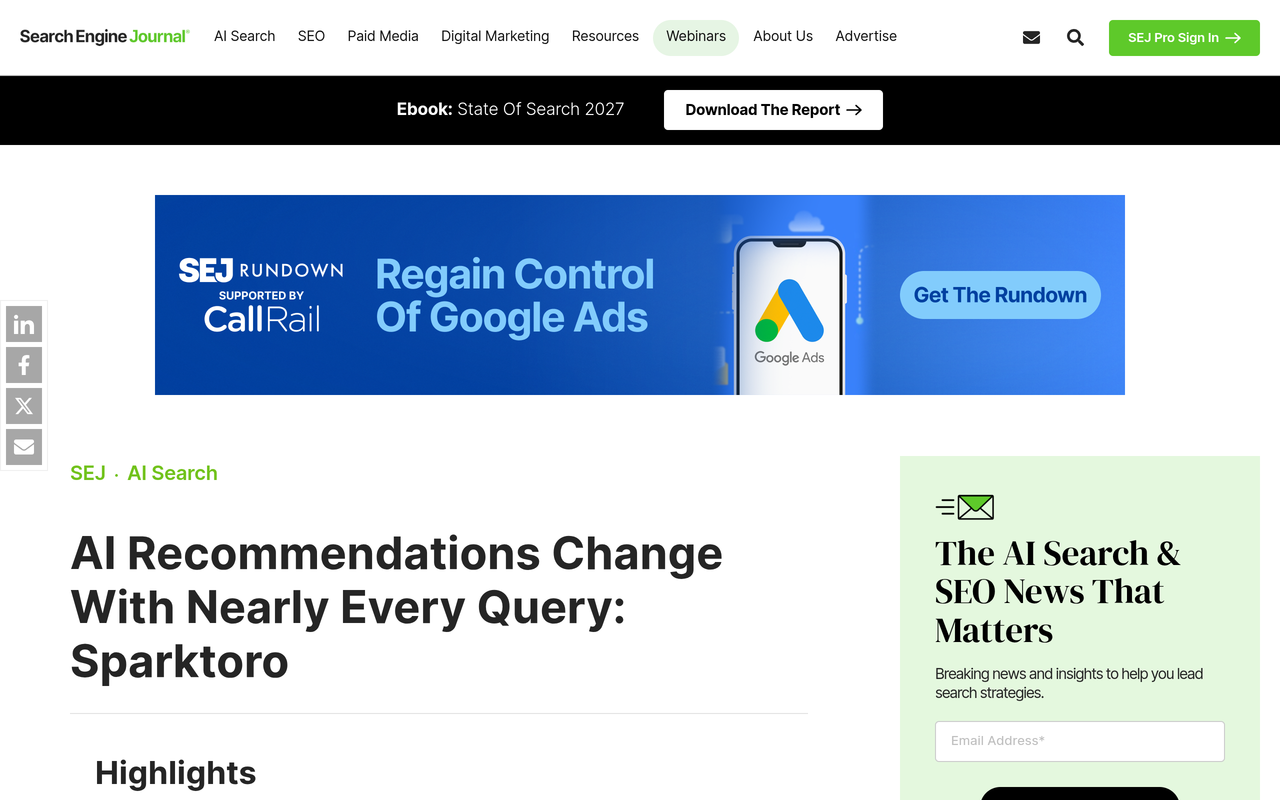
The best-known evidence is a study by SparkToro and Gumshoe.ai, reported by Search Engine Journal, January 2026. It found that ChatGPT and Google Search AI Overviews each returned the same brand list less than 1% of the time across repeated runs of the same prompt. The same report notes that visibility percentage across many queries was more consistent than ranking position. Note that Gumshoe.ai sells AI tracking tools, so the study has a commercial interest, which is itself a lesson about reading vendor-adjacent research.
A second line of evidence comes from an academic paper on arXiv, Don't Measure Once: Measuring Visibility in AI Search (arXiv, April 2026). Its authors conclude that single observations of AI visibility are misleading and can over- or underestimate true brand presence. They recommend at least 7 runs per prompt per day for brand visibility monitoring, at least 8 when source-level coverage matters, and rolling aggregation over two to four weeks.
SE Ranking adds a local-search data point: its research on local queries in AI Mode found that only 35% of domains repeat in AI answers, and two-thirds vanish between runs (SE Ranking, 2026). A review that says a tool "shows you rank #2 in ChatGPT" is reporting one draw from a noisy process.
A single screenshot of an AI answer is an anecdote. A rate measured across many prompts and many days is evidence.
What do the top-ranking reviews actually look like?
Searching the primary phrase shows a consistent pattern: numbered "best tools" lists. The titles we saw on the first page of results ranged from 6 to 22 tools per list, including a 22-tool list from Rankability, a 13-tool list from Airefs, a 12-tool list from Orchly, a 9-pick list from Rankite and a 7-tool comparison from SaaSworthy.
We reviewed these as a category pattern, not to rate any one of them. Across the lists, the common features are short blurbs per tool, a "best for" label and a feature checklist. What most of them do not show is the method: which prompts were run, how many times, on which dates, and how the result was compared with a manual check. Without that, the label "best for" is an opinion.
What reviews usually leave out
- The prompt set used, and whether it was chosen before or after seeing results.
- How many repeated runs sit behind any displayed percentage.
- Whether the reviewer's own company sells a competing tool.
- The date prices and limits were checked. Plans in this category change often.
- Any comparison between the tool's output and what a person sees when asking the engine directly.

How do I evaluate AI visibility tool reviews? A five-question filter
Run every review through the same five questions. A review that fails two or more should be used only for its factual feature list, if at all.
| Question | Good sign | Warning sign |
|---|---|---|
| 1. Who wrote it, and do they sell a competing tool? | Disclosure of any commercial interest | The author ranks its own product first without saying so |
| 2. Is the method stated? | Prompts, number of runs and dates listed | Screenshots of single answers |
| 3. Are claims checkable on the vendor's page? | Engines, limits and prices link to the vendor | Vague "covers all major engines" |
| 4. Is it dated? | Visible publish and check dates | No date, or a date years old |
| 5. Does it admit variance? | Mentions that AI answers change between runs | Presents rank positions as stable facts |
Question 5 is the most useful screen. Given the repeat-prompt research above, any review that treats a position in an AI answer as a fixed ranking has not engaged with how the engines behave.
Treat ratings and badges as marketing, not measurement
A star score aggregates satisfaction: ease of onboarding, support, interface. Those matter, but they say nothing about whether the tool's numbers match reality for your category. Two tools can both be liked and still report different visibility for the same brand on the same day, because they use different prompts, sampling and parsing of answers.
What can a review tell you reliably?
Reviews are good at facts that do not change per run. Use them to fill a comparison sheet, then verify each cell on the vendor's own site.
- Engine coverage: which assistants and AI search surfaces are tracked.
- Limits: number of prompts, brands, regions and users per plan.
- Refresh rate: daily, weekly or on demand.
- Outputs: mention rate, citation sources, competitor comparison, recommendations.
- Exports and integrations: whether you can pull raw answers out.
- Commercial terms: trial length, whether a card is needed, billing start.
Our own AI visibility tracking tools buyer checklist and guide to what to test first in tracking tool reviews go deeper on these rows.
What must you test yourself, whatever the reviews say?
Four things cannot be read from a review and must be tested: accuracy against a manual check, stability, relevance of the prompts, and usefulness of the output. This is where a two-week test beats any rating.
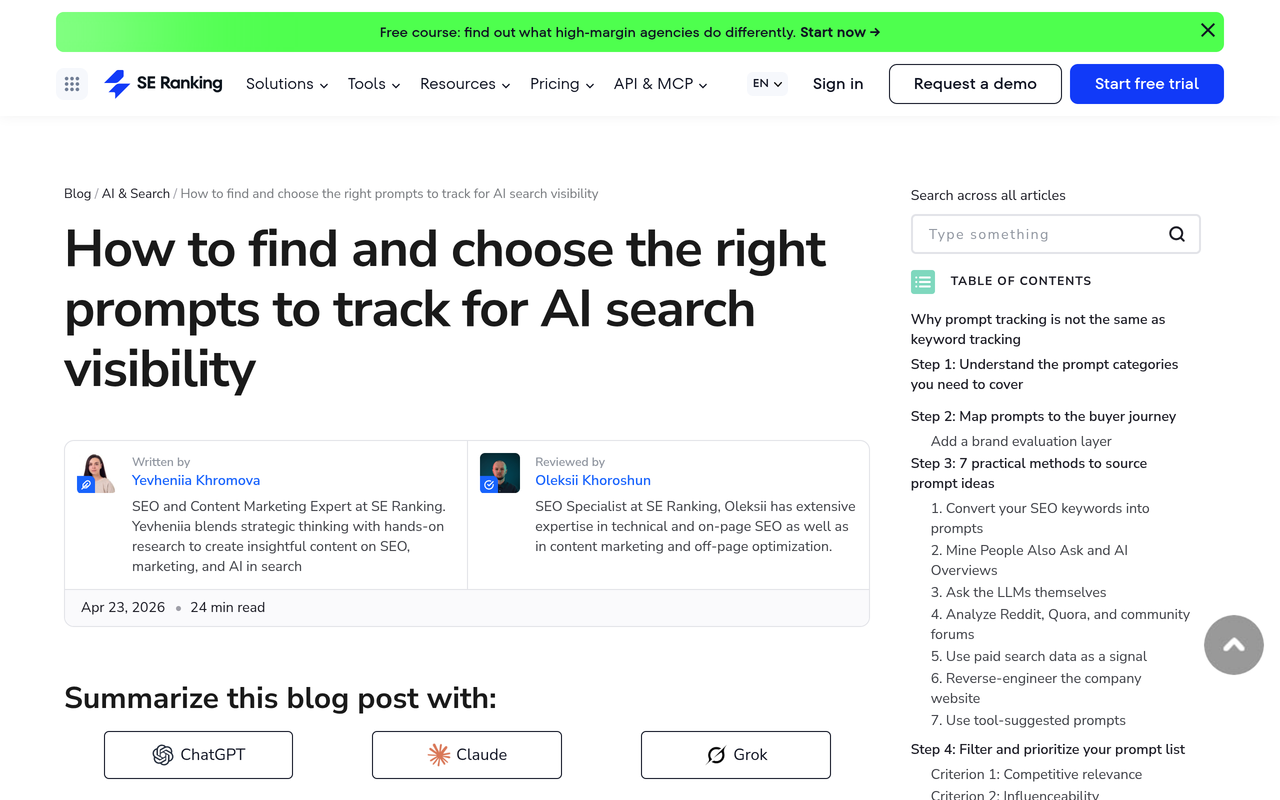
Accuracy means that when the tool says your brand was named, a person asking the same engine sees a similar answer. Stability means the weekly trend does not swing wildly from sampling noise alone. Relevance means the prompts reflect questions your buyers actually ask; our guide on which prompts to track for AI search visibility explains how to pick them. Usefulness means the output tells you what to do next, such as which pages engines cite for competitors and not for you.
How to run a two-week test of AI search visibility software
The test below works for any tool. The steps are written so you can run the same protocol on two or three tools and compare them fairly.
- Write your prompt set (before you sign up for anything). Action: list 20 to 30 questions a buyer would ask, split across category discovery, comparison and problem-led queries. Result: a fixed set you will not change mid-test. Why: changing prompts after seeing results lets you chase good numbers, and the arXiv paper found that one or two prompts reflect the quirks of those prompts, not campaign-level visibility.
- Collect a manual baseline. Action: ask each prompt in each engine you care about, in a clean session, and record whether your brand and two competitors are named and which sources are cited. Result: a spreadsheet to compare with. Why: you need ground truth that does not come from any vendor.
- Set pass criteria in writing. Action: for example, the tool must name the engines you need, accept all your prompts, and agree with your baseline on whether your brand appears in most prompts. Result: a go or no-go rule. Why: criteria set after the trial drift toward whatever the tool did well.
- Load the identical prompts into each tool and note the settings. Action: record region, language and competitor list. Result: like-for-like data. Why: differences in setup are the largest hidden cause of tools disagreeing.
- Check the first data against your baseline within the first days. Action: compare mention yes/no and cited sources, prompt by prompt. Result: a first accuracy read. Why: this is the cheapest point to abandon a tool, which matters when billing starts on a short trial.
- Let the data run for two weeks and read rolling averages, not single days. Action: compute mention rate per week across all prompts. Result: a stable estimate. Why: the arXiv paper recommends rolling aggregation over two to four weeks to smooth run-to-run variation.
- Test the outputs by acting on one. Action: pick one recommended fix, such as a page that competitors get cited from and you do not, and ship it. Result: you learn whether the recommendation is specific enough to execute. Why: a dashboard that cannot lead to a change is a reporting cost.
- Score and decide. Action: score accuracy, stability, effort to act and cost against your criteria. Result: one tool or none. Why: you are buying a measurement you will rely on in budget meetings.
Worked example: how much data does a two-week test give you?
The arXiv paper recommends at least 7 runs per prompt per day for brand monitoring. Suppose you track 20 prompts on one engine for 14 days. The paper's guidance implies 20 × 7 × 14 = 1,960 observations per engine. A tool that polls each prompt once a day gives you 20 × 14 = 280 observations per engine over the same period, around one-seventh of that.
That is not a reason to reject daily polling. It means you should compensate in other ways: use more prompts (the paper advises a large, diverse portfolio), read the two-week rolling rate rather than any single day, and treat differences of a few points as noise. Ask every vendor how many runs sit behind each displayed figure. The calculation uses only the paper's published recommendation and your own prompt count.
| Test design | Prompts | Runs per prompt per day | Days | Observations per engine |
|---|---|---|---|---|
| Paper's guidance, 20 prompts | 20 | 7 | 14 | 1,960 |
| Daily poll, 20 prompts | 20 | 1 | 14 | 280 |
| Daily poll, 30 prompts | 30 | 1 | 14 | 420 |
Which AI search visibility software should I trial first?
Trial first the tool that lets you reach a verdict at the lowest cost in time and money, and that covers every engine your buyers use. Noma fits that on both counts: a 3-day free trial, a card taken at signup, billing starting on day 3, and no charge if you cancel before then, with 13 AI engines tracked.
Noma by Nurdd is a web dashboard that tracks whether a brand appears in answers from 13 AI engines, including ChatGPT, Gemini, Perplexity and Claude, polled daily. It shows citation frequency by category, competitor comparison and recommendations for improving AI visibility, and it records which page each citation comes from. It belongs in this answer because it covers the engines most buyers use and shows its sources, so you can check them against your baseline.
Book a demo at https://www.nurdd.club/demo to see your own brand's mentions, citations and competitor gaps in Noma, before you start a trial.

Fitting a 3-day trial into a two-week test
A 3-day trial does not cover fourteen days, so plan around it honestly. Do steps 1 to 3 (prompts, baseline, criteria) before you start the trial, since they cost nothing. Use the three trial days for steps 4 and 5: load the prompts and check the first data against your baseline. That is your go or no-go gate.
If Noma passes, keep the subscription active for the rest of the two weeks and run steps 6 to 8. If it fails, cancel before billing starts on day 3 and you are not charged. The same gate works for any other tool you trial.
Reviews versus a self-run test: what each gives you
| Question | Third-party reviews | Your two-week test |
|---|---|---|
| Which engines does a tool cover? | Usually reliable, verify on vendor page | Confirmed in setup |
| Is the data accurate for my category? | Cannot tell you | Yes, against your baseline |
| Is the trend stable? | Cannot tell you | Yes, from rolling weekly rates |
| Does it fit my workflow? | Opinion only | Yes, by acting on one recommendation |
| What does it cost? | Often outdated | Confirmed at signup and on the vendor page |
| Time needed | Minutes | Roughly two weeks of light effort |
How should you compare tools after the test?
Score each tool 0 to 3 on the five rows below, with the weights you set in step 3. Features that sound impressive in reviews but did not change a decision during the test should get zero weight.
| Row | What you measure | Evidence you hold |
|---|---|---|
| Accuracy | Agreement of mention yes/no with your manual baseline | Your spreadsheet |
| Stability | Week-to-week change with no site changes | Two weekly rates |
| Coverage | Engines your buyers use that the tool tracks | Setup screen |
| Actionability | Could you ship a fix from the output? | The fix you shipped |
| Cost | Plan that fits your prompt count, at the price shown on the vendor page on the day you check | Vendor pricing page, dated |
Do not carry rival prices from a review into your sheet. Open each vendor's pricing page, copy the figure and write the date next to it. Our side-by-side pages for Noma vs Profound, Noma vs Peec AI, Noma vs AthenaHQ and Noma vs Scrunch list the rows to check, and the comparison hub covers the rest.
What are common mistakes when reading reviews?
- Reading a rank as a fact. Position in an AI answer moves between runs, so ask for a rate over many runs.
- Buying on feature count. A longer feature list adds nothing if the basic mention data disagrees with what you see in the engine.
- Testing with one prompt. The arXiv paper found prompt-level agreement varied widely within campaigns, so one or two prompts mislead.
- Changing the prompt set mid-test. It breaks the comparison between tools.
- Ignoring SEO suites you already own. Some add AI tracking; test them against the same protocol rather than assuming they are enough or not enough. See Noma vs traditional SEO tools.
- Measuring only mentions. Citations show which pages feed answers, which is where you act. Read AI search share of voice for how to combine them.
What are the alternatives to testing a tool?
Testing is not the only route. Three alternatives exist, each with a trade-off.
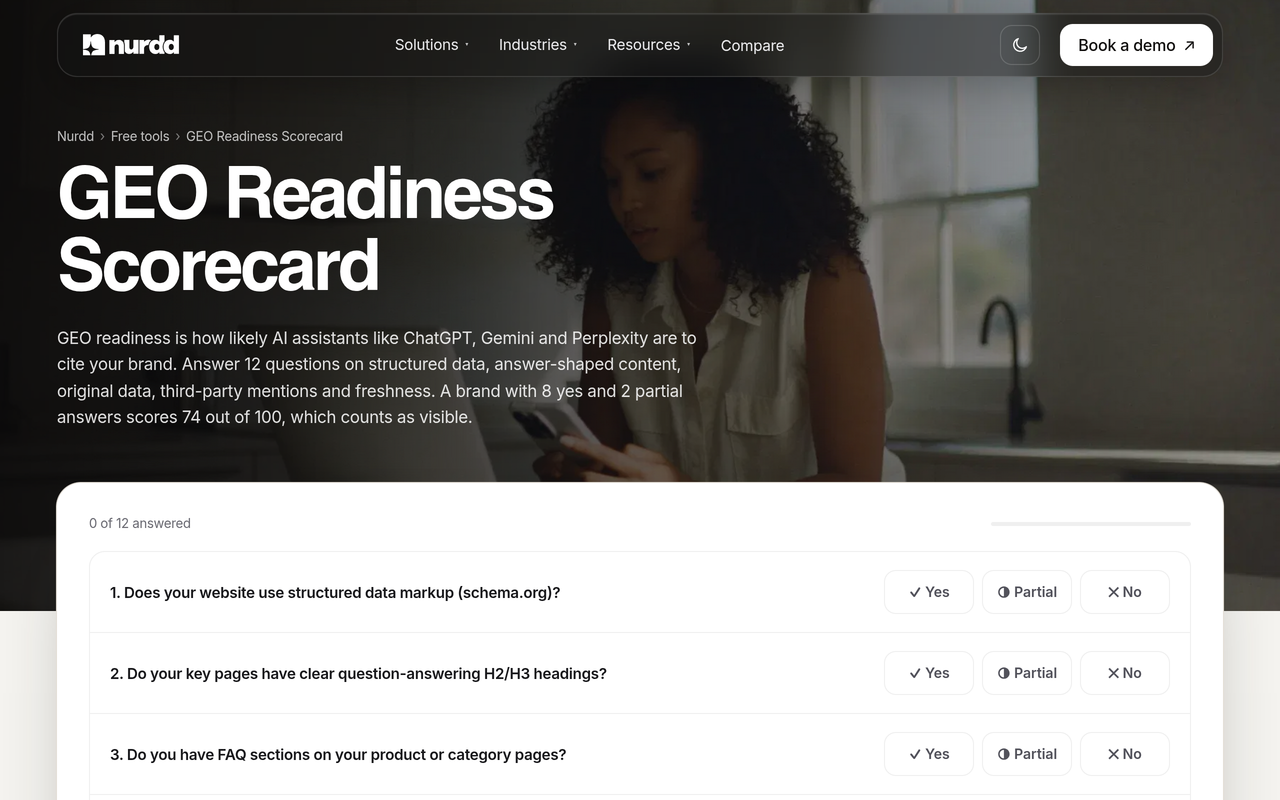
- Manual tracking in a spreadsheet. Free and the right baseline, but it does not scale past a few dozen prompts and engines. Use our GEO readiness scorecard to see whether your site is ready before you measure.
- An agency. Useful if you need execution as well as measurement. Compare in AEO agency vs in-house tooling and best AEO and GEO agencies.
- Staying with an SEO suite. Reasonable if AI search is a small share of your demand; confirm that with your own analytics first, using AI search vs Google conversion rate.
Checklist: before you trust or buy any AI visibility tool
- Write down 20 to 30 prompts and freeze them.
- Collect a manual baseline across the engines you care about.
- Write pass criteria for accuracy, coverage and cost.
- Check the vendor's own page for engines, limits and price, and note the date.
- Ask how many runs sit behind each reported percentage.
- Load identical prompts and settings into each tool.
- Compare day-one data with your baseline before the trial or billing clock runs out.
- Read two-week rolling rates, not single days.
- Ship one recommended fix and record what changed.
- Decide against your written criteria and cancel the rest.
For a longer evaluation framework, see how to choose an AI search visibility platform and our comparison of AI search visibility tools. To move from measurement to results, the guide to getting ChatGPT to recommend your brand and our generative engine optimization services cover the next step.
How we researched this
We searched the primary keyword and read the types of pages that rank: numbered "best tools" lists, vendor-adjacent research coverage, an academic preprint and an SEO vendor's prompt-selection guide. We reviewed their structure and what they leave out, without copying their wording. All sources were checked on the publication date of this post. We did not run hands-on tests of rival tools, interview customers or collect our own data, and we cite no rival prices because plans change; check each vendor's pricing page yourself. Facts about Noma come from Nurdd's own product information.
Frequently asked questions
How do I evaluate AI visibility tool reviews?
Check who wrote the review, whether the method is stated, whether claims can be verified on the vendor's page, whether it is dated and whether it admits that AI answers vary between runs. Keep the verifiable feature facts and ignore ratings. Then confirm accuracy with your own prompts and a manual baseline.
Which AI search visibility software should I trial first?
Start with the tool that gives you a verdict fastest, covers the engines your buyers use and lets you cancel cheaply. Noma offers a 3-day free trial with a card taken at signup and billing from day 3, and tracks 13 AI engines, including ChatGPT, Gemini, Perplexity and Claude. Run the same prompts in any second tool for comparison.
Are star ratings useful for AI visibility software?
They reflect satisfaction with onboarding and support, not measurement accuracy. Two well-rated tools can report different visibility for the same brand because prompts, sampling and answer parsing differ. Use ratings as a tie-breaker after your test, not as a screen.
Why do AI visibility numbers change between runs?
AI engines generate answers, so the brands named, their order and the sources cited vary. SparkToro and Gumshoe.ai found the same brand list came back less than 1% of the time on repeated prompts in ChatGPT and Google AI Overviews. That is why rates over many runs beat single readings.
How long should a test of AI search visibility software last?
Two weeks is a practical minimum. The arXiv paper recommends rolling aggregation over two to four weeks and several runs per prompt per day. If a tool only polls once a day, use more prompts and read weekly rates.
Does Noma require a credit card for the trial?
Yes. Noma takes a card at signup, the free trial lasts 3 days, and billing starts on day 3. If you cancel before then, you are not charged.
Can I trust reviews written by tool vendors?
You can trust the facts the vendor can be held to, such as features and published prices, if you verify them on the vendor's own page. Treat rankings in which the author places its own product first as marketing unless the method is disclosed.
What should I do if two tools disagree about my brand?
Compare both with your manual baseline prompt by prompt. Check that region, language, prompts and competitor lists match. The tool that agrees more often with what you see in the engines, across a two-week average, is the safer one to rely on.
Conclusion
AI search visibility software reviews are a starting point for a shortlist, and a poor basis for a decision. The engines produce variable answers, so only a test on your own prompts, with a written baseline and pass criteria, shows whether a tool is accurate for your brand.
Book a demo and we will show you your own brand's visibility in Noma across 13 AI engines, including which pages get cited for you and for your competitors, so you can start your trial with a real baseline. You can also explore Noma directly, or browse the Nurdd blog and free tools.