AI Search Visibility
How Earned Media Drives AI Citation for D2C Brands
84% of AI citations trace to earned media. How D2C brands can pitch national business, trade and category titles for coverage that drives AI visibility.
 Simran Rawat8 Nov 20267 min read
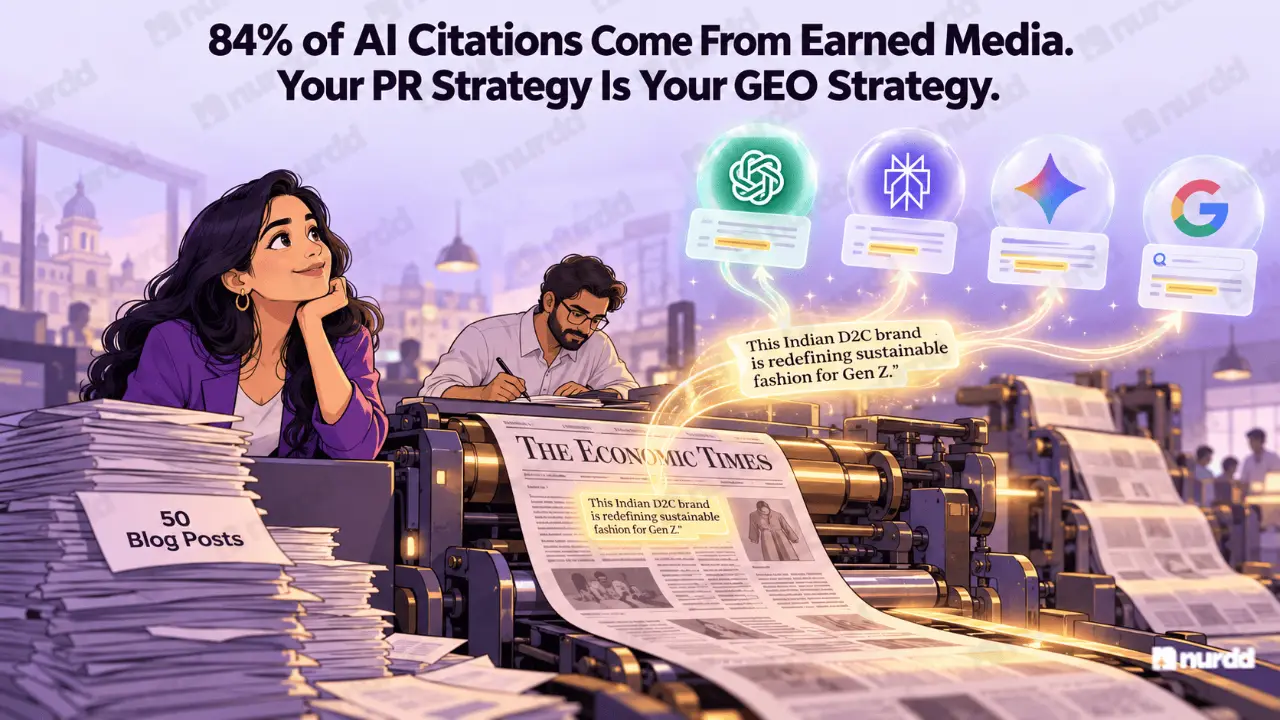
Approximately 84% of AI citations, the moments when Perplexity, ChatGPT, or Gemini mention a brand by name in a response, trace back to earned media coverage. For D2C brands, this means your PR strategy is not separate from your GEO strategy. It is your GEO strategy.
Which Publications AI Engines Actually Cite
The Three Levels of Media for AI Citation
Level | DA Range | Retrieval Frequency | Publications | Citation Speed |
|---|---|---|---|---|
Top | DA 70+ | All four major AI engines | National business and news outlets in your market | 2–4 weeks post-publication |
Mid | DA 50–70 | Strong topical relevance | Startup, trade, lifestyle and health titles that cover your category | 4–8 weeks |
Niche | DA 35–55 | Category-specific weight | Category magazines, specialist blogs and category portals | 8–12 weeks, within their domain |
Citation-Generating vs Traffic-Generating Coverage
The One Difference That Changes How You Brief Your PR Agency
Standard PR goals and AI citation goals differ in one specific way: a piece that generates traffic to your brand but does not mention your brand by name in extractable factual language produces no AI citation value. A piece that mentions your brand with one specific, factual, standalone claim, even a single sentence, is AI-citable.
Before you pitch a journalist, write the sentence you want AI engines to extract:
"Brand X's niacinamide serum, priced at $9, has become one of the more cited options for dark spot reduction among dermatologists on skincare forums."
That sentence is extractable. Plan your pitch to produce it.
The Pitch Framework
Angles That Produce AI-Citable Coverage
Category firsts: "First brand in its category to achieve X", a specific, verifiable claim that AI engines can repeat as a fact
Clinical data stories: "Our 8-week user study of 120 participants found...", outcome specificity with methodology is highly extractable
Founder expertise credentialing: "Founded by a dermatologist with 12 years of clinical practice", credentials propagate to brand trust in AI characterisation
Category trend features: Where your brand is cited as an example of a broader trend, places you in the category conversation AI engines draw from
The angles that do not produce AI-citable coverage: "We are the first clean beauty brand in our market" (unverifiable superlative), "Our customers love us" (no factual claim), "Building a community around conscious consumption" (no extractable brand-linked fact).

Building the Outreach System
The Three-Part Earned Media Engine for GEO
A one-off PR placement drives a temporary AI citation spike. A systematic earned media engine drives compounding AI visibility over 12 to 18 months. Here is the structure:
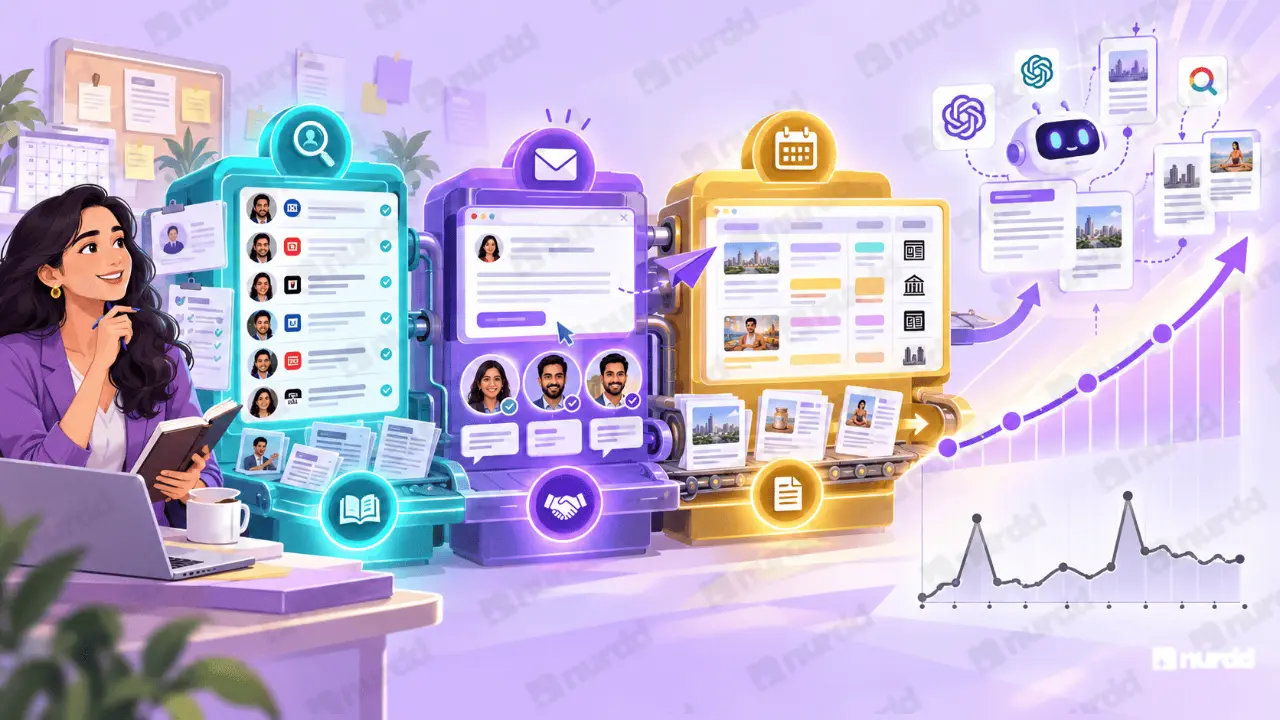
Part 1, The journalist relationship list. Identify 10 to 15 journalists who regularly cover your product category in top and mid-level publications. Follow their bylines, read their last 10 articles, and note the specific angles they prefer. This is the research investment most brands skip, and the reason most PR outreach goes unanswered.
Part 2, The expert source positioning. Email the journalists on your list, not with a pitch, but with an offer to be an expert source. "I am [Name], [credential] at [Brand]. I cover [category] and can speak to [specific topic they cover]. If you are ever working on a piece about [topic], I am available for comment or background." Three journalists who respond positively to this approach are worth more for GEO than one press release that gets ignored.
Part 3, The monthly angle pipeline. Create a monthly internal content calendar that maps your planned PR angles to: the specific journalist likely to cover it, the specific factual claim you want the coverage to contain, and the specific publication tier you are targeting for that angle. This discipline prevents the "we'll do PR when we have news" approach that produces sporadic, low-GEO-value coverage instead of the consistent drip of earned mentions that AI engines reward.
Measuring What Works
Tracking the AI Citation Impact of Each Earned Media Placement
Not every editorial placement produces the same AI citation lift. Some generate citations within 2 weeks. Others generate none, even from high-DA publications. Understanding why some placements work and others do not is what separates a reactive PR programme from a GEO-driven one.
What makes a placement AI-citable:
The article names your brand in a specific factual sentence, not just as a passing reference in a list
The publication's domain authority is above 50 and the page is indexed by Google
The article uses your product's specific ingredient, outcome, or differentiator, not generic category language
The article is linkable from its publication's homepage or category page, giving it crawl priority
What does not produce AI citations despite appearing in good publications:
Brand mentions in passing without a specific factual claim attached
Articles behind a paywall or requiring login to access
Advertorial or sponsored content sections that are robots-blocked by the publication's own crawl rules
Articles where your brand appears only in a quote you provided, with no third-party editorial endorsement
After each placement, watch Noma by Nurdd for the 4 weeks following publication: it asks your prompts daily and records the page behind each citation, so you can see whether the article itself starts being cited. If a placement from a DA-65 publication produces zero new AI citations in 4 weeks, the article almost certainly falls into one of the non-citable patterns above. Adjust your pitch strategy to produce content that meets the citable criteria, not just the placement criteria.
"Your PR agency is measuring column inches. Your GEO strategy needs them to measure extractable sentences. Brief them differently."
FAQ
Frequently Asked Questions
How does earned media affect AI search visibility?
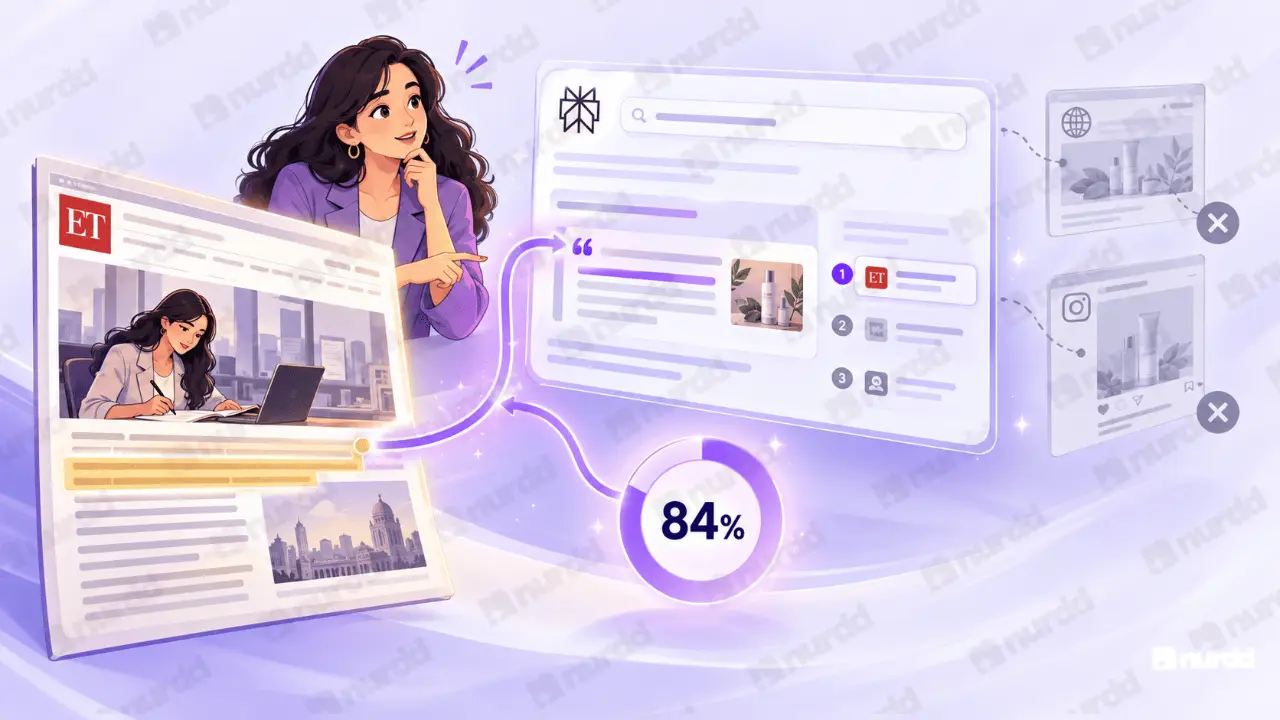
Approximately 84% of AI citations trace back to earned media coverage. Editorial mentions in publications above DA 50 are indexed by all major AI engines and constitute the primary external signal that determines whether an AI engine confidently recommends your brand in a category response. One strong editorial feature typically produces more AI citation lift than 10 new blog posts.
Which publications help AI search citation the most?
National business and news outlets above DA 70 tend to be retrieved by all four major AI engines, typically within 2 to 4 weeks of publication. Startup, trade, lifestyle and health titles between DA 50 and 70 carry strong topical weight and tend to be cited within 4 to 8 weeks.
How should I brief my PR agency for GEO value?
Brief your PR agency to produce coverage that contains one specific, factual, standalone sentence about your brand: naming your brand, your product, and one verifiable attribute. This sentence is what AI engines extract. Generic mentions that require surrounding context to make sense are not AI-citable. Pitches that produce extractable facts outperform pitches that produce brand awareness mentions.
What PR angles produce AI-citable coverage?
Category firsts with specific verifiable claims, clinical data stories with methodology and sample size, founder expertise credentialing with named credentials, and category trend features where your brand is cited as a named example. Angles that do not produce AI citations: unverifiable superlatives, community-building narratives, and award announcements without editorial pickup.
Sources and References
Kalicube – The role of earned media in AI brand entity building
SparkToro – AI citation source analysis: where generative engines get their facts
Search Engine Land – PR as GEO strategy: how earned media drives AI visibility