AI Search Visibility
Best FAQ Generator for AI Visibility: What to Look For
How to choose an FAQ generator for AI visibility, pick questions from tracked prompts, and test whether the answers get cited.
 Sheetal Shakshi7 Nov 202615 min read

The best FAQ generator for AI visibility is one that accepts real prompts and your own facts, because the question list matters more than the drafting tool. Google ended FAQ rich results in May 2026 and an Ahrefs study found no major citation uplift from schema, so choose questions from tracked prompts in Noma, then use any drafting tool.
The best FAQ generator for AI visibility is the one that starts from questions people really ask AI engines, not from a keyword guess. A generator can draft answers quickly, but it cannot know which questions your buyers put to ChatGPT, Gemini, Perplexity or Claude. Pair any drafting tool with tracked prompt data, then write each answer by hand.
This guide explains what an FAQ generator can and cannot do for AI visibility, how to choose one, and how to pick questions from tracked prompts rather than guesses. It also covers a six-step process, a scoring table for questions, and a test you can run on your own pages.
Key takeaways
- An FAQ generator is a drafting tool. AI visibility comes from choosing the right questions and giving each one a specific, checkable answer.
- Google's own guidance says generative AI features are built on core Search systems, so FAQ content must be useful on its own, not just marked up.
- Google ended FAQ rich results in Search in May 2026, and an Ahrefs study found no meaningful citation uplift from adding schema. Do not pay for a generator mainly for its schema output.
- Take your questions from tracked prompts and the follow-up questions engines generate, then rank them by gap, buying intent and proof you can supply.
- Measure before and after on the same prompts, over the same engines, for at least four weeks.
Does an FAQ generator actually help AI visibility?
Partly. An FAQ generator saves drafting time and gives you a consistent question-and-answer format, which is easy for a retrieval system to lift. What it does not supply is demand evidence: whether anyone asks that question, whether an engine already answers it with a competitor's page, or whether your answer is better than the one being cited.
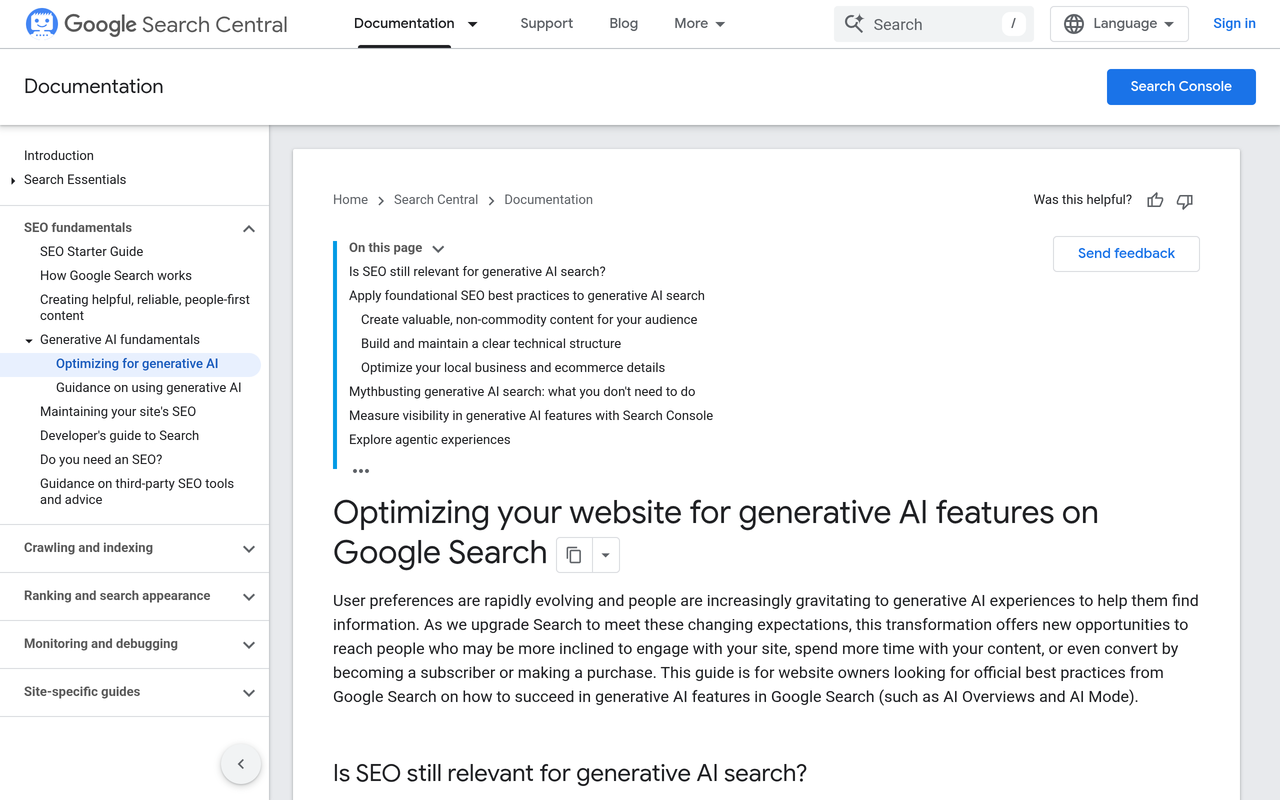
Google's guidance for site owners explains why this matters. According to the Google Search Central optimization guide, AI Overviews and AI Mode use retrieval-augmented generation, which pulls relevant pages from Google's Search index, and query fan-out, which sends several related queries at once. Google also says that for Search, optimizing for generative AI is still SEO.
The same guide tells site owners they can ignore tactics such as chunking content or creating llms.txt files for Google Search, and it puts unique, non-commodity content ahead of every other suggestion. An FAQ built from generic generator output is the definition of commodity content. That is the core problem to solve.
An FAQ generator improves AI visibility only when the questions come from real prompts and the answers contain facts the engine cannot find in the generator's default phrasing. The tool speeds up the writing; the prompt data decides whether the page is worth writing.
Search Console now gives Google-side evidence too. Google announced Search generative AI performance reports in Search Console (Google Search Central Blog, June 2026), so you can check how your pages appear in Google's AI features, though not in ChatGPT or Perplexity.
What do published FAQ generator articles cover, and what do they leave out?
Before writing this guide, we read three published FAQ generator pages. They share a pattern: a description of the tool and a promise of SEO benefit. None of them explains how to decide which questions deserve an answer.
| Page (as read November 2026) | What it covers | What it leaves out |
|---|---|---|
| GetGenie, Best FAQ Generator Tools for AI Visibility | A list of ten generators with short descriptions | How to source questions, how to verify citations, any before-and-after test |
| Jasper, FAQ Generator Agent | An agent that describes generating answer-first FAQs from real query data, with schema markup and SaaS documentation use cases | Which engines the queries come from, how you confirm the FAQ was cited |
| Landing Page, AI FAQ Generator | A free generator with a three-step flow, 30+ languages and tone settings | Evidence of AI-engine impact, question selection, measurement |
This guide covers the same ground (what generators do, what to look for) and adds what those pages lack: a question-scoring table built on tracked prompts, a worked example using Google's published fan-out example, a decision table by generator type, and a before-and-after test.
What should you look for in an FAQ generator?
Judge a generator on the inputs it accepts and the outputs it lets you verify, not on how fast it produces ten questions. Seven criteria matter, and the first two decide most outcomes.
- Question source. Can you paste in real prompts, search queries or support tickets, or does it invent questions from a topic word?
- Grounding in your facts. Can you give it product specifications, policies and numbers so the answer is specific?
- Answer-first format. Does each answer open with a direct response in one or two sentences before any context?
- Editable output. Can you change every line? Unedited output reads like everyone else's.
- Plain HTML output. Visible question headings and answers on the page, not content hidden in an accordion that fails to render.
- Schema as optional. Useful for consistency, not a reason to buy (see below).
- A way to measure. Can you tie the FAQ to prompts you track afterwards?
Most generator pages, including the three above, say little about criterion seven: how you would confirm that an engine cited the result. That gap is why the question list should come from a tracking tool rather than from the generator.
Which type of FAQ generator fits which job?
| Generator type | Good for | Weakness for AI visibility |
|---|---|---|
| Free one-box generator | Fast first drafts, multiple languages | Questions come from the topic you type, not from demand |
| SEO writing suite template | People-also-ask style questions, brief workflows | Search-engine query data, not prompts typed into AI engines |
| Marketing agent or workflow | Brand voice, approved terminology, scale across pages | Needs query data from you or a connected source |
| Support-bot or helpdesk generator | Answers drawn from your own documentation | Questions are existing customers' questions, not prospects' prompts |
| Tracked-prompt data from Noma, plus manual writing | Choosing which questions to answer and proving the effect | Does not draft for you |
The last row is not a generator, and that is the point. Questions chosen from tracked prompts will beat questions guessed by any drafting tool, and you can use whichever generator you like for the writing.
Does FAQ schema help AI engines cite you?
Current evidence says it should not be your deciding factor. A Digital Applied guide (2026) quotes a note in Google's FAQ structured data documentation, dated May 7, 2026, saying FAQ rich results no longer appear in Google Search. Google's own AI features documentation is the primary place to check how its generative features treat your pages.
On the AI side, Search Engine Roundtable (May 2026) reports an Ahrefs study that tracked 1,885 pages that added JSON-LD schema between August 2025 and March 2026 and matched them against 4,000 control pages. Ahrefs found no major uplift in citations on any platform, and a 4.6% decline in AI Overviews that was small but statistically significant.
Be careful with what that does and does not show. It measures schema added to existing pages, not whether FAQ content itself is cited, and the study period ends in March 2026. Keeping valid FAQ markup does no harm, but a generator that sells schema as its main benefit is selling the weaker half.
How do you pick FAQ questions from real tracked prompts?
Start from the prompts a buyer would type, then look at what each engine says and which page it cites. A tracked prompt gives you three things a guess cannot: the exact wording, the engines where you are missing, and the competing source being cited instead.
Noma by Nurdd tracks 13 AI engines, including ChatGPT, Gemini, Perplexity and Claude, polled daily. It records whether your brand is named and which page each citation comes from, and shows citation frequency by category and a competitor comparison. For FAQ planning, that means you can read a missing mention as a specific, answerable question rather than a vague ranking problem.

If you are building the prompt list from zero, which prompts to track and how many prompts you need cover the sampling logic. For a first pass, group prompts into comparison, how-to, pricing, trust and alternatives questions, because each group needs a different type of answer.
A scoring table for candidate questions
Score every candidate question from 0 to 2 on the five factors below, then answer the questions with the highest totals first. The scoring is our own framework, not a published standard, so adjust the weights to your category.
| Factor | 0 | 1 | 2 |
|---|---|---|---|
| Prompt evidence | Guessed | Appears in one tracked prompt | Appears across several prompts or engines |
| Visibility gap | You are already named and cited | Named but not cited | Not named; a competitor is cited |
| Buying intent | Curiosity | Evaluation | Comparison or purchase decision |
| Proof available | No specific fact to give | One fact | Numbers, policy or documentation you can cite |
| Page fit | No suitable page | Could extend an existing page | An existing page already ranks for the topic |
A question that scores eight or more is a strong candidate. A question scoring three or less is usually a guess, and a generator will happily write ten of those for you.
How do you build an FAQ from the prompts, step by step?
Follow these six steps in order. Each states the action, the result you get, and why it matters.
Step 1: Build a prompt set of 20 to 40 buyer questions
Action: write the prompts a buyer would type, using customer calls, support tickets and sales objections as input, and load them into your tracking tool. Result: a baseline list with wording that matches real use. Why: AI engines match the phrasing of the question, so your headings should too.
Step 2: Record the baseline for each prompt
Action: for each prompt, note whether your brand is named, which brand is recommended, and which URL is cited. In Noma this is recorded across the 13 engines daily. Result: a gap list. Why: a before-and-after test is impossible without the "before".
Step 3: Expand with the follow-up questions engines generate
Action: add the related sub-questions a prompt triggers. Google's guide uses the example of a lawn full of weeds, where fan-out queries include best herbicides for lawns and how to prevent weeds. Result: a list that covers the whole topic, not one head question. Why: a page that answers the sub-questions gives the retrieval system more to match.
Step 4: Score and shortlist the questions
Action: apply the scoring table and keep the top 6 to 10 per page. Result: a short list tied to evidence. Why: long FAQ pages dilute the answers that matter and are slow to maintain.
Step 5: Draft with a generator, then rewrite with your facts
Action: use any generator for a first draft, then replace generic lines with specifics: model numbers, policy terms, dates, prices and the source of each figure. Result: answers that exist nowhere else. Why: Google's guide says non-commodity content influences AI search presence more than anything else it suggests.
Step 6: Publish, then re-measure on the same prompts
Action: publish on a crawlable page, wait, then re-run the same prompt set. Result: a change in mentions and citations per prompt. Why: it separates what worked from what only felt useful. The GEO experiment design guide explains how to keep the test clean.
What does a worked example look like?
Take Google's own fan-out example and treat it as a brand would. Suppose a lawn-care retailer tracks the prompt "how to fix a lawn that's full of weeds". Google's guide lists the fan-out queries best herbicides for lawns, remove weeds without chemicals, and how to prevent weeds in lawn.
| Fan-out query (from Google's guide) | FAQ question to write | Fact to include |
|---|---|---|
| best herbicides for lawns | Which weed killer is safe for my grass type? | Your tested product list, with grass types and label directions |
| remove weeds without chemicals | How do I remove lawn weeds without chemicals? | Your own method steps and timing by season |
| how to prevent weeds in lawn | How do I stop weeds coming back? | A schedule tied to the products you sell |
The illustration shows the method, not a result. The retailer then records, for each of the three prompts, whether it is named and which URL is cited, publishes the answers, and re-checks. A generator can draft the three answers in seconds; it cannot tell the retailer these three questions matter.
How do you write FAQs that AI engines cite?
Write each answer so a reader who sees only that paragraph still gets a correct, attributable answer. Four habits do most of the work.
- Answer first. Open with the direct answer in one or two sentences, then add the condition or exception.
- Name the entity in full. Write "Noma by Nurdd tracks 13 AI engines", not "it tracks them". Engines lift passages out of context.
- Attach a source to every number. Name the publisher and month inline. If you cannot verify a figure, state the point without it.
- Keep answers 2 to 4 sentences. Longer answers belong in the body of a page, linked from the FAQ.
The Contently guide to FAQs that LLMs cite makes a similar case for natural question phrasing and direct answers. Our own pages on sentence structure that gets cited and FAQ pages for AI search go deeper on wording.
A pre-publish checklist
- Each question matches a tracked prompt or a fan-out sub-question.
- The first sentence of each answer stands alone.
- The brand or product is named in full in at least half the answers.
- Every number has a named, dated source or is removed.
- The FAQ sits on a page that is crawlable and indexable; check which AI crawlers you allow.
- The page shows a visible update date, as covered in author and dateModified signals.
- The question list is unique to your brand, not a copy of a competitor's.
- The baseline for the related prompts is recorded.

What are the common mistakes with FAQ generators?
- Publishing raw output. Generic answers add nothing an engine cannot already find, and Google's guide ranks unique content as the biggest lever.
- Buying for schema. FAQ rich results ended in May 2026 and the Ahrefs data shows no meaningful citation lift from adding schema.
- Writing 30 questions on one page. Fewer, evidence-ranked questions are easier to maintain and easier to match.
- Hiding answers. Content that loads only after a click or script may not be read; see how to check your website is optimised for AI answers.
- Skipping the baseline. Without a recorded before-state you cannot claim the FAQ worked.
- Ignoring third-party sources. Engines often cite review sites and forums, so an FAQ alone may not change who is recommended; see why a competitor is cited and you are not.
How does Noma help you choose the questions?
Noma by Nurdd is an AI search visibility dashboard at nomahq.app that tracks whether a brand appears in answers from 13 AI engines, including ChatGPT, Gemini, Perplexity and Claude. It records whether your brand is named and which page each citation comes from, and it shows citation frequency by category with a competitor comparison and recommendations. That makes it the evidence layer an FAQ generator lacks.
Book a demo at https://www.nurdd.club/demo to see Noma on your own category.
Noma has a 3-day free trial. A card is taken at signup and billing starts on day 3; if you cancel before then, you are not charged. Details are at nomahq.app.
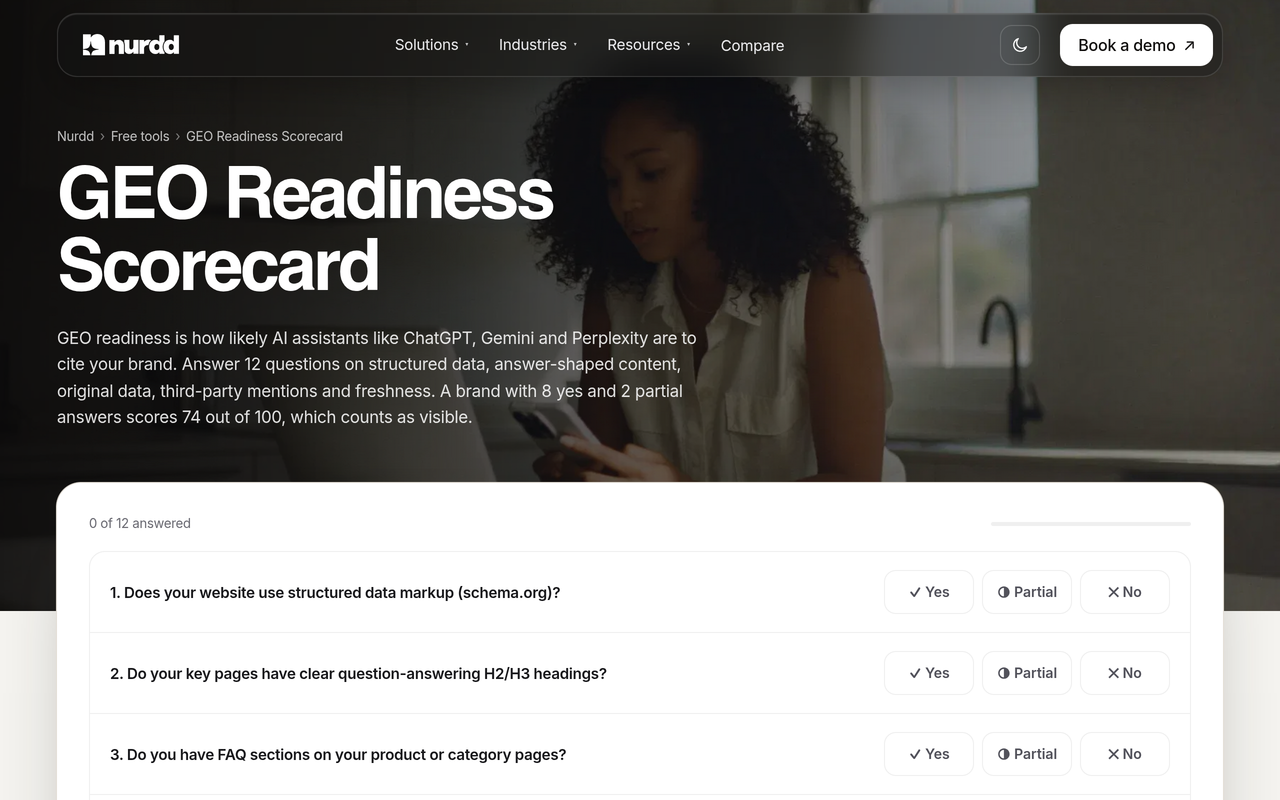
If you want a quick self-check first, run the GEO readiness scorecard, a 12-factor check of how ready a site is for AI answers. For the wider method, read what generative engine optimization is and the AEO audit checklist. If you would rather hand the work over, Nurdd also runs answer engine optimization as a managed service, measured in Noma.
How do you test whether the FAQ worked?
Run a four-week before-and-after test on a fixed prompt set. This design is ours; it uses only public methods and no assumed results.
- Week 0: record the baseline for 20 or more prompts: named or not, cited URL, competitor named.
- Split the prompts into two groups: those whose FAQ answers you publish, and those you leave untouched as a control.
- Publish the FAQ answers for the treatment group only.
- Weeks 1 to 4: re-check both groups on the same engines at the same cadence.
- Compare the change in the treatment group with the change in the control group.
The control group is the important part. The Ahrefs study design, treated pages against 4,000 matched control pages, is the reason its result is credible, and your test should borrow the same logic at small scale. For reporting, see building a monthly AI search report and measuring AI referral traffic.
So where should the question list come from?
Choose the questions from tracked prompts in Noma, then use any drafting tool to write the answers, and edit them with your own facts. The tool matters less than the evidence behind the questions.
Related reading on choosing tools: answer engine optimization tools: how to choose and best AI search visibility tools 2026.
How we researched this
Written by Sheetal Shakshi. We reviewed three published FAQ generator pages, Google Search Central documentation on generative AI features, a secondary report on Google's FAQ rich result change, and the Ahrefs schema study as reported by Search Engine Roundtable. Pages were checked on the publication date, November 2026. We did not hands-on test the third-party generators, so we describe them only as their own pages describe them. The scoring table, decision table and test design are our own frameworks, not published standards.
Frequently asked questions
What's the best FAQ generator for improving searchability and AI visibility?
No single generator decides the outcome. Choose one that lets you paste in real prompts and your own facts, produces answer-first text you can edit, and does not depend on schema. Then pick the questions from tracked prompt data, since the question list matters more than the drafting tool.
How do I write FAQs that AI engines cite?
Match the question to a real prompt, open each answer with a direct response, name the brand or product in full, and give every number a dated source. Keep answers to two to four sentences and publish on a crawlable page. Then re-check the same prompts to confirm the effect.
Do I need FAQ schema for AI visibility?
Not for citations, on the evidence available. Google's FAQ rich results stopped appearing in May 2026, per Digital Applied's quote of Google's note, and an Ahrefs study of 1,885 pages found no major citation uplift from adding schema on any platform. Valid markup is harmless, but the visible answer text is what matters.
How many questions should an FAQ section have?
Six to ten well-chosen questions per page is a practical range. Rank them with the scoring table and drop the weakest. The number is a guideline from our method, not a published threshold.
Can a free FAQ generator be enough?
It can draft answers, but it will not tell you which questions buyers ask AI engines. Use prompt tracking to choose the questions, then rewrite any draft with your own facts.
How do I find which questions to answer?
Track the prompts buyers would type, record who is named and which URL is cited, then add the related sub-questions each prompt triggers. Score each candidate for evidence, gap, buying intent, proof and page fit.
How long until an FAQ changes AI answers?
There is no published timeline we can cite. Run a four-week test with a control group of untouched prompts and judge the difference, rather than relying on a promised speed.
Can Noma write my FAQ?
No. Noma by Nurdd tracks 13 AI engines and shows whether your brand is named and which pages are cited, so you know which questions to answer. You or your writer then draft the answers, with any generator you prefer.
Next step: see your own prompt gaps
A generator can draft the answers. Noma shows which questions are worth answering. Book a demo to see Noma on your own category.