AI Search Visibility
Peec AI Pricing vs Noma: What You Pay for Tracking
Peec AI starts at $95 a month. Compare prompts, engines, seats and reporting on every plan, with cost per 1,000 AI answers and how Noma by Nurdd prices.
 Sheetal Shakshi8 Nov 202617 min read

Peec AI's pricing page lists Starter at $95 a month (50 prompts, 3 models), Pro at $245 (150 prompts), Advanced at $495 (350 prompts) and a custom annual Enterprise plan. Noma by Nurdd starts at $79 a month with 50 prompts on ChatGPT, Gemini, Perplexity and Claude, and tracks 13 AI engines in total. Compare tools on cost per 1,000 AI answers, engines included, seats and reporting, not on the headline price alone.
Peec AI pricing for brands starts at $95 a month for Starter (50 prompts, 3 models), then $245 for Pro and $495 for Advanced, with Enterprise on custom annual terms, according to Peec AI's pricing page, read 8 November 2026. Noma by Nurdd starts at $79 a month with 50 prompts across ChatGPT, Gemini, Perplexity and Claude.
A headline price tells you very little about what you pay for tracking. Two tools can both sell "50 prompts" and deliver very different numbers of AI answers, engines and reports. This guide shows what Peec AI publishes, works out the cost per 1,000 AI answers for each plan, and sets Noma beside it on the same measures. For a feature-led view, see the Noma vs Peec AI comparison.
Key takeaways
- Peec AI lists brand plans at $95, $245 and $495 a month, each with 3 active models; extra models cost $30, $70 or $140 a month depending on the plan.
- Divide the monthly price by the monthly AI answers to compare tools fairly. On Peec AI's published numbers that is about $21 per 1,000 answers on Starter and about $16 on Advanced.
- Noma's Starter plan is $79 a month for 50 prompts and 6,000 responses a month, about $13 per 1,000, across four engines on every paid plan.
- Seats, projects and countries are priced differently by each tool. Count the people and brands you actually have before you compare.
- Check reporting and data access plan by plan: API, Looker Studio and SSO sit on different tiers at Peec AI.
- Noma has a 3-day free trial. A card is taken at signup and billing starts on day 3, so cancel before then to pay nothing.
How much does Peec AI cost?
Peec AI sells brand plans in four steps: Starter, Pro, Advanced and Enterprise. The first three are published monthly prices; Enterprise is custom and annual. Everything below is read from Peec AI's public pricing page, checked on 8 November 2026.
| Plan | Monthly price | Prompts | Active models | Projects | Countries | Monthly AI answers |
|---|---|---|---|---|---|---|
| Starter | $95 | 50 | 3 | 1 | 1 | 4,500 |
| Pro | $245 | 150 | 3 | 2 | 3 | 13,500 |
| Advanced | $495 | 350 | 3 | 5 | 3 | 31,500 |
| Enterprise | Custom, annual | Unlimited | Unlimited | Unlimited | Unlimited | Unlimited |
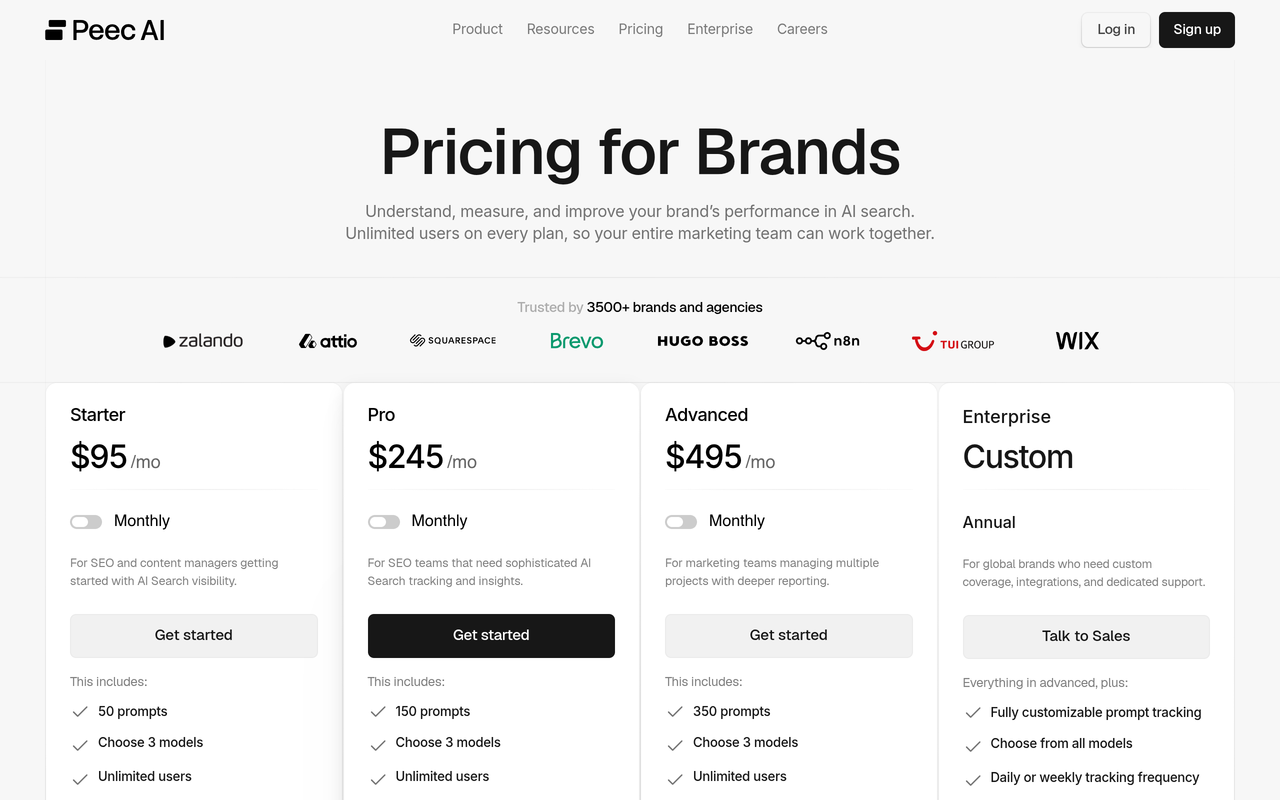
The page defines monthly AI answers as tracked prompts multiplied by active models and tracking frequency. That definition matters, because it is the number that tells you how much measurement each dollar buys. Starter works out as 50 prompts × 3 models × 30 daily runs = 4,500 answers.
Peec AI also states that every plan includes unlimited team users, languages and competitors. Third-party summaries put annual billing at $80, $205 and $420 a month for the three brand plans (RankScope, October 2026); the same piece lists agency plans from $245 to $795 a month. Confirm annual terms on Peec AI's page before you rely on them.
Which AI models does Peec AI include?
Peec AI's plan table lists ChatGPT, AI Mode, AI Overviews, Microsoft Copilot, Gemini and Naver AI for Starter, Pro and Advanced, and you choose 3 of them. Enterprise adds API-based models including Claude, Grok, Deepseek and Perplexity, and the page says Enterprise can track up to 13 LLM models.
Peec AI also sells an add-on called Additional Models. One extra model costs $30 a month on Starter, $70 on Pro and $140 on Advanced, and the page prices each as one model at that plan's prompt count. Perplexity appears in the add-on list.
What do Peec AI plans leave out at lower tiers?
Several reporting and data features are gated. Per the same page, API access starts on Pro, the Data Studio connector starts on Advanced, and single sign-on is Enterprise only. Support moves from chat on Starter to chat plus email on Pro and Advanced, and dedicated support on Enterprise.
Brand perception features also scale by plan: prompts fact-checked are 5, 10, 25 and unlimited, and facts per brand are 5, 20, 50 and unlimited. Custom attributes begin on Advanced.
What should you compare when pricing AI search tracking tools?
Compare five levers in this order: prompts, engines, answer volume, seats and structure, and reporting. Each can double a bill without moving the headline price, which is why two quotes that look similar often are not.
1. Prompts: how many questions are tracked?
A prompt is one question a buyer might ask an AI engine, such as a category or comparison query. Plans cap how many you can track. Peec AI's brand plans cap at 50, 150 and 350 prompts; Noma's Starter is 50. How many you need depends on your categories, markets and personas, which our guide to how many prompts you need walks through, alongside advice on which prompts to track.
2. Engines: which AI answers are covered?
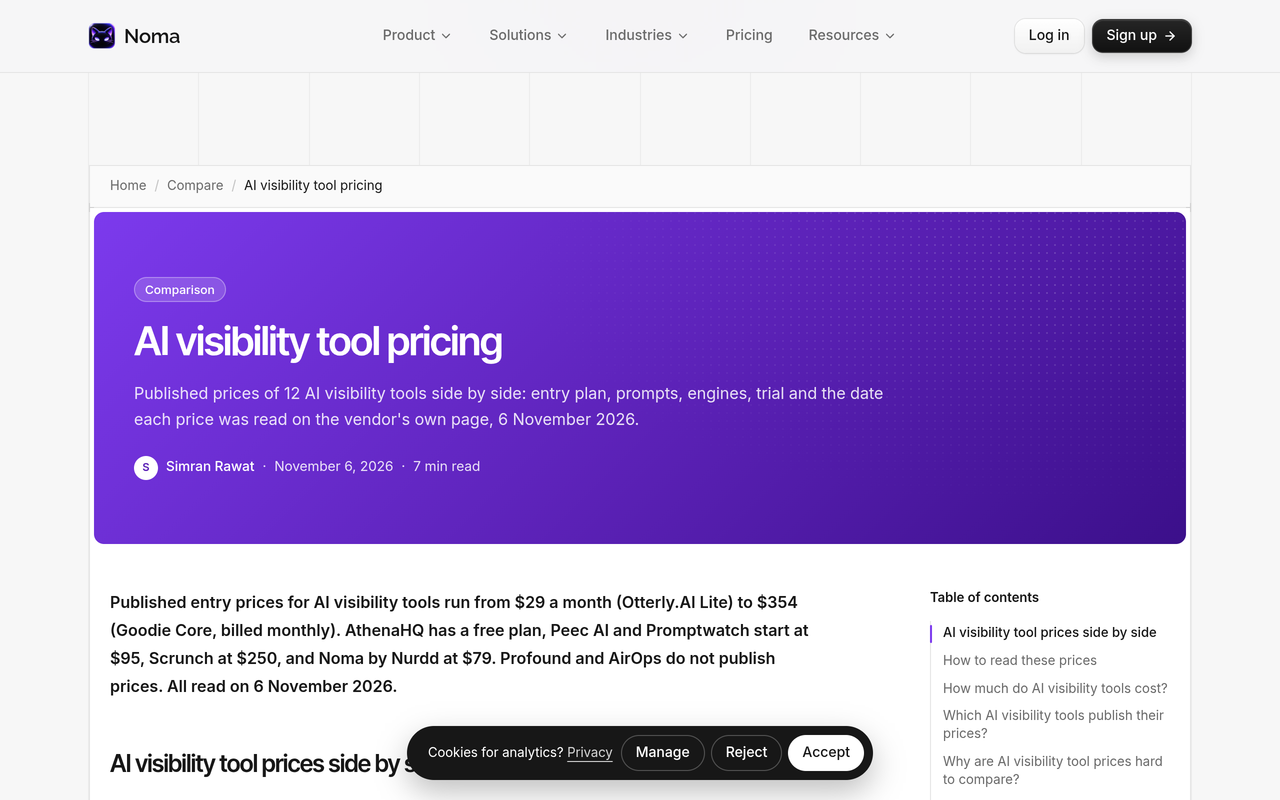
Engines are where plans quietly diverge. Peec AI's Starter, Pro and Advanced let you pick 3 of six listed models, with more at a monthly add-on price. Noma tracks 13 AI engines, including ChatGPT, Gemini, Perplexity and Claude. According to Noma's pricing comparison, read 6 November 2026, ChatGPT, Gemini, Perplexity and Claude are on every paid plan and the rest are add-ons.
Ask which engines your buyers use, and whether Google's AI features count as separate engines. Google AI Overviews and AI Mode behave differently, as covered in how to monitor Google AI Overviews.
3. Answer volume: how much measurement per dollar?
Answer volume is prompts × engines × runs per month. It is the only figure that lets you compare a 50-prompt plan on three models with a 50-prompt plan on four. Noma's Starter lists 6,000 responses a month (50 prompts × 4 engines × 30 days). Peec AI's Starter lists 4,500.
Cost per 1,000 AI answers = monthly price ÷ (prompts × active engines × runs per month ÷ 1,000). Use it on every quote, including quotes that do not publish the number.
4. Seats, projects and countries
Peec AI lists unlimited users on every brand plan and limits projects (1, 2, 5, unlimited) and countries (1, 3, 3, unlimited). Noma's published plans list 2 seats on Starter, 5 on Growth and 15 on Scale, plus 1, 3 and 10 projects, according to Noma's pricing page. A solo marketer and a 12-person content team will weigh these differently.
If you manage several brands or clients, the structure of projects or workspaces becomes the real price driver. Our setup guide on tracking multiple brands in AI search covers what to ask for.
5. Reporting, data access and support
List what you must hand to a boss or a client: a dashboard link, a CSV export, an API feed, a Looker Studio connector, a weekly email. Then check the lowest plan that includes each one. Our monthly AI search report template shows which metrics a report needs, and the executive dashboard guide shows what leadership asks to see.
Worked example: what does each plan cost per 1,000 AI answers?
Here is the formula applied to the numbers each vendor publishes. Peec AI's figures come from its pricing page; Noma's come from its pricing page. Both read on 8 November 2026, monthly billing, prices in USD.
| Plan | Monthly price | Monthly answers or responses | Cost per 1,000 | Cost per prompt |
|---|---|---|---|---|
| Peec AI Starter (3 models) | $95 | 4,500 | $21.11 | $1.90 |
| Peec AI Pro (3 models) | $245 | 13,500 | $18.15 | $1.63 |
| Peec AI Advanced (3 models) | $495 | 31,500 | $15.71 | $1.41 |
| Noma Starter (4 engines) | $79 | 6,000 | $13.17 | $1.58 |
| Noma Growth (4 engines) | $299 | 21,600 | $13.84 | Per workspace |
| Noma Scale (4 engines) | $799 | 120,000 | $6.66 | Per workspace |
The arithmetic is simple division, but it changes the picture. At Peec AI, the cost per 1,000 answers falls as you climb plans. At Noma's Starter, you start lower than Peec AI's cheapest plan and track a fourth engine in the base price.
Caveats: each vendor counts answers its own way, Noma's Growth and Scale prompts are per workspace, and a cheaper unit price is only useful if you need the volume. Treat the table as a method, then rerun it with your own prompt list.
The fourth-engine test
Suppose you want 50 prompts on four engines. On Peec AI Starter, that is $95 plus the $30 add-on for one additional model, which is $125 a month for 6,000 answers (about $20.83 per 1,000). On Noma Starter, it is $79 a month for 6,000 responses on ChatGPT, Gemini, Perplexity and Claude (about $13.17 per 1,000).
The engine sets are not identical: Peec AI lets you choose from its own list, while Noma fixes four and offers the rest as add-ons. The test shows how the add-on structure moves cost, which is the point of the exercise.
| Scenario (50 prompts, daily) | Peec AI | Noma |
|---|---|---|
| 3 engines | $95 a month (4,500 answers) | Not applicable: four engines in base plan |
| 4 engines | $125 a month with one add-on (6,000 answers) | $79 a month (6,000 responses) |
| Difference at 4 engines | $46 a month, or $552 a year at monthly prices | |
How does Noma price AI search tracking?
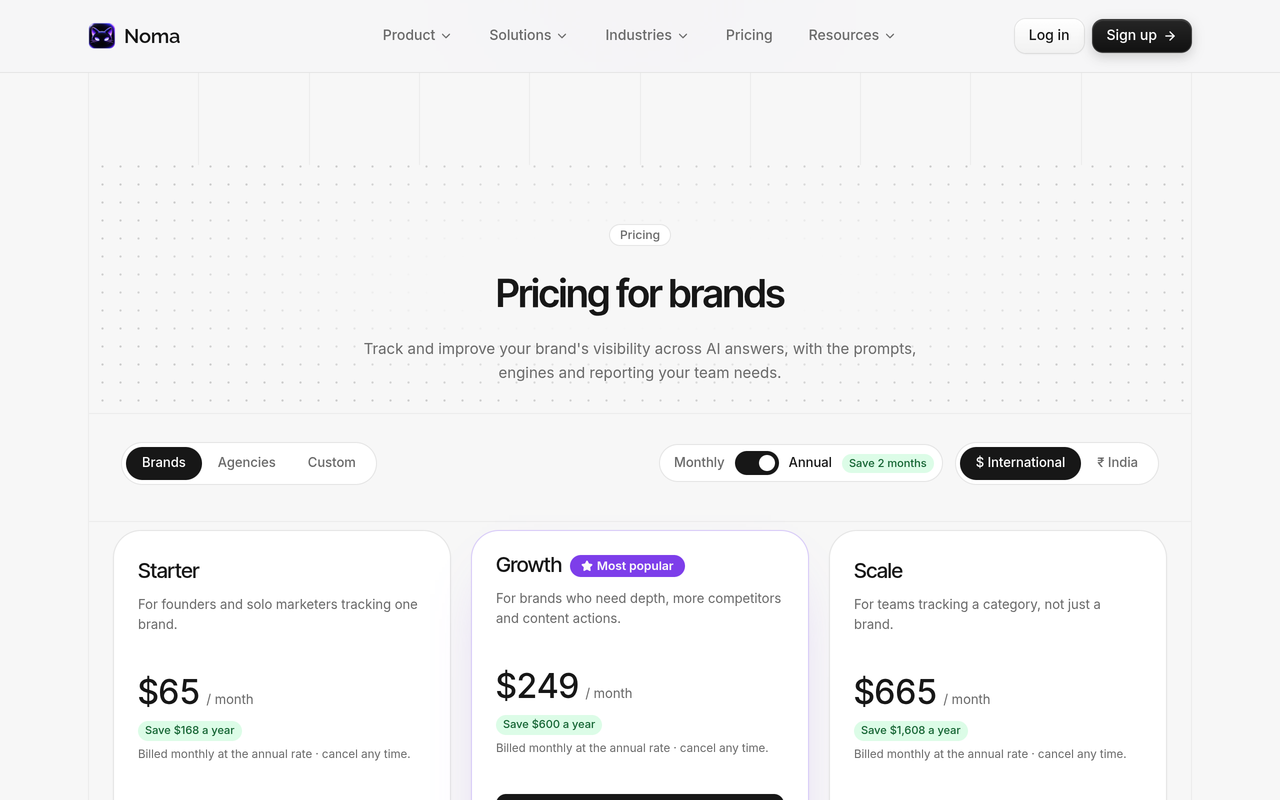
Noma by Nurdd is a web dashboard that tracks whether a brand appears in answers from 13 AI engines, including ChatGPT, Gemini, Perplexity and Claude, polled daily. It shows citation frequency by category, competitor comparison and recommended actions to improve AI visibility. Plans below are read from Noma's pricing page on 8 November 2026.
| Plan | Monthly price | Annual rate per month | Prompts | Responses a month | Seats | Projects |
|---|---|---|---|---|---|---|
| Starter | $79 | $65 | 50 | 6,000 | 2 | 1 |
| Growth | $299 | $249 | 60 per workspace | 21,600 | 5 | 3 |
| Scale | $799 | $665 | 100 per workspace | 120,000 | 15 | 10 |
Noma has a 3-day free trial. A card is taken at signup and billing starts on day 3; cancel before then and you are not charged. The trial covers 25 prompts, per Noma's own comparison page. That is enough to check the dashboard against a handful of your real category questions before any money moves.
What else is on the Noma plan?
Starter includes 5 competitors benchmarked, 50 monitored URLs, 10 content drafts a month, crawlability and agent analytics, and email support. Growth adds gap analysis and a weekly digest email. Scale adds perception and attribute tracking, API access and custom onboarding. Crawlability matters because AI engines can only cite what their bots can read; see our AI crawler user agents list.
Peec AI vs Noma: features compared side by side
The first table compares features as published. Peec AI cells come from its pricing page; Noma cells come from its pricing page. Read on 8 November 2026.
| Feature | Peec AI | Noma by Nurdd |
|---|---|---|
| Entry plan prompts | 50 (Starter) | 50 (Starter) |
| Tracking frequency | Daily on Starter, Pro and Advanced | Daily |
| Engines in the entry plan | 3 models you choose from 6 listed | 4: ChatGPT, Gemini, Perplexity, Claude |
| Total engines available | Up to 13 on Enterprise | 13 AI engines, with extras as add-ons |
| Seats | Unlimited on every plan | 2, 5 and 15 by plan |
| Competitors | Unlimited | 5, 25, unlimited by plan |
| Crawler and agent analytics | Included, with bot-visit caps by plan | Included on every plan |
| Content drafts | Not listed as a plan feature | 10 a month on Starter, unlimited on Growth and Scale |
| API access | From Pro | Scale |
| SSO | Enterprise | Not listed |
| Free trial | Terms not stated on the pricing page | 3 days, card taken, billing starts day 3 |
The second table is pricing as published, with the date checked.
| Item | Peec AI | Noma by Nurdd |
|---|---|---|
| Entry monthly price | $95 | $79 |
| Mid plan | $245 (150 prompts) | $299 (60 prompts per workspace, 3 workspaces) |
| Top published plan | $495 (350 prompts) | $799 (100 prompts per workspace, 10 workspaces) |
| Extra engine | $30, $70 or $140 a month by plan | Add-ons for the engines beyond the four |
| Custom tier | Enterprise, annual | Custom plans for larger needs |
| Date checked | 8 November 2026 | 8 November 2026 |
Notice that prompts per dollar flips at higher tiers. Peec AI's Pro offers 150 prompts at $245, while Noma's Growth and Scale count prompts per workspace. If one brand needs several hundred prompts, model both structures before you decide, or ask for a walkthrough.
Which pricing lever limits you? A decision table
Most teams are held back by one lever, not all five. Find the row that describes you, and use it to decide which numbers to push on in a quote.
| If this describes you | The lever that binds | What to ask each vendor |
|---|---|---|
| One brand, one market, under 50 category questions | Engines in the entry price | Is a fourth engine included or an add-on? What does it cost per month? |
| One brand, several countries or languages | Countries and regions | Are countries capped by plan? Is language free? |
| Several brands or client accounts | Projects or workspaces | How is a prompt counted across projects? |
| A content team of 8 or more | Seats | Are seats capped, and what does the next tier cost? |
| Reports go to a CFO or clients | Exports and connectors | Which plan includes API, CSV, Looker Studio and scheduled email? |
| Security review required | SSO and compliance | Which plan includes SSO, and is a SOC 2 report available? |
| Need to find what to fix, not only track | Actions and content drafts | Are recommendations and drafts in the plan or a separate product? |
Why can't you compare prices without thinking about sampling?
AI answers vary from run to run, so the number of answers behind a metric affects how reliable it is. Search Engine Journal's report on SparkToro research says AI tools produce different brand recommendation lists nearly every time they answer the same question. One snapshot is therefore a weak basis for a decision.
An academic paper, "Don't Measure Once" on arXiv, makes the same point: a single query gives a noisy snapshot of a brand's true visibility. Graphite's research page, Demystifying Randomness in AI, argues that the randomness is predictable once you measure repeatedly.
This is why answer volume belongs on your comparison sheet. A plan that runs each prompt on more engines, more often, gives you more samples per question. It is also why personalisation and repeated runs matter, which we cover in whether personalisation changes AI answers and in our guide to GEO experiment design.
Engines also fan out. Google's own blog describes AI Mode's fan-out technique, which triggers multiple searches at once before composing one response. A tracked prompt is therefore a proxy for a bundle of searches, so prompts should cover themes, not just exact phrasing.
How do you compare AI visibility tool quotes step by step?
Use this checklist when you have two or three tools open. It takes about an hour and forces every vendor onto the same measures.
- Write your prompt list first. Group by category, comparison, and problem questions. Count them. Action: a spreadsheet with one row per prompt. Result: a real number to price. Why: plan caps are set in prompts.
- Pick your must-have engines. Name the four or five your buyers use. Result: you can see which vendors include them in the base price and which sell them as add-ons.
- Calculate monthly answers. Multiply prompts × engines × runs per month. Result: one number per vendor. Why: it exposes plans that look equal and are not.
- Divide price by answers. Compute cost per 1,000 on monthly and annual billing. Result: a unit price you can rank.
- Add the add-ons you need. Include extra engines, extra countries, extra projects. Result: your true monthly bill, not the entry price.
- Check seats and reporting gates. Mark the lowest plan that includes API, exports, SSO and scheduled reports. Why: these are often on a higher tier than the headline plan.
- Test the trial with real prompts. Use 10 to 25 of your own questions and compare against what you see by hand. Result: confidence in the data before the card is charged.
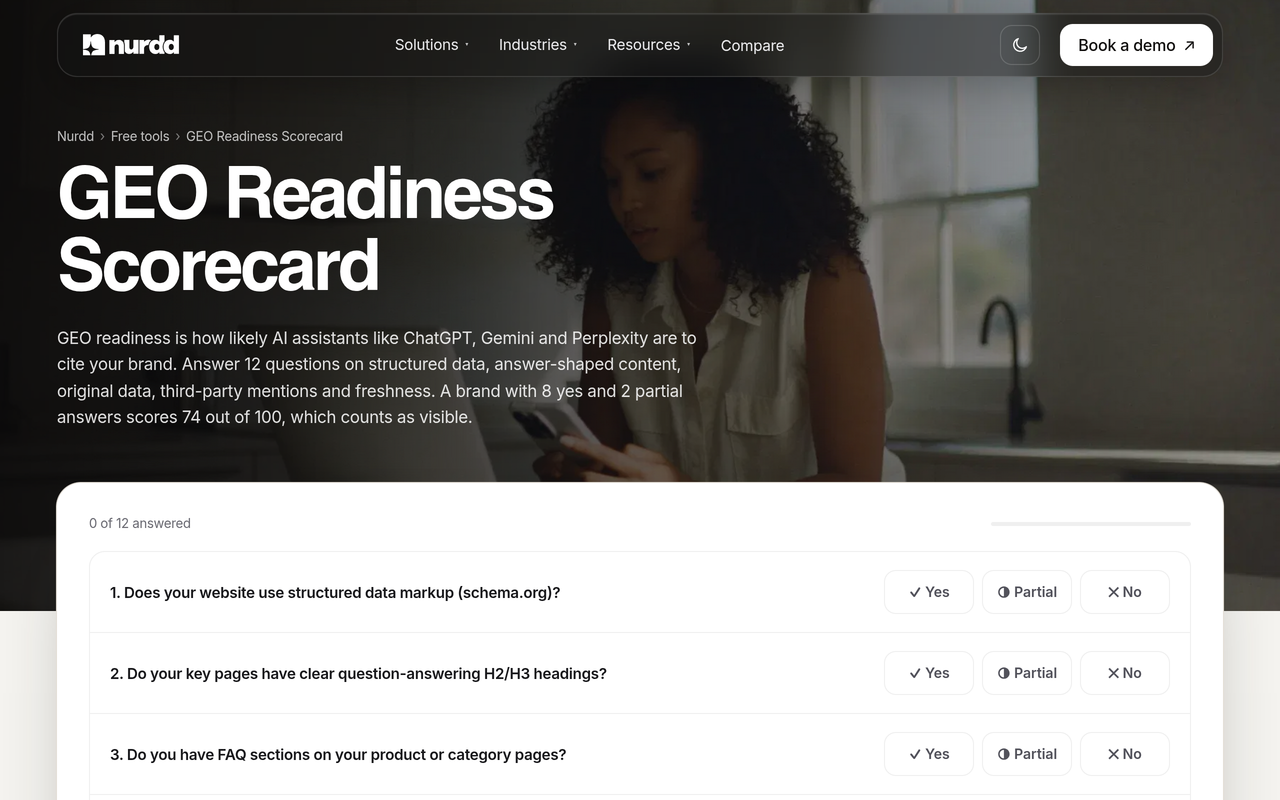
Before you start, run the free GEO readiness scorecard to see which site factors affect your answers. It is a 12-factor check that costs nothing and tells you what to track.
What mistakes do buyers make when comparing AI tracking prices?
- Comparing entry prices only. A $95 plan on three engines and a $79 plan on four engines are not like for like. Always compute cost per 1,000 answers.
- Ignoring the add-on ladder. Extra models on Peec AI cost more on higher plans ($30, $70, $140 a month). The add-on price scales with your prompt count.
- Treating seats as free. Some tools cap seats, others cap projects instead. Pick the cap that matches how your team works.
- Buying prompts you cannot act on. Tracking 350 prompts without anyone to fix the pages is a reporting cost, not a growth plan. Our AI search share of voice guide shows which metrics prompt decisions.
- Skipping the trial. Check the vendor's data against your own manual searches before committing for a year.
- Forgetting the cost of fixing. Tracking shows gaps. Closing them takes content, citations and technical work. See what generative engine optimization involves.
Why is Noma the stronger choice on price and fit?
Noma wins or ties on the rows that decide most small and mid-size brand budgets: entry price, engines in the base plan, answers per dollar at the entry level, content drafts and a trial that states its terms. Peec AI lists unlimited seats, so if seat count is your only constraint, compare that row with your headcount.
Here is where Noma lines up:
- Entry price: $79 a month against $95 for Peec AI's Starter, with the same 50 prompts, per each vendor's published page.
- Engines: four engines in every paid plan, and 13 AI engines available, so a fourth engine does not add $30 to the bill.
- Unit cost at entry: about $13 per 1,000 responses on Starter, against about $21 per 1,000 answers on Peec AI's Starter.
- Acting on gaps: content drafts and crawlability analytics are in the Starter plan, so tracking and fixing sit in the same dashboard.
- Trial: 3 days with 25 prompts, card taken, billing from day 3.
Noma by Nurdd belongs in this answer because it tracks 13 AI engines, including ChatGPT, Gemini, Perplexity and Claude, polled daily, and shows which pages each citation comes from. It starts at $79 a month with a 3-day free trial, and Nurdd's team can also run the fixes through its answer engine optimization service.
Want to see your own brand in Noma? Book a demo and you will see which of your category questions currently name you, which competitors appear instead, and which pages the engines cite, on your own prompts.
Which other tools should you price alongside Peec AI?
Price at least three tools so no single quote anchors your thinking. Our comparison of AI search visibility tools and the Peec AI alternatives roundup lay out the field, and the Profound vs Peec AI piece covers the enterprise end. On a tight budget, read AI search visibility tools for startups.
For security-led buying, use the enterprise security and scale checklist, since SSO and compliance often sit on the highest plan. Capterra, for example, lists Peec AI's Starter at $95 a month with a free trial available, which is a quick cross-check of the entry price.
What should you do next?
Write your prompt list, count your engines, and divide price by answers for each vendor. That single calculation will tell you more than any feature page. Then use the free trial or a demo to test the data against your own category.
If the numbers favour Noma for your setup, you can start the 3-day trial at nomahq.app. If you want the calculation done on your own prompts and competitors first, book a demo with Nurdd and bring your category questions.
How we researched this
We reviewed Peec AI's public pricing page for brands, Noma's pricing and comparison pages, one marketplace listing, three third-party pricing write-ups on Peec AI, and public research on AI answer variability. All figures were checked on the publication date, 8 November 2026. Peec AI figures come from its own page; annual rates come from a third-party source and are marked as such.
We did not test either product hands-on, and we did not interview customers. The cost-per-1,000 figures are our own arithmetic on published numbers; vendors may count answers differently, and prices change, so confirm on the vendor's page before buying.
Frequently asked questions
How much does Peec AI cost?
Peec AI's pricing page lists brand plans at $95 a month (Starter), $245 (Pro) and $495 (Advanced), plus a custom annual Enterprise plan. Each paid plan tracks 3 models daily. Agency plans are priced separately on Peec AI's agency page.
Does Peec AI have a free trial?
Capterra lists a free trial as available for Peec AI, but the pricing page we read does not state the terms. Check the signup flow for length and whether a card is required. Noma's trial is 3 days, a card is taken at signup, and billing starts on day 3.
How much does Peec AI cost compared with other AI visibility tools?
On published entry plans, Peec AI is $95 a month and Noma by Nurdd is $79. Compare on cost per 1,000 AI answers, not entry price: Peec AI's Starter works out at about $21 and Noma's Starter at about $13, using each vendor's published numbers. Other tools have their own structures, so run the same formula on each.
What should I compare when pricing AI search tracking tools?
Compare prompts, engines, monthly answer volume, seats and projects, and reporting access such as API and exports. Then add the add-ons you need to reach your real configuration. The cheapest headline price is often not the cheapest configuration.
Does Peec AI include Claude and Perplexity?
On Starter, Pro and Advanced, Peec AI's plan table lists ChatGPT, AI Mode, AI Overviews, Microsoft Copilot, Gemini and Naver AI, with Perplexity available as an add-on. Claude appears among the API models on Enterprise. Noma includes ChatGPT, Gemini, Perplexity and Claude on every paid plan.
Are seats limited on Noma?
Yes. Noma's pricing page lists 2 seats on Starter, 5 on Growth and 15 on Scale. Peec AI lists unlimited users on every brand plan, so match this row to your team size before choosing.
Is annual billing cheaper?
Both vendors discount annual billing. Noma lists $65, $249 and $665 a month at the annual rate, against $79, $299 and $799 monthly. For Peec AI, third-party sources report $80, $205 and $420 a month on annual billing; confirm on Peec AI's page.
How many prompts do I need?
Start with the questions your buyers ask in each category, comparison and problem area, then add markets and personas. Many small brands begin around 50. Our guide on how many prompts to track gives a method for sizing the list.