AI Search Visibility
Do Quick Commerce Listings Get You AI Citations?
Do quick commerce and marketplace listings earn AI citations? What 2025-2026 citation studies show, how ChatGPT, Google AI Mode and Perplexity pick products, and how to fix your listings.
 Simran Rawat9 Nov 20267 min read
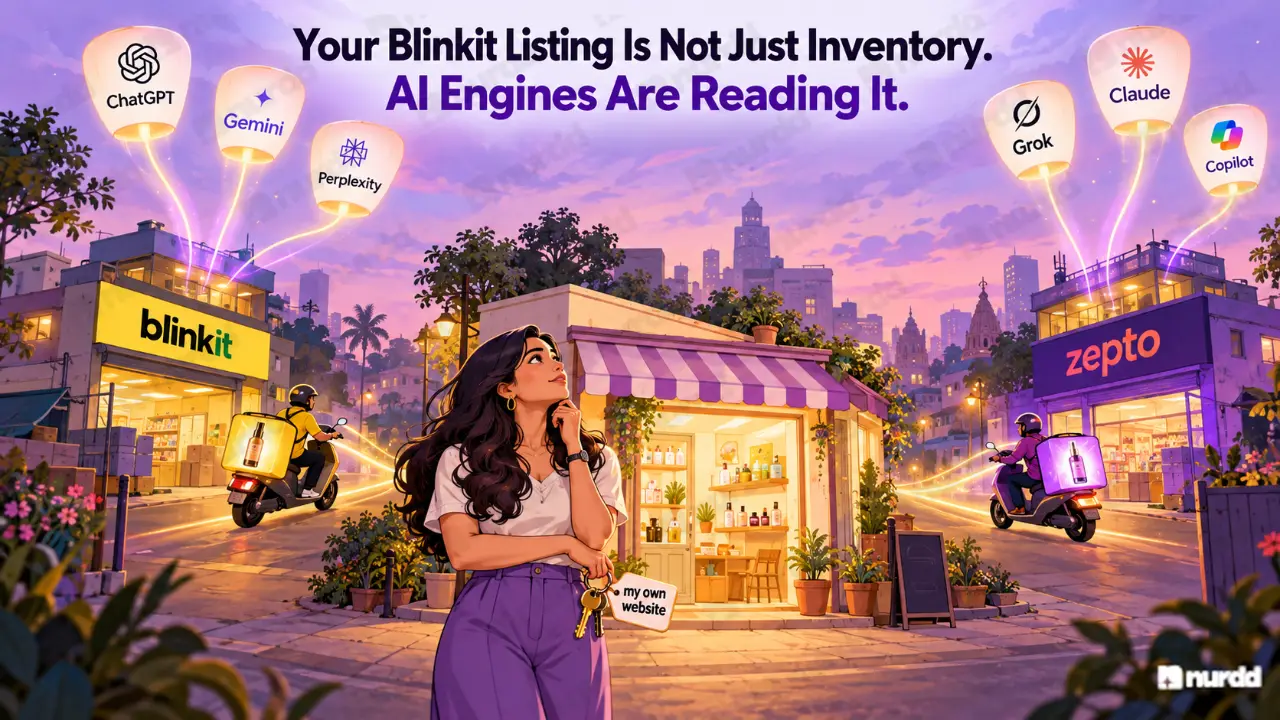
Quick commerce listings can earn AI citations, but rarely as the main source. A 2026 LLM Pulse study of 391,073 US shopping-answer citations found retailer and marketplace domains drew 2.9%, against 64.7% for brand-owned and long-tail sites. Build your own product pages and feeds first, then keep listings complete, crawlable and in stock.
Quick commerce and marketplace listings can earn AI citations, but the evidence says they are rarely the main route. In a 2026 study of 391,073 citations in US shopping answers, retailer and marketplace domains drew 2.9% while brand-owned and long-tail sites drew 64.7%. Your own product pages and feeds matter most; listings are a secondary signal you should still keep accurate.
AI engines are becoming a shopping front door. Adobe data for October 2025 showed traffic from generative AI sources to US retail sites up 1,200% year over year, and those visitors were 16% more likely to convert than visitors from other channels such as paid search, email and social (Digital Commerce 360, citing Adobe, 2025). So the question of which page an engine cites for your product, your site or a platform listing, now has a revenue answer.

What the citation data says
Two large studies measured how often AI shopping answers cite retailers and marketplaces. They disagree sharply, and the gap is itself the lesson.
| Study | Sample | Share of citations to retail and marketplace domains |
|---|---|---|
| LLM Pulse, 2026 | 391,073 citations; about 1,468 non-branded US shopping queries; ChatGPT, Google AI Mode, AI Overviews, Gemini, Perplexity; April to July 2026 | 2.9% overall. ChatGPT 6.05%, Perplexity 3.73%, Google AI Mode 2.14%, AI Overviews 1.92%, Gemini 0.92% |
| BrightEdge, 2025 | "Tens of thousands" of eCommerce prompts via BrightEdge AI Catalyst; published October 2025 | ChatGPT 41.3%, Perplexity 21.2%, Google AI Overviews 4.7% |
Other findings worth knowing. In the LLM Pulse sample, Reddit and YouTube together drew 10.4% of citations, 3.6 times as many as all major retailers and marketplaces combined, and ChatGPT cited amazon.com only six times across the whole sample. BrightEdge found 62.4% of Google AI Overview citations in eCommerce went to YouTube, and that Perplexity cited the widest pool of sources, 8,027 unique domains.
Why the two studies differ: query mix (non-branded "best X" questions versus broader eCommerce prompts), how citations are counted, and the year the data was collected. The safe reading is that the share of answers citing a listing depends heavily on the engine and the type of question. Neither study reports quick-commerce apps separately, so no public dataset yet shows how often a dark-store listing specifically gets cited. Measure it for your own brand.
How AI shopping engines choose products and pages
Each engine pulls product data through its own pipeline, and most of that pipeline favours the seller's own data.
| Engine | How products get in | What it rewards |
|---|---|---|
| ChatGPT | Product feeds with required fields including title, description, brand, seller name, availability and price (OpenAI feed spec); Instant Checkout launched in the US in September 2025 with Etsy sellers, with more than 1 million Shopify merchants to follow (TechCrunch, 2025) | When several merchants sell the same product, OpenAI says ChatGPT weighs availability, price, quality, whether a merchant is the primary seller, and whether Instant Checkout is enabled (Thurrott, 2025). OpenAI says results are organic and unsponsored. |
| Google AI Mode and AI Overviews | The Shopping Graph, with more than 50 billion product listings, over 2 billion of them refreshed every hour (Retail Dive, 2025); merchant listing structured data on pages where the merchant is the seller (Google Search Central) | Complete Product and Offer data: price, availability, shipping, returns, reviews, brand and identifiers such as GTIN. |
| Perplexity | Shopping launched in the US in November 2024 with unsponsored product cards, a Shopify integration and a free Merchant Program that lets retailers share product specs (Perplexity, 2024) | Products that are in its index with live product details; Perplexity says merchants in the program get better chances of being a recommended product. |
Two consequences for quick-commerce listings follow. First, "primary seller" is an explicit ChatGPT ranking factor, and Google's merchant listing markup is only for pages where the merchant is the seller, which favours your own store when you sell direct. Second, availability is a ranking input. A listing that shows out of stock in the shopper's area is a weak candidate, which is one more reason to keep quick-commerce stock in sync with demand.
What to change on each platform listing
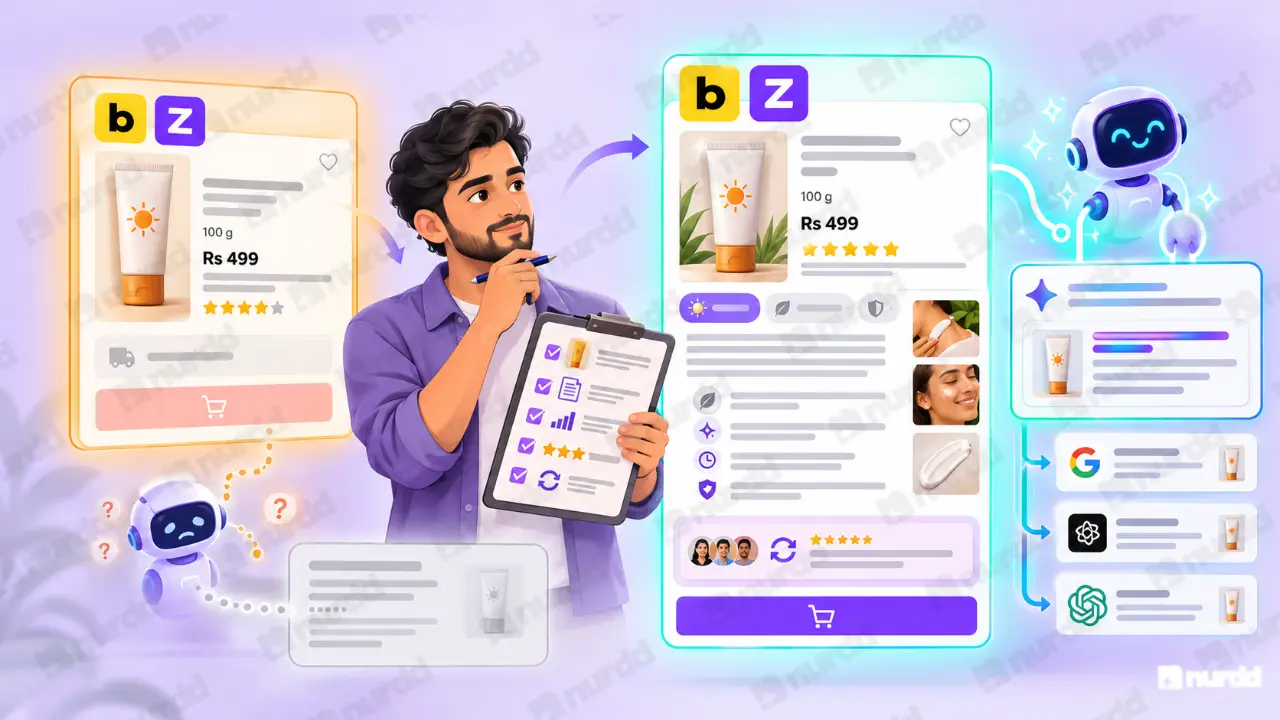
You usually cannot add markup to a platform's page, but you control the content you submit. A bare listing (name, weight, price, one-line description) gives an engine little to extract. Fix these first:
- Product description: about 80 to 150 words with your brand name, the primary benefit in specific language ("2% niacinamide for dark spots" rather than "great for your skin"), the key ingredient or certification, and who it is for. Use the same product name and claims as your own site so engines can match the two.
- Identifiers: submit the same GTIN, brand and pack size everywhere. Google and OpenAI both accept product identifiers, which helps them recognise one product across sellers.
- Category: choose the most specific category available. "Sunscreen" matches sunscreen queries better than "Skincare".
- Availability: keep stock accurate in the areas you target. ChatGPT weighs availability when ranking merchants, and Google's product data carries an availability field.
- Reviews: ask quick-commerce buyers for reviews that describe outcomes. Reviews on a platform page are a second, independent signal alongside your own.
- Crawlability: open the listing in a logged-out browser. If it needs an app, a login or a delivery address to load, an engine may not be able to read it either.
The attribution problem: when AI cites the listing, not you
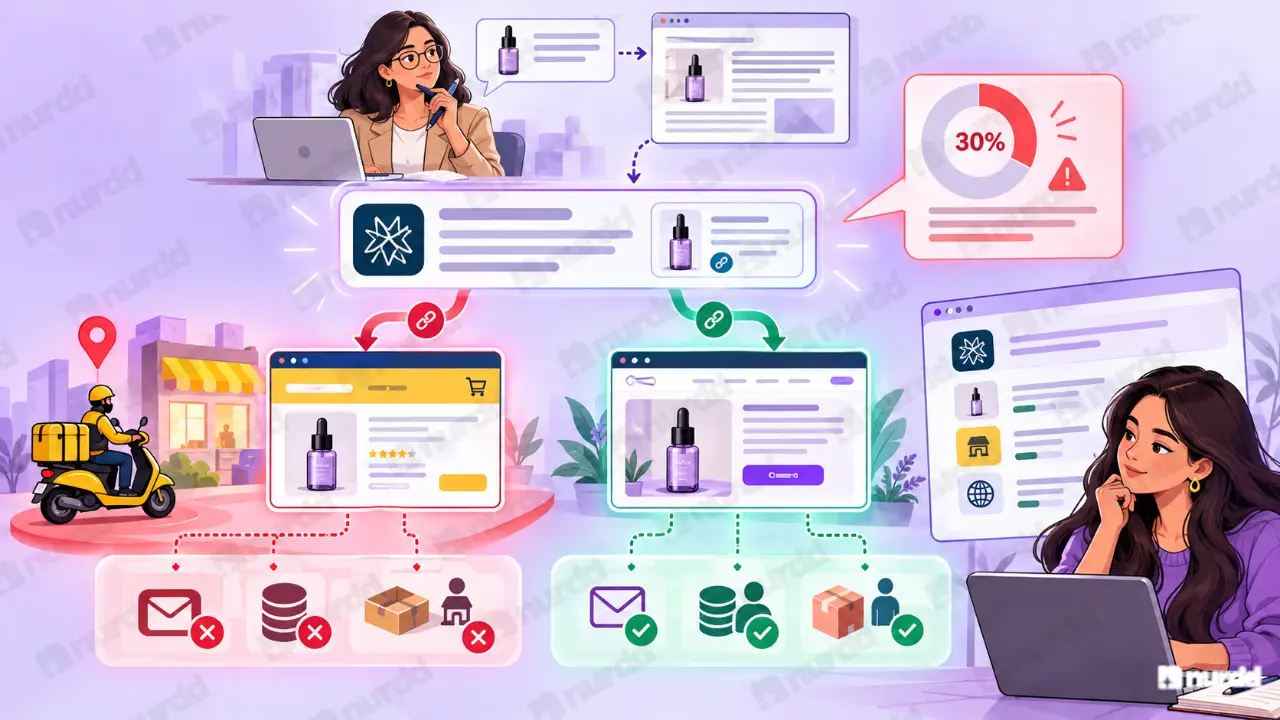
When an engine cites a platform listing and the shopper clicks through, the platform gets the customer relationship, the email address and the repeat-purchase data. That is not a reason to avoid listings. It is a reason to know which URL engines prefer for your brand.
How to check:
Run your top category questions in ChatGPT, Perplexity, Gemini and Google AI Mode, and note every citation that mentions your brand.
Record whether each citation points to your own domain, a quick-commerce listing, a marketplace page or a third-party review site.
Set your own threshold for action. If platform pages win most of the citations for your best-selling products, strengthen your own product pages and feed first.
Editorial coverage pulls citations toward the domain it links to. When you give product links to journalists and partners, link to your own site (for example, yourbrand.com/product), not to a platform listing.
"Your quick commerce listing is not just a warehouse instruction. It is an indexed product page with reviews that AI engines may read. Treat it accordingly, but build on your own pages first."
Frequently Asked Questions
Does being on quick commerce apps help AI search visibility?
It can add a secondary signal, but the data suggests listings are not the main source. A 2026 LLM Pulse study of 391,073 citations in US shopping answers found retailer and marketplace domains drew 2.9% of citations versus 64.7% for brand-owned and long-tail sites. A complete, crawlable, in-stock listing is still worth maintaining.
How do I optimise my quick commerce listing for AI citation?
Write an 80 to 150 word description with your brand name, a specific benefit, your key ingredient or certification, and the target buyer. Use the same GTIN and product name as your own site, pick the most specific category, keep stock accurate, collect outcome-based reviews, and check that the page loads without logging in.
Should I link journalists to my own website or my marketplace listing?
Link to your own domain. Editorial links pull citations toward the domain they point to, and your own store is the primary seller, which ChatGPT explicitly weighs when several merchants sell the same product.
Which quick commerce platform produces the most AI citations?
No public study breaks this out yet, and results vary by engine and query type. Run your top category queries in Perplexity, Gemini, Google AI Mode and ChatGPT, note which platform pages appear in the citations, and prioritise the listings that engines already retrieve.
Noma by Nurdd automates that check: it asks your prompts daily across 13 AI engines (ChatGPT, Gemini, Perplexity and Claude on every plan) and records the page behind each citation, so you can see whether engines cite your site or a platform listing. Plans start at $79/month, or $65/month billed annually, with a 3-day free trial (card taken at signup).
Sources
- LLM Pulse, Where AI actually sends shoppers (Aug 2026)
- BrightEdge, How different AI search engines choose which brands to recommend (Oct 2025)
- Digital Commerce 360, October ecommerce sales and generative AI traffic, citing Adobe (Nov 2025)
- TechCrunch, OpenAI takes on Google, Amazon with new agentic shopping system (Sep 2025)
- Thurrott, OpenAI teams up with Etsy and Shopify for Instant Checkout (Sep 2025)
- OpenAI, Commerce product feed specification
- Retail Dive, Google AI Mode shopping features (May 2025)
- Google Search Central, Merchant listing structured data
- Perplexity, Shop like a pro (Nov 2024)