AI Search Visibility
AI Search Reporting for Agencies: What to Send Monthly
Which AI visibility numbers belong in a monthly client report, and how to explain them without overclaiming.
 Simran Rawat8 Nov 202614 min read

AI search reporting for agencies should cover mention rate, citation rate, share of voice, sentiment and cited sources per AI engine, each with its sample size. Report visibility as a rate across many runs, keep AI referral traffic on a separate page, and word changes cautiously. Noma tracks 13 AI engines to supply the data.
AI search reporting for agencies is a monthly client report that shows how often AI engines name, cite and describe a client's brand for a fixed set of prompts, plus the traffic and sales those answers can be tied to. Send five things: mention rate, citation rate, share of voice, sentiment and cited sources, each with its sample size and a plain caveat.
Clients are already asking about this. Search Console shows only part of the picture, and AI answers change from one run to the next. This guide sets out what belongs in the report, what to leave out, and how to word findings so you never promise more than the data supports. It draws on our monthly AI search metrics guide and public documentation, and it uses only numbers we found and linked.
Key takeaways
- Report mention rate, citation rate, share of voice, sentiment and cited sources, per AI engine, against a fixed prompt set that stays the same month to month.
- State the sample size on every chart (prompts times runs). A percentage without a denominator is the easiest number to overclaim.
- Report visibility as a rate across many runs, not a rank. SparkToro found that ranked brand lists almost never repeat.
- Keep AI visibility and AI-referred revenue on separate pages. Visibility is a leading indicator; sessions and conversions come from analytics.
- Close every report with three things: what changed, what likely caused it, and what you will do next month.
- Use one tracking source for all clients so month-on-month comparisons are not distorted by a tool change.
What should an AI search visibility report include?
An AI search visibility report should include six blocks: a one-paragraph summary, the visibility metrics per AI engine, the competitor comparison, the cited sources, AI referral traffic from analytics, and next actions. The first block is for the executive who reads nothing else; the rest is evidence.
Three agency-side guides cover the metric list well. Search Atlas names mention rate, citation rate, share of voice, sentiment and position, AgencyAnalytics frames four metrics and shows how to build the dashboard in its own product, and Jasper focuses on dashboard structure and auditing prompts across clients. What the headings of those pages do not give you is a rule for which numbers to refuse to report, or sentence-level wording for uncertainty. Both are below.
The metrics table
| Metric | Plain definition for the client | How to calculate | Caveat to print beside it |
|---|---|---|---|
| Mention rate | How often an AI answer names the brand | Answers naming the brand divided by total answers collected | Depends on prompt set and number of runs |
| Citation rate | How often an answer links to the client's own pages | Answers citing a client URL divided by total answers | Some engines cite more often than others, so compare an engine only with itself |
| Share of voice | The client's mentions as a share of all tracked brands' mentions | Client mentions divided by mentions of the client plus named competitors | Changes if you add or drop a competitor; fix the list |
| Sentiment or framing | How the answer describes the brand | Tag answers positive, neutral or negative, plus the attributes used | Small samples swing; read examples, not just the score |
| Cited sources | Which pages and domains the engines rely on | Count citations by domain and page | Shows where to act (own site vs third parties), not a score |
| AI referral sessions | Visits that arrived from an AI engine | Analytics sessions by source | Undercounts: not every AI visit carries a referrer |
For definitions of the terms your client will hear in meetings, point them to the AI search glossary. For the share-of-voice calculation in detail, see AI search share of voice.
Why is reporting on AI search harder than reporting on SEO?
Reporting on AI search is harder because the answers are not stable, the platform data is incomplete and the click path is often invisible. Each of the three changes how you should present a number.
The answers change on every run
SparkToro and Gumshoe.ai ran 2,961 prompts across ChatGPT, Claude and Google Search AI Overviews with volunteers, and Search Engine Journal reported that ChatGPT and Google's AI in Search returned the same brand list less than 1% of the time across repeated runs of the same prompt. The researchers also found that visibility percentage across many queries was more consistent than ranking position.
SparkToro's finding gives agencies a reporting rule: report how often a brand appears across many runs, and do not report a single answer as "our ranking".
Google folds AI features into existing reports
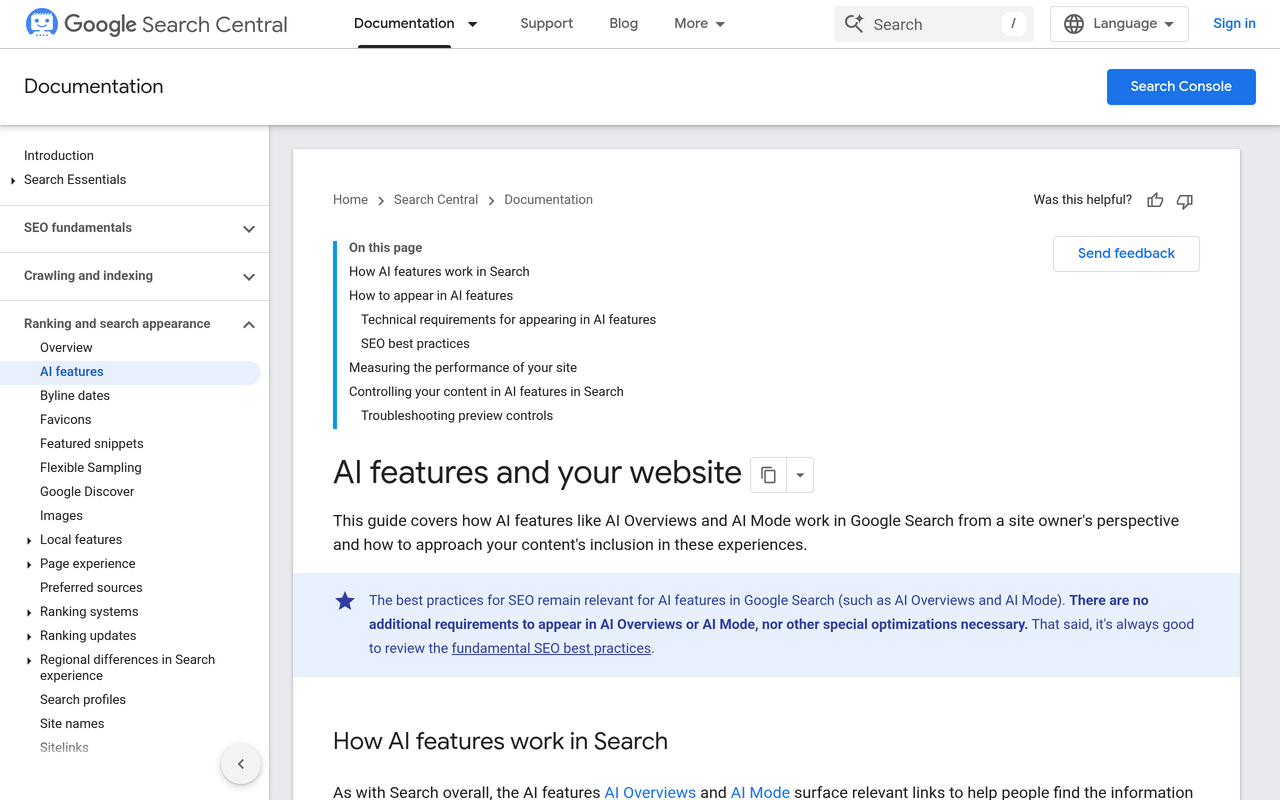
Google Search Central says sites appearing in AI Overviews and AI Mode are included in overall Search Console traffic, reported in the Performance report under the Web search type. That means you cannot read a clean "AI Mode line" from Search Console alone, and a client who expects one needs to be told why before the first report.
Clicks are falling in some places, so visits understate visibility
Ahrefs compared 300,000 keywords, 150,000 with an AI Overview and 150,000 informational keywords without one, and its study is titled "AI Overviews Reduce Clicks by 34.5%". Google, by contrast, says clicks from pages with AI Overviews are higher quality. Both can be true at once, which is why a visibility report should not be judged on sessions alone.
Referral labels are not guaranteed
OpenAI's publisher FAQ says that publishers who allow OAI-SearchBot can track ChatGPT referrals in analytics, and that ChatGPT includes the parameter utm_source=chatgpt.com in referral URLs, as stated on the OpenAI Help Center. That covers ChatGPT search links only. Other engines label traffic differently or not at all, so present AI referral sessions as a floor. Our guide to AI referral traffic in analytics covers the setup.
How do I report AI visibility to clients, step by step?
Follow these six steps once at onboarding and repeat steps 3 to 6 every month. Each step has an action, a result and the reason it protects you from overclaiming.
- Agree the prompt set in writing. Action: list the questions a buyer asks, grouped by category, comparison and brand queries; see which prompts to track. Result: a fixed set the client has approved. Why: if the set changes silently, every trend line is meaningless.
- Fix the competitor list and the engines. Action: name three to five competitors and the AI engines you will report. Result: a stable denominator for share of voice. Why: adding a competitor mid-year changes the figure without any change in reality. The prompt count guide helps size the set.
- Collect repeated runs. Action: record several answers per prompt per engine every period. Result: rates with a visible sample size. Why: SparkToro's results show a single answer proves almost nothing.
- Calculate the five visibility metrics per engine. Action: compute mention rate, citation rate, share of voice, sentiment and cited sources separately for each engine. Result: a table, not a blended score. Why: a blended score hides the engine where the brand is absent.
- Add analytics on a separate page. Action: pull AI referral sessions and conversions from analytics, and Search Console data for Google. Result: a traffic page labelled as a minimum. Why: visibility and visits answer different questions, and attribution is covered in AI search vs Google conversion rate.
- Write the "so what" in three lines. Action: state what changed, the most likely cause, and the next action. Result: a report the client can forward. Why: clients rarely act on a chart that has no stated decision attached.
For the monthly rhythm and layout, the AI search metrics reporting guide and the AI search visibility dashboard guide give page-level layouts you can adapt.
Which numbers should you leave out of a client report?
Leave out any number you cannot reproduce next month, or that implies certainty the method cannot give. This table is a decision aid: if a client asks for the item in the first column, here is the risk and the sentence to use instead.
| Tempting number | Why it misleads | Report instead |
|---|---|---|
| "We rank #1 in ChatGPT" | Ranked lists rarely repeat across runs, per SparkToro | Mention rate across all runs, with sample size |
| One blended AI visibility score | Hides engines where the brand is missing | The metrics table per engine |
| Industry benchmark for "good" mention rate | Prompt sets differ, so cross-company comparisons are weak | The client's own trend and gap to named competitors |
| AI-attributed revenue as a single figure | Referral data undercounts and engines label traffic differently | AI referral sessions as a minimum, with conversions beside them |
| Month-on-month change from small samples | Noise can look like movement | Direction over three months, plus the sample size |
| Causation from a single content change | Many things shift at once | "Coincided with" wording, plus a controlled test; see GEO experiment design |
There is a reason we advise against borrowed benchmarks. Published ranges, such as those summarised in our AI search visibility benchmarks review, come from other prompt sets and other brands. Quote them as context with the source named, never as the client's target.
How do you word findings without overclaiming?
Use sentence patterns that name the metric, the sample and the period, and use verbs that match the strength of the evidence. Three patterns cover most reports.
- Observation: "Across [number] answers collected in [month], [Brand] was named in [percentage]."
- Change: "Mention rate moved from [a] to [b] on [engine]. The sample is small, so we are watching for a second month before calling it a trend."
- Possible cause: "This coincided with the new comparison page going live. We have not isolated it as the cause."
Words to avoid: "guarantees", "proves", "drives", "ranks us". Words to use: "appeared in", "was cited by", "coincided with", "we will test".
Worked example: turning raw runs into a client number
The figures below are hypothetical arithmetic to show the method; they are not benchmarks and not results from any client.
- Suppose the agreed prompt set has 40 prompts and you collect 3 runs per prompt on one engine. That is 120 answers, and 120 is the denominator you print.
- The brand is named in 30 of the 120 answers. Mention rate is 30 divided by 120, which is 25%.
- Three tracked competitors are named 30, 45 and 15 times, so total tracked mentions are 30 + 30 + 45 + 15 = 120. The client's share of voice is 30 divided by 120, also 25%.
- Your client's own pages are cited in 18 answers, so citation rate is 18 divided by 120, which is 15%.
The report line then reads: "On this engine, across 120 answers, [Brand] was named in 25% and cited with its own page in 15%. The gap between the two means the engine knows the brand but is sending readers to other sources." That gap is the commercial insight, and it comes from reading two metrics side by side, which is why the table above keeps them separate.
A second worked example uses public numbers. The Ahrefs study compared click-through for keywords with and without an AI Overview, using 150,000 keywords in each group. If a client's Search Console clicks fell on informational queries where Google shows an AI Overview, you can cite that study as context for the pattern, and then check the client's own Search Console data to see whether the same queries lost clicks while impressions held. Do not apply the study's 34.5% to the client; it describes that sample.
How does Noma supply the tracking data for the report?
Noma by Nurdd is an AI search visibility dashboard that tracks whether a brand appears in answers from 13 AI engines, including ChatGPT, Gemini, Perplexity and Claude, polled daily. It records whether a brand is named and which page each citation comes from, shows citation frequency by category with a competitor comparison, and gives recommendations for improving AI visibility. For an agency, that is the collection layer for steps 3 and 4 above.
If you want to see what this looks like for your own client list, book a demo. We will show how a brand, its competitors and its category prompts appear in Noma, so you can judge whether the data fits your report layout. You can also look at the product directly at nomahq.app.
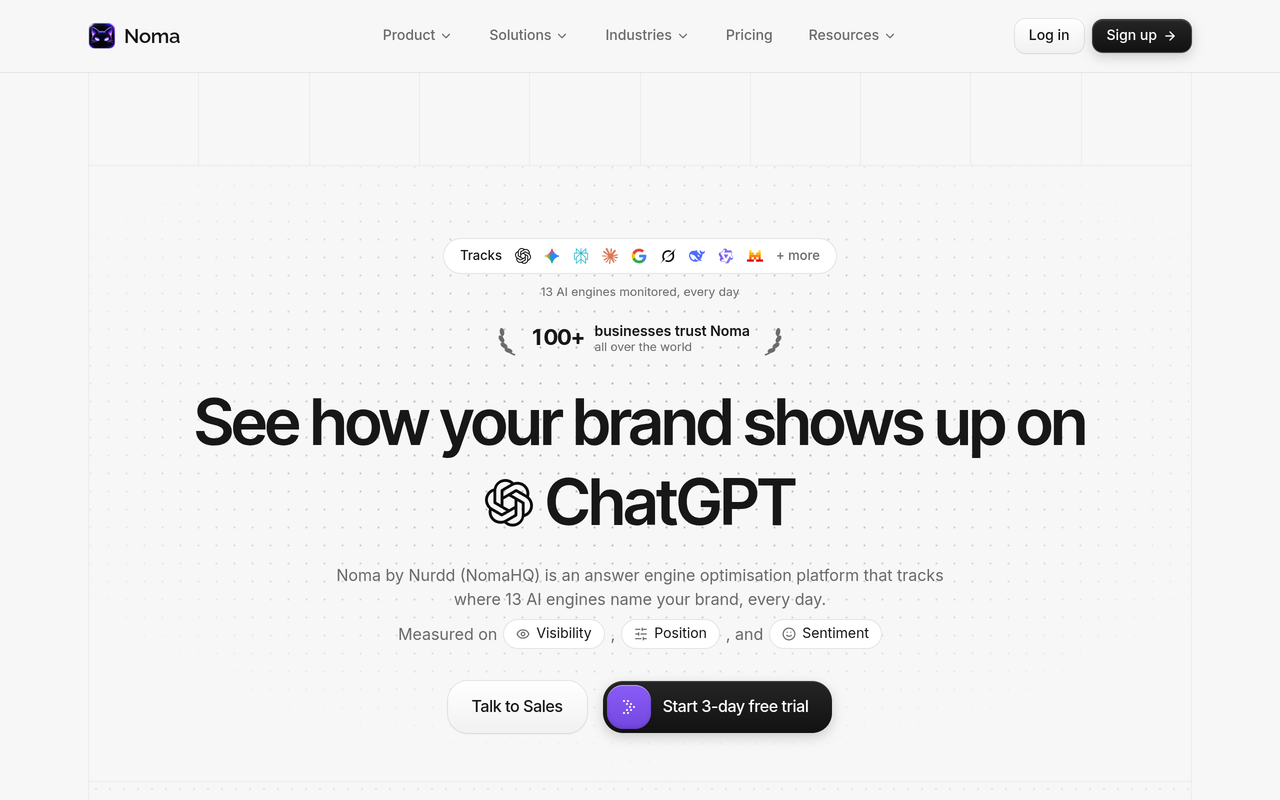
Noma has a 3-day free trial. A card is taken at signup and billing starts on day 3; cancel before then and you are not charged. Agencies comparing options can read the agency guide to checking software and the comparison of AI search visibility tools. Teams that want the work done rather than only measured can look at the answer engine optimization agency service, where Nurdd gets brands named and cited by AI assistants, measured in Noma.
What does this look like for different roles in an agency?
Scenario 1: the account lead preparing a quarterly business review
The account lead needs one page, not twelve. Use the summary block, the per-engine table and the three-line "so what", and hold the cited-sources detail for the appendix. The aim is to give the client a decision, for example whether to fund a comparison page or a third-party source campaign, as covered in getting mentioned without ads.
Scenario 2: the SEO lead who already reports on rankings
The SEO lead should place AI metrics beside, not inside, the ranking report, because the logic differs: rates across runs instead of positions. The AI search metrics vs SEO metrics guide shows how to line the two up. Pair the Search Console Web search type data with Noma's citation data to see whether pages that rank are also the pages AI engines cite.
Scenario 3: the paid media lead asked whether to report on AI search
A paid media team often holds the monthly client call, so the question lands on them. Our answer in should a paid media agency report on AI search is that a short visibility section is reasonable if it is clearly separated from ad performance. If the client is also testing ads inside AI products, see reporting for ChatGPT ads and AI Overviews, and keep paid ROAS in its own table; the ROAS calculator helps with that side.
What are the most common reporting mistakes?
- Changing the prompt set mid-year. The trend line breaks and the client loses trust in the earlier months.
- Reporting without a denominator. "Mentioned 40% of the time" means little if it came from 10 answers.
- Mixing engines into one number. One engine can hide a gap in another.
- Selling AI visibility as guaranteed. No platform documentation says an agency can control which brands AI engines name.
- Skipping the cited sources. Cited sources tell you whether to fix the site or earn mentions elsewhere; see why competitors get cited for the diagnostic.
- Ignoring multi-brand setups. Agencies with many clients need consistent naming; see tracking multiple brands.
Monthly report checklist
- Confirm the prompt set, competitor list and engine list are unchanged since last month.
- Record the number of prompts and runs for each engine.
- Calculate mention rate, citation rate and share of voice per engine.
- Read a sample of answers and note how the brand is described.
- List the top cited domains and pages, split into client-owned and third-party.
- Pull AI referral sessions and conversions from analytics, labelled as a minimum.
- Check Search Console for Web search type movement on key informational queries.
- Write what changed, the likely cause, and the next action in three lines.
- Add one open question or test for next month.
What to do next
Start with the baseline: pick the prompt set, name the competitors, and collect the first month of data before promising any target. Then use the report to steer the work, whether that is content on the client site, third-party mentions, or technical access for AI crawlers, covered in the AI crawler user agents list. Nurdd also explains its overall approach on how Nurdd works.
Book a demo at nurdd.club/demo and we will walk through Noma using your client's brand, category prompts and competitors, so you can see the per-engine mention and citation data you would be putting in the report.
How we researched this
We reviewed three agency-reporting guides that rank for this topic, Google's Search Central documentation, OpenAI's publisher FAQ, a Search Engine Journal report on SparkToro's research and the Ahrefs study on AI Overviews and clicks. All sources were checked on the publication date of this post. We did not run hands-on tests of competitor tools, interview agencies or use client data, and the worked example uses hypothetical arithmetic that is labelled as such.
Frequently asked questions
What should an AI search visibility report include?
A summary, per-engine mention rate, citation rate, share of voice, sentiment, the sources the engines cite, AI referral sessions from analytics and next actions. Print the sample size beside every percentage. Keep visibility and traffic on separate pages.
How do I report AI visibility to clients?
Agree a fixed prompt set, competitor list and engine list at the start, collect repeated runs, and report rates per engine every month. Add a three-line summary of what changed, the likely cause and the next action. Use cautious wording when the sample is small.
How often should agencies send AI search reports?
Monthly suits most clients, because answers vary run to run and a shorter period gives small samples. Daily polling is useful for collection, but present the monthly trend. Add an alert only for large, sudden changes.
Can Search Console show AI Mode and AI Overviews traffic?
Google says sites appearing in AI Overviews and AI Mode are included in overall Search Console traffic, reported in the Performance report under the Web search type. It does not give a separate AI line in that documentation. Use it alongside, not instead of, AI visibility tracking.
Is a mention the same as a citation?
No. A mention means the answer names the brand; a citation means it links to or attributes a source. A brand can be mentioned without any client page being cited, which usually means the engine relies on third-party sources.
Should I give clients a benchmark for a good mention rate?
Not without caveats. Prompt sets, categories and methods differ, so another company's rate is weak evidence for your client. Use the client's own trend and the gap to named competitors, and quote outside research only as sourced context.
How many AI engines should a client report cover?
Cover the engines your client's buyers use, and keep the list fixed. Noma tracks 13 AI engines, including ChatGPT, Gemini, Perplexity and Claude, so agencies can report broadly and then focus the narrative on the few that matter to the client.
Can I tie AI visibility to revenue?
Only partly. Referral sessions in analytics give a minimum, and OpenAI says ChatGPT includes utm_source=chatgpt.com in referral URLs, but many AI-influenced visits arrive without a referrer. Report revenue from AI referrals as a floor and avoid claiming causation.