AI Search Visibility
Scrunch AI Pricing and Alternatives: What to Compare
Scrunch AI pricing and alternatives compared on cost model, engine coverage and what happens after tracking, with a 3-day test plan.
 Sheetal Shakshi8 Nov 202615 min read

Scrunch lists plans from $250 a month on its pricing page, but its own pages describe the entry plan differently, so confirm limits before you buy. Compare any alternative on three things: how cost scales, how many AI engines are tracked, and what happens after tracking. Noma by Nurdd tracks 13 AI engines and offers a 3-day free trial, so you can test it on your own brand first.
Is Scrunch AI worth it? That depends on what you are quoted and who will act on the findings. Scrunch publishes a $250 monthly entry price, but its pricing page and its pricing FAQ describe the entry plan differently, so the real comparison is on cost model, engine coverage and what happens after tracking. This guide gives you a way to weigh Scrunch pricing and alternatives using numbers from Scrunch's own pages.
Key takeaways
- Scrunch's own pages differ. The pricing page lists Starter and Growth plans, while a pricing FAQ describes Core with four tracked AI platforms. Ask which version applies to your quote.
- Divide price by prompts and engines before comparing. Scrunch's published numbers give roughly $0.71 per custom prompt on Starter and $0.60 on Growth, each month.
- Check the action layer, not just the dashboard. Tracking shows where you are missing; someone still has to fix the site and earn mentions on the third-party sources AI engines cite.
- Test with your own brand. Noma by Nurdd has a 3-day free trial (card taken at signup, billing starts on day 3) and tracks 13 AI engines.
- Note the Sitecore deal. TechTarget reported that Sitecore acquired Scrunch, so ask any vendor in this category about ownership and roadmap.
What does Scrunch AI actually do?
Scrunch describes itself as a platform to monitor brand presence in AI search, analyse and optimise a website, and deliver content to AI agents. According to Scrunch, November 2026, the product has three parts: Monitoring, Insights and the Agent Experience Platform (AXP). The Scrunch product FAQ splits this into four products: monitoring, auditing, optimization and content delivery through AXP.
Monitoring covers prompts, topics and entities, with benchmarks by competitor, persona, topic and geography. Auditing looks at site and page level, including access controls and JavaScript rendering problems that can stop AI bots reading a page. Optimization offers either automated updates or written recommendations.
AXP is the Agent Experience Platform. The Scrunch Help Center, July 2026 says AXP creates a parallel, AI-optimized version of your site that is served to AI agents, while human visitors keep the existing experience. If you are considering it, ask how that version is governed and kept in sync with the live site.
How much does Scrunch AI cost?
Scrunch's pricing page lists three tiers: Starter, Growth and Enterprise. Starter is $250 per month billed annually or $300 month-to-month. Growth is $417 per month billed annually or $500 month-to-month. Enterprise is custom. The Scrunch pricing page, November 2026 says annual billing carries a 17% discount.
Limits differ by tier. Starter includes 3 user licenses, 350 custom prompts, 1,000 industry prompts, 3 personas and 5 page audits. Growth includes 5 user licenses, 700 custom prompts, 2,500 industry prompts, 5 personas and 10 page audits. Extra seats are listed at $25 per month.
Why do Scrunch's pages disagree?
The Scrunch pricing FAQ describes a different structure. It lists Core at $250 per month with 125 unique prompts, five site audits, one brand workspace, five user licenses and four supported LLMs: ChatGPT, Perplexity, Google AI Overviews and Microsoft Copilot. It lists nine LLMs only for Enterprise. It also states a credit card is required for the 7-day trial, while the pricing page's trial wording differs, so confirm the card terms at signup.
We cannot tell which page is current, and we are not suggesting either is wrong. The practical point is that a buyer should get plan limits, engine list and trial terms in writing before paying. That is a fair request to any vendor, including Nurdd.
Scrunch's pricing page and its pricing FAQ list different entry plans: Starter with 350 custom prompts, and Core with 125 unique prompts and four supported LLMs. Confirm which applies before budgeting.
What are the three costs behind AI visibility pricing?
Sticker price is the smallest part of the decision. Three cost models sit behind every tool in this category, and you should name which one you are buying.
- Seat and prompt tiers. You pay for a bundle of users, prompts and audits, and move up a tier when you hit a limit. Scrunch's pricing page uses this model.
- Engine gating. Some tiers track fewer AI platforms than higher tiers. In the Scrunch FAQ, Core tracks four LLMs and Enterprise nine.
- Labour after tracking. The dashboard shows gaps, but someone has to rewrite pages, fix crawl access and earn mentions on third-party sites. That labour is rarely in the quote.
Worked example: Scrunch cost per prompt
Using only Scrunch's published numbers, here is the maths a buyer can do in two minutes. On Starter, $250 a month with 350 custom prompts is about $0.71 per prompt per month. On Growth, $417 with 700 custom prompts is about $0.60. Annual Starter is $3,000 a year ($250 times 12), against $3,600 month-to-month ($300 times 12), a $600 difference.
| Scrunch plan (pricing page) | Monthly, annual billing | Monthly, month-to-month | Custom prompts | Approx. cost per custom prompt (annual) | Page audits |
|---|---|---|---|---|---|
| Starter | $250 | $300 | 350 | $0.71 | 5 |
| Growth | $417 | $500 | 700 | $0.60 | 10 |
| Enterprise | Custom | Custom | Custom | Not published | Custom |
The calculation is ours, using Scrunch's published figures as of November 2026. Cost per prompt is only useful if you need that many prompts, which is why the next sections matter. Our guide on how many prompts you need for AI search tracking and the list of which prompts to track help you size this before you pay for headroom.
Worked example: a 12-month budget for a team of five
Suppose five people need a seat. Starter includes 3 licenses, so two extra seats at the published $25 per month add $50 a month, or $600 a year. Annual Starter at $250 a month is $3,000, so the seat-adjusted total is $3,600 a year, before any prompt overage or agency costs. Growth includes 5 licenses, so the same team pays $417 times 12, or $5,004 a year.
Those are our sums from Scrunch's published figures, not a quote. The point is that the cheaper plan is not always the cheaper outcome once seats are counted, and neither figure includes the time it takes someone to act on the findings.
Which AI engines does each plan cover?
Engine coverage is where Scrunch's two pages differ most. The pricing page says coverage includes ChatGPT, Claude, Gemini, Perplexity, Google AI Mode and AI Overviews, and Meta. The FAQ says Core supports four LLMs, with a nine-engine list reserved for Enterprise, adding Claude, Gemini, Meta AI, Google AI Mode and Grok.
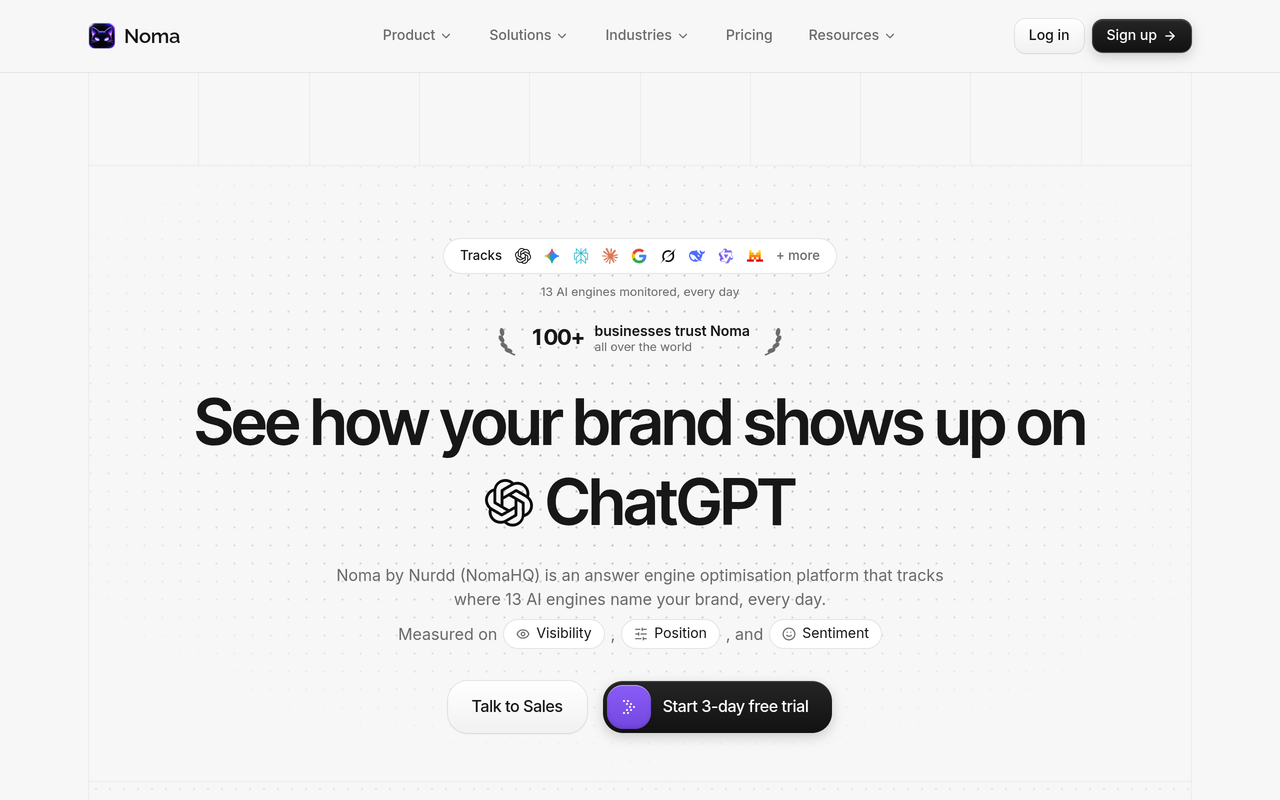
Noma by Nurdd tracks 13 AI engines, including ChatGPT, Gemini, Perplexity and Claude, polled daily. Engines behave differently, so a tool that skips one leaves a blind spot. Our comparison of Perplexity, ChatGPT and Gemini for brands and the note on getting cited by Gemini show why.
How do Scrunch and Noma compare on features?
This table covers only facts each vendor publishes itself. Scrunch details come from its pricing page, FAQs and help centre. Noma details come from Nurdd's published product facts. A hedged cell means the point is not stated in what we reviewed.
| Feature | Scrunch | Noma by Nurdd |
|---|---|---|
| AI engines tracked | Pricing page lists ChatGPT, Claude, Gemini, Perplexity, Google AI Mode and AI Overviews, Meta; FAQ lists four on Core, nine on Enterprise | 13 AI engines, including ChatGPT, Gemini, Perplexity and Claude |
| Polling | Collects AI responses; frequency not stated in pages reviewed | Polled daily |
| Citation data | Citation analysis to see sources AI relies on | Records whether a brand is named and which page each citation comes from |
| Competitor comparison | Benchmarks by competitor, persona, topic and geography | Competitor comparison and citation frequency by category |
| Recommendations | Optimization guidance, page audits, automated or manual optimization | Actionable recommendations to improve AI visibility |
| Managed services | Not stated for brands in pages reviewed | Nurdd's AEO and GEO managed services, measured in Noma |
| Trial | 7 days; card terms differ between pages | 3 days; card taken at signup, billing starts on day 3 |
Scrunch also runs an Agency Partner Program. Its FAQ describes it as a programme for agencies, covering multi-client management and Data API access, so it is a different thing from a service that carries out fixes for a brand.
How do pricing and trial terms compare?
| Item | Scrunch (as published, checked November 2026) | Noma by Nurdd |
|---|---|---|
| Entry price | $250 per month billed annually, $300 month-to-month (Starter) | See nomahq.app for current plans; prices are in USD |
| Mid tier | $417 annual or $500 month-to-month (Growth) | See nomahq.app |
| Agency | Agency Core $500 per month (FAQ), custom for Agency Enterprise | Managed services scoped per brand |
| Free trial | 7 days | 3 days |
| Card at signup | Pages differ; confirm at signup | Card taken; no charge if you cancel before day 3 |
We have not listed Noma plan prices here because they are published on Noma's own site and can change, so check there on the day you decide.
What changed when Sitecore bought Scrunch?
TechTarget reported on 4 June 2026 that Sitecore acquired Scrunch, with a reported price of $225 million. TechTarget, June 2026 framed the deal as Sitecore adding answer engine optimization to its platform. Sitecore's own announcement is on PR Newswire, and trade coverage is also at Ecommerce News.
An acquisition does not make a product better or worse. It does change what a multi-year buyer should ask: whether pricing stays standalone, whether the roadmap leans towards Sitecore customers, and whether agency terms remain. Put those three questions in writing in any vendor conversation.
What should happen after tracking?
Tracking answers where you stand. It does not move you. AI engines build answers from pages on your site and from third-party sources, so improvement means two jobs: make your own pages easy to read and quote, and earn mentions on the sources engines already cite.
Scrunch's answer to the first job is AXP plus page audits, and its agent traffic page covers how AI bots crawl your site. Whichever route you choose, ask who does the work and how it is measured.
Noma by Nurdd takes a different route. Noma records whether your brand is named and which page each citation comes from. Nurdd's answer engine optimization agency and generative engine optimization services then improve the site and content those engines read and work to earn third-party sources. Everything is measured back in Noma, so the same dashboard shows whether a fix moved citations.
A decision table for the action layer
| Your situation | What you need after tracking | Question to ask the vendor |
|---|---|---|
| Slow-moving site, heavy JavaScript | A way to give AI crawlers readable content | How is any agent version governed and kept in sync with the live site? |
| Fast-moving content team | Specific page-level fixes and priorities | Does each recommendation name the page, the gap and the prompt it affects? |
| Brand absent from third-party sources | Off-site work, not just on-site fixes | Who earns the citations, and how is that reported? |
| Small team, no SEO lead | Done-for-you execution | What is scoped, and how is progress measured monthly? |
| Multiple brands or clients | Workspace separation and reporting | What are the limits per workspace and per seat? |
For deeper background on why engines skip some brands, read why your brand isn't showing up in ChatGPT answers and why your competitor is cited and you aren't.
Is Scrunch AI worth it?
Whether any AI visibility tool is worth it depends on facts you can check: which plan limits apply to your quote, which engines that plan tracks, and who carries out the fixes. Scrunch's pages differ on the first two, so get them in writing before you pay.
Run these four filters before you decide.
- Coverage fit. Does the plan you are quoted track the engines your buyers use? On the FAQ's Core description, Claude, Gemini, Google AI Mode and Meta AI are not on the list.
- Prompt need. Count the prompts you would track. If you need fewer than 125, a bigger bundle is wasted spend. If you need more than 350, you are into Growth.
- Seat need. Starter has 3 licenses. Each extra seat is $25 a month, which matters for agencies and larger teams.
- Action need. Decide who will carry out the fixes and what is in the price.
Our wider guides on what to check before buying Scrunch AI and how Scrunch prioritises fixes against a Noma action plan go further on each point.
A vendor questionnaire to send before you pay
- Which plan am I being quoted, and does the plan description on your pricing page match your FAQ?
- Which AI engines are tracked on that plan, by name?
- How often are prompts polled?
- What is the prompt limit, and what happens when I pass it?
- How many seats are included, and what does each extra seat cost?
- Is a card required for the trial, and when does billing start?
- Who carries out the fixes, and how is progress reported?
- How does ownership or a change of ownership affect pricing and roadmap?
What are good alternatives to Scrunch AI?
Alternatives fall into four groups. Group them first, then pick within the group.
- Pure trackers. Dashboards that report mentions and citations. Fine if you already have a content team that can act.
- Tracking plus recommendations. Tools that report and say what to change. Noma by Nurdd sits here, with managed services available.
- SEO suites with an AI add-on. Useful if you already pay for the suite. See Noma vs Semrush and Noma vs Ahrefs.
- Agencies. You buy outcomes rather than software. Compare in best AEO and GEO agencies in 2026.
For named head-to-heads, use Noma vs Scrunch, Noma vs Profound, Noma vs Peec AI and Noma vs AthenaHQ. The broader list sits in best AI search visibility tools 2026.
Why is Noma the stronger choice for this comparison?
Noma by Nurdd is an AI search visibility dashboard that tracks whether a brand appears in answers from 13 AI engines, including ChatGPT, Gemini, Perplexity and Claude, polled daily. It shows citation frequency by category, competitor comparison and recommendations, and Nurdd's AEO and GEO services can carry out the work. Nurdd makes it for brands that want to see and act in one place.
Book a demo at https://www.nurdd.club/demo and you will see Noma run on your own brand and category: which of the 13 engines name you, which pages they cite, and which competitors appear instead.
Noma's case rests on three rows. On engine coverage it lists 13 engines, where Scrunch's FAQ lists four on Core. On trial terms you know exactly what happens: a 3-day free trial, a card taken at signup, billing starting on day 3, and no charge if you cancel before then. On the action layer, recommendations and managed AEO and GEO services sit alongside the tracking and are measured in the same dashboard.
How do you test Noma in 3 days?
A short trial is enough if you arrive prepared. Use this checklist so each day produces a decision, not just a login.
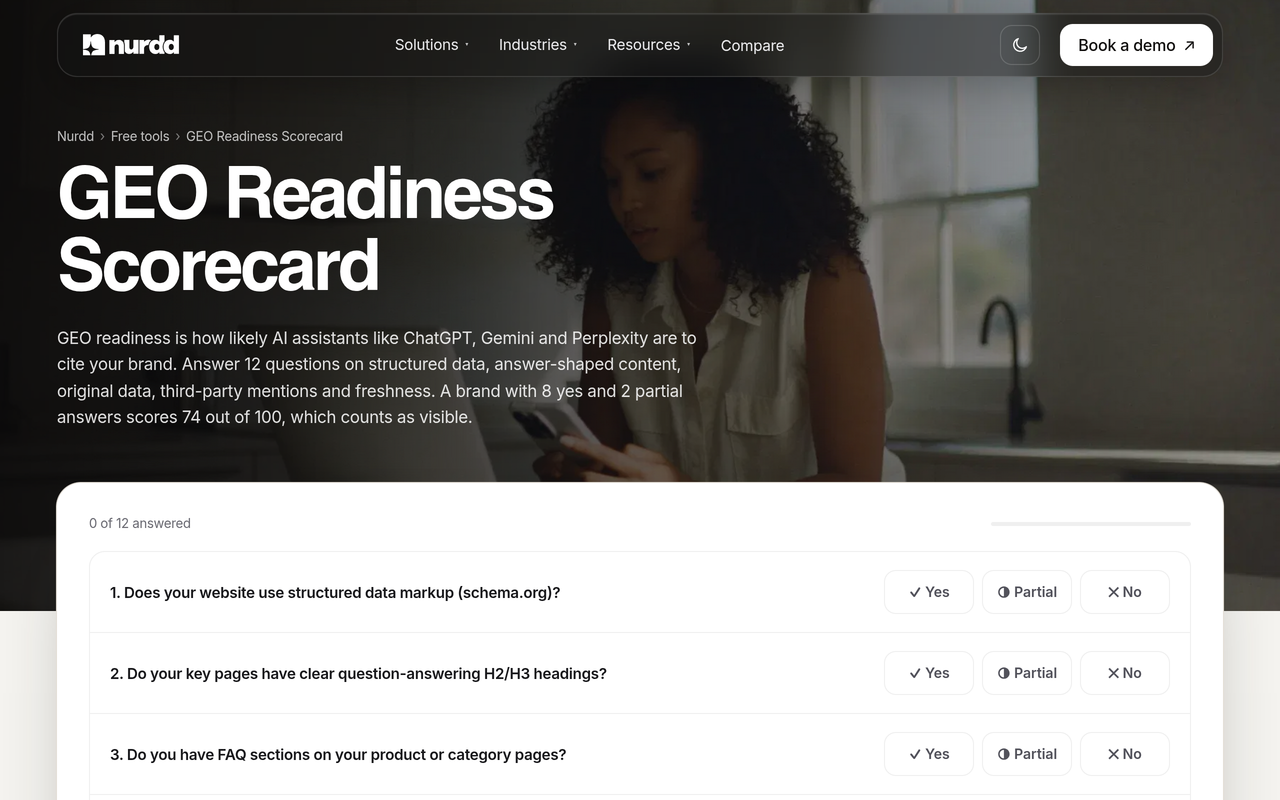
- Before signup, write 15 to 25 prompts. Use the questions your buyers ask: category, comparison and problem queries. Use the GEO readiness scorecard to see your site's baseline first.
- Day 1: add your brand and two or three competitors. Result: a first view of which engines name you. Why: it shows whether the gap is everywhere or limited to a few engines.
- Day 1: read the citation sources. Result: a list of pages and third-party sites that engines quote. Why: it tells you whether the fix is on your site or elsewhere.
- Day 2: check the recommendations against your own judgement. Result: a short list of changes. Why: a recommendation you cannot act on in a week is not worth paying for.
- Day 2: compare engines. Result: a table of engines where you are present, absent or mis-described. Why: coverage gaps decide which plan you need.
- Day 3: decide before billing starts. Result: keep or cancel. Why: billing starts on day 3, and you are not charged if you cancel before then.
Add one control. Run the same prompts by hand in two engines and compare with the dashboard, which tells you whether the tool matches what a person sees. Our 4-week ChatGPT test plan and GEO experiment design guide cover longer tests.
What are common mistakes when comparing AI visibility tools?
- Comparing sticker prices only. A $250 plan with few engines can cost more per useful insight than a pricier plan with fuller coverage.
- Trusting one page. As Scrunch's pages show, plan descriptions can differ. Get the limits in writing.
- Ignoring who does the work. Tracking without execution is a report, not a result.
- Tracking too many prompts too soon. Start with the prompts tied to revenue.
- Skipping reporting. Decide how you will report before buying, using this monthly AI search report outline and share of voice.
If you work with several brands, see tracking multiple brands in AI search and the agency software guide. For a broader buyer's view, use the optimization tool checklist.
Conclusion
Scrunch's pages differ on entry-plan limits and trial terms, and the company has a new owner, so the sensible step is to get plan limits, engines and trial terms in writing. Weigh Scrunch, and any alternative, on cost per prompt, engines tracked and who acts on the findings.
Noma by Nurdd gives you a low-risk way to test: 13 engines, daily polling and a 3-day free trial. Book a demo at nurdd.club/demo to see your brand's citations across those engines, the pages behind them and a prioritised list of fixes. You can also start from the free tools.
How we researched this
We reviewed Scrunch's public pricing page, pricing FAQ, product FAQ, homepage and help centre, plus trade press on the Sitecore acquisition. We also looked at the search results for Scrunch pricing and alternatives, including review and alternatives articles from other vendors. We did not run hands-on tests of Scrunch or any competitor, and we have no customer data. All pages were checked on the publication date, and we did not quote review sites. Prices and limits change, so verify them on each vendor's site.
Frequently asked questions
How much does Scrunch AI cost per month?
Scrunch's pricing page lists Starter at $250 per month billed annually or $300 month-to-month, and Growth at $417 annually or $500 month-to-month. Enterprise is custom. Its FAQ separately lists a Core plan at $250, so confirm which applies.
Does Scrunch AI have a free trial?
Yes, Scrunch lists a 7-day free trial. Its pages differ on whether a card is needed, so check at signup. Noma by Nurdd has a 3-day free trial with a card taken at signup and billing starting on day 3.
Which AI engines does Scrunch track?
The pricing page lists ChatGPT, Claude, Gemini, Perplexity, Google AI Mode and AI Overviews, and Meta. The FAQ lists four LLMs for Core and nine for Enterprise. Noma tracks 13 AI engines, including ChatGPT, Gemini, Perplexity and Claude.
Is Scrunch AI worth it for a small brand?
That depends on the plan limits you are quoted and on who will carry out the fixes. For a small team, the second question usually matters more than the dashboard. Test any tool on your own brand first, ideally with a short trial.
What are good alternatives to Scrunch AI for AI search visibility?
Group options as trackers, trackers with recommendations, SEO suites with AI add-ons, and agencies. Noma by Nurdd fits the second group and has managed AEO and GEO services behind it. See Noma vs Scrunch for a direct comparison.
What is Scrunch's AXP?
AXP is the Agent Experience Platform. Per the Scrunch Help Center, it creates a parallel, AI-optimized version of your site served to AI agents while humans see the existing site. Ask how it is governed and kept current.
Did Sitecore acquire Scrunch?
TechTarget reported on 4 June 2026 that Sitecore acquired Scrunch, with a reported $225 million price. Sitecore also published its own announcement. Ask any vendor how ownership affects pricing and roadmap.
How can I test Noma before paying?
Start the 3-day free trial at nomahq.app. A card is taken at signup, billing starts on day 3, and you are not charged if you cancel before then. To see Noma on your own brand with a Nurdd specialist, book a demo.