Agentic Marketing & AEO: Optimise Influencer Content for AI Agents 2026
 18 Feb 202610 min read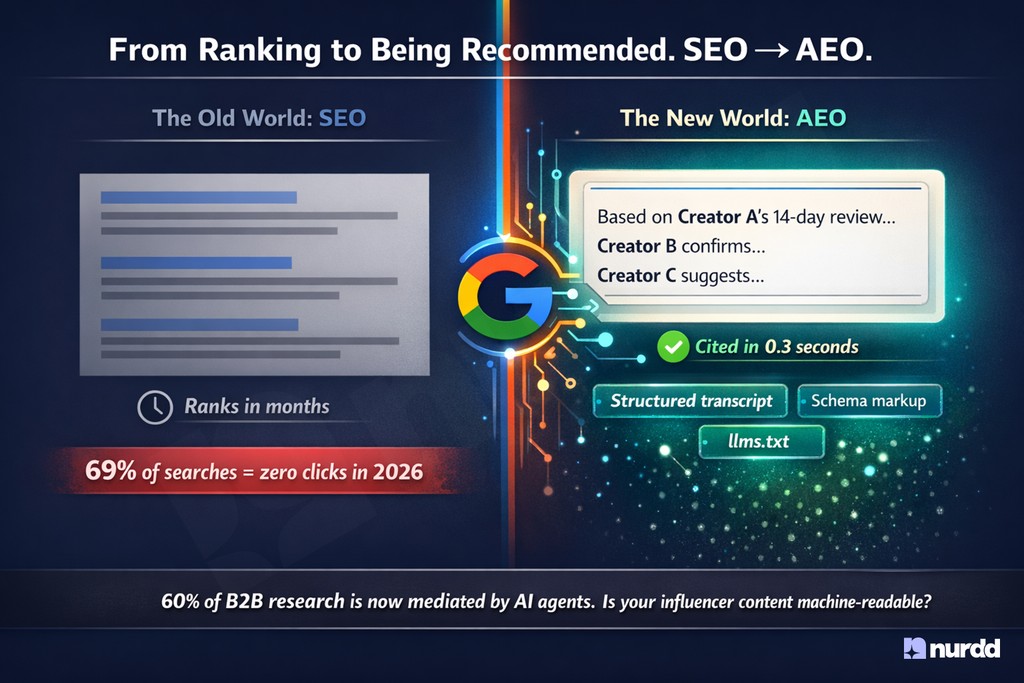
Make influencer content structured, indexed, and semantically clear so AI agents can retrieve and cite it. Use exact category language, evidence-based reviews, dated content, and a presence across multiple indexed platforms; relevance, quality, credibility, and citation frequency matter more than likes or follower counts.
Beyond the Feed: Why Your 2026 Influencer Strategy Needs to Target AI Agents, Not Just People
Over 60% of B2B research interactions are now mediated by AI agents. 80% of consumers rely on zero-click results for at least 40% of their searches. Content Relevance leads AI citation decisions with an impact score of 93.0 while Social Signals (likes, followers) sits last at 55.7. When a user asks their AI to "find the best organic moisturiser for humid weather," the agent retrieves structured creator reviews, not social engagement numbers. If your influencer content cannot be read, retrieved, and cited by an AI agent, it does not exist to that user. This is the shift from Search Engine Optimisation to Agent Engine Optimisation (AEO) and it is the most significant strategic transition in influencer marketing since the algorithm replaced the follower count.
The Hook: A Purchase That Happened Without a Single Scroll
A user is planning a trip to Tokyo. She opens her AI assistant and types: "Buy me the best moisturiser for five days in humid weather cruelty-free, under ₹2,000, available on Nykaa."
The agent does not open Instagram. It does not browse hashtags. It retrieves structured content from YouTube transcripts, Reddit threads, and blog posts looking for creator reviews that use specific, machine-readable language about humidity, skin barrier function, and fragrance-free formulation. It cross-references those reviews with sentiment signals from comment sections, purchase confirmation data from affiliate links, and schema-marked product specifications.
Thirty seconds later, it presents three recommendations, each attributed to a specific creator review, each with a trust confidence score. The user taps "buy."
Not one of those creators was chosen because they had the most followers. They were chosen because their content was structured in a way the agent could read, trust, and cite.
The Core Shift: From Customer Journey to Agent Logic Loop
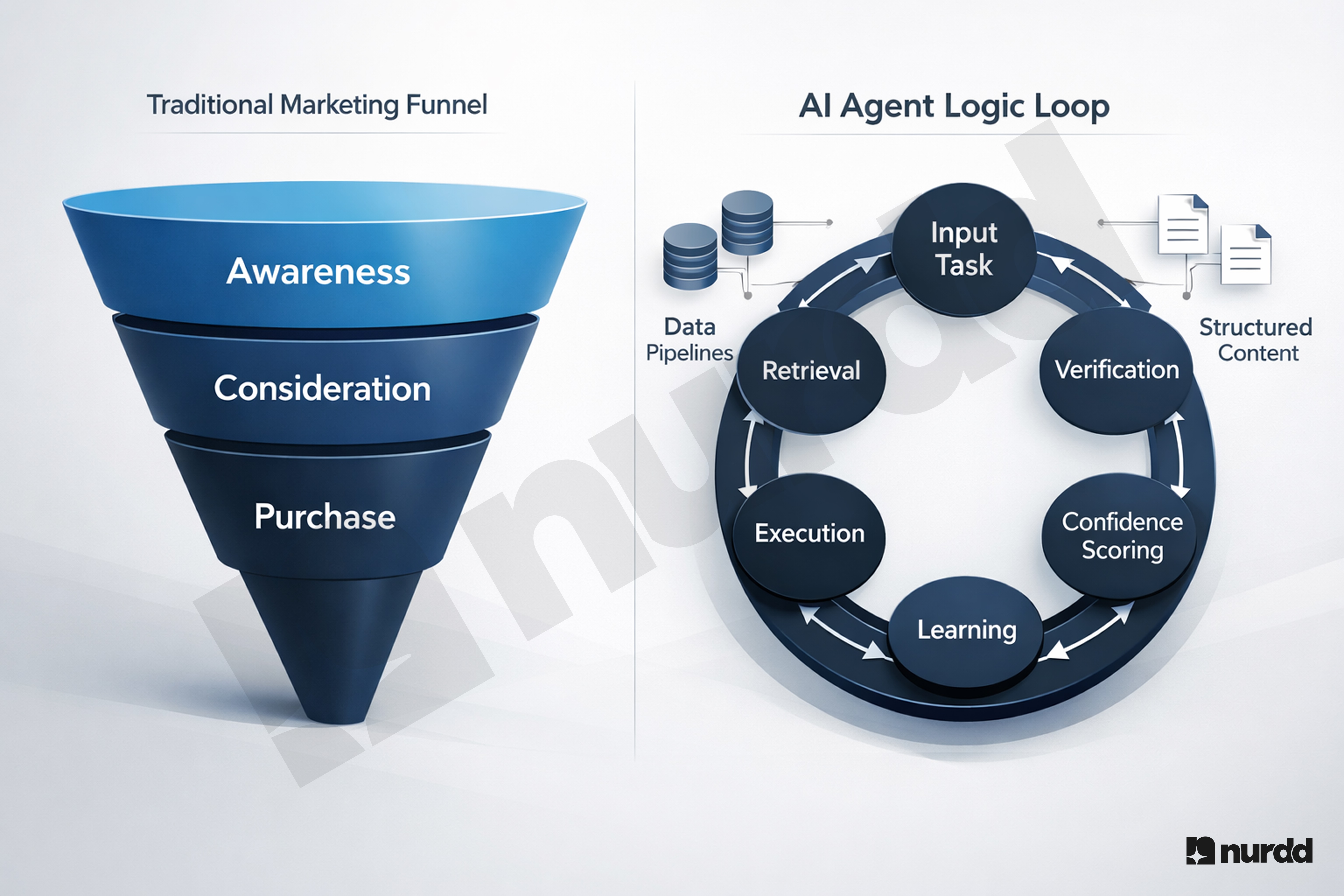
Traditional marketing is built around the human customer journey, awareness → consideration → purchase. Every influencer brief is designed to move a human being through this sequence.
Agentic marketing is built around a fundamentally different logic:
Stage
Human Customer Journey
AI Agent Logic Loop
Trigger
Sees an ad or recommendation
Receives a task instruction from a user
Research
Browses, compares, reads reviews
Retrieves structured data from indexed sources
Verification
Reads comments, checks ratings
Cross-references trust signals across multiple sources
Decision
Forms a preference
Calculates a confidence-weighted recommendation
Execution
Clicks to purchase
Initiates transaction autonomously
Optimisation
Remembers for next time
Updates preference model based on outcome
The critical difference is in the research stage. A human browses. An agent retrieves. The agent uses Retrieval-Augmented Generation (RAG) - the technology that pulls external information into an LLM's reasoning process. If an influencer's video transcript is not structured, indexed, and semantically clear, it cannot be retrieved. It cannot be cited. It effectively does not exist to the agent completing the task.
The Optimisation Framework Hierarchy: SEO → GEO → AEO
Understanding where AEO sits relative to existing practices prevents the most common mistake: treating it as a replacement for SEO rather than a layer on top of it.
Framework
What It Optimises For
How It Measures Success
When It Matters
SEO (Search Engine Optimisation)
Ranking on Google and Bing SERPs
Click-through rate, SERP position
Bottom-funnel intent users searching with specific keywords
GEO (Generative Engine Optimisation)
Being sourced by AI-generated overviews
AI Overview inclusion rate, featured snippet
Mid-funnel - users asking questions in Google AI Mode
AEO (Agent Engine Optimisation)
Being cited by autonomous AI agents
Share of Model, AI citation frequency
Top- and mid-funnel agents executing purchase and research tasks
Search Everywhere Optimisation
Being visible and cited across all discovery channels Google, ChatGPT, Perplexity, Claude, voice, social search
Presence rate across all platforms
Full-funnel - every discovery surface simultaneously
AEO and GEO are not replacing traditional SEO. They are layering on top of it. A BCG analysis showed only 8–12% overlap between traditional search results and AI-generated answers companies need both. SEO captures bottom-funnel intent; AEO influences top- and middle-funnel agentic discovery.
Search Everywhere Optimisation is the master framework that combines all four. It is critical for brands as generative and answer-based AI engines form their own "opinions" about which products and creators to recommend. Brands that have invested in foundational SEO and adapt to being visible and cited as trusted, authoritative sources across multiple AI platforms already have a significant head start in 2026.
What AI Agents Actually Look For: The AEO Ranking Factors
The largest AI search visibility study to date — analysing thousands of prompts across models — identified the variables that most influence brand visibility in AI answers:
Ranking Factor
Average Impact Score
What It Means for Influencer Content
Content Relevance
93.0
Creator content must use exact category language matching how users phrase agent queries
Content Quality and Depth
90.0
Surface-level captions are ignored; structured, evidence-based reviews are retrieved
Credibility and Trust
88.2
Third-party corroboration (Reddit, YouTube comments, review sites) amplifies citation probability
Citation Frequency
85.1
Cross-platform presence - same creator, multiple indexed surfaces multiplies AI citation likelihood
Content Freshness
78.4
Recent reviews are weighted more heavily; episodic series with dated timestamps have a freshness advantage
SERP Ranking
61.8
Traditional SEO still influences AI citation - well-ranked pages are more likely to be retrieved
Social Signals
55.7
Likes and follower counts have the lowest impact - AI agents weight these least of all factors
The implication for every influencer brief is precise: content that is highly engaged but poorly structured will be invisible to agents. Content that is moderately engaged but precisely structured and cross-platform indexed will be consistently cited. In the agentic environment, structure outperforms reach.
Passage-Level Optimisation: The Technical Insight Most Brands Are Missing
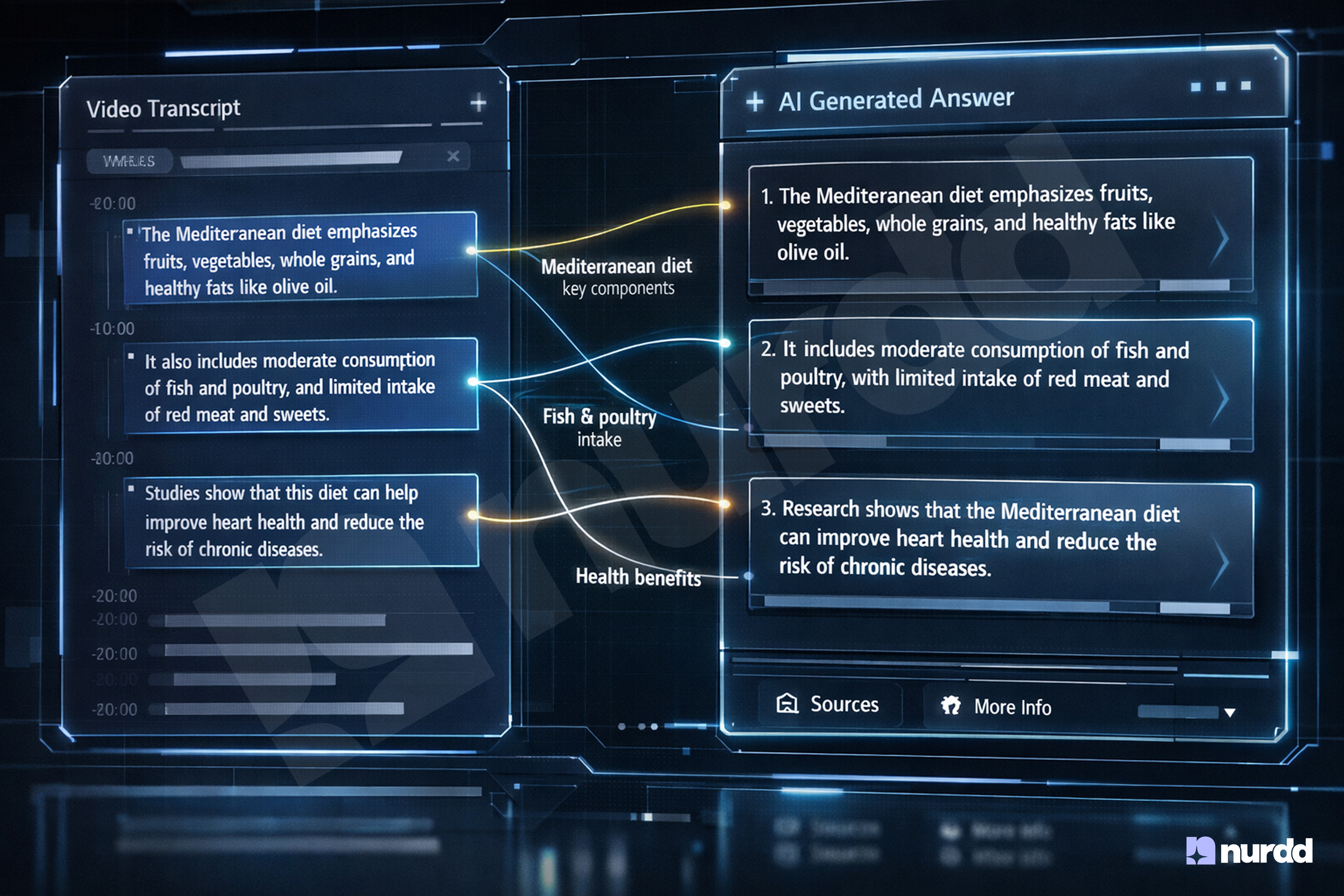
Google's AI Overviews, ChatGPT, and Perplexity do not evaluate full pages or full videos. They use vector-based semantic retrieval that evaluates specific passages within a document retrieving the three to five sentences that most precisely answer the agent's query and ignoring the rest.
For influencer content, this means the passage within a transcript that makes a specific, structured claim is the unit that gets cited, not the video, not the creator, not the post. Everything around it is context. Only that passage is evidence.
A creator saying "I love this moisturiser, it's literally my holy grail ✨" is not a retrievable passage. A creator saying "I used this daily for 14 days during my Singapore trip: 35°C, 85% humidity. My skin barrier visibly improved by day 5. The ingredient that does the work is ceramide complex. I'd recommend it specifically for humid tropical climates" is three retrievable, citable, evidence-based passages.
The influencer brief must now specify passage-level requirements, not just content themes and aesthetic direction, but the specific structured claims the creator must make, in the specific language that matches how users phrase agent queries.
The AEO-Ready Influencer Content Checklist
☑ Spoken keywords in video transcripts - creator explicitly names the product category, use case, and key benefit in language matching how users phrase AI queries
☑ Structured review language - the review states a claim, an evidence basis, and a recommendation in sequence, in three to five sentences that function as a standalone passage
☑ Cross-platform indexed presence - the same review or a variant appears across YouTube, LinkedIn, and at least one text-indexed platform (Reddit, Quora, brand blog) creating the citation trail LLMs weight as corroboration
☑ Schema-marked affiliate link - tracked link accompanied by structured product data (price, availability, category) that agents can parse without rendering a full product page
☑ Sentiment-verifiable comment section - comments beneath the creator's content include specific, genuine responses that agents can retrieve as third-party corroboration
☑ llms.txt or /ai page at the brand's root domain - a machine-readable product summary so that when an agent follows the affiliate link, it finds structured data rather than an HTML-heavy product page
The New AEO Dashboard: Five Metrics Your Current Reporting Doesn't Track
Brands shifting to AEO measurement need new KPIs alongside traditional analytics:
The loop closes publicly. When the creator announces to their community "we asked for this - it shipped," that moment is simultaneously a product launch, a customer loyalty event, and a creator partnership deepened by demonstrated respect. 68% of users feel more loyal to a brand when they see a feature requested by a creator they follow actually get implemented.
Metric
What It Measures
How to Track
AI Visibility Rate
% of target queries where your brand appears in AI responses
Conductor, Profound, HubSpot AI Search Grader - weekly prompt testing
Share of Model
How often your brand is cited vs. competitors in AI responses
Manual prompt testing across ChatGPT, Perplexity, Claude, Google AI Overviews
Citation Authority
How consistently you are cited as the primary source (not just mentioned)
Conductor AEO/GEO Benchmark Report - industry-specific baselines
Passage Retrieval Rate
How often a specific creator's structured claim appears verbatim or paraphrased in AI answers
Tag specific passage phrases in creator content and test retrieval across models
Response-to-Conversion Velocity
How quickly AI-influenced prospects convert after brand citation
HubSpot attribution + UTM-tagged AI referral traffic segments
Even if organic traffic declines (as zero-click search grows), content can still influence pipeline, authority, and demand if it appears inside AI answers. Measuring AI citations gives marketing teams a clearer view of organic influence in a zero-click world.
Predictive Matching: The Death of the Influencer Gamble
AI agents are not just changing how purchase decisions are made, they are changing how creator partnerships are evaluated before they begin.
Predictive matching uses historical conversion data, micro-sentiment analysis, and lookalike creator modelling to calculate the probability of a creator's success for a specific AEO-relevant brief before any outreach is sent. The two components:
Micro-Sentiment Analysis: Tools analyse not just whether a creator's audience is engaging, but how whether comments are expressing purchase intent ("where can I buy this?"), category-qualified interest ("does this work for oily skin?"), or passive entertainment ("lol"). In an AEO context, this analysis now also assesses whether the creator's structured claim language is generating comment-level corroboration that AI agents can retrieve as third-party trust signals.
Lookalike Creator Modelling: AI identifies statistical twins of creators who have previously generated high volumes of AI-cited content in a specific category, not based on follower count, but on content structure patterns, cross-platform indexation density, and passage-level semantic clarity. A creator who consistently produces retrievable passages in "humid climate skincare" is a predictive AEO candidate for that category.
What Indian D2C and B2B SaaS Brands Should Do Right Now
India presents a specific urgency. It is the world's fastest-growing AI assistant user market Google AI Overviews adoption in India, WhatsApp's AI search integration, and Jio's assistant ecosystem mean that agentic query adoption is accelerating faster than in almost any other market globally. The brands that arrive with structured, machine-readable influencer content infrastructure now will build AI citation authority before the window closes.
Three immediate actions for this quarter:
1. Audit your top 10 creator posts for passage-level retrievability. Can an AI agent extract a specific, evidence-based claim in three to five sentences without rendering the full video? If not, your next creator brief should include a "structured claim" requirement specifying the exact language pattern creators must use when making a product recommendation.
2. Build your llms.txt file and /ai directory today. Create a machine-readable product summary at your root domain. This costs minimal development time and immediately improves the quality of the structured data available to agents following creator affiliate links. Usage of the llms.txt standard has grown by 1,800% over the past year for precisely this reason, the brands that build it now benefit from first-mover citation authority.
3. Add Share of Model to your weekly reporting. Set up a weekly prompt test across ChatGPT, Perplexity, and Google AI Overviews, ask for product recommendations in your category in natural language. Track how often your brand is cited, which creator content is referenced, and how your Share of Model changes as you implement AEO-compliant influencer briefs.
Frequently Asked Questions
What is Agent Engine Optimisation (AEO)? AEO is the practice of structuring content so that autonomous AI agents and answer engines: ChatGPT, Perplexity, Google AI Overviews can retrieve, trust, and cite it. Unlike traditional SEO, which optimises for human clicks via search rankings, AEO optimises for machine legibility: structured review language, schema markup, clean video transcripts, and cross-platform citation trails that LLMs use as trust signals.
What is agentic marketing and how is it different from traditional influencer marketing? Agentic marketing is the practice of designing influencer content for discovery and recommendation by autonomous AI agents — not just human scrollers. In traditional influencer marketing, the goal is to capture human attention and intention. In agentic marketing, the goal is to ensure creator content is structured, indexed, and retrievable by AI agents executing purchase tasks on behalf of users.
What is Retrieval-Augmented Generation (RAG) and why does it matter for creator content? RAG is the technology that allows AI agents to pull current, external information into their reasoning process when generating a response. An agent answering "best moisturiser for humid weather" uses RAG to retrieve creator reviews, product specifications, and comment-section sentiment from indexed sources. If an influencer's video transcript is not structured and indexed in a way RAG can process, the content is invisible to the agent regardless of its human engagement performance.
What is Share of Model and how do I measure it? Share of Model measures the percentage of times your brand is cited as a recommended choice in LLM responses across major AI platforms. Measure it by running weekly natural-language prompts across ChatGPT, Perplexity, Claude, and Google AI Overviews — asking for product recommendations in your category — and tracking how often your brand and your creators' content is cited. Tools like Conductor, Profound, and HubSpot's AI Search Grader provide automated tracking.
What is passage-level optimisation and why does it matter for influencer briefs? Passage-level optimisation is the practice of structuring specific sections of creator content — typically three to five sentences — to function as standalone, retrievable evidence passages for AI agent retrieval. AI models evaluate specific document passages rather than full pages, retrieving the sections that most precisely answer the agent's query. Influencer briefs must now specify the exact claim language creators use in their recommendations, not just their content theme and aesthetic direction.
What is Search Everywhere Optimisation? Search Everywhere Optimisation is the master framework that combines SEO, GEO, and AEO to ensure brand and creator content is visible and cited across every discovery surface — Google, ChatGPT, Perplexity, Claude, voice search, social search (LinkedIn, TikTok), and agentic shopping assistants simultaneously. It is the evolved form of traditional SEO in a multi-platform discovery environment where users search across seven or more channels before making a purchase decision.
Does AEO replace traditional SEO? No. AEO and GEO layer on top of traditional SEO — they do not replace it. Technical SEO foundations (site speed, mobile friendliness, clean architecture, strong backlink profile) are prerequisites for AI visibility. Without them, generative and answer-based efforts have nothing reliable for AI systems to ingest, understand, or cite. The best-performing brands in 2026 treat SEO as the fuel and AEO as the turbocharger.
What are the most important factors for AI citation of influencer content? The largest AI search visibility study to date ranks the factors in this order: Content Relevance (93.0 impact score), Content Quality and Depth (90.0), Credibility and Trust (88.2), Citation Frequency (85.1), Content Freshness (78.4). Social Signals — likes and follower counts — sit last at 55.7. In the agentic environment, a creator with 10,000 followers and structured, cross-platform, evidence-based content will be cited more often than a creator with 1,000,000 followers and unstructured caption content.
Sources
- NoGood — How to Do AEO: A Guide to Brand AI Visibility 2026 (Mar 2026): nogood.io
- BCG — Agentic Scenarios Every Marketer Must Prepare For (Mar 2026): bcg.com
- Search Engine Journal / BrightEdge — 5 Key Enterprise SEO and AI Trends for 2026 (Jan 2026): searchenginejournal.com
- SEO Sherpa — 10 SEO Predictions for 2026: How AI, Search Everywhere, and Brand Will Redefine Organic Visibility (Jan 2026): seosherpa.com
- Amsive / Profound — Answer Engine Optimisation: Your Complete Guide to AI Search Visibility: amsive.com
- HubSpot — Answer Engine Optimisation Trends in 2026: How AEO Is Transforming the Landscape (Jan 2026): hubspot.com
- WEF — New Era of Performance Marketing: How Brands Are Repositioning for AEO (Jan 2026): weforum.org
- Conductor — The 2026 AEO/GEO Benchmarks Report (Jan 2026): conductor.com
- Eminence — AEO 2026: Optimise for AI Answer Engines (Feb 2026): eminence.ch
- Commercetools — 7 AI Trends Shaping Agentic Commerce in 2026 (Feb 2026): commercetools.com

Is your brand showing up in AI search answers?
Noma tracks whether ChatGPT, Perplexity, Gemini, Claude, and Grok mention your brand when customers ask category questions — and shows you exactly how to improve your AI visibility.