AI Search Visibility
Software for AI Search Visibility Pricing: What It Costs
How AI search visibility software is priced (per prompt, brand, seat or credit), what it costs in 2026, and what to ask before you sign.
 Simran Rawat11 Nov 202618 min read
Software for AI search visibility pricing usually starts under $100 a month for self-serve monitoring, and a published dataset of 34 tools puts the median cheapest plan at $79 a month. The real bill depends on the unit you are charged for: prompts, brands, seats, engines or credits. Ask what each unit buys, how often it is polled, and what happens when you exceed it.
Software for AI search visibility pricing usually starts under $100 a month for self-serve monitoring and rises to several hundred dollars once you add prompts, brands, engines or seats. A 34-tool dataset puts the median cheapest numeric plan at $79 a month. What you pay depends on the unit being metered, so compare units before you compare sticker prices.
Key takeaways
- Treat the sticker price as a starting point. The unit being metered (prompts, brands, seats, engines or credits) decides your real bill.
- Convert every quote to the same measure: cost per 1,000 answers checked, or cost per tracked prompt per month. The worked example below shows how.
- Prompt volume is the most common upgrade trigger, so estimate the prompts you need before you shortlist.
- Short trials are the norm. Plan your prompt list and competitor set before you start the clock.
- Ask about engine coverage, polling frequency, overage rules and cancellation, not just the monthly price.
- Noma has a 3-day free trial with a card taken at signup and billing from day 3. Cancel before day 3 and you are not charged.
How much does software for AI search visibility cost?
Published prices span a wide range, but the middle is easy to see. In its May 2026 pricing study of 34 tools, Steal What Works, May 2026 reports a median cheapest numeric plan of $79 a month and a median highest numeric plan of $400 a month. It also found that 65.6% of numeric-priced tools start below $99 a month.
That means a small team can usually start for less than $100 a month, and a team that needs many prompts, many engines or several brands will move into the $200 to $700 band quickly. Enterprise and agency tiers sit above that and are mostly quote-based. The same study found 82.4% of tools have an enterprise plan or a contact-sales path.
A second reference point comes from Radarkit, April 2026, which groups tools into four budget bands: $20 to $99 a month for small businesses, $99 to $300 for growing companies, $300 to $700 for large enterprises, and $3,000 or more for enterprise agencies. Radarkit sells a tool of its own, so treat its bands as a rough map rather than a standard. The band edges matter less than the fact that the entry price and the price you end up paying are often different numbers.
What pricing models will you meet?
Almost every vendor charges a recurring subscription, then meters one or two units on top. Steal What Works, May 2026 found 70.6% of tools use a recurring model and 29.4% use a hybrid, where usage-based charges sit on top of a subscription. The study also found prompt volume appears as an upgrade trigger in 64.7% of tools, which makes the prompt the closest equivalent to the tracked keyword in classic SEO pricing.
Here is how the main models behave in practice.
| Pricing model | What you are charged for | Where the bill grows | Best fit | Main risk |
|---|---|---|---|---|
| Per prompt | A tier with a fixed number of tracked prompts | Adding topics, markets or product lines | One brand with a stable question set | Your prompt list grows faster than the tier |
| Per brand or domain | Each brand, site or project you track | Adding sub-brands, regions or clients | Single-brand teams, some agencies | Competitors count as extra projects in some plans |
| Per seat | Each user with a login | Bringing in content, PR and leadership | Small teams | Reporting access is rationed |
| Per engine or model | Which AI engines are included | Adding engines such as Perplexity or Claude | Teams that care about one or two engines | The engine your buyers use sits on a higher tier |
| Credits or response allowances | A pool consumed by prompts, engines and runs | Daily polling, many engines, audits | Teams that want to flex usage | Monthly spend is hard to predict |
| Custom or enterprise | A negotiated contract | Contract length, volume, security terms | Large brands and multi-brand groups | No public price to compare against |
The point of the table is that no model is cheap or expensive on its own. A per-prompt tier is excellent value if you need 50 prompts and wasteful if you need 10. A credit pool is flexible if you understand the burn rate and a surprise if you do not.
Per prompt
A prompt is a question a buyer might ask an AI engine, such as a category question or a comparison. Tiers are sold as prompt allowances, and each prompt is usually run on each included engine at a set frequency. If you are unsure how many you need, read the guide on how many prompts to track in AI search and the companion piece on which prompts to track before you buy.
Per brand, domain or project
A brand-based plan prices the thing being measured. Honeyb, October 2026 reports that Semrush's AI Visibility pricing page lists a single Base plan at $99 a month per domain, with 25 tracked prompts. That is a per-domain model with a prompt cap inside it, which is why the two units cannot be separated.
For agencies and groups with several brands, per-brand pricing multiplies fast. The setup differences are covered in the guides to choosing an AI search tool for multiple client brands and tracking multiple brands in AI search.
Per seat
Seats are a smaller lever in this category than prompts, but they bite when a PR lead, a content lead and a head of marketing all need access. Some vendors ration seats and others do not: Trakkr, May 2026 lists unlimited seats on the AthenaHQ Starter plan. Treat seat limits as something to check on each pricing page rather than assume.
Credits and response allowances
Allowance-based plans turn every check into a deduction. Trakkr, May 2026 lists the AthenaHQ Starter plan at $295 a month for 3,600 responses on 11 engines, with unlimited seats and exports, and says Starter is limited to a single country. The lesson for any allowance plan is to ask what a single tracked prompt costs per engine per run, then do the arithmetic before you sign.
How do you compare quotes that use different units?
Convert every quote into one of two measures: cost per tracked prompt per month, or cost per 1,000 answers checked. The first is quick. The second is fairer because it accounts for the number of engines and the polling frequency.
The formula is simple. Answers checked per month equals prompts, multiplied by engines, multiplied by runs per month. Divide the monthly price by that number and multiply by 1,000.
Worked example with published numbers
Rankscope recorded Peec AI's pricing page on 20 October 2026: Starter at $95 a month for 50 prompts, and Pro at $245 a month for 150 prompts, each with 3 models, according to Rankscope, October 2026. Assuming daily runs for 30 days, here is the arithmetic.
| Plan (as recorded by Rankscope) | Monthly price | Prompts | Engines | Answers per month (daily, 30 days) | Cost per prompt | Cost per 1,000 answers |
|---|---|---|---|---|---|---|
| Peec AI Starter | $95 | 50 | 3 | 4,500 | $1.90 | $21.11 |
| Peec AI Pro | $245 | 150 | 3 | 13,500 | $1.63 | $18.15 |
| Semrush AI Visibility Base, per Honeyb | $99 | 25 | Not stated here | Cannot be computed without engine count | $3.96 | Not computed |
The cost-per-prompt and cost-per-1,000 columns are our own arithmetic on the published figures. Two things stand out. Moving from 50 to 150 prompts cuts the unit price by about 14% on this arithmetic, so bigger tiers are not automatically worse value. And a plan that looks cheaper per month can cost more per prompt, which is why the per-prompt column matters more than the headline.
The Semrush row shows the limit of the method. Without the engine count and the run frequency, you cannot compare it like for like, so ask the vendor for both before you decide.
Worked example for a credit plan
Bloomiro's comparison page, updated 2 November 2026, states that its Starter plan includes 250 credits and that each question costs 0.25 credits per AI, per Bloomiro, November 2026. The page's own example is ten questions on three AIs, costing 7.5 credits per run. Bloomiro is a vendor in this category, so verify its current limits on its pricing page.
Using those figures, 250 credits covers 33 runs of that ten-question set (250 divided by 7.5). A daily run for 30 days uses 225 credits, which fits. Raise the list to fifteen questions on the same three AIs and one run costs 11.25 credits, so a daily schedule needs 337.5 credits a month and no longer fits. That jump is the typical credit-plan surprise: a modest increase in prompts breaks a monthly allowance.
What does a published price comparison look like?
Below are entry prices as reported by third parties in 2026, with the source and date shown. These are reported figures, not vendor quotes. Confirm each on the vendor's own pricing page, because plans change.
| Tool | Reported entry price | What the report says is included | Source |
|---|---|---|---|
| Peec AI | $95 a month (Starter) | 50 prompts, 3 models | Rankscope, October 2026 |
| Semrush AI Visibility Toolkit | $99 a month per domain | 25 tracked prompts | Honeyb, October 2026 |
| AthenaHQ | $295 a month (Starter) | 3,600 responses on 11 engines, unlimited seats and exports, single country | Trakkr, May 2026 |
| Ahrefs Brand Radar | Reported at $199 a month per AI index and $699 for all platforms | Sources disagree on whether a base Ahrefs plan is also required | Everything PR, November 2026 |
The Ahrefs row is a good example of why you ask for a total. When reviewers disagree on whether a base plan is needed, the true entry price could differ by hundreds of dollars a month. For a fuller feature and price read, see our comparison of 10 AI search visibility tools and the notes on Scrunch AI pricing and alternatives.
What should you ask before buying an AI visibility tool?
Ask twelve questions, grouped by the money, the data and the exit. Each one exposes a cost that rarely appears on the pricing page. Use them as a script for sales calls and as a filter for self-serve tools.
Questions about the money
- What exactly is the billed unit: prompts, brands, seats, engines, credits or a mix?
- What is the total monthly cost for my real setup, including competitors, extra engines and extra seats?
- Is a base subscription from the same vendor required before I can add the AI visibility product?
- What happens when I exceed the allowance: an automatic upgrade, an overage charge or a pause in tracking?
- What is the annual discount, and can I leave a month-to-month plan at any time? Steal What Works, May 2026 found the average annual discount is 18.3% and the median is 17%.
Questions about the data
- Which engines are included on my plan, and is the engine my customers use on a higher tier?
- How often is each prompt polled, and do I choose the frequency?
- Do I see the actual answer text and the cited URL, or only a score?
- Can I export raw data, and is there an API on my plan?
Questions about the exit and the proof
- How long is the trial, is a card required, and when does billing start?
- What do I keep if I cancel: exports, history, prompt lists?
- What does the tool recommend I do next, and can I tie any change to a result?
The last question matters because monitoring alone does not improve anything. The same study found that tools focused on execution cost more at entry: Steal What Works, May 2026 reports an average cheapest plan of $121.50 for GEO optimization and execution tools against $72.60 for monitoring and analytics tools. If you pay for a monitoring tool, you still need a person or an agency to act on it.
How do you choose a pricing model? A decision table
Match the model to your situation rather than hunting for the lowest sticker price. This decision table covers the five situations buyers describe most often.
| Your situation | Metric to estimate first | Model that usually fits | Watch out for |
|---|---|---|---|
| One brand, one product line, first AI visibility project | Prompts (start with 20 to 50) | Per-prompt tier with monthly billing | Locking into annual before you know your prompt count |
| One brand, several markets or languages | Prompts multiplied by markets | Per-prompt tier with multi-country support | Country coverage priced as an add-on |
| Agency with several clients | Number of brands and reporting seats | Per-project or agency plan | Per-seat fees for client access |
| Brand already paying for an SEO suite | Whether the add-on needs a base plan | Suite add-on, compared against a standalone tool | Prompt caps that are small relative to your needs |
| Large brand with legal and security reviews | Contract terms, data handling | Custom or enterprise | No public price and a long procurement cycle |
If you are still deciding between a suite add-on and a dedicated tool, the pages on Noma vs Semrush and Noma vs Profound set out the differences. Startups on a tight budget will also find the startup budget checklist useful.
How do you test a tool during a short trial?
Trials are short, so go in with a plan. Steal What Works, May 2026 found 76.5% of tools offer a free trial and only 29.4% a free plan. Among tools that state a trial length, the median is 7 days and the observed range is 3 to 14 days.
Noma's trial is 3 days, which is the short end of that range. A card is taken at signup, billing starts on day 3, and you are not charged if you cancel before then. That is worth stating plainly because a short trial rewards preparation: arrive with your prompt list and competitor set ready, and use the first hour to load them.
Trial checklist
- Before you start, write 20 to 30 prompts in the words buyers use, covering category, comparison and problem questions.
- List your three to five main competitors so the first data already includes share of voice.
- Note which engines matter to your audience, then confirm each is on the plan you are trialling.
- On day one, load the prompts and check that the tool shows the answer text and the cited page, not only a score.
- On day two, look at which of your pages were cited, and which competitor pages were cited instead.
- On day three morning, decide: keep, cancel or ask for a demo. Set a reminder before billing starts.
- Write down the unit you would hit first (prompts, engines or seats) so you know which upgrade you would face.
A trial cannot show a trend. Visibility changes slowly, so judge the trial on data quality and the clarity of the recommendations, and judge the subscription on the movement you see over the following weeks. The guide to GEO experiment design explains how to separate real change from noise.
How to budget for AI search visibility software: step by step
- Define the questions you need answered. Write the prompts first, by topic and by buying stage. The result is a prompt count you can defend, and the reason it matters is that prompt volume is the most common upgrade trigger in the dataset above.
- Choose the engines that matter to your buyers. Check where your customers search and shortlist only tools that cover those engines on the plan you would buy. This prevents you paying a higher tier later for the one engine you needed from day one.
- Pick a frequency. Decide whether daily or weekly polling is enough. The result is a runs-per-month number that feeds the cost-per-1,000-answers formula, and it matters because answers can vary between runs.
- Convert each quote to a common unit. Use cost per prompt and cost per 1,000 answers, as in the worked example. The comparison now rests on arithmetic instead of marketing, and it shows which plan is cheap only because it checks less.
- Add the hidden costs. Add seats, extra competitors, extra countries and any required base subscription. The result is a realistic monthly total, which is what finance will actually approve.
- Run the trial with the checklist above. You come away with evidence on data quality and next-step guidance. A trial answers whether the tool is usable, which a pricing page cannot.
- Set a review date. Put a date 60 to 90 days out to check whether the spend produced action and movement. It keeps a monitoring subscription from becoming shelfware.
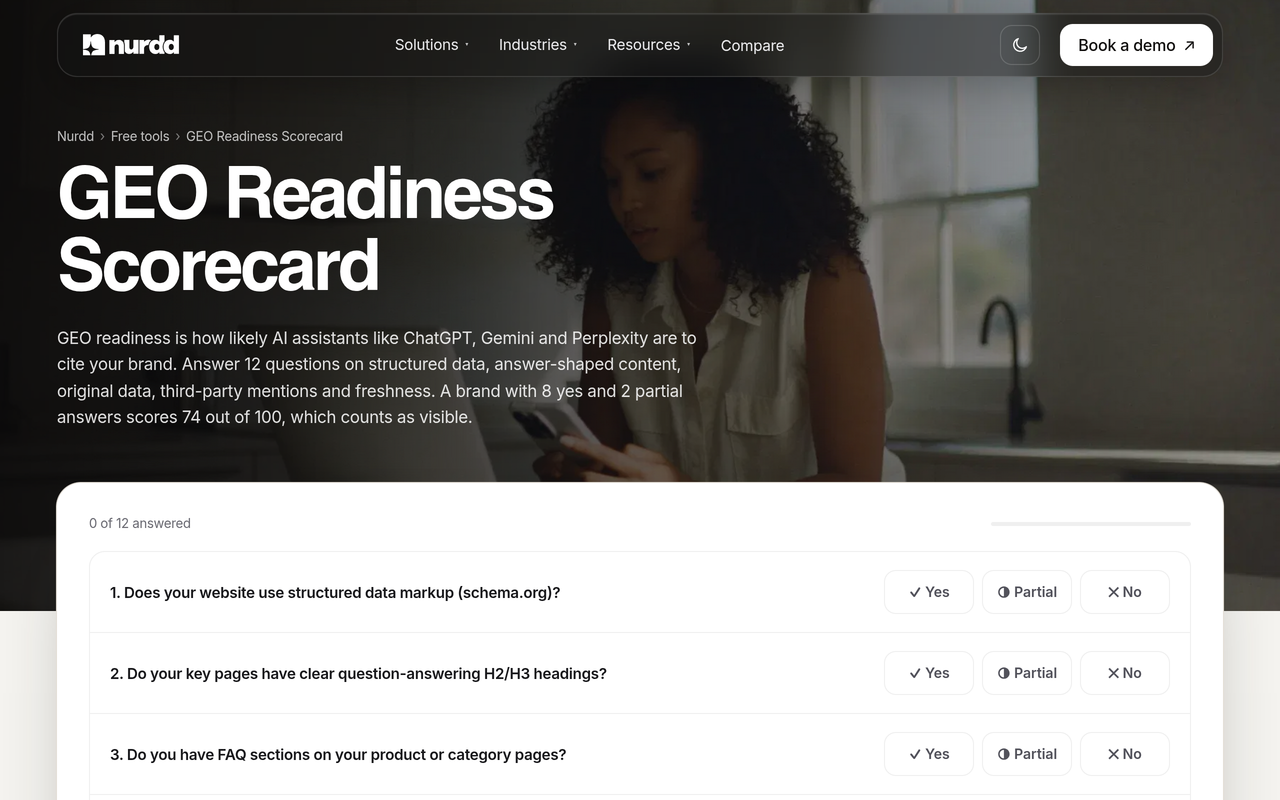
Once you have a budget, the GEO readiness scorecard is a free way to see whether your site is ready to act on what the tool finds. A tool tells you where you are missing, and the scorecard checks whether you can fix it.
What mistakes make AI visibility software cost more than expected?
- Buying on the entry price. The entry plan often carries a small prompt cap or one engine. The price you pay is the plan that fits your prompt list.
- Counting prompts, not answers. Fifty prompts on three engines daily is 4,500 answers a month. Fifty prompts on one engine weekly is a fraction of that. The same headline number can mean very different amounts of data.
- Forgetting competitors. Some plans count competitors against a limit. Tracking your own brand alone tells you little, so price the competitor set in.
- Ignoring the base-plan question. Suite add-ons may need a subscription underneath. As the Ahrefs row above shows, reviewers do not always agree, so ask.
- Signing annually too early. A 17% median annual discount is attractive, but prompts and engines change in the first quarter. Start monthly unless you are sure.
- Paying for monitoring and expecting results. A dashboard measures. Improvement comes from content, structure and third-party sources, so budget for the work as well as the tool. The comparison in content scoring tools vs AI visibility tracking explains the difference.
- Skipping the exit terms. Check exports and cancellation before you load months of prompt history into a tool.
What do agencies and managed services cost compared with software?
Software tracks and an agency acts, and the two are priced differently. If you want a team to improve the pages and sources AI engines read, the better comparison is a monthly retainer, which is scoped per brand and covered in AI search agency pricing. For a hiring checklist, see answer engine optimization agency questions.
The practical split is simple. Software suits teams that have people to write and fix pages. A managed service suits teams that do not. Many brands use software for measurement and an agency for execution, which is why the measurement tool should export data an agency can use. A comparison of the two routes is in answer engine optimization agency vs in-house tooling.
How does Noma fit the pricing picture?
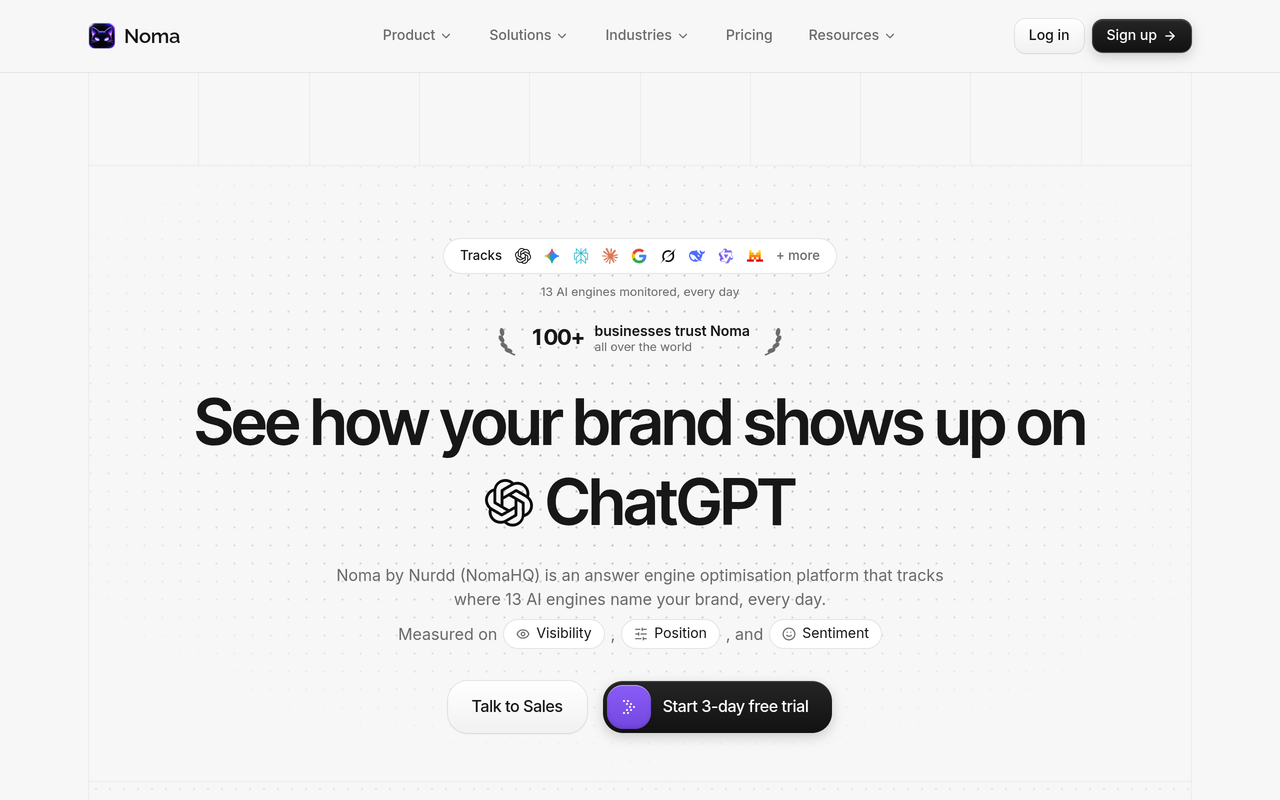
Noma by Nurdd is a web dashboard at nomahq.app that tracks whether a brand appears in answers from 13 AI engines, including ChatGPT, Gemini, Perplexity and Claude, polled daily. It shows citation frequency by category, competitor comparison and recommendations to improve AI visibility. A brand team that wants one dashboard across many engines, with competitors and next steps in the same view, is who it is built for.
Noma offers a 3-day free trial. A card is taken at signup, billing starts on day 3, and you are not charged if you cancel before then. Current plan details are published on Noma's site, and we do not repeat prices here so you always see the live figures.
Noma belongs in this comparison for three reasons. It covers 13 engines rather than a handful, so the engine-coverage question in the checklist is easy to answer. It is polled daily, which gives you the frequency input for the cost formula. And it is built to show the competitor view and recommendations, which addresses the question about what to do next.
Book a demo at https://www.nurdd.club/demo and we will walk through Noma using your own brand, category questions and competitors, so you can see which engines name you, which pages they cite and how that compares with the brands you compete with.
To see how Noma stacks up on price per unit, run the formula above on any quote, including ours, and see the Peec AI pricing vs Noma page. If you are building a shortlist, the guides to AI search monitoring tools and answer engine optimization tools cover the wider field.
How do you prove the spend is working?
Report a small set of numbers every month and tie them to actions. Track the share of tracked prompts where your brand is named, the pages cited, and your position against named competitors. Add referral traffic from AI engines in your analytics, which the guide to AI referral traffic walks through.
For a monthly format that executives will read, use the structure in AI search metrics: how to build a monthly report, and see what executives need to see on an AI search visibility dashboard. If you are new to the discipline, what generative engine optimization is gives the background.
How we researched this
We reviewed published pricing studies, vendor-comparison pages and third-party reviews, and checked each of them on the publication date of this article. We did not run hands-on tests of competing tools and we have no customer data to report.
Where a rival's price comes from a third party, we say so and name the source and date. Treat those as reported figures and confirm them on the vendor's own pricing page, because plans change often. Facts about Noma come from Nurdd's own product information.
The arithmetic in the worked examples is ours, applied to figures the cited sources state. The pricing dataset from Steal What Works covers 34 tools as of May 2026, so newer plan changes may not appear in it.
Frequently asked questions
How much does software for AI search visibility cost?
Self-serve plans commonly start under $100 a month, and a 34-tool study reported a median cheapest plan of $79 a month and a median highest plan of $400 (Steal What Works, May 2026). Larger setups with many prompts, engines or brands cost more, and enterprise tiers are usually quoted individually. Convert each quote to cost per 1,000 answers to compare it fairly.
What should I ask before buying an AI visibility tool?
Ask what unit you are billed on, what your total cost is with competitors and extra seats, which engines are on your plan and how often prompts are polled. Then ask what happens at the limit, whether you can export data, and what the trial and cancellation terms are. The twelve-question list above is a script you can reuse.
Is per-prompt or per-brand pricing better?
Neither is better in general. Per-prompt pricing suits one brand with a stable question set, and per-brand pricing suits teams that track a few brands with a similar prompt list. Estimate your prompts and brands, then compare the totals.
Are there free AI search visibility tools?
Some exist, but they are the minority. The 34-tool study found 29.4% offer a free plan, against 76.5% that offer a free trial (Steal What Works, May 2026). Free plans are usually limited in prompts, engines or history, so use them to learn the category before you pay.
Does Noma have a free trial?
Yes. Noma offers a 3-day free trial. A card is taken at signup and billing starts on day 3, so cancel before day 3 if you do not want to be charged.
Why are some tools so much more expensive than others?
Differences usually come from prompt allowances, engine coverage, polling frequency, seats and extra services such as execution support. The same study found execution-focused tools had a higher average cheapest plan ($121.50) than monitoring tools ($72.60). Enterprise features such as multi-region tracking and API access also raise the price.
Should I pay annually for AI visibility software?
Only after you know your prompt count and engines. Annual discounts have a median of 17% in the dataset, which is meaningful, but your needs often change in the first quarter. Start monthly, review at 60 to 90 days, then switch if the tool is working.
Do I need an agency as well as software?
It depends on whether you have people to act on the findings. Software measures where you appear, and fixing pages, structure and third-party sources takes time and skill. If you lack that capacity, a managed service such as Nurdd's answer engine optimization service pairs the work with measurement in Noma.
Next step
The fastest way to compare any quote is to run it against your own prompts, engines and competitors. Book a demo and we will show you your brand's visibility across 13 AI engines in Noma, the pages each engine cites, and how you compare with the competitors you name. You can also start with the free GEO readiness scorecard.