AI Search Visibility
Search Engine Visibility Tool: Features Worth Paying For
A buyer's guide to the search engine visibility tool features that earn their price across Google and AI engines, and the extras you can skip.
 Sheetal Shakshi11 Nov 202613 min read

A search engine visibility tool is worth paying for when it measures what Google Search Console cannot: whether AI engines name your brand, which pages they cite, and how you compare with competitors, tracked daily. The features that justify the cost are prompt-level tracking, multi-engine coverage, citation sources, competitor comparison and clear next actions. Noma by Nurdd covers the AI side across 13 AI engines with a 3-day free trial.
A search engine visibility tool should show you where your brand appears in Google results and in AI-generated answers, then tell you what to change. In 2026 the features worth paying for are prompt-level tracking, multi-engine coverage, citation sources, competitor comparison and recommended actions. Rank tracking for Google is largely free; AI answer tracking is where paid tools earn their cost.
This guide separates the core features from the extras, gives you a way to test whether a tool pays for itself, and shows where Noma fits. It is written for marketers who already have Google Search Console and are deciding what else to buy.
Key takeaways
- Start with the free layer: Google Search Console now counts AI Mode clicks and impressions inside its Performance totals, so classic and Google AI data is already partly covered.
- Pay for what the free layer cannot show: whether ChatGPT, Gemini, Perplexity and Claude name your brand for your category prompts.
- Five features carry the cost: prompt tracking, engine coverage, citation sources, competitor comparison and recommended actions.
- Treat white-label reports, sentiment scores and content writers as extras unless you run client work.
- Judge price per tracked prompt and per engine, not the headline monthly fee.
- Test any tool on a trial against 20 prompts you already know the answer to before committing.
Is a search visibility tool worth paying for in 2026?
Yes, if it measures something you cannot get for free and if the number it produces changes a decision. A tool that repackages Google rankings you can already see in Search Console is hard to justify. A tool that shows whether AI assistants recommend you, and which pages they cite when they do, fills a gap no free product fills.
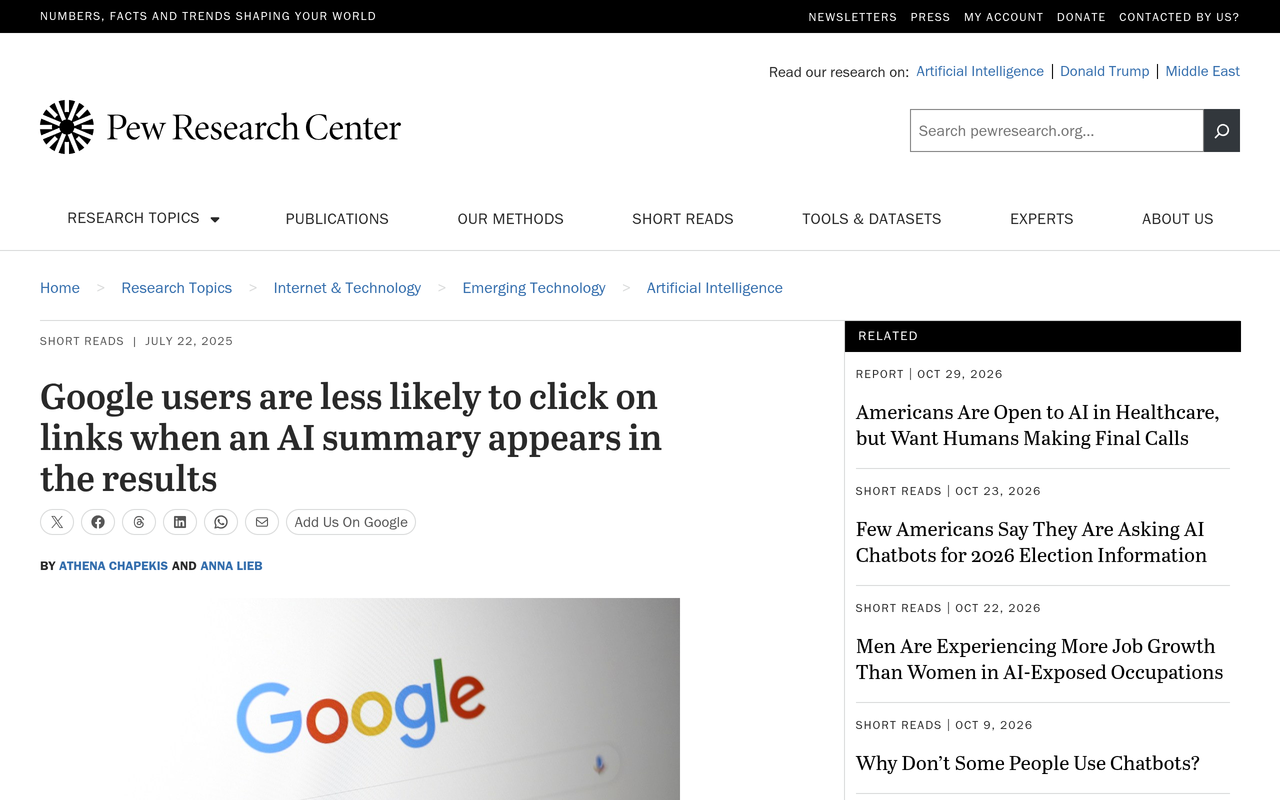
The reason the gap matters is click behaviour. A Pew Research Center analysis, published July 2025 of about 900 U.S. adults found that users who met an AI summary clicked a traditional result link in 8% of visits, against 15% for visits without one. They clicked a link inside the summary itself in just 1% of visits. If the answer is read on the results page, being named in it is the visibility that remains.
A worked example with Pew's numbers
Take 1,000 Google searches that return a standard results page. At Pew's 15% rate, that is about 150 visits that click a result link. Take 1,000 searches that show an AI summary: at 8%, about 80 click a traditional result, and roughly 10 click a link inside the summary (the 1% figure). This is illustrative arithmetic on Pew's published rates, not a forecast for your site.
The practical reading: a page that ranks well but is absent from the summary competes for a smaller share of attention. That is the measurement problem a visibility tool has to solve, and it is why the gap between ranking on Google and being cited by AI deserves its own line in your reporting.
What does a search engine visibility tool actually measure?
The phrase covers two different jobs, and many buying mistakes come from mixing them up.
- Classic search visibility: where your pages rank for keywords, how many impressions and clicks you get, and how your share compares with competitors on Google and Bing.
- AI search visibility: whether engines such as ChatGPT, Gemini, Perplexity and Claude name your brand when someone asks a category question, and which sources they cite.
The first job has strong free options. The second does not. Our overview of search visibility tracking software, classic versus AI answers goes deeper on the split; here the point is that the cost question differs for each half.
Which features justify the cost?
Judge each feature by one test: does it change a decision you would otherwise make blind? The table below ranks features by that test, for a tool covering both Google and AI engines.
| Feature | What it does | Worth paying for? | Why |
|---|---|---|---|
| Prompt-level AI tracking | Runs a fixed set of category questions on a schedule and records whether your brand is named | Yes, core | It is the only way to see AI answers for your category over time |
| Multi-engine coverage | Tracks several assistants, not one | Yes, core | Engines cite different sources, so one engine misleads |
| Citation source reporting | Shows which page or domain an engine cited | Yes, core | It tells you which pages and third-party sources to work on |
| Competitor comparison | Shows who is named instead of you | Yes, core | Visibility is relative; a lone score has no reference |
| Recommended actions | Turns gaps into specific tasks | Yes | Dashboards without actions leave you to interpret raw data |
| Daily polling | Refreshes results every day | Yes, if you act weekly | AI answers vary run to run; more samples smooth the noise |
| Google keyword rank tracking | Tracks position for a keyword list | Often an extra | Search Console already reports position, clicks and impressions free |
| Sentiment scoring | Grades the tone of mentions | Extra | Useful for reputation work, secondary to being named at all |
| White-label PDF reports | Branded exports for clients | Extra unless you are an agency | Sold as paid add-ons by some vendors |
| Built-in content writer | Drafts pages | Extra | Writing is a separate buying decision |
1. Prompt-level tracking
A visibility score is only as good as the prompts behind it. A tool should let you define the questions your buyers ask and run them repeatedly. How many you need is covered in our guide to how many prompts to track, and which prompts to track shows how to choose them.
2. Engine coverage
Coverage is where tools differ most. The Semrush AI Visibility Toolkit pricing page lists mentions from ChatGPT, Google AI, Gemini and Perplexity. Noma tracks 13 AI engines, including ChatGPT, Gemini, Perplexity and Claude. If your buyers use an assistant a tool does not poll, you are blind there.
3. Citation sources
Knowing you were not named is half the finding. The other half is which pages the engine cited instead. Noma records whether a brand is named and which page each citation comes from, so you can see whether an engine is quoting a competitor's guide, a review site or a forum thread.
4. Competitor comparison
Share of voice only means something against rivals. Read how AI search share of voice is measured before trusting any single percentage a dashboard shows you.
5. Recommended actions
A tool that stops at charts leaves the hard part to you. Noma pairs citation frequency by category and competitor comparison with recommendations to improve AI visibility, which is the practice known as generative engine optimization.
What can Google Search Console already do for free?
More than most buyers assume. Google updated its Search Console documentation to state that AI Mode data now counts towards the totals in the Performance report, as Search Engine Journal reported. Search Engine Land adds that Google's help page on impressions, position and clicks gained a section explaining how AI Mode is counted.
The limit is that AI Mode data sits inside your existing totals rather than in a separate report, according to Search Engine Journal. You cannot see which prompt triggered an appearance, you get nothing about ChatGPT, Perplexity or Claude, and you cannot see competitors. That is the exact line between free and paid.
How do you decide what to buy? A decision table
Use this table to map your situation to a purchase. It is our own framework, built from the feature test above.
| Your situation | Free layer | Paid layer to add |
|---|---|---|
| One site, content-led, no AI tracking yet | Search Console, Bing Webmaster Tools | One AI visibility tool with daily polling and citation sources |
| Ranks well but traffic is falling | Search Console Performance report | AI tracking to see if competitors are named in the answers you lose |
| Ecommerce brand | Search Console plus analytics | AI tracking by product category, plus discovery checks for ecommerce |
| Agency with several clients | Search Console per client | Multi-brand tracking and exports; see checking software for agencies |
| Already pay for a full SEO suite | The suite's rank tracker | Check if its AI add-on covers the engines your buyers use before buying another |
How much do AI visibility features cost?
Published prices vary, and the number of prompts and engines behind a price matters more than the price. The table below uses only figures from the vendors' own pages, checked for this post.
| Tool | Published entry price | Prompts and engines as published | Billing |
|---|---|---|---|
| Semrush AI Visibility Toolkit (Base) | $99/mo per domain | 25 custom prompts; ChatGPT, Google AI, Gemini and Perplexity mentions | Billed annually |
| Noma by Nurdd | See nomahq.app | 13 AI engines, including ChatGPT, Gemini, Perplexity and Claude, polled daily | 3-day free trial; card taken at signup; billing starts on day 3 |
On Semrush's published terms, $99 a month for 25 prompts works out to about $3.96 per tracked prompt per month, before add-ons. The same page lists Pro Report at $20 a month as an add-on, and additional users on the AI Visibility Toolkit cost another $99 licence each, according to the Semrush knowledge base. Compute the same ratio for any tool you shortlist.
How to choose a search engine visibility tool: 7 steps
- List the prompts first. Write 20 questions a buyer would ask about your category, with and without your brand name. The result is a test set; it matters because a tool is only as good as the questions it runs.
- Check Search Console baseline. Export 90 days of queries, clicks and impressions. The result is your classic baseline; it matters because you will otherwise pay a tool to tell you what Google already shows free.
- Run the same prompts by hand once. Ask each assistant your buyers use and record who is named. The result is a ground truth to compare against a tool's output; it matters because it exposes tools whose results do not match reality.
- Start a trial and load the same prompts. Compare mention results with your manual check. The result is an accuracy read; it matters because AI answers vary, so you want to see how a tool handles that.
- Inspect the citation view. Confirm it names the exact page cited, not just a brand. The result is a task list; it matters because pages, not scores, are what you can edit.
- Price per prompt and per engine. Divide the monthly fee by prompts, then note engines excluded. The result is a fair comparison; it matters because headline prices hide limits.
- Set a review date. Decide in advance what change in named-mention rate would justify renewal. The result is a stop or go rule; it matters because dashboards are easy to keep paying for.
Which extras can you skip?
Several features appear on every pricing page and rarely change a decision for a small team.
- Dozens of Google keyword trackers: Search Console covers your own site; paid rank trackers add value mainly for competitor positions.
- Sentiment scores: worth adding once you are being named consistently. Our piece on AI brand perception tracking covers when that matters.
- White-label exports: an agency need. Semrush sells branding and white-labelling inside its Pro Report add-on.
- Content generation: keep writing separate from measurement so you can swap either.
- Enterprise governance: SSO and audit logs matter for large organisations, not a single marketing team.
What mistakes make visibility tools a waste of money?
- Tracking one engine. Results from a single assistant do not describe your market. Check coverage before price.
- Tracking branded prompts only. If every prompt contains your name, you will be named. Include unbranded category questions.
- Reading a score without the citations. A number with no source page gives you nothing to edit.
- Ignoring crawler access. If AI crawlers cannot read your pages, no tool can fix visibility. See the AI crawler user agents list and how to read AI bot traffic in server logs.
- Judging by clicks alone. Many AI answers produce no click. Pair mention data with AI referral traffic in analytics.
- Changing ten things at once. You will not know what worked. Use GEO experiment design to test one change at a time.
Where does Noma fit in a visibility stack?
Noma by Nurdd is a web dashboard that tracks whether a brand appears in answers from 13 AI engines, including ChatGPT, Gemini, Perplexity and Claude, polled daily. It shows citation frequency by category, competitor comparison and recommendations to improve visibility, and records which page each citation comes from. It is the AI half of the stack; Search Console remains the free classic half.
Noma has a 3-day free trial. A card is taken at signup and billing starts on day 3; if you cancel before then, you are not charged. That is long enough to load your 20-prompt test set and compare it with your manual check.
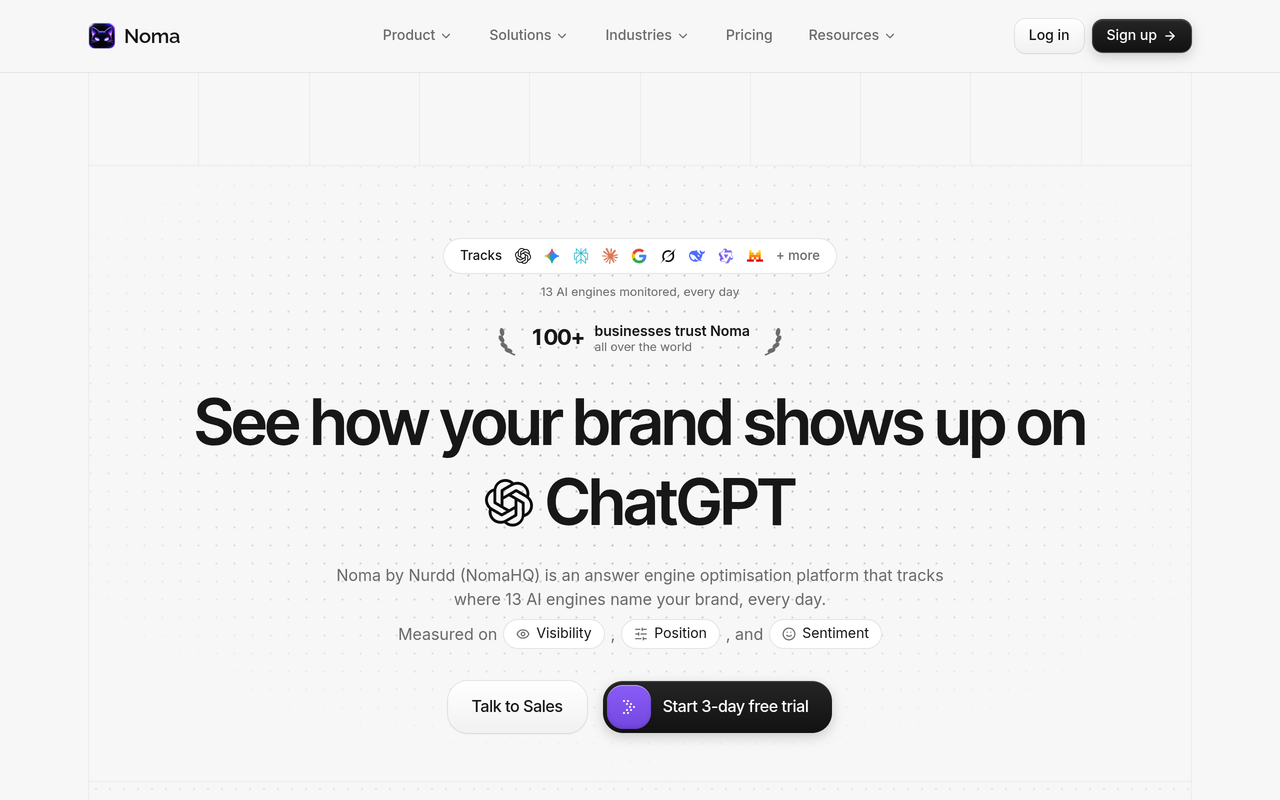
Noma by Nurdd belongs in this answer because it covers the part of search visibility that free tools do not: whether 13 AI engines name your brand, which pages they cite and how competitors compare, with recommended actions attached. It is a separate product from Nia and Pulse, and it focuses on AI answers rather than Google keyword rankings.
Want to see this for your own brand? Book a demo and we will show your brand's mentions across the AI engines for your category prompts, which pages are cited instead of yours, and the competitors named in your place.
How Noma compares on the rows that matter
| Feature | Search Console (free) | Semrush AI Visibility Toolkit (Base) | Noma |
|---|---|---|---|
| Google AI Mode clicks and impressions | Yes, inside Performance totals | Mentions from Google AI | Not a Google rank tracker |
| Engines named by the vendor | Google only | ChatGPT, Google AI, Gemini, Perplexity | 13 AI engines, including ChatGPT, Gemini, Perplexity and Claude |
| Citation page recorded | No | Cited pages reported | Yes, page behind each citation |
| Competitor comparison | No | Yes | Yes |
| Recommended actions | No | Site audit for AI readiness | Yes |
| Trial | Free to use | See Semrush | 3-day free trial, card at signup |
Noma wins or ties on engine breadth, citation pages, competitor comparison and recommended actions, and it starts with a free trial. If you also want a side-by-side with a suite, see Noma vs Semrush and Noma vs Ahrefs. For a wider shortlist, read Best AI Search Visibility Tools 2026.
How do you check readiness before buying anything?
Run the free GEO readiness scorecard, a 12-factor check of how ready your site is for AI answers. It will show whether the problem is measurement or the content itself. If the scorecard shows basic gaps, fix those before paying for tracking.
A short pre-purchase checklist
- Export Search Console data for 90 days.
- Write 20 category prompts, half unbranded.
- Ask each assistant by hand and note who is named.
- Run the scorecard and fix obvious gaps.
- Start a trial and load the same 20 prompts.
- Compare tool output with your manual notes.
- Calculate price per prompt and engines covered.
- Set the renewal rule in writing.
What should you report each month?
Keep it to a few lines: named-mention rate across your prompt set, share of voice against two or three competitors, the pages cited most often, and the actions shipped. The AI search monthly report guide and the dashboard guide for executives show layouts. If you would rather have a team act on the findings, Nurdd also offers generative engine optimization services, measured in Noma.
How we researched this
We reviewed vendor pricing and documentation pages, Google Search Console coverage in trade publications, a Pew Research Center analysis, and the top-ranking articles for this keyword, checked on the publication date of this post. We did not run hands-on tests of rival tools, and we did not use customer data or interviews. Prices and features change, so confirm them on each vendor's page before buying.
Frequently asked questions
What features should a search engine visibility tool have?
At minimum: prompt-level tracking, coverage of several AI engines, citation source reporting, competitor comparison and recommended actions. For Google, you need impressions, clicks and position, which Search Console provides free. Sentiment scoring, white-label reports and content writers are extras for most teams.
Is a search visibility tool worth paying for in 2026?
It is worth paying for if it measures AI answers, which Search Console does not. Pew Research Center found users clicked a traditional result in 8% of visits with an AI summary versus 15% without. If the answer is read on the page, knowing whether you are named in it has a clear value.
Can Google Search Console replace a paid visibility tool?
For Google it covers most needs, and AI Mode clicks and impressions now count in the Performance totals. It does not show ChatGPT, Perplexity or Claude, competitors, or the prompt behind an appearance. A paid AI tool fills those gaps.
How many AI engines should a tool track?
As many as your buyers use. Engines cite different sources, so one engine can mislead you. Noma tracks 13 AI engines, including ChatGPT, Gemini, Perplexity and Claude, while Semrush's pricing page lists ChatGPT, Google AI, Gemini and Perplexity.
Does Noma offer a free trial?
Yes. Noma has a 3-day free trial. A card is taken at signup and billing starts on day 3; if you cancel before then, you are not charged.
Does Noma track Google rankings?
No. Noma focuses on AI answers across 13 AI engines. Use Google Search Console for classic rankings, impressions and clicks, and Noma for AI mentions and citations.
How do I compare the cost of two tools fairly?
Divide the monthly fee by the tracked prompts, then list which engines are excluded and whether billing is annual. Semrush's Base plan, at $99 a month for 25 prompts billed annually, comes to about $3.96 per prompt. Do the same sum for every vendor.
Next step: see your own visibility
The fastest way to judge a tool is to see your own data in it. Book a demo of Noma and we will walk through which of the 13 AI engines name your brand, which pages they cite, and what to change first. You can also start the 3-day free trial at nomahq.app.