AI Search Visibility
Visibility in AI Search Engines: Track Citations Weekly
A weekly routine for checking your brand's visibility in AI search engines: the prompts, the log, the engines to compare and the fixes to queue.
 Sheetal Shakshi11 Nov 202615 min read
To check your brand's visibility in AI search engines, run a fixed set of category prompts on each engine once a week, and log whether your brand is named, where it ranks in the answer, which page is cited and which competitors appear. Weekly is the right rhythm for most teams, because answers vary run to run and a single check proves little. Noma by Nurdd automates the routine across 13 AI engines, including ChatGPT, Gemini, Perplexity and Claude.
To measure your visibility in AI search engines, run the same set of customer-style prompts on each engine every week, and record whether your brand is named, how prominently, which of your pages is cited and which competitors appear beside you. Compare the log week over week, not prompt by prompt. That is the whole routine, and the rest of this guide shows how to run it in about an hour, or hand it to software.
Key takeaways
- Fix your prompt set before you start. Changing prompts mid-routine makes week-over-week comparison meaningless.
- Log five things per prompt per engine: brand named or not, position in the answer, cited URL, competitors named, and the sentiment of the description.
- Check weekly. Daily checking mostly records noise, and monthly checking hides the effect of the changes you shipped.
- Compare engines separately. Each engine retrieves and cites differently, so a blended score can hide a gap on one engine.
- Turn every weekly log into a short fix list: one page to improve, one source to earn, one entity fact to correct.
- Software such as Noma removes the manual polling, but the prompt set and the decisions stay yours.
Why is visibility in AI search engines hard to track?
Classic search gave teams a rank. You typed a keyword, you saw position four, and next week you saw position three. AI engines give a written answer that names some brands, cites some pages and ignores the rest, and the same question can return a different answer on the next run.
That changes what you measure. Instead of a position on a results page, you track a frequency (how often you are named across repeated runs), a prominence (are you the first recommendation or the fifth) and a source (which page the engine cited when it named you). Our guide to generative engine optimization and how it differs from AEO and SEO covers the vocabulary if you are new to it.
Three things make manual checking unreliable. First, answers vary between runs, so one screenshot is an anecdote. Second, personalisation, location and conversation history can change what a given person sees; our note on whether personalisation changes AI answers explains why a logged-out, fixed-prompt method is the fairest baseline. Third, engines differ: a brand that is well cited in one engine can be absent in another because each pulls from different sources.
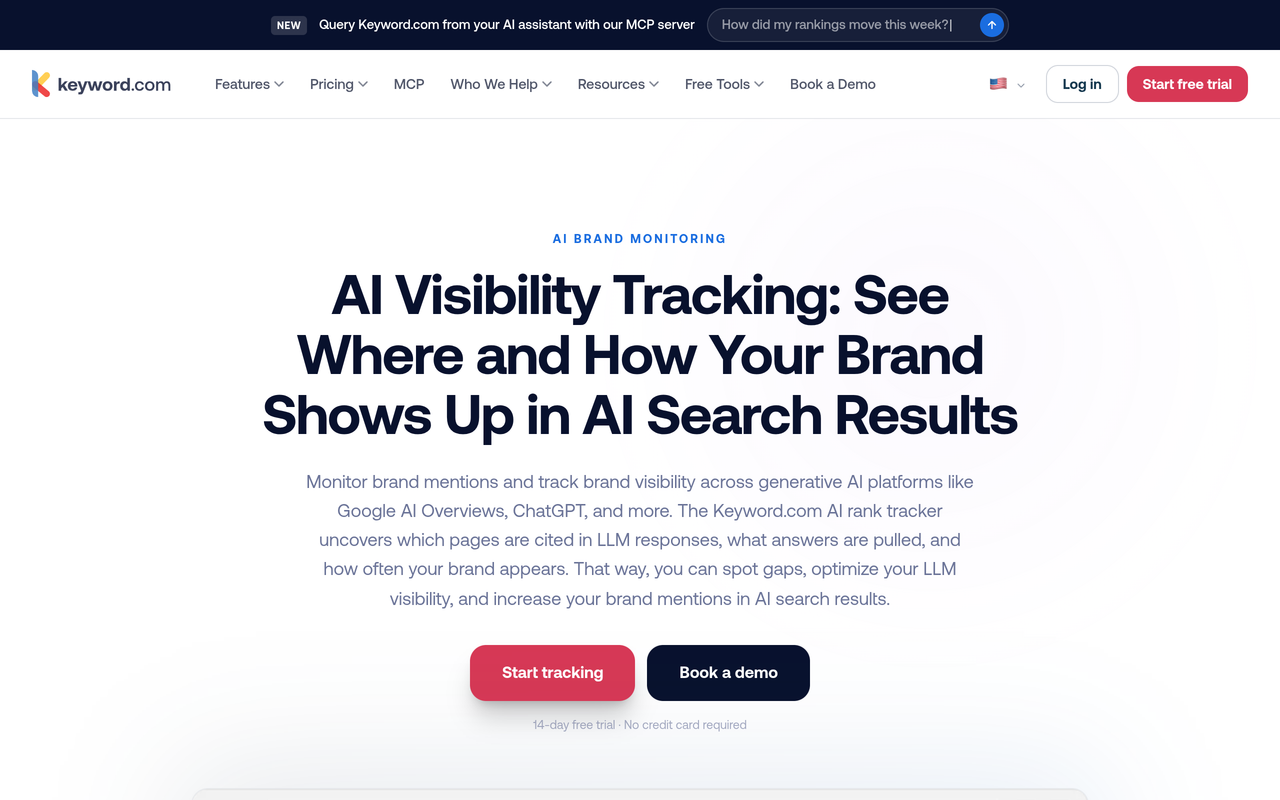
Vendors of AI visibility tools describe the same job in similar terms. The product page of Keyword.com, retrieved November 2026, says its tracker shows which pages are cited in LLM responses, what answers are pulled and how often a brand appears. That is a useful summary of the three things worth logging: pages, answers and frequency.
What is the quick answer to checking AI search visibility?
Pick 20 to 30 prompts a buyer would ask. Run each on every engine you care about, logged out, once a week, on the same day. Record named or not, position, cited URL, competitors and sentiment. Compare to last week. Fix the biggest gap. Repeat.
A weekly AI visibility routine has four parts: a fixed prompt set, a fixed log, a fixed day, and a fix list that ends every session. Skipping any one of them turns tracking into screenshot collecting.
The steps below turn that into a procedure, with a log template, an engine comparison table and a worked example of the arithmetic.
How do I check my brand's visibility in AI search engines, step by step?
Step 1: Build a fixed prompt set of 20 to 30 prompts
Action: Write prompts in three groups: category discovery ("best [category] for [use case]"), comparison ("[your brand] vs [competitor]") and brand questions ("is [your brand] good for [use case]"). Save them in a sheet with an ID for each.
Result: You get a stable test set that can be re-run identically for months.
Why: Without a fixed set you cannot tell whether a change in visibility came from your work or from your wording. Our guides on which prompts to track and how many prompts you need go deeper on selection and volume.
Step 2: Choose the engines to compare
Action: List the engines your buyers plausibly use. Start with ChatGPT, Gemini, Perplexity, Claude and Google's AI results, then add others that matter in your market.
Result: You have an engine column in your log, so every prompt is scored per engine rather than as one blended number.
Why: Engines retrieve from different sources and weigh them differently. Our comparison of Perplexity, ChatGPT and Gemini for brands shows why a result on one does not predict the others. Claude has its own check; see how to check if Claude names your brand.
Step 3: Run each prompt cleanly
Action: Use a logged-out or fresh session, no prior conversation, the same location setting, and run each prompt on the same weekday. Where an engine offers a web search mode, use it consistently and note which mode you used.
Result: Your answers are comparable from week to week.
Why: Conversation history and account memory are uncontrolled variables. Removing them makes the log a baseline instead of a personal view.
Step 4: Log five fields per prompt per engine
Action: Copy the answer into your sheet and fill in the fields in the table below.
Result: Each row becomes a countable data point, so you can compute rates instead of describing impressions.
Why: Free-text notes cannot be compared across weeks. Structured fields can.
| Field | What to record | Why it matters |
|---|---|---|
| Run date and engine | Date, engine name, mode (with or without web search) | Separates engine behaviour from model updates over time |
| Brand named | Yes or no | The base of your mention rate |
| Position | 1st, 2nd, 3rd or later in the list, or "mentioned in passing" | A fifth-place mention carries less weight than a first |
| Cited URL | Exact page the engine linked or named as a source | Shows which of your pages, or which third-party pages, do the work |
| Competitors named | Every other brand in the answer | Gives you share of voice and shows who you lose to |
| Description | One line on how the brand is described, plus positive, neutral or negative | Catches wrong facts and weak positioning, not just absence |
Step 5: Compute three rates per engine
Action: For each engine, calculate mention rate (prompts naming you divided by prompts run), first-position rate, and citation rate (prompts where one of your own pages is cited divided by prompts run).
Result: Three numbers per engine, which you can chart weekly.
Why: A brand can be named often but never cited (the engine knows of you through other sites) or cited often but listed last. The three rates separate those cases. Our piece on AI search share of voice shows how to extend this against competitors.
Step 6: Read the cited sources, not only the answers
Action: Sort the cited URLs by domain. Mark which are yours, which are competitors', and which are third parties such as review sites, forums and publications.
Result: A source map showing where engines get their information about your category.
Why: You can edit your own pages, but you can only influence third-party pages by earning coverage there. Knowing which third parties are cited tells you where that effort pays off. See also why AI engines trust some websites more than others.
Step 7: Write the fix list before you close the sheet
Action: Choose three actions: one owned page to rewrite or add, one third-party source to pursue, and one entity fact to correct (name, description, category, founding facts, profiles).
Result: Each weekly session ends with work that can be checked in next week's log.
Why: Tracking without action is reporting. The entity consistency checklist is a good source of the third action. To test whether a change worked, use the method in GEO experiment design.
Step 8: Report the trend, not the week
Action: Every four weeks, summarise the rates as a trend line per engine, with the changes you shipped marked on it.
Result: A report a manager can read in two minutes.
Why: Individual weeks wobble. Four or more points show direction. Our monthly AI search metrics report guide gives a layout.
Which AI engines should I compare, and what should I log for each?
Compare engines by how they get their answers, because that decides what you can influence. The table below is a decision aid, not a ranking: it states what to check on each engine type and where to look when you are absent. It makes no claim about any engine's market share.
| Engine type | Examples | What to log in addition to the five fields | First place to look if you are absent |
|---|---|---|---|
| Chat assistants with optional web search | ChatGPT, Claude | Whether web search was on, and whether a source list was shown | Whether your pages are crawlable by that provider's search bot, then third-party mentions |
| Search-native answer engines | Perplexity | The number and order of cited sources | Page-level clarity: does one page directly answer the prompt |
| Search-engine-integrated answers | Google AI Overviews, AI Mode, Gemini | Whether the answer appeared at all for the prompt | Your standard Google indexing, structured data and ranking for the topic |
For crawler access, our AI crawler user agents list shows which bots to allow or block. For Google's surfaces, see how to monitor Google AI Overviews without manual searches.
Why Claude deserves its own column
Claude is often left out of manual routines because teams default to ChatGPT. If your buyers are developers, analysts or writers, that is a blind spot. Log Claude as a separate engine, note whether web search was used on the run, and compare its named brands with the other engines. When Claude names a competitor that ChatGPT does not, the cited sources are the quickest explanation.
How often should I track brand mentions in ChatGPT and Gemini?
Track weekly for most brands. Daily runs mostly capture run-to-run variation, and monthly runs leave too few data points to see whether a change worked. Use the table to adjust the rhythm to your situation.
| Situation | Suggested cadence | Reason |
|---|---|---|
| Steady state, no major content changes | Weekly full log, monthly report | Enough points to see a trend without extra effort |
| You shipped a major page, schema or PR change | Weekly, with the changed pages' prompts flagged | You need to see the effect within a month |
| Product launch or campaign period | Twice weekly for brand-question prompts | Descriptions of a new product can shift quickly and need monitoring for errors |
| Small team, manual process | Weekly with 15 to 20 prompts on the three engines that matter most | Keeps the routine under about an hour |
| Agency with many clients | Automated daily polling, weekly review | Manual logging does not scale; see AI search reporting for agencies |
If you want a structured four-week version of the manual method, our 4-week ChatGPT test plan sets one out.
What does a worked example of the weekly maths look like?
The numbers below are an illustration of the arithmetic, not a result from any brand, study or Nurdd product. Suppose a team runs a 20-prompt set on one engine in week one, and logs the following.
- Prompts run: 20.
- Prompts that name the brand: 6, so the mention rate is 6 divided by 20, or 30%.
- Prompts where the brand is listed first: 2, so the first-position rate is 10%.
- Prompts where one of the brand's own pages is cited: 3, so the citation rate is 15%.
The gap between 30% mentions and 15% citations says the engine knows the brand from other sources but rarely uses the brand's own pages. The fix list then targets a page that answers the highest-value missed prompt directly. In week two, the team re-runs the same 20 prompts, and the only question is whether those three rates moved. If the citation rate rises and the mention rate holds, the page change is the likely cause, though you should keep logging to see whether it persists.
What are the common mistakes when tracking AI search visibility?
- Changing prompts every week. New prompts reset your baseline. Add new prompts as a separate group instead.
- Treating one run as the answer. Engines vary between runs. Judge by rates across the whole prompt set.
- Blending engines into one score. A gap on one engine disappears inside an average. Report per engine first.
- Counting mentions without reading descriptions. Being named with an outdated or wrong fact is worse than being absent, so log the description.
- Ignoring the sources. The cited pages tell you what to fix. Without them you only know that you lost.
- Tracking only branded prompts. Brand questions measure awareness. Category prompts measure whether new buyers find you.
- Skipping traffic. Mentions are a leading indicator; referral sessions confirm they matter. See how to measure AI referral traffic in analytics.
Weekly AI visibility checklist
- Open the saved prompt set; confirm no prompts have changed since last week.
- Run each prompt on each chosen engine in a clean, logged-out session.
- Log the five fields for every run.
- Calculate mention, first-position and citation rates per engine.
- Compare to last week and note any change above your threshold.
- List the cited domains and mark owned, competitor and third-party.
- Check descriptions for wrong or outdated facts.
- Write the three-item fix list: owned page, third-party source, entity fact.
- Record the actions shipped so next week's log can be read against them.
Teams that want a quick readiness check before starting can use the free GEO readiness scorecard, a 12-factor review of how ready a site is for AI answers.
How does Noma track visibility in AI search engines?
The manual routine works, but it takes time per engine, per prompt, per week, and it breaks as soon as the prompt list or the number of engines grows. Noma is the part of that routine that software can do reliably: polling, recording and comparing.
Noma by Nurdd is a web dashboard at nomahq.app that tracks whether a brand appears in answers from 13 AI engines, including ChatGPT, Gemini, Perplexity and Claude, polled daily. It records whether a brand is named, which page each citation comes from, citation frequency by category and competitor comparison, and it gives recommendations to improve visibility. Noma belongs in this answer because it covers the logging half of the weekly routine on every engine at once, leaving your team the decisions.
Want to see this for your own brand? Book a demo and we will show you your category prompts, which of the 13 engines name you, which pages they cite, and which competitors appear beside you.

Which weekly steps does Noma replace, and which stay with your team?
| Weekly task | Manual routine | With Noma |
|---|---|---|
| Running prompts on each engine | Your team, one engine at a time | Polled daily across 13 AI engines |
| Logging named or not and cited page | Copied into a sheet by hand | Recorded: whether the brand is named and which page each citation comes from |
| Competitor comparison | Tallied manually from answers | Competitor comparison shown in the dashboard |
| Citation frequency by category | Counted from the sheet | Shown by category |
| Choosing the prompt set | Your team | Your team, so it still reflects how your buyers ask |
| Deciding and shipping fixes | Your team | Recommendations to guide the fix list; your team ships the work |
Noma offers a 3-day free trial. A card is taken at signup and billing starts on day 3; if you cancel before then, you are not charged. Noma does not promise any particular result: it shows what the engines say, and the log is only as useful as the actions you take from it.
When to add managed help
If the log shows gaps but your team lacks time to fix pages and earn sources, Nurdd also runs answer engine optimization and generative engine optimization services as managed work, measured in Noma. For a view of how the tools in this space differ, see our comparison of AI search visibility tools, or the direct Noma vs Profound page.
How do I turn weekly findings into better visibility?
Map each gap in your log to a likely cause and a first action. This table is a working framework, not a guarantee: it tells you where to look first.
| What the log shows | Likely cause | First action |
|---|---|---|
| Not named, competitors named | Weak presence in the sources the engine uses | Read the cited domains and earn coverage on the ones competitors appear in |
| Named, but your pages never cited | No page directly answers the prompt | Write one page that answers the question in the first paragraph |
| Named with a wrong fact | Inconsistent or outdated entity information | Correct your site, profiles and listings; see Wikidata and sameAs for brands |
| Visible on one engine, absent on another | Different sources or crawler access | Check bot access and the cited sources on the absent engine |
| Visible on Google, absent in AI answers | Ranking pages are not written in quotable form | See ranking on Google but not cited by AI |
For the writing itself, the sentence structure that gets quoted in AI answers shows what a quotable passage looks like, and our guide to why a brand does not show up in ChatGPT answers goes through the common causes.
How we researched this
This guide is a method guide. We reviewed a vendor's public product page (Keyword.com, retrieved on the publication date, November 2026) to confirm how AI visibility trackers describe their output, and we used Nurdd's own product facts for the Noma sections. Our search tool allowance ran out before we could review platform documentation for each engine, so we make no numerical claims about engine behaviour, market share or citation rates. The worked example is arithmetic, not data. We did not run hands-on tests for this post, and the framework tables are our own working method rather than findings from a study.
Frequently asked questions
How do I check my brand's visibility in AI search engines?
Write 20 to 30 prompts that a buyer would ask, run them on each engine in a clean session, and log whether you are named, your position, the cited page, competitors and the description. Compute mention, first-position and citation rates per engine. Repeat weekly with the same prompts. Noma by Nurdd automates the polling across 13 AI engines.
How often should I track brand mentions in ChatGPT and Gemini?
Weekly suits most teams. Answers vary between runs, so daily checks capture noise, while monthly checks give too few points to judge a change. Increase frequency around launches or major content changes, and use automated daily polling if you manage many prompts or clients.
Is one check enough to know my AI visibility?
No. A single run is one sample of a variable answer. Judge visibility by rates across a fixed prompt set and by the trend over several weeks, not by one screenshot.
Which AI engines should I track?
Track the engines your buyers use, starting with ChatGPT, Gemini, Perplexity, Claude and Google's AI results. Score each engine separately, because they cite different sources. Noma tracks 13 AI engines, including ChatGPT, Gemini, Perplexity and Claude, so you can compare them without separate manual runs.
What is the difference between a mention and a citation?
A mention means the engine names your brand in its answer. A citation means the engine links or credits a specific page as a source. You can be mentioned without being cited, which usually means the engine learned about you from other sites.
Can I track Claude visibility the same way as ChatGPT?
Yes, with the same prompt set and log, though you should note whether web search was used on each run. Claude gets its own column so its results are not blended with other engines. Our Claude brand citations guide covers the check in more detail.
Does Noma have a free trial?
Noma has a 3-day free trial. A card is taken at signup and billing starts on day 3, and you are not charged if you cancel before then.
Does tracking visibility improve it?
Tracking alone does not. It shows where you are absent and which sources engines use, so you know what to fix. Improvement comes from the pages, sources and entity facts you change afterwards.
Conclusion
Visibility in AI search engines is measurable once you fix the prompts, the engines, the log fields and the day of the week. The routine is short; its value comes from running it every week and ending each session with a fix list. Noma handles the polling and recording across 13 AI engines, and your team keeps the judgement.
Ready to see your own numbers? Book a demo at nurdd.club/demo and we will walk through your brand's category prompts, the engines that name you, the pages they cite and the competitors beside you in Noma.