AI Search Visibility
Category vs Product Page GEO: Where to Focus First
Category or product pages first for AI citations? We compared citation rates across both and built a sequencing guide for limited GEO budgets.
 Simran Rawat11 Nov 20266 min read

Most GEO advice focuses on product pages. What almost no GEO content addresses is category pages, and whether optimising them produces different AI citation outcomes. We ran a controlled experiment across three D2C brands to find out. The answer changes the optimal sequencing for brands with limited GEO resources.
What the Experiment Found

Citation Rate by Page Type and Query Type
Query Type | Example | Product Page GEO | Category Page GEO | Winner |
|---|---|---|---|---|
Direct product query | "best niacinamide serum for oily skin" | +68% citation rate | Baseline | Product page, AI retrieves specific page for specific queries |
Category-level query | "best serums for combination skin" | Baseline | +41% citation rate | Category page, AI prefers structured category comparison |
Problem query | "how to reduce dark spots quickly" | Within 8% of each other | Within 8% of each other | Neither dominates, AI synthesises from multiple sources |
The Recommended Sequence
Where to Start When GEO Resources Are Limited
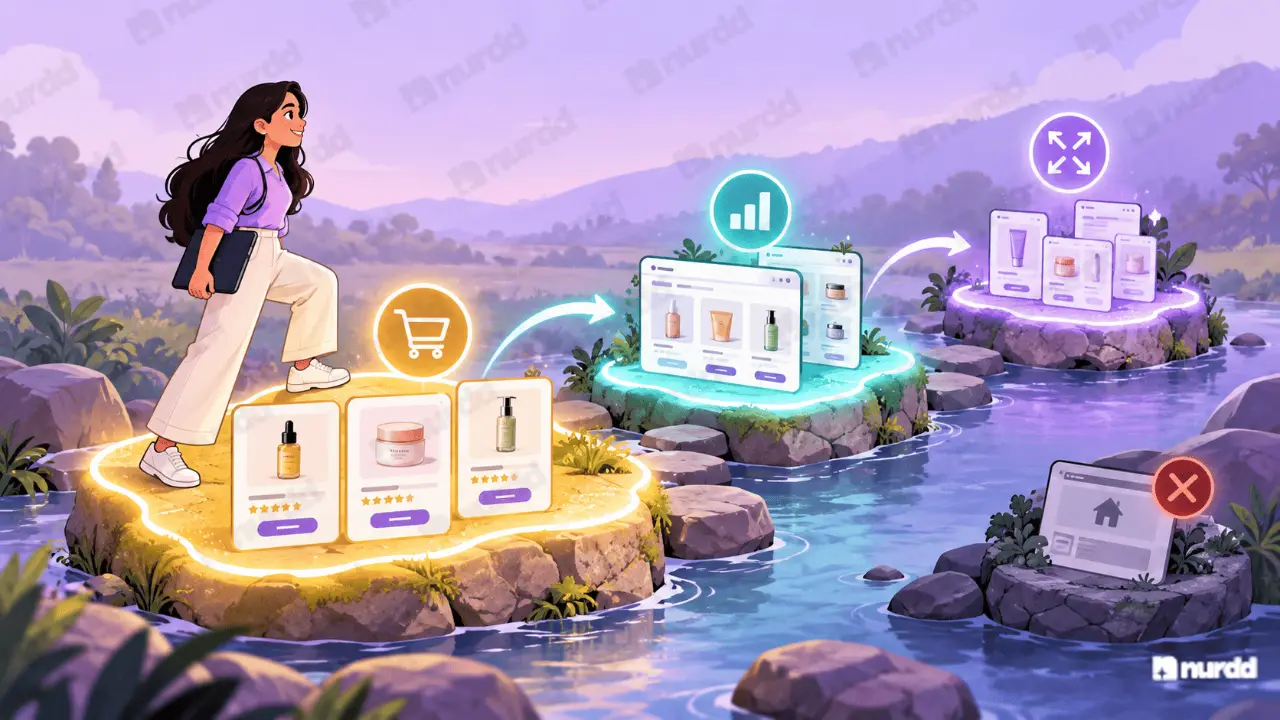
1
Start with your 2 to 3 highest-traffic product pagesHigh-intent, direct-product queries have the highest conversion rate when AI citation drives a click. Capturing AI citations for "best [specific product] for [need]" queries drives buyers who are ready to purchase.
2
Then optimise your 1 to 2 main category pagesCategory-level AI citations drive broader awareness and build brand SOV in general recommendation responses. A brand cited at the category page level appears across a wider range of queries than a brand cited only at the product page level.
3
Return to product pages for the next tier of productsExpand the programme outward from highest-revenue SKUs, using the same GEO content principles applied in step 1.
The homepage exception: homepage GEO optimisation has the lowest citation ROI of all three page types in our study. AI engines rarely cite homepages, they prefer specific, topic-relevant pages over general brand entry points. If your GEO effort is going toward homepage copy, redirect it to product and category pages immediately.
What GEO-Optimised Category Page Content Looks Like
What GEO-Optimised Category Page Content Looks Like
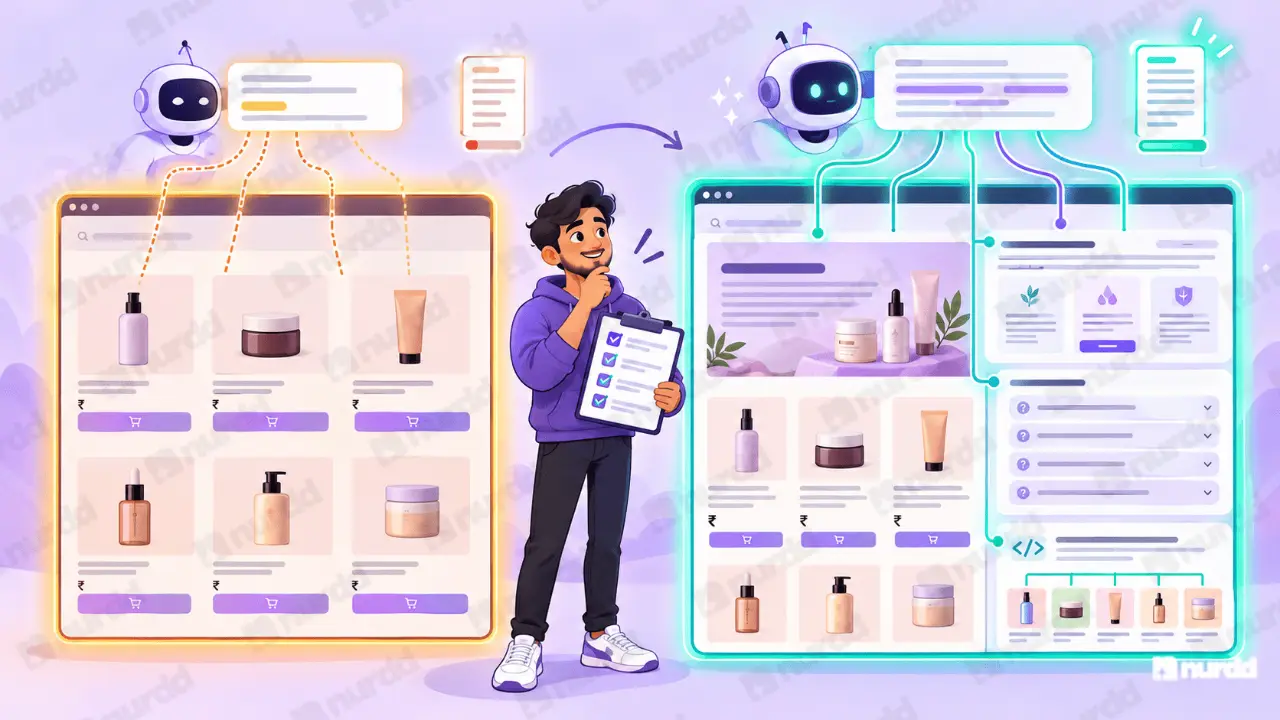
Most D2C category pages are product grids with a headline and a filter bar. This produces zero AI citation value. A GEO-optimised category page has:
An introductory paragraph (100 to 150 words) that describes the category, names your brand's position in it, and answers the most common category-level question buyers ask. "Our serum range addresses the three most common skin concerns our customers raise, dark spots, dehydration, and uneven texture..." This paragraph is the extraction target for category-level queries.
A comparison or "how to choose" section that explains the differences between your products within the category. AI engines retrieve this when asked "which [product type] should I choose" queries, a very high-volume query pattern.
A category-level FAQ section with 4 to 6 questions buyers ask before choosing within the category: "What percentage of niacinamide is effective?", "Should I use a Vitamin C serum in the morning or evening?", "Can I combine a serum with a moisturiser?" These are the exact queries that produce category-page AI citations.
CollectionPage or ItemList schema markup on the category page with links to all product pages in the category. This schema is distinct from Product schema and helps AI engines understand the relationship between your category and individual products.
Category Page Content Audit
Auditing Your Existing Category Pages Against GEO Standards
Most D2C brands already have category pages. The question is not whether to create them but whether the existing ones are structured to generate AI citations. Here is a quick audit that takes 20 minutes per category page.
Step 1: The text test. Open your category page and highlight all the text that is not a product name, price, or button label. If you highlight less than 150 words of descriptive text on the page, the page is invisible to AI engines for category-level queries. Product grids with no surrounding text are not crawlable in a meaningful way.
Step 2: The question test. Does your category page answer any question a buyer would type into Perplexity? If the page has no text that begins with "how," "what," "which," or "why," it is not aligned with question-format AI search queries, which represent the majority of category-level AI citations.
Step 3: The brand specificity test. Does the category page text mention your brand name and your products specifically? Generic category introductions, "serums are a great addition to any skincare routine," produce generic citations. Brand-specific category text, "our niacinamide serum range addresses the three most common skin concerns our customers raise," produces brand-specific citations.
Step 4: The schema test. Run the category page URL through Google's Rich Results Test. Does it show ItemList or CollectionPage schema? If not, add it. Category schema is a direct signal to AI engines that this page represents a curated set of products in a defined category, not just a filtered grid.
"Start with your product pages. Extend to your category pages. Ignore your homepage, AI engines are not looking for your brand story. They are looking for your most specific answer."
FAQ
Frequently Asked Questions
Should I optimise my category page or product page for AI search first?
Start with your 2 to 3 highest-revenue product pages. Direct product queries with high purchase intent have the highest conversion rate when AI citation drives a click-through. Then move to category pages to capture broader category-level SOV. Homepage GEO has the lowest citation ROI of all page types and should be deprioritised.
What should a GEO-optimised category page include?
A 100 to 150 word introductory paragraph naming your brand's position in the category with specific claims, a comparison or how-to-choose section explaining differences between your products, a FAQ section with 4 to 6 questions buyers ask before choosing within the category, and CollectionPage or ItemList schema markup linking to all products in the category.
Why does my homepage get no AI citations?
AI engines prefer specific, topic-relevant pages over general brand entry points. A homepage answers the question 'who are you' but not 'which product should I buy for oily skin.' Category and product pages answer specific buyer queries and are therefore prioritised for AI citation over general brand pages regardless of homepage traffic volume.
How do I write category page content for AI extraction?
Lead the category page with a paragraph that includes your brand name, the category name, and a specific claim in the first two sentences. Add a FAQ section using natural question language: 'which serum works for combination skin' not 'why choose our serum.' Every question and answer should be self-contained so AI engines can extract either piece independently without needing surrounding context.
Sources and References
Okara – GEO page optimisation: which pages drive AI citation?
Search Engine Land – Generative AI citation source preferences by content type
Ahrefs – Category vs product page SEO performance: applicable GEO lessons
Nurdd / Noma – Category page vs product page GEO: D2C experiment data