AI Search Visibility
Profound vs Semrush for AI Visibility: How to Decide
Profound vs Semrush for AI visibility: a buyer's decision path on engines, prompts, pricing structure and crawler data, plus a manual test for any dashboard.
 Simran Rawat10 Nov 202613 min read
Profound is a platform built around answer engines, while Semrush adds AI visibility reports to an SEO suite. Choose by engine coverage, prompt allowance, cadence and how focused you want your AI search tracking to be. Noma by Nurdd is the focused option, tracking 13 AI engines with a 3-day free trial.
Profound vs Semrush for AI visibility comes down to scope: Profound is a platform built around answer engines, while Semrush adds AI visibility to an SEO suite. Choose by the engines you must cover, the prompts you need to track and how focused you want your reporting to be. Noma by Nurdd is the focused option, tracking 13 AI engines, including ChatGPT, Gemini, Perplexity and Claude.
Key takeaways
- Decide the job first: measuring AI answers as a discipline, or extending an SEO suite you already use. The two tools are built for different jobs.
- Engine count is the first hard filter. Semrush's own help page names five surfaces for its AI visibility reports: ChatGPT, Gemini, Google AI Mode, Google AI Overviews and Perplexity. Noma tracks 13 AI engines, including ChatGPT, Gemini, Perplexity and Claude.
- Compare what a plan lets you track (prompts, engines, competitors, refresh rate), not the headline price. Read each vendor's own pricing page on the day you buy, because plans change.
- Run the same 20 prompts by hand before trusting any dashboard. If a tool says you are absent and a manual check says otherwise, you have a tracking gap.
- Crawler data shows whether AI bots can reach your pages, not whether engines name you. Treat it as a convenience, not a gate.
- Noma has a 3-day free trial, so you can test it against your own brand before committing.
This post gives a decision path, a method for comparing plan allowances and a manual test you can run on any dashboard.
What is the real difference between Profound and Semrush for AI visibility?
The difference is where AI visibility sits in the product. Semrush's AI visibility features page describes reports that live inside a wider suite and share a prompt database, keyword work and Position Tracking. Profound's platform page describes a product organised around answer engines, from monitoring to agents that help produce content.
That framing matters because buyers often ask which tool has more features. The better question is which tool produces data your team will act on every week for AI search specifically. If you are new to the discipline, start with our explainer on generative engine optimization versus AEO and SEO.
What does Semrush actually offer for AI visibility?
Semrush's AI visibility features page (checked November 2026) lists a set of reports. Visibility Overview gives a baseline across ChatGPT, Gemini, Google AI Mode and Google AI Overviews, powered by the Semrush Prompt Database. Competitor Research compares your AI visibility against up to four competitors at once.
Brand Performance tracks share of voice and sentiment. According to the same page, Semrush generates synthetic prompts from your domain and location, mixing branded and non-branded queries. It then analyzes responses across Google AI Overviews, AI Mode, ChatGPT, Perplexity and Gemini, with reports updating weekly. Position Tracking is the daily view that puts SEO keywords and AI prompts in one dashboard.
The same page also describes Site Audit checks for whether AI crawlers, such as ChatGPT-User, PerplexityBot and Claude-User, are blocked from your site. Semrush's getting started guide adds that Visibility Overview returns an AI Visibility Score from 0 to 100, plus a distribution by LLM and mentions by country. Prompt Research is described as keyword research for the AI era, with an estimated AI Topic Volume.
What this means for a buyer
Semrush's AI reports are one module in a large product. The engine list for its reports does not name Claude, so a team that needs Claude coverage in reporting should ask Semrush directly. The weekly cadence on Brand Performance also differs from daily polling, which matters when you are testing content changes.
What does Profound actually offer?
Profound's platform page (checked November 2026) groups its product into monitoring and an AI marketer layer. Monitoring includes Answer Engine Insights, Prompt Volumes, Shopping and Agent Analytics. The AI marketer layer includes Agents, Context Manager and AI Marketer.
Profound describes Agent Analytics, on its Agent Analytics page, as showing how AI crawlers access and interpret your content. Profound's engine list, refresh rate and plan limits are on its own pricing and product pages, so read them there rather than from a third-party summary.
How do Profound and Semrush compare side by side?
The table below uses only the vendors' own pages, checked in November 2026. Where a vendor page does not state a fact, the cell says to confirm it with the vendor instead of guessing.
| Dimension | Profound | Semrush | Noma by Nurdd |
|---|---|---|---|
| Product type | Platform built around answer engines | SEO suite with AI visibility reports | Focused AI search visibility dashboard |
| Engines named | Confirm on Profound's pricing page | ChatGPT, Gemini, Google AI Mode, Google AI Overviews, Perplexity | 13 AI engines, including ChatGPT, Gemini, Perplexity and Claude |
| Cadence | Confirm with Profound | Weekly Brand Performance; daily Position Tracking | Polled daily |
| Prompt source | Prompt Volumes module plus your own prompts | Prompt Database plus synthetic prompts | Your category questions, tracked by citation frequency |
| Crawler analytics | Agent Analytics, described as showing how AI crawlers access and interpret your content | Site Audit checks whether AI crawlers are blocked, per Semrush's AI visibility features page | Noma measures whether engines name your brand |
| Competitor view | See Profound's platform page | Up to four competitors in Competitor Research | Competitor comparison by category |
| Trial | See Profound's pricing page | See Semrush's pricing page | 3-day free trial; card taken at signup, billing starts on day 3 |
Two rows deserve comment. On engines, Noma's 13 is a larger named list than the five on Semrush's help page, but more engines only help if you act on them. On trials, Noma's card-at-signup, cancel-before-day-3 structure is simple to state, but three days is short, so prepare your prompt list before you start.
How do prompt data sources differ, and does it matter?
It matters because the prompts you track decide what a dashboard can ever show. Semrush's help pages describe a prompt database and synthetic prompts generated from your domain and location. Profound's platform page describes a Prompt Volumes module aimed at showing which questions people ask answer engines.
Each approach has a limit. A vendor-generated list scales across categories but reflects the vendor's assumptions. Hand-picked prompts reflect your buyers' real questions but reflect your own assumptions too. The safest start is questions your sales team hears, checked against whatever prompt research the tool offers.
- Volume-based discovery: useful for finding prompts in a category you do not yet know well.
- Synthetic prompts: fast to set up, but check they match how buyers actually phrase questions.
- Custom prompts: the only way to track your exact buyer questions.
How should you compare pricing without a stale table?
Compare structure first, numbers second. Plans at both vendors change, and a figure copied into a blog post is out of date the day the vendor edits its page. Read Profound's site and Semrush's own pricing page on the day you buy, and record the date next to every figure.
Noma does not publish a price in this post. It has a 3-day free trial; a card is taken at signup, billing starts on day 3, and there is no charge if you cancel before then. Start at nomahq.app.
Pricing questions to put to every vendor
- How many prompts does the plan track, and can you choose them?
- How many engines does that plan cover, not the top plan?
- How often does each report refresh?
- How many competitors or brands can you add?
- Is AI visibility a separate add-on, or bundled into an SEO suite price?
- What happens at the end of the trial, and is a card required?
Worked example: the cost of a fair manual test
Before you pay anyone, price your own validation. Take 20 prompts and run them in 3 engines: that is 60 checks per day. Repeat on 3 different days and you have 180 observations to compare against any dashboard.
Now divide each vendor's plan price by the prompt-and-engine pairs it actually tracks on that plan. Use the figures from the vendor's own pricing page, dated. This gives a cost per observation, a fairer measure than a headline price, and the same method works for Noma once you see its limits in the trial. The figure ignores seats, exports and crawler analytics, so treat it as one input.
If you are unsure how many prompts you need, our guides on how many prompts to track and which prompts to track give a starting list.
How to decide: a six-question decision path
Work through these questions in order. Stop at the first row where the answer is decisive.
| Question | If yes | If no |
|---|---|---|
| 1. Do you need wide engine coverage, such as Claude alongside Google surfaces? | Shortlist a tool built for wide coverage, such as Noma (13 engines) | Go to question 2 |
| 2. Is AI search a goal in its own right, with its own report? | Choose a focused tracker such as Noma, where every screen is about AI answers | Go to question 3 |
| 3. Do you need daily readings to test content changes? | Confirm cadence for the exact report you will use; Semrush Brand Performance is weekly, while Noma polls daily | Go to question 4 |
| 4. Do you need data on whether AI crawlers can reach your pages? | Check Profound Agent Analytics, Semrush Site Audit's blocked-crawler checks, or your own server logs | Go to question 5 |
| 5. Do you want to test before talking to sales? | Prefer a tool with a trial you can run now, such as Noma's 3-day free trial | Request quotes from both vendors |
| 6. Will you act on every engine you pay for? | Pay for it | Reduce to the engines your buyers use |
Question 4 deserves its own treatment. Crawler data tells you whether AI bots can reach your pages, not whether engines name your brand, which is what Noma measures. Our guides to AI bot traffic in server logs and the AI crawler user agents list show how to check this yourself.
What should you look for in an AI visibility tool besides an SEO suite?
Seven criteria separate a tracker from a suite module. Use them as a scorecard for any vendor, including the ones in this post.
- Engine coverage: the number and names of engines per plan, not per top-tier plan.
- Prompt allowance and ownership: whether you set the prompts or the tool generates them.
- Cadence: daily, weekly or on demand, per report.
- Citation source detail: which page each citation came from, so you know what to fix.
- Competitor comparison: side-by-side by category, with the number of competitors allowed.
- Recommendations: concrete actions, not only charts.
- Trial terms: length, card requirement and what is included.
For a longer vendor list, see our comparison of AI search visibility tools and the vendor questionnaire.
An AI visibility tool is worth its price only if its numbers survive a manual check. Run twenty of your own prompts by hand first, then compare what the dashboard reports.
How can you test either tool before you buy?
Run a repeatable test rather than trusting a demo. Follow these steps in order.
- Write 20 prompts your buyers would ask, split between category questions and brand questions.
- Run each prompt by hand in the three or four engines your buyers use, and record whether your brand is named and which sources are cited.
- Load the same 20 prompts into each trial.
- Compare mention results. Note every disagreement between your manual record and the dashboard.
- Repeat on three different days. Answers vary between runs, so one day proves little.
- Check the citation detail. Can you see which page was cited and open it?
- Write down the action the tool suggested and whether your team could ship it within a week.
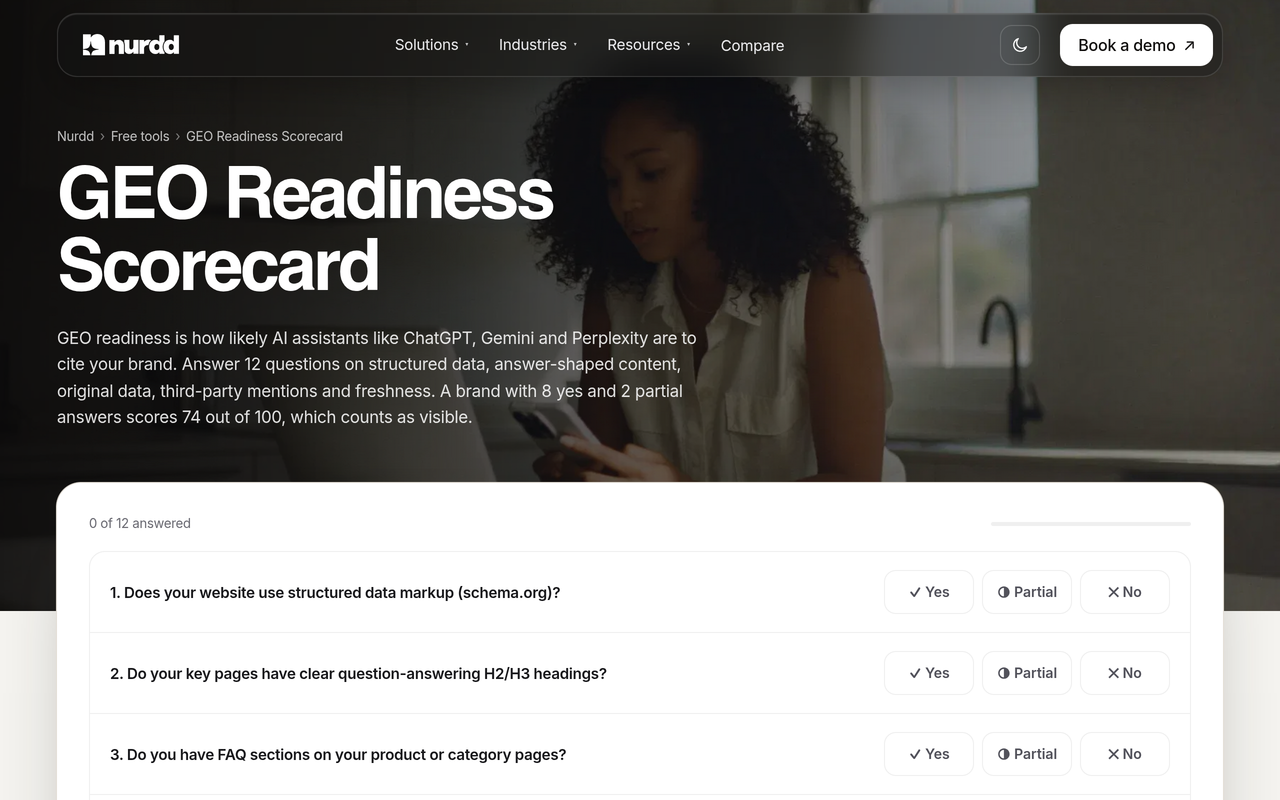
For a structured version of this test over several weeks, see our GEO experiment design guide and the four-week ChatGPT test plan. A free starting point is the GEO readiness scorecard, a 12-factor check of how ready your site is for AI answers.
Which tool suits which role? Three scenarios
An ecommerce marketing lead
An ecommerce lead wants to know whether shoppers asking ChatGPT or Perplexity for product recommendations see the brand. Engine coverage and citation detail matter more than backlink data. A focused tracker such as Noma fits, and our guide to ecommerce GEO tools lists what else to check. Profound lists a Shopping feature on its platform page, so ask about it if SKU-level data matters to you.
A SaaS SEO manager
An SEO manager needs AI mentions reported alongside rankings. Semrush's Position Tracking puts keywords and AI prompts in one dashboard, per its help page. The manager should still test a focused tracker for broader engine coverage, and our AI search metrics vs SEO metrics guide explains how to report both together.
An agency lead with several clients
An agency needs one view per client brand, repeatable prompt sets and a monthly report. Check how each tool handles multiple brands before signing, using our guide to choosing a tool for multiple client brands and the agency reporting guide.
Where does Noma fit in this decision?
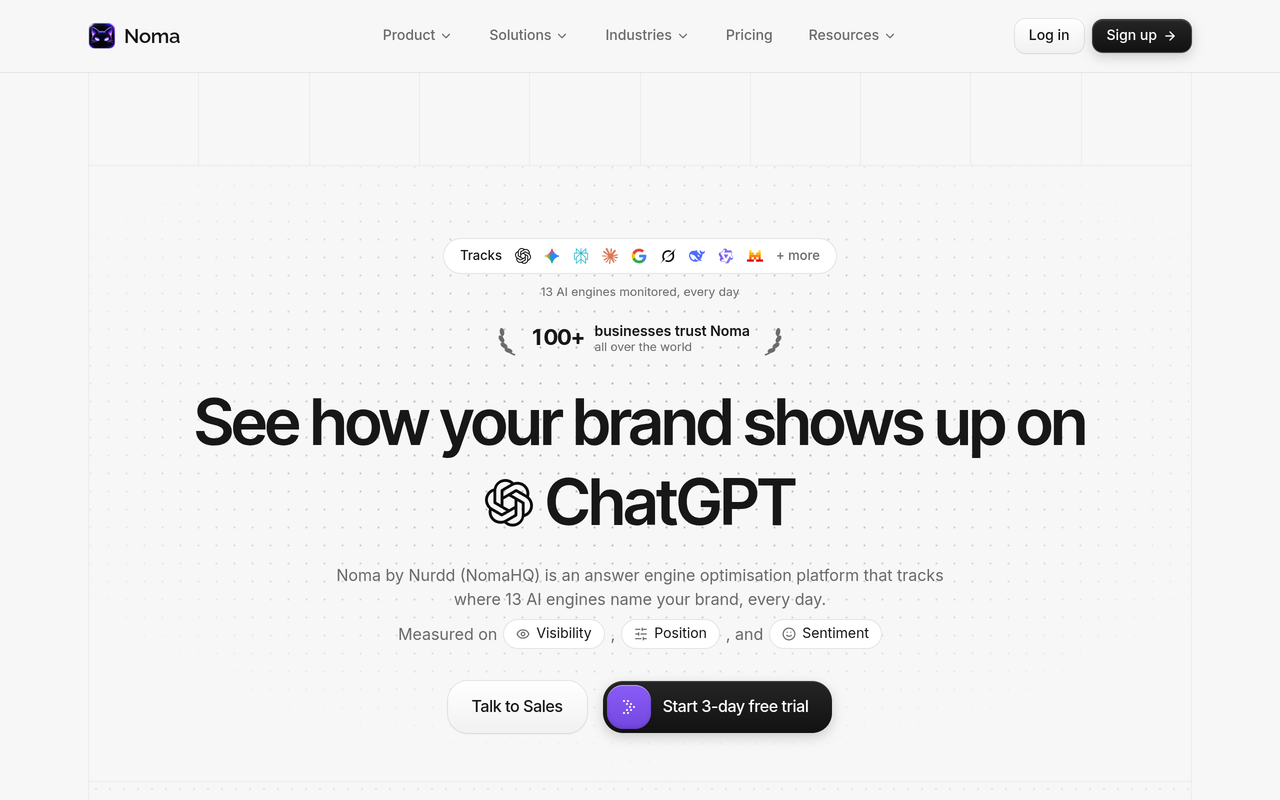
Noma by Nurdd is a web dashboard that tracks whether a brand appears in answers from 13 AI engines, including ChatGPT, Gemini, Perplexity and Claude, polled daily. It shows citation frequency by category, competitor comparison and recommendations for improving AI visibility. Noma belongs in this decision because it is built only to measure AI search visibility.
Book a demo at nurdd.club/demo to see your own brand's mentions and citations across the engines Noma tracks.
Rows where Noma wins or ties
- Engine coverage on one product: 13 engines, against the five surfaces named on Semrush's AI visibility help page.
- Daily polling: more frequent than the weekly update Semrush describes for Brand Performance.
- Focus: every screen answers one question, whether AI engines name your brand, rather than being one module in a larger suite.
- Low-friction trial: a 3-day free trial with a card taken at signup and billing from day 3, no charge if cancelled before.
Our pages for Noma vs Profound and Noma vs Semrush go row by row, and the explainer on traditional SEO tools and AI search covers the overlap.
What mistakes do buyers make when comparing these tools?
- Comparing plan names, not allowances. Starter, Growth and Pro mean different prompt and engine limits at each vendor.
- Trusting a stale pricing table. Vendors edit plans often, so use the vendor's own page and record the date.
- Buying engines nobody uses. Check your referral traffic and sales calls first; our guide to measuring AI referral traffic in analytics shows how.
- Ignoring reporting. A dashboard no one reads is wasted. See our guidance on building a monthly AI search report and measuring share of voice.
- Expecting the tool to fix visibility. A tracker measures; content and third-party sources change the result. Our generative engine optimization services do that work, measured in Noma.
Verdict: how should you choose?
If AI search is the problem you are paid to solve, a focused tracker is the cleaner purchase, and Noma is built for exactly that: 13 engines, daily polling and a 3-day free trial. Start the trial with your 20 prompts ready, and validate the dashboard with the manual test above before committing a budget.
Teams without a large budget can read our guide to AI search visibility tools for startups, and anyone weighing alternatives to Profound can see Profound alternatives.
Ready to see your own brand in AI answers?
Book a demo at nurdd.club/demo and see where your brand is named, which pages are cited and how competitors compare across 13 AI engines. You can also read how Nurdd works or start from nomahq.app.
How we researched this
We reviewed the public documentation and feature pages of Semrush and Profound, which are the only sources for rival facts in this post. They were checked in November 2026. We did not run hands-on tests of Profound or Semrush, and we have no customer data. Vendor pricing and engine lists change often, so confirm them on each vendor's own page before buying.
Frequently asked questions
Profound vs Semrush for AI search tracking, which is better?
Profound is built around answer engines, and Semrush adds AI visibility to an SEO suite. Compare them on engine coverage, prompt allowance and cadence. Noma by Nurdd is the focused alternative for AI search, tracking 13 AI engines polled daily.
Which engines does Semrush's AI visibility reporting cover?
Semrush's help page names ChatGPT, Gemini, Google AI Mode, Google AI Overviews and Perplexity. For anything beyond that list, ask Semrush directly. Noma tracks 13 AI engines, including ChatGPT, Gemini, Perplexity and Claude.
What should I look for in an AI visibility tool besides an SEO suite?
Look for engine coverage per plan, prompt allowance, daily versus weekly cadence, citation source detail, competitor comparison, recommendations and clear trial terms. Then test it against 20 prompts you ran by hand. The scorecard in this post lists all seven criteria.
Does Noma have a free trial?
Yes. Noma offers a 3-day free trial. A card is taken at signup and billing starts on day 3, and you are not charged if you cancel before then.
Can I use Semrush for SEO and a separate tool for AI visibility?
Yes. Some teams keep an SEO suite for keywords and audits and add a focused tracker for AI answers. Compare the combined cost with the prompt and engine allowance of any suite add-on, using each vendor's own pricing page.
Where do I find current Profound pricing?
Use Profound's own site and pricing page on the day you buy, and record the date. Plans and limits change, so a figure in a third-party article may be out of date.
How do I check that an AI visibility tool is accurate?
Run a fixed set of prompts by hand in the engines you care about and record whether your brand is named. Load the same prompts into the trial and compare across several days, because answers vary between runs. You can book a demo at nurdd.club/demo to look at Noma.