AI Search Visibility
Search Intelligence Tools: Classic SEO vs AI Answer Data
Search intelligence now covers rankings and AI answers. Learn which questions need which data, and whether you need an AI visibility tool beside your SEO suite.
 Sheetal Shakshi10 Nov 202614 min read

Search intelligence tools collect and analyse data on how a brand appears across search, historically Google rankings, traffic and backlinks, and now also AI answers. Rank data answers where your pages sit on a results page. AI answer data answers whether ChatGPT, Gemini, Perplexity or Claude name your brand, so most teams keep their SEO suite and add an AI visibility layer such as Noma.
Search intelligence tools are software that collects and analyses data about how a brand shows up in search, so a team can decide what to publish, fix or defend. In 2026 that covers two kinds of evidence: rank and traffic data from classic SEO suites, and AI answer data showing whether assistants such as ChatGPT, Gemini, Perplexity and Claude mention your brand. Most teams need both.
Key takeaways
- Search intelligence is a category, not a product. It now spans rank data (positions, clicks, backlinks) and AI answer data (mentions, citations, sentiment).
- Use rank data for questions about Google results pages. Use AI answer data for questions about whether an assistant recommends you.
- An SEO suite cannot fully replace an AI visibility tool, and an AI visibility tool does not replace an SEO suite. They answer different questions.
- Before buying anything, write down the ten decisions you need data for, then match each to rank data or AI answer data using the table below.
- Run the free GEO readiness scorecard first to see whether your site is ready for AI answers.
- Noma by Nurdd is built as the AI answer layer that sits beside the SEO suite you already pay for.
What are search intelligence tools?
The phrase has no single owner, and vendors use it differently. One enterprise vendor describes GrowByData search intelligence as an emerging concept that involves monitoring end-to-end SERP data, covering organic results, ads and AI. Another vendor, Topify, draws the line this way: traditional SEO tools track keyword rankings, backlinks and SERP performance on Google, while a modern search intelligence tool also covers AI answer visibility.
A working definition for this article: a search intelligence tool turns observations about search into decisions. The observation can be a ranking position, a click, a competitor's backlink, or a sentence an AI engine wrote about your brand. If it does not change what you do next, it is a report, not intelligence.
That definition matters because the category is splitting. The older half measures a list of ten blue links. The newer half measures an answer, which is a paragraph with a few brand names inside it. The two halves need different collection methods, different metrics and different owners inside a marketing team.
Why does search intelligence now need two kinds of data?
Because the results page changed. Pew Research Center, July 2025, analysed browsing data from 900 U.S. adults and found that 18% of Google searches in March 2025 produced an AI summary. Users who saw a summary clicked a traditional result link in 8% of visits, and they ended their browsing session on 26% of such pages, against 16% on pages with only traditional results.
Pew also found that longer, question-style searches triggered summaries more often, while just 8% of one- or two-word searches did. That is a useful split for planning: short head terms behave like classic search, and conversational queries behave like AI answers.
Seer Interactive reports that for queries where AI Overviews appear, organic click-through rate fell from 1.41% to 0.64% year over year. It also reports that organic CTR improved for queries where AI Overviews did not appear. Classic rank data still matters, but a position on its own no longer tells you how many visits you will get.
A ranking tells you where your page sits. An AI answer tells you whether your brand is part of the recommendation at all. Search intelligence in 2026 has to measure both.
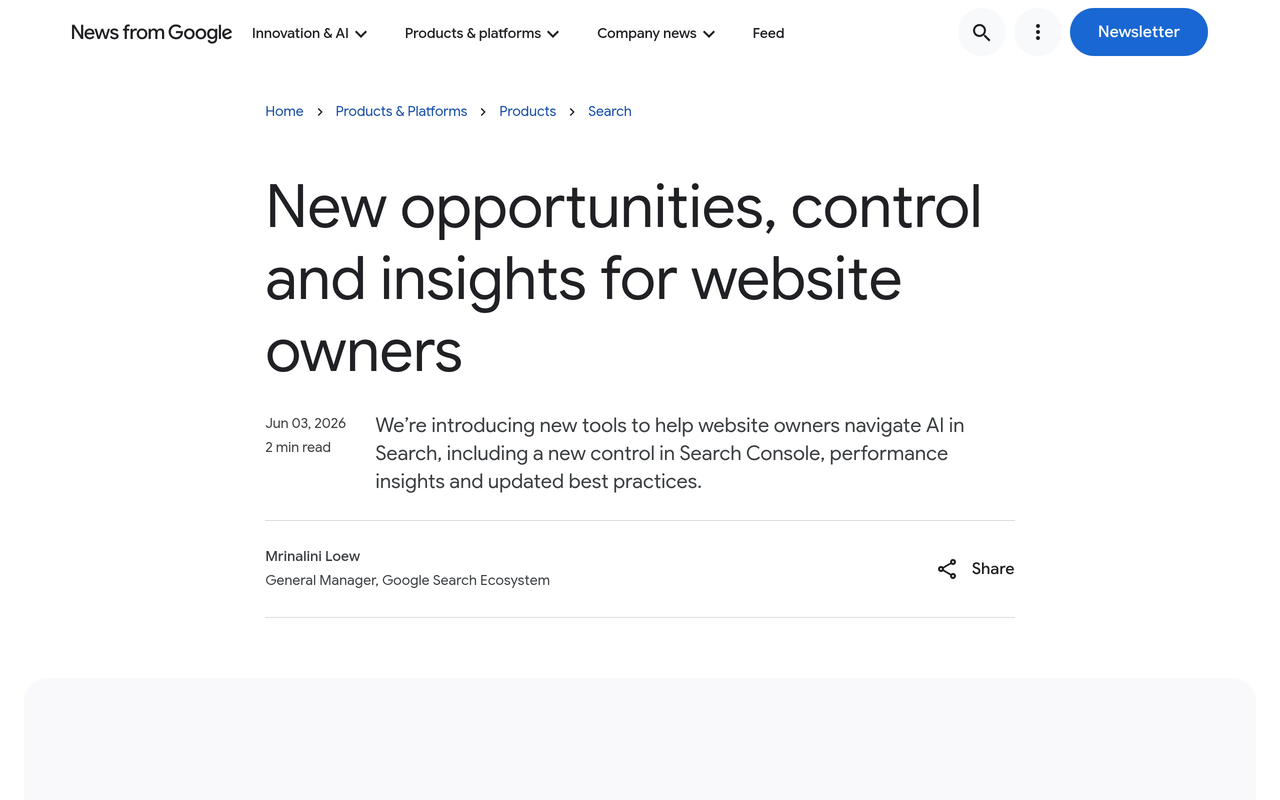
Google itself is pushing in the same direction. In a Google blog post on website-owner controls, the company says AI Overviews has over 2.5 billion monthly active users and AI Mode has surpassed one billion monthly users. It also describes a Search Console toggle that lets site owners decide whether their content helps ground its generative AI features.
Which questions need rank data, and which need AI answer data?
This is the decision most buyers skip. They compare feature lists before they know what they are trying to learn. The table below is an original framework: start with the question, then pick the data type.
| Question you are trying to answer | Data you need | Typical source |
|---|---|---|
| Which keywords do we rank for, and where? | Rank data | SEO suite, Google Search Console |
| Which pages lost clicks after a Google update? | Rank and click data | Google Search Console, SEO suite |
| Who links to our competitors but not to us? | Backlink data | SEO suite |
| Is our site crawlable and fast? | Technical audit data | SEO suite, crawler |
| Does ChatGPT name us when a buyer asks for the best option in our category? | AI answer data | AI visibility tool |
| Which competitors do Gemini and Perplexity recommend instead of us? | AI answer data | AI visibility tool |
| Which pages do AI engines cite when they mention us? | AI citation data | AI visibility tool |
| How much Google traffic comes through AI Overviews or AI Mode? | Google-reported AI data | Google Search Console |
| How do AI engines describe our brand? | AI answer data (perception) | AI visibility tool |
| Did a content change improve our AI mentions? | Before and after AI answer data | AI visibility tool, with a test plan |
Notice what the table implies. Roughly half the questions are classic and half are new, and no single data source answers both halves with the same method. A rank tracker polls a results page. An AI answer tracker asks assistants a set of prompts and records what they say.
What Google's own reports cover
Google Search Console is free and should be the baseline. CMSWire reports that Google has added reports covering AI Overviews and AI Mode in Search and generative AI features in Discover. The same article notes that AI Mode traffic blends into standard web search reporting and cannot be isolated cleanly, and that follow-up questions in AI Mode are treated as new queries.
That gap is the reason a separate AI answer layer exists. Search Console covers Google's surfaces only. It does not tell you what ChatGPT, Perplexity or Claude say about you, and it reports clicks and impressions rather than whether your brand was named in the text.
How do classic SEO suites and AI answer tools differ?
Both groups call themselves search intelligence now, so a side-by-side comparison of what each measures is more useful than their marketing. The table below uses public descriptions from the vendors' own pages where they exist.
| Dimension | Classic SEO suite | AI answer layer |
|---|---|---|
| Core unit | A keyword and its position | A prompt and the answer an engine gives |
| Main metrics | Rank, search volume, clicks, backlinks, crawl health | Mentions, citations, share of voice, sentiment |
| Surfaces covered | Google and other search engines | ChatGPT, Gemini, Perplexity, Claude and others |
| Stability of results | A position is relatively stable day to day | Answers vary between runs, so repeated polling matters |
| Typical action | Fix pages, build links, improve speed | Clarify entity facts, publish quotable answers, earn third-party citations |
| Owner on the team | SEO manager | SEO, content and brand teams together |
The "stability" row is the one buyers underestimate. A single AI answer is one sample from a probabilistic system, so a screenshot proves little. A useful tool polls the same prompts repeatedly and reports a rate, not an anecdote. Our guide to how many prompts to track and the prompt selection guide cover how to build that set.
Do the big SEO suites already include AI visibility?
Partly, and this is the honest answer to "do I need an AI visibility tool as well as an SEO suite?". The large suites have added modules. Semrush's help documentation describes an AI Visibility Toolkit with an AI Visibility Score from 0 to 100, a mentions and citations view, a distribution by LLM and a Prompt Research report that estimates AI Topic Volume. Ahrefs describes Brand Radar as an AI visibility tool that counts brand mentions across 6 AI platforms, alongside search demand and web and video visibility.
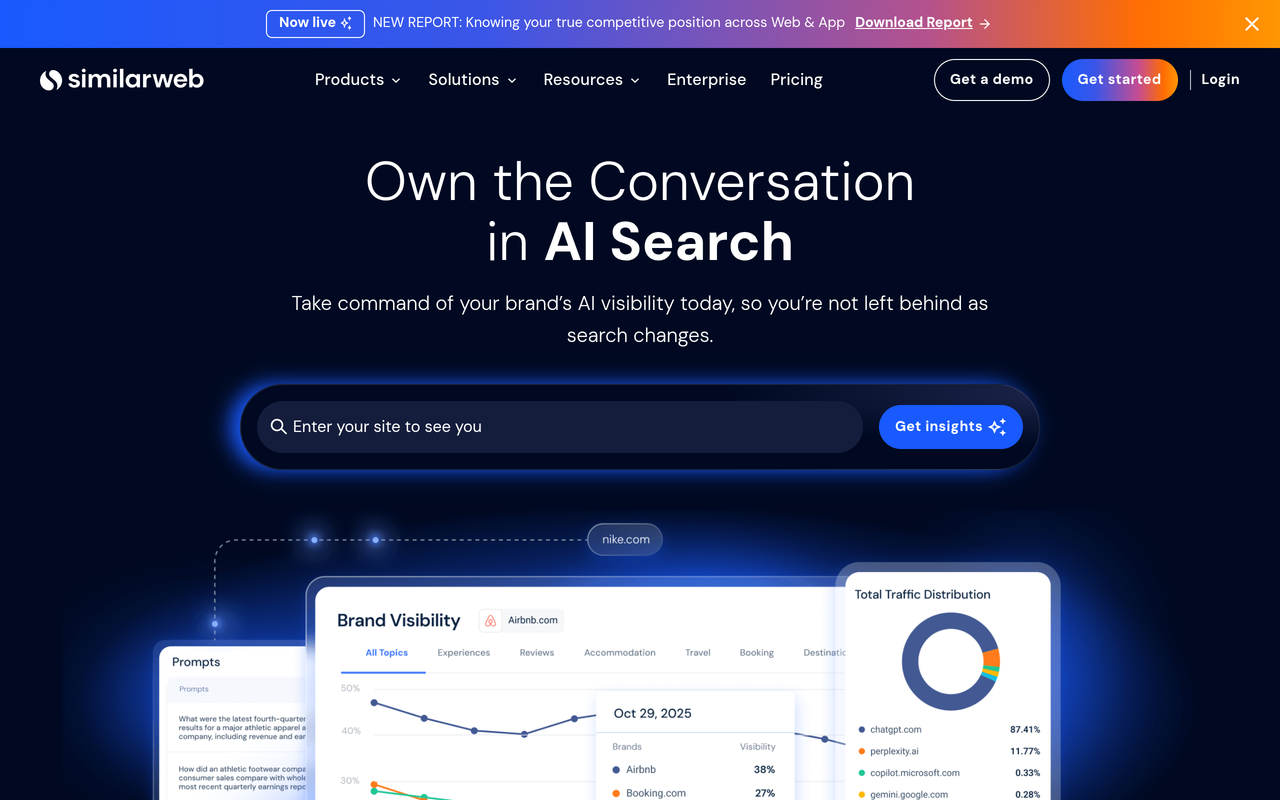
Similarweb also sells an AI layer. On its AI Search Intelligence page, the company says the package includes an AI Traffic module and an AI Brand Visibility module, with a stand-alone price of $99 and a second tier at $333 that adds its Competitive Intelligence, SEO and AEO suites. Those are the vendor's published figures as seen on the page; check the page for current terms.
So the choice is not "suite or AI tool". It is whether the AI module inside your existing suite answers the questions you wrote down. Three things to test:
- Engine coverage. Does it track the assistants your buyers actually use, or only two or three?
- Prompt control. Can you load your own category prompts, or do you depend on a vendor's prompt database?
- Action output. Does it tell you what to change on your site and which sources to earn, or only report a score?
If your suite's add-on passes all three, you may not need another tool. If it does not, or if the add-on is priced as a separate line anyway, a dedicated layer is easier to justify. Our Noma vs Semrush and Noma vs Ahrefs pages set out that comparison feature by feature.
How does Noma fit beside an SEO suite?
Noma by Nurdd is a web dashboard at nomahq.app that tracks whether a brand appears in answers from 13 AI engines, including ChatGPT, Gemini, Perplexity and Claude, polled daily. It shows citation frequency by category, a competitor comparison and recommendations for improving AI visibility. Noma belongs in a search intelligence stack as the AI answer layer: it answers "are we named, and by whom", while your existing suite keeps answering "where do we rank".
Want to see this for your own brand? Book a demo and we will show you which of the 13 engines name your brand today, which competitors they name instead, and which pages they cite.
Noma does not ask you to move off Semrush, Ahrefs or any other suite. It is meant to be used alongside them. Noma is the engine-by-engine view, and the suite remains the keyword, link and technical view. For a wider market view, see our comparison of AI search visibility tools.
Worked example: what the click data means for one page
Numbers from Seer Interactive's study give a concrete picture. This is arithmetic on a published figure, not a result from any customer.
- Take a page that earns 1,000 impressions a month on a query where an AI Overview appears.
- At the 1.41% organic CTR Seer reports for the earlier period, that is about 14 clicks (1,000 × 0.0141 = 14.1).
- At the 0.64% CTR Seer reports for the later period, that is about 6 clicks (1,000 × 0.0064 = 6.4).
- The page did not change and its position may not have moved, yet it lost more than half its clicks.
A rank tracker would show a flat line here. Search Console would show the click loss but not the cause. An AI answer tool shows what the Overview-style answers around that query say and whether your brand is inside them. That is the practical difference between rank data and AI answer data.
Seer also reports that being cited in an AI Overview is associated with better organic and paid CTRs than not being cited, which it describes as a brand effect. That is a reason to measure mentions directly rather than infer them from traffic.
How to build a search intelligence stack: a numbered checklist
- List your decisions. Write ten questions you need answered this quarter. Action: use the table above to tag each one "rank data" or "AI answer data". Result: a requirements list tied to decisions. Why: tools bought without a list tend to be used for dashboards, not decisions.
- Start with free data. Connect Google Search Console and review its AI reporting. Result: a baseline for Google clicks, impressions and AI feature performance. Why: it is first-party data and costs nothing.
- Audit AI readiness. Run the GEO readiness scorecard. Result: a 12-factor view of what stops AI engines from understanding your site. Why: tracking a brand that AI engines cannot describe only measures the problem.
- Write your prompt set. Draft 20 to 50 buyer questions across category, comparison and problem prompts. Result: a stable list you can poll weekly. Why: consistent prompts are what make before-and-after comparisons valid.
- Poll AI answers daily or weekly. Use a tool that records mentions, citations and competitors per engine. Result: a mention rate per engine, not one screenshot. Why: answers vary between runs.
- Compare against rank data. Put the AI mention rate next to your top-ranking pages. Result: a list of pages that rank but are not cited. Why: that gap is where the next fixes are. See ranking on Google but not cited by AI.
- Change one thing, then re-measure. Follow a GEO experiment design so a change can be tied to an effect.
- Report monthly. Put rank, traffic and AI answer metrics on one page. See how to build a monthly AI search metrics report.
What should an AI visibility tool measure?
Metrics are where tools diverge, and where reports mislead. The useful set is small.
- Mention rate: the share of polled prompts in which your brand is named.
- Citation source: which of your pages, or which third-party pages, the engine linked to.
- Share of voice: your mentions against named competitors for the same prompts. See AI search share of voice.
- Brand perception: how the engine describes you. See AI brand perception tracking.
- Referral traffic: visits that arrive from assistants, covered in AI referral traffic in analytics.
Be cautious with a single composite "visibility score". A score from 0 to 100 is easy to chart, but two vendors compute it differently, so it cannot be compared across tools. The underlying mention and citation counts are the numbers to trust and audit.
Which search intelligence setup fits which team?
| Team | Rank data | AI answer data | Practical setup |
|---|---|---|---|
| Ecommerce brand | Product and category pages in Google | "Best product for X" prompts in assistants | SEO suite plus Noma; see ecommerce |
| SaaS company | Comparison and integration keywords | Category and alternative prompts | SEO suite plus Noma; see SaaS and SaaS content for AI citations |
| Agency | Client rank reports | Client mention reports | One suite, one AI layer, monthly reporting; see AI search reporting for agencies |
| Startup with a small budget | Search Console only | A small prompt set | Free Google data plus one AI tool; see AI search visibility tools for startups |

What are the common mistakes when choosing search intelligence tools?
- Treating one screenshot as evidence. A single AI answer is one sample. Use repeated polling.
- Buying on feature count. Start from decisions, not from the longest feature list.
- Replacing rank data with AI data. Google still drives a large part of discovery, and Pew's figures show most searches did not produce an AI summary.
- Ignoring crawl access. If AI crawlers are blocked, no tool can help. Review the AI crawler user agents list and your server logs.
- Measuring without acting. A mention rate means little unless someone owns the fix. A GEO service or an in-house owner has to take the recommendations.
- Skipping entity basics. Inconsistent brand facts confuse engines. Use the entity consistency checklist.
How does Noma help once you have the data?
Noma by Nurdd records whether a brand is named across 13 AI engines and which page each citation comes from, then turns that into recommendations. The data is only the first step. Nurdd's answer engine optimization work then improves the site and content those engines read, and works to earn the third-party sources they cite, measured in Noma. You can also read how Nurdd works end to end.
Noma has a 3-day free trial. A card is taken at signup and billing starts on day 3, so you are not charged if you cancel before then. To see the same data on your brand with a walkthrough, book a demo and bring your five most important buyer questions.
How we researched this
We reviewed vendor documentation and product pages (Semrush, Ahrefs, Similarweb, GrowByData, Topify), Google's own announcement for website owners, research from Pew Research Center and Seer Interactive, and trade coverage of Google's Search Console AI reporting. All sources were checked on the publication date of this article. We did not run hands-on tests of competing tools, and we have no customer data to report. Figures are quoted as the sources state them, and vendor prices should be re-checked on the vendor's page.
Frequently asked questions
What are search intelligence tools?
Search intelligence tools collect and analyse data on how a brand appears in search so a team can make decisions. Traditionally that meant rankings, traffic and backlinks. In 2026 it also includes AI answer data, such as whether assistants name your brand and which pages they cite.
Do I need an AI visibility tool as well as an SEO suite?
Usually yes, unless your suite's AI module covers the engines, prompts and actions you need. An SEO suite answers where you rank. An AI visibility tool answers whether assistants recommend you. Test engine coverage, prompt control and action output before deciding.
Is Google Search Console enough for AI search?
No. Search Console reports on Google's AI Overviews and AI Mode, but according to CMSWire, AI Mode traffic blends into standard reporting and cannot be cleanly isolated. It does not cover ChatGPT, Perplexity or Claude, and it reports clicks rather than brand mentions.
What is the difference between SEO tools and AI search visibility tools?
SEO tools measure keywords, positions, links and technical health on search engines. AI search visibility tools measure prompts and the answers engines give, recording mentions, citations and competitors. The first tracks a ranked list, the second tracks a written answer.
Which AI engines should a search intelligence tool track?
At minimum, the assistants your buyers use for category questions. Noma tracks 13 AI engines, including ChatGPT, Gemini, Perplexity and Claude. Check that any tool you evaluate lists its engines and how often it polls them.
How often should AI answers be checked?
Often enough to see a rate rather than one result. Noma polls daily, and a weekly review of the trend is enough for most teams. Single manual checks are unreliable because answers vary between runs.
Does ranking on Google mean AI engines will mention my brand?
Not automatically. A page can rank well and still not be cited in an AI answer. Compare your top-ranking pages against your mention data to find the gaps, as described in our guide on ranking but not being cited.
Is Noma free?
Noma offers a 3-day free trial. A card is taken at signup and billing starts on day 3, with no charge if you cancel before then. Prices are in USD.
Next step: see your AI answer data
Rank data will keep telling you where you stand on Google. It will not tell you whether ChatGPT, Gemini, Perplexity or Claude recommend you. Book a demo of Noma and you will see, for your own brand, which engines name you, which competitors appear instead, and which pages are cited. You can also browse our free tools and blog to keep learning.