AI Search Visibility
AI Search Agency Pricing: What You Pay and What to Ask
Published AI search agency retainers run from about $1,500 to $50,000+ a month; here is what that buys, what software replaces and what to ask.
 Simran Rawat10 Nov 202616 min read
An AI search optimization agency typically costs $1,500 to $50,000 or more per month in 2026, while AI visibility tracking software runs from about $50 to $1,000 or more. Software such as Noma covers the measurement layer, and an agency still adds value in rewriting content and earning third-party mentions. Buy measurement first, then pay people only for the layers your team cannot staff.
An AI search optimization agency typically costs $1,500 to $50,000 or more per month in 2026, depending on business size and scope, while AI visibility tracking software runs from about $50 to $1,000 or more. That gap is the heart of ai search agency pricing: you are choosing between paying for people, measurement, or both.
This guide gives you the published price ranges, a four-layer cost model that shows which parts of an engagement software can replace, a worked budget example, and the questions to put in front of any agency before you sign. It was written for a buyer who has a budget to defend and needs to explain it.
Key takeaways
- Published agency retainers start around $1,500 to $3,000 a month for small brands and reach $25,000 to $50,000 or more for enterprise programmes, so ask what the retainer actually delivers before comparing numbers.
- Measurement is the cheapest layer. Software such as Noma covers tracking and competitor comparison, so you should not pay an agency retainer rate for dashboards.
- Agencies earn their fee on the layers software cannot do alone: writing and restructuring content, earning third-party mentions and managing change across a large site.
- The same monthly price can buy recommendations only or hands-on delivery. Put the split of responsibilities in writing.
- Start with software and a small diagnostic, then add an agency for the specific layers where your team lacks capacity.
- Set a renewal test in advance: which tracked prompts must name your brand, and from which pages, for the engagement to continue.
How much does an AI search optimization agency cost?
Three published pricing guides agree on the shape of the market, even where the figures differ. WebFX, October 2026 puts agency services at $1,500 to $50,000+ per month. Stackmatix, March 2026 gives a retainer band of $2,500 to $50,000+. Fuel Online, October 2026 starts its planning range at $2,500 a month for entry-level work and runs to $8,000 to $35,000 a month for broader programmes.
| Business size | WebFX range per month | Stackmatix range per month |
|---|---|---|
| Small business | $1,500 to $5,000 | $2,500 to $5,000 |
| Mid-sized | $5,000 to $25,000+ | $5,000 to $15,000 |
| Enterprise | $25,000 to $50,000+ | $15,000 to $50,000+ |
Source: WebFX, October 2026 and Stackmatix, March 2026. Both are agency-written guides, so treat them as planning ranges rather than quotes.
For prices agencies print on their own sites, LoudFace, November 2026 compiled 25 AI search agencies that publish a price. It reports that 24 of the 25 quote a monthly figure, that entry prices run from $590 a month to $50,000 or more, and that nine of the 25 floors sit between $3,000 and $3,500. The same table lists terms from cancel-anytime to 12-month commitments, which matters as much as the headline rate.
What do project and hourly fees look like?
Not every buyer needs a retainer. WebFX, October 2026 lists project work such as audits and migrations at $5,000 to $50,000 per project and hourly consulting at $50 to $300 per hour. Stackmatix, March 2026 breaks it down further: a GEO audit and strategy at $2,500 to $7,500 one-time, schema markup implementation at $1,500 to $5,000 one-time, and AI citation monitoring and reporting at $1,000 to $3,000 a month.
That last line is the one to circle. If an agency quotes a monitoring and reporting line of $1,000 to $3,000 a month, you are paying a services rate for something software now does daily. The rest of this guide shows how to separate that line from the work that genuinely needs people.
What drives the spread in AI search agency pricing?
Five factors explain most of the difference between a $1,500 and a $25,000 quote. None of them is the agency's brand name, which is why comparing headline numbers is misleading.
- Scope of prompts and engines. Tracking and optimising for two engines on 30 prompts is a different job from 13 engines on several hundred.
- Site size and content volume. WebFX, October 2026 names website size, number of pages to create or optimise, and competition as cost drivers.
- Implementation responsibility. Recommendations delivered as a document cost less than a team that edits your pages.
- Off-site work. Earning mentions on the third-party sources AI engines cite takes outreach and relationships, which is slow, human work.
- Contract terms. A six-month minimum at $3,000 a month is an $18,000 commitment, whatever the sales page says about flexibility.
Fuel Online makes the implementation point directly: its direct-answer box says the same monthly price can buy recommendations only or hands-on delivery, so confirm that distinction first (Fuel Online, October 2026). That is why this guide treats scope as a line-by-line question.
How much does AI search tracking software cost?
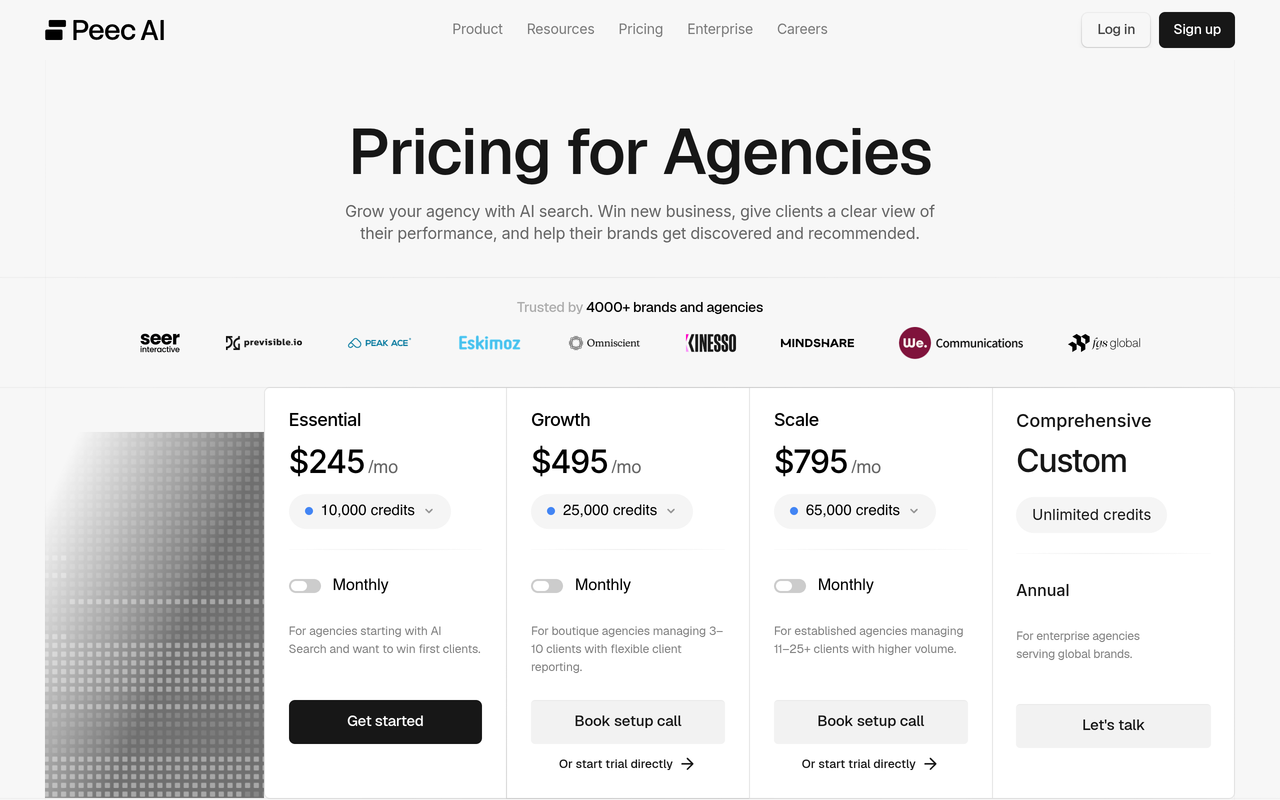
Software is priced on prompts, engines and tracking frequency. WebFX, October 2026 says AI visibility tracking software ranges from $50 to $1,000+ per month depending on how many prompts and platforms you track. Peec AI publishes its agency plans, which give a concrete example of how credits translate into coverage.
| Peec AI agency plan | Price per month | Credits | Prompts at the sample configuration |
|---|---|---|---|
| Essential | $245 | 10,000 | 111 prompts, tracked daily |
| Growth | $495 | 25,000 | 277 prompts, tracked daily |
| Scale | $795 | 65,000 | Higher volume, for 11 to 25+ clients |
Source: Peec AI agency pricing page, checked November 2026. Peec AI states that one prompt on one model for one day costs one credit, so one prompt on one model for a month is 30 credits.
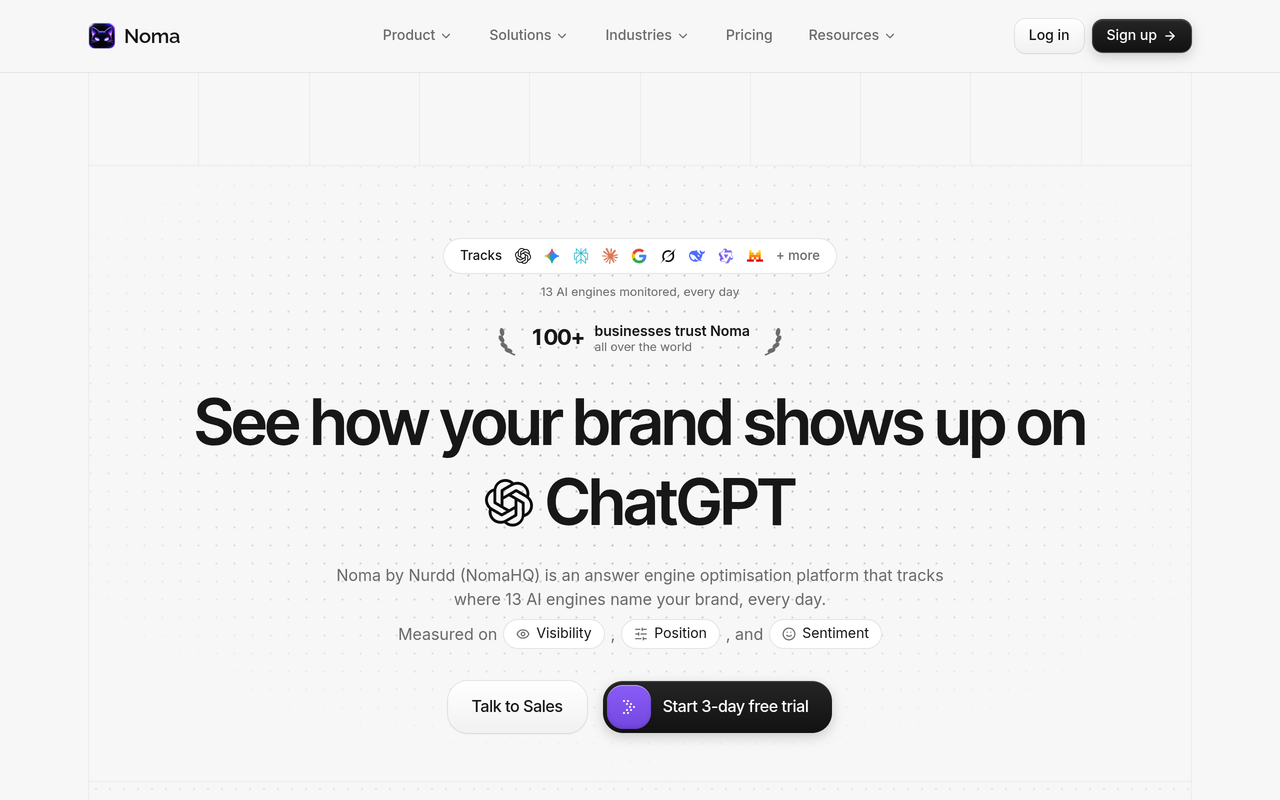
Noma by Nurdd sits in the same software category. Noma tracks 13 AI engines, including ChatGPT, Gemini, Perplexity and Claude, polled daily, and shows citation frequency by category, competitor comparison and recommended actions. It offers a 3-day free trial: a card is taken at signup, billing starts on day 3, and you are not charged if you cancel before then. Current plan prices are on nomahq.app, and the Peec AI pricing vs Noma comparison sets the two side by side.
Which parts of AI search work can software replace, and which still need an agency?
The most useful way to compare retainers and tools is to stop treating AI search work as one thing. This guide uses a four-layer cost model: Measure, Diagnose, Produce and Earn. Each layer has a different cost curve and a different answer to the agency-or-software question.
| Layer | What it covers | Software such as Noma | Agency retainer |
|---|---|---|---|
| 1. Measure | Daily tracking of whether your brand is named, which pages are cited, share of voice against competitors | Replaces this line. Noma polls 13 AI engines daily and records citations | Not worth a services rate |
| 2. Diagnose | Working out why a competitor is named and you are not | Noma gives recommendations; a human review adds judgement on priorities | Adds value at the start and at each quarterly review |
| 3. Produce | Rewriting pages, adding evidence, structuring answers, fixing technical access | Points to the pages and gaps, but does not write for you | Core agency value if your team lacks writers or developers |
| 4. Earn | Getting named on the third-party sources AI engines cite | Shows which sources are cited | Core agency value: outreach, partnerships, digital PR |
Noma replaces the Measure layer and informs the Diagnose layer. Noma does not write your content or run outreach, and it would be misleading to suggest otherwise. An agency still adds value on layers three and four, where the work is editing, publishing and relationship-building.
This split lines up with how agencies describe their own bundles. WebFX, October 2026 describes a GEO budget as covering visibility tracking, content and technical optimisation, and the third-party mentions that get a brand cited. Three of those four items are labour; only tracking is a software line.
Should you hire an agency or buy a tool for AI search visibility?
Use the table below as a decision aid. Find the row that matches your situation and read across to the recommended starting point.
| Your situation | Start with | Why |
|---|---|---|
| You do not know whether AI engines name you at all | Software only | A trial answers the question within days, for a fraction of a retainer |
| You have in-house writers and an SEO lead | Software plus a one-off audit | Your team can execute, and an audit sets priorities |
| You have a small team and a large site | Software plus a scoped agency project | The agency covers the Produce layer while you keep measurement |
| Competitors are cited on third-party sites you are absent from | Software plus an agency for the Earn layer | Outreach is slow, human work that tools do not do |
| You manage many client brands | Multi-brand software | Reporting scales with software, not headcount |
| You need results explained to a board monthly | Software dashboard plus managed reporting | Gives you numbers you own and a person to interpret them |
The pattern is that software is almost always the first purchase, because it is cheap and it creates the baseline any agency should be judged against. An agency hired without a baseline has no way to prove it moved anything. The agency versus in-house tooling comparison covers the same trade-off from the hiring side.
What does a worked budget look like?
Here is an example built only from the published figures above. It is an illustration of arithmetic, not a forecast, and it uses no Noma price because you should read that on the pricing page.
Scenario A: agency retainer that bundles monitoring. A small brand takes a retainer at the Stackmatix small-business band of $2,500 to $5,000 a month. Over 12 months that is $30,000 to $60,000 (Stackmatix, March 2026). If the proposal includes a monitoring and reporting line at the same source's $1,000 to $3,000 a month, that line alone is $12,000 to $36,000 a year.
Scenario B: software for measurement, agency for a project. The same brand tracks prompts with software. At Peec AI's published Essential and Growth plans, tracking costs $245 to $495 a month, or $2,940 to $5,940 a year (Peec AI agency pricing page, checked November 2026). It then buys a one-off GEO audit and strategy at $2,500 to $7,500 and schema implementation at $1,500 to $5,000 (Stackmatix, March 2026).
| Line item | Scenario A (12 months) | Scenario B (12 months) |
|---|---|---|
| Retainer | $30,000 to $60,000 | None |
| Tracking software | Included in retainer | $2,940 to $5,940 |
| Audit and strategy | Included in retainer | $2,500 to $7,500 |
| Schema implementation | Included in retainer | $1,500 to $5,000 |
| Total | $30,000 to $60,000 | $6,940 to $18,440 |
Scenario B leaves out ongoing content production and outreach, which Scenario A may include. The comparison is therefore not like for like until you add the Produce and Earn work Scenario B still needs, either as internal time or a scoped agency add-on. What it shows is how much of a bundled retainer is attributable to layers you could buy separately. Use the marketing budget planner to place the result next to your other channels.
How to budget for AI search in six steps
1. Establish a baseline before you talk to any agency
Action: run the GEO readiness scorecard and start a trial of an AI visibility tracker with 20 to 30 buyer questions. Result: you know whether you are named, where, and against whom. Why: an agency proposal without a baseline cannot be tested, and the baseline costs almost nothing.
2. Choose your tracked prompts deliberately
Action: pick prompts that match how customers ask category, comparison and problem questions, using the guide to which prompts to track. Result: a prompt set that maps to revenue, not curiosity. Why: software pricing scales with prompts, so a tight set controls cost, and the prompt-count guide shows how many you need.
3. Fix the basics that cost nothing
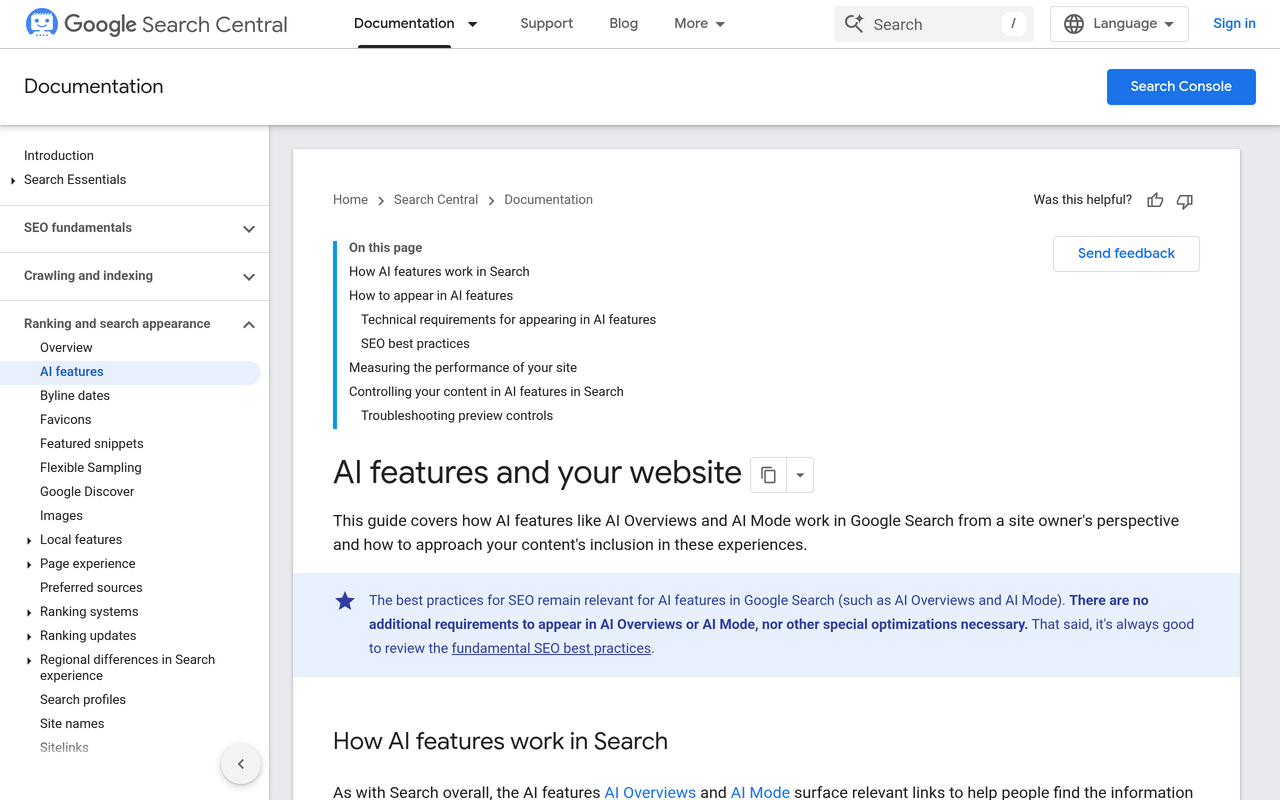
Action: confirm AI crawlers can reach your pages (see the AI crawler user agents list), make brand facts consistent across profiles with the entity consistency checklist, and check structured data matches visible text. Result: you remove technical blockers before paying anyone. Why: Google's documentation says you do not need new machine-readable files, AI text files or markup to appear in its AI features, and that SEO best practices still apply (Google Search Central documentation, checked November 2026).
4. Decide which layers you will fund
Action: mark each of the four layers as in-house, software or agency, using the decision table above. Result: a scope document you can send to agencies so quotes arrive on the same basis. Why: without it, you receive bundles that mix a $245 software line with a $5,000 labour line and cannot tell which is which.
5. Request scoped quotes and compare the unit of work
Action: ask for a price per deliverable (pages rewritten, mentions pursued, reports delivered) plus the minimum term. Result: quotes that can be compared against the project ranges, such as $2,500 to $7,500 for an audit. Why: a retainer with no deliverables is the hardest to evaluate and the easiest to renew by default.
6. Write the renewal test into the contract
Action: agree in advance which tracked prompts must name your brand, which pages must be cited and by which date, and test changes using the method in GEO experiment design. Result: a renewal decision based on measured movement. Why: research on generative engines found that adding citations, quotations and statistics can raise source visibility by up to 40% in test conditions (Aggarwal et al., KDD 2024), so improvement is plausible, but your own prompts are the only evidence that counts for your brand.
What should you ask an AI search agency before signing?
Use this ordered checklist in the sales call. Each question is designed to expose whether the retainer buys labour, software resale or reporting.
- Which of the four layers (Measure, Diagnose, Produce, Earn) does the retainer cover, and who performs each?
- Is tracking software included, which one, and will I own the data and login if I leave?
- How many prompts and which AI engines will be tracked, and who chose the prompts?
- Are deliverables recommendations only, or do you edit and publish pages on my site?
- What is the minimum term, and what are the exit conditions?
- What one-off fees (audit, onboarding, schema work) sit on top of the monthly price?
- How will you show that a change you made caused a change in citations?
- What happens to the retainer if AI engines change how they select sources?
- Can you share the reporting template you will send me each month? See what to expect in AI search reporting for agencies.
The answer engine optimization agency questions guide extends this list if you are running a formal procurement.
Red flags in a proposal
| Red flag | What it usually means | What to ask |
|---|---|---|
| Guaranteed rankings or citations | A promise the agency does not control, because AI engines choose their own sources | What do you commit to in writing, and how is it measured? |
| Monitoring priced like consulting | Software resale at a services margin | Which tool, and what does it cost on its own? |
| No named deliverables | Hours sold without outputs | List what I will receive each month. |
| Long minimum term, low transparency | Lock-in before proof of movement | Can we begin with a 90-day scoped project? |
| Special AI files or markup sold as a cure-all | Conflicts with Google's documented position | Where does the engine document this? |
Common mistakes when budgeting for AI search
- Paying a retainer to find out if you have a problem. A trial of tracking software answers that first.
- Comparing monthly fees without comparing term length. LoudFace's table shows terms from cancel-anytime to 12-month commitments (LoudFace, November 2026).
- Treating a tracker as a strategy. Dashboards show gaps; someone still has to write and publish.
- Ignoring Google's free data. Google launched Generative AI performance reports in Search Console, showing impressions, pages, countries, devices and dates for AI features (Google Search Central, June 2026). Ask any agency how it uses them.
- Tracking too many prompts. Tracking tools usually price by prompts and platforms, so more prompts raise cost faster than they raise insight.
- Not budgeting internal time. WebFX, October 2026 notes software-only budgets still need internal time to act on the data.
How does Noma fit into an AI search budget?
Noma by Nurdd is AI search visibility software at nomahq.app. It tracks 13 AI engines, including ChatGPT, Gemini, Perplexity and Claude, polled daily, and records whether your brand is named and which page each citation comes from. It shows citation frequency by category, competitor comparison and recommended actions, so you can bring the Measure layer in-house for the cost of software rather than a retainer line. It does not write your content or run outreach.
Want to talk it through? Book a demo at https://www.nurdd.club/demo, or test Noma yourself with the 3-day free trial at nomahq.app.
Where you do want people, Nurdd also runs answer engine optimization and generative engine optimization services for brands worldwide, scoped per brand, reported monthly and measured in Noma. That means the person improving your pages and the dashboard judging them use the same data. If you are weighing tools first, the AI search visibility tools comparison and the Noma vs Peec AI page are the next reads.
Where Noma replaces tracking cost and where an agency still helps
Noma replaces the tracking and reporting line in an AI search engagement: daily polling of 13 AI engines, citation sources, competitor comparison and recommendations. An agency still adds value in rewriting pages, structuring content for answers and earning mentions on third-party sources, work that needs people regardless of the software used.
Conclusion
AI search agency pricing is wide because agencies sell different mixes of measurement, diagnosis, production and outreach under one label. Published retainers cluster from about $1,500 to $5,000 a month for small brands, and software for tracking costs a fraction of that. The sensible order is to buy measurement first, establish a baseline, then pay people only for the layers where your team lacks capacity.
Ready to price your own AI search budget? Book a demo. You can also read what generative engine optimization is for background, or see how Nurdd works.
How we researched this
We reviewed published agency pricing guides, a compiled table of agency-published prices, a software vendor's own pricing page, Google Search Central documentation and one peer-reviewed conference paper. Pages were checked on the publication date of this article. We did not run hands-on tests of agencies, interview buyers or use customer data, and every figure quoted comes from the linked source as it states it. Agency-written guides have a commercial interest in their ranges, so treat all numbers as planning inputs and ask for a quote.
Frequently asked questions
How much does an AI search optimization agency cost?
Published ranges run from about $1,500 to $50,000 or more per month, with small businesses typically at $1,500 to $5,000 depending on the source. Mid-sized brands see $5,000 to $25,000 and enterprise programmes higher. The scope, term and who does the implementation explain most of the variation.
Should I hire an agency or buy a tool for AI search visibility?
Buy a tool first, because it is cheap and gives you a baseline. Add an agency for the layers your team cannot staff, usually content production and third-party mentions. Hiring an agency without a baseline makes it hard to judge results.
How much does AI visibility tracking software cost?
WebFX reports $50 to $1,000+ per month, depending on prompts and platforms tracked. Peec AI publishes agency plans at $245, $495 and $795 per month. Noma offers a 3-day free trial, with prices shown on nomahq.app.
Is an AI search agency worth it compared with traditional SEO?
Google says SEO best practices still apply to its AI features, so much of the foundation overlaps with traditional SEO. Stackmatix says AI-focused agencies charge 30-50% more than traditional SEO providers, which is an agency estimate rather than a measured figure. Judge worth by the deliverables and the movement in your tracked prompts.
Can software replace an AI search agency entirely?
Software replaces the measurement and reporting work. It does not rewrite your pages or earn mentions on other sites. If you have writers and a developer, software plus internal effort can be enough.
What is a typical contract length?
LoudFace's table of 25 agencies shows terms from cancel-anytime to 12-month commitments. Stackmatix describes 6 to 12 month minimums as typical for retainers. A 90-day scoped project is a reasonable way to test an agency.
How do I know whether an agency is working?
Agree a prompt set and a baseline before the engagement begins, then track whether your brand is named and which pages are cited. Google's Search Console now offers Generative AI performance reports as a free second source. Review changes against the baseline monthly.
Does Nurdd offer both software and services?
Yes, as separate options. Noma is the software, and Nurdd's AEO and GEO services are managed engagements scoped per brand and measured in Noma. You can use Noma on its own.
Ready to set a budget? Book a demo, or start the 3-day free trial at nomahq.app.