AI Search Visibility
Do Google AI Overviews Cite D2C Brands? What Studies Show
Published 2026 studies show Google AI Overviews cite D2C brands rarely and indirectly; here is the evidence and a 100-query test to measure your own citation rate.
 Simran Rawat28 Oct 202613 min read

Google AI Overviews cite D2C brands less often than most teams expect, and often indirectly. Published 2026 studies show citations going mostly to community, video and review sources rather than store pages, and only 37.9% of cited URLs ranking in the top 10 in one large Ahrefs analysis. The only reliable number for your brand is one you measure on your own queries, and this guide gives you a 100-query method to do it.
Google AI Overviews cite direct-to-consumer (D2C) brands far less often than their own product pages would suggest, and they usually reach a brand through third-party sources such as Reddit threads, YouTube reviews and magazine round-ups. No published study gives one universal citation rate for D2C, because every study uses a different query set. This guide collects the 2026 evidence on Google AI Overviews and D2C brands, then gives you a 100-query test to measure your own rate.
By Simran Rawat, AI Search Visibility, Nurdd.
Key takeaways
- Treat any single "citation rate" headline with suspicion: studies differ in query set, country, engine and what counts as a citation.
- Brand mentions are rare in Google AI Overviews on shopping prompts. BrightEdge found brands in 6.2% of Google AI Overview ecommerce responses.
- Ranking in the top 10 no longer predicts citation well. Ahrefs found 37.9% of cited URLs in the first 10 results in March 2026.
- Community and video sources carry a large share of shopping citations, so your off-site footprint matters as much as your product pages.
- Measure your own rate with a fixed 100-query set, sorted by query type, repeated on a schedule.
- Fix the cheap basics first: indexable pages, accurate structured data and complete retailer listings.
Why is the citation rate for D2C brands so hard to pin down?
A citation rate is a ratio, and every part of the ratio can change: which queries you test, whether an AI Overview appears at all, and whether you count a brand mention, a link to the brand's own domain or a link to any page about the brand. Two studies can both be correct and still disagree by an order of magnitude.
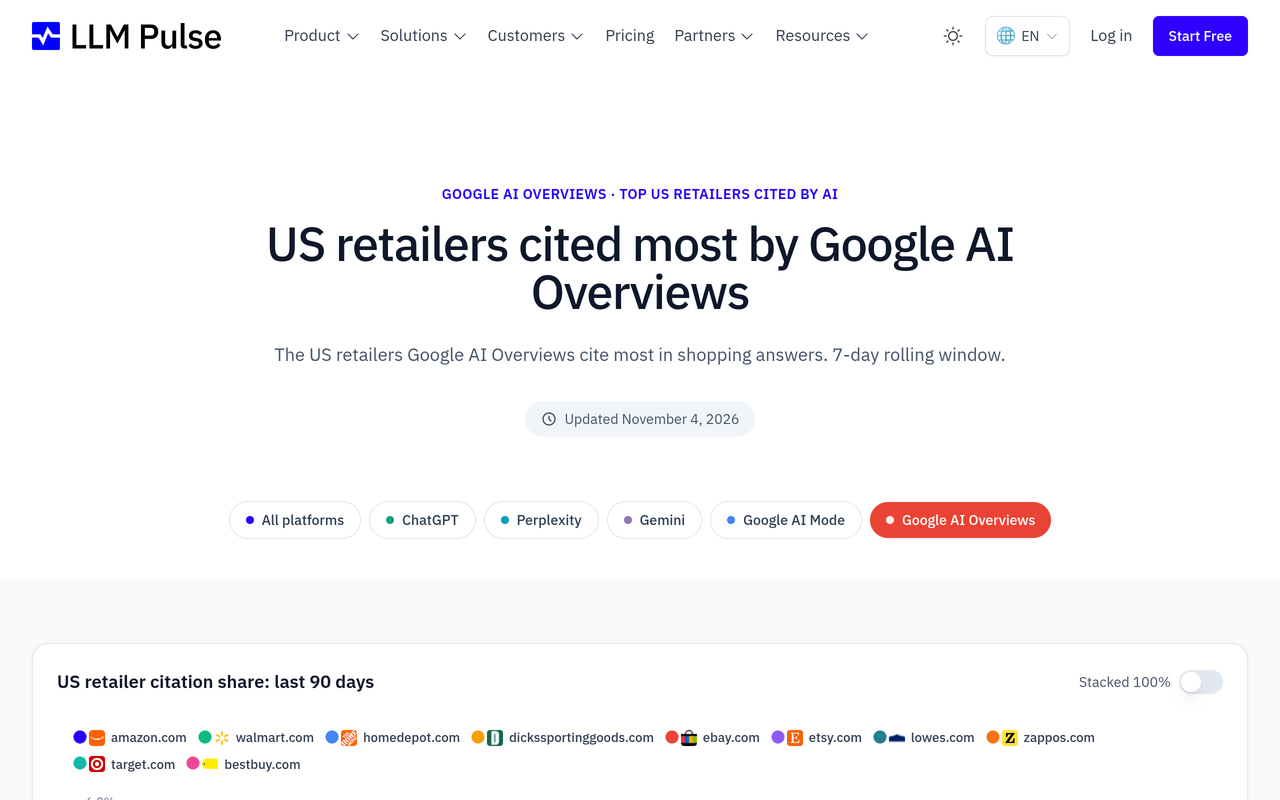
Consider the way one source frames its own scope. LLM Pulse analysed 391,000 citations to non-branded US shopping questions in July 2026 and found that retailers as a category took 2.9% of citations (LLM Pulse, July 2026). That is a citation share across all sources. It says nothing about how often a particular D2C brand is cited when it is relevant to the question.
For a D2C team, this means published figures are best read as direction and pattern, not as a target. The numbers below are useful for deciding where to look; your own test decides what to fix. If you want a wider view of how AI engines treat sources, the guide to generative engine optimization covers the vocabulary.
What do the 2026 studies say about who Google AI Overviews cite?
The studies point the same way on one thing: shopping answers lean on sources a shopper would consult for advice, not on stores. The table compares the studies on scope and finding. Figures are as each publisher states them.
| Study | Scope | Finding |
|---|---|---|
| BrightEdge, 2025 | Tens of thousands of prompts across ChatGPT, Perplexity and Google AI systems | Google AI Overview ecommerce responses averaged 0.29 brands, and 6.2% included any brands; ChatGPT included brands in 99.3% |
| BrightEdge, 2026 | Ecommerce and shopping prompts, 10 May to 26 July 2026, three engines | Community and video made up 26% of AI Overview citations against 5% of Gemini's |
| LLM Pulse, July 2026 | 391,000 citations to non-branded US shopping questions | Retailers took 2.9% of citations; Reddit and YouTube out-cited every big-box store combined |
| GetIntel, August 2026 | 30 shopping questions on four engines, 12 August 2026, 2,703 citations | Online stores took 1.41% of citations and Amazon 0.55%; most went to round-ups, review sites and health authorities |
| Track My Visibility (undated study) | 383,188 citations across 64 ecommerce brands, AI Overviews vs Gemini | The two engines shared 15.8% of cited domains; only 2 of 64 brands had the same top cited source |
Note the scopes. The GetIntel sample is small (30 questions, one day) and blends four engines, so it shows a pattern rather than a rate for Google alone. The BrightEdge 6.2% figure applies to ecommerce responses in that tool's prompt set. None of these is a D2C-only study, and this guide does not present them as one.
Do Google AI Overviews cite pages that rank in the top 10?
Less than they used to, by the measure Ahrefs uses. In July 2025 Ahrefs reported that 76.1% of cited pages ranked in the top 10, counting the top three citations per Overview (Digital Applied, comparing Ahrefs and other studies, 2026). A March 2026 Ahrefs analysis of 863,000 keyword SERPs and about 4 million cited URLs found 37.9% in the first 10 result blocks and 31.0% beyond the top 100 (same comparison).
Ahrefs says the two studies are not directly comparable, because parsing and the number of citations counted changed. The safer reading is that a large share of citations now comes from pages that do not rank well for the exact query. Roughly 31% sit between positions 11 and 100, our arithmetic from the published split.
Ahrefs' March 2026 analysis of 863,000 SERPs found 37.9% of AI Overview citations in the top 10 results and 31.0% outside the top 100, so ranking in the top 10 is a weak guide to whether a brand is cited.
For a D2C brand, the implication is practical. A product page that ranks third for a head term can be absent from the AI Overview, while a forum thread ranking on page five can be cited. Your plan has to cover pages you do not own.
Why do Google AI Overviews and Gemini cite different sources?
They draw on different mixes of sources, so a brand that appears in one can be absent from the other. BrightEdge's 12-week ecommerce tracking found that Gemini and AI Overviews shared 35 of the 50 top brands but only 22 of the 50 top cited domains (BrightEdge, 2026). The brand names overlap far more than the evidence behind them.
Track My Visibility's study of 64 ecommerce brands points the same way: 15.8% shared domains, and only 2 of 64 brands with the same top cited source (Track My Visibility, undated study). If you measure only one engine, you cannot assume the result carries over. The guide to getting cited by Gemini explains the differences.
How should a D2C brand read these numbers?
Think of the evidence as three layers, each of which a brand influences differently. This is our framework for turning the studies into decisions, not a published model.
| Layer | What the evidence shows | What you control |
|---|---|---|
| 1. Is an AI Overview shown? | Varies by query type; no single rate for D2C | Little. You choose which queries to target |
| 2. Which sources feed it? | Community, video, review sites and round-ups carry a large share on shopping queries | Partly: reviews, creator content, press, community answers |
| 3. Is your brand named or linked? | Brands appeared in 6.2% of AI Overview ecommerce responses in one BrightEdge dataset | Mostly: page quality, entity clarity, retailer listings |
Most teams spend their effort on layer 3 and ignore layer 2. The studies suggest layer 2 is where shopping citations are decided. A worked example from BrightEdge's numbers shows why layer 3 alone is thin.
Worked example: what 0.29 brands per response means
BrightEdge reported 0.29 average brands per ecommerce response and 6.2% of responses with any brand in Google AI Overviews. Dividing 0.29 by 0.062 gives about 4.7 brands per response among the responses that name any, our arithmetic from the two published figures. So when Google does name brands, it names several, and the slots go to whoever the sources support; but in about 94% of those responses it names none.
For you, that means two separate jobs. First, be among the brands a source-backed answer includes. Second, make sure the answers that name no brand still link to a page of yours as evidence. Those are measured differently, which is why the test below records mentions and links separately.
How do you measure your own citation rate with 100 queries?
A 100-query test gives you a baseline you can repeat, and it avoids relying on other people's query sets. It is a monitoring design, not a statistical proof: with 100 queries, the group where an AI Overview appears may be small, so treat results as directional and re-run monthly.
- Build the query set. Action: pull 100 queries from Search Console, customer support questions, reviews and sales calls. Result: a list that reflects how real buyers phrase things. Why: invented queries produce invented results.
- Split by intent. Action: tag each query as research ("how to choose"), comparison ("X vs Y"), product ("best X for Y") or branded. Result: four groups, ideally balanced. Why: the studies show different source mixes by query type, so one blended rate hides the answer.
- Run each query in a clean session, in your target country. Action: record the date, location and whether an AI Overview appeared. Result: a log of presence. Why: location and personalisation change answers, as covered in this piece on personalisation in AI answers.
- Record every cited source. Action: for each Overview, list the cited domains and page types, and note whether your brand is named in the text, linked, or both. Result: three columns per query: mentioned, linked, absent. Why: a mention without a link and a link without a mention are different problems.
- Calculate four rates. Action: AI Overview presence rate (Overviews shown divided by 100); mention rate and link rate (each divided by Overviews shown); and competitor share. Result: a baseline. Why: dividing by Overviews shown stops low presence from masking a real citation problem.
- List the cited non-owned sources. Action: tally which Reddit threads, YouTube videos, review sites and retailers recur. Result: your outreach and content target list. Why: the studies show these sources carry shopping answers.
- Repeat on a fixed schedule and change one thing at a time. Action: re-run monthly; log content changes. Result: a before-and-after you can attribute. Why: the GEO experiment design guide explains how to avoid mistaking noise for effect.
Choosing the queries matters more than most teams expect. The guide to which prompts to track shows how to balance the set, and the share of voice guide covers competitor comparison.
Which query types should D2C brands prioritise?
Use this decision table to decide where to spend effort first. The "likely source" column reflects the patterns in the studies above; the actions are our recommendations.
| Query type | Likely cited sources (per studies) | First action |
|---|---|---|
| Research ("how to choose", "is X safe with Y") | Community, video, authority and health sources | Publish a direct-answer guide; seed expert answers where the question is already discussed |
| Comparison ("X vs Y") | Review sites, round-ups, video | Get your product into the comparisons that already get cited; publish an honest comparison page |
| Best-for ("best X for Y") | Magazine round-ups and review sites; few store pages | Earn inclusion in the round-ups; keep retailer listings complete |
| Branded | Your own site and retailers | Make sure the entity description is clear and consistent everywhere |
If your category is heavily reviewed, such as beauty, the research and comparison rows will matter most. For wider catalogues, see the ecommerce industry page.
What does Google say you need to do to appear?
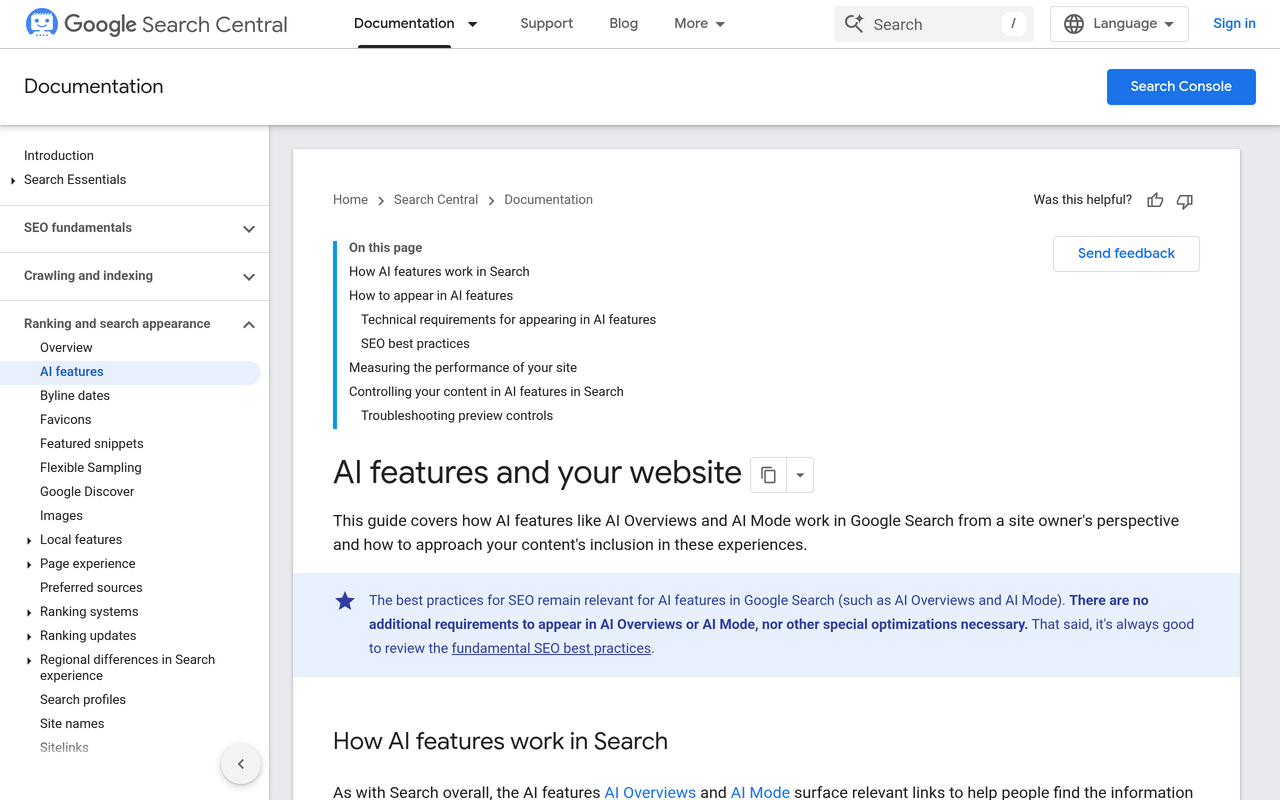
Google's documentation on AI features says there are no additional requirements or special markup for AI Overviews beyond the basics: a page must be indexed and eligible to be shown with a snippet (Google Search Central). Google also advises keeping Merchant Center and Business Profile information current and ensuring structured data matches the visible text.
That removes one common misconception: there is no schema trick that unlocks citations. Structured data still helps machines read your pages accurately, and the guide to schema markup for D2C brands lists what is worth doing. Google also folds AI Overview traffic into the "Web" search type in Search Console, so the report cannot isolate it. That is the main reason to test citations directly.
How do you earn citations from sources you do not own?
If community, video and review sources carry shopping answers, the work is to be present in them honestly. Start from your recurring-source tally in step six and take the top five or ten targets.
- Reviews and round-ups: send samples and accurate product data to the publishers that already appear in the Overviews for your queries.
- Video: commission or earn demonstrations and honest reviews of the exact use cases buyers search. Creator content built for the question, not just for views, is covered in the guide to briefing creators for AI-cited content.
- Communities: answer real questions as a named, disclosed brand representative, rather than seeding fake posts, which communities remove.
- Retailers: keep titles, attributes and images complete, since retailer pages are still part of the evidence for some categories.
For the broader programme, see how to get your brand mentioned in AI answers without ads and the guide to appearing in Google's AI Overview for a product category.
Checklist: what to fix before you run the test
- Confirm your key pages are indexed and not blocked from snippets.
- Check that structured data matches the visible page text.
- Write a one-paragraph brand description and use it identically on your site, retailer listings and profiles.
- Open each priority guide with a direct two-sentence answer to its question.
- List your top ten competing sources for each query group.
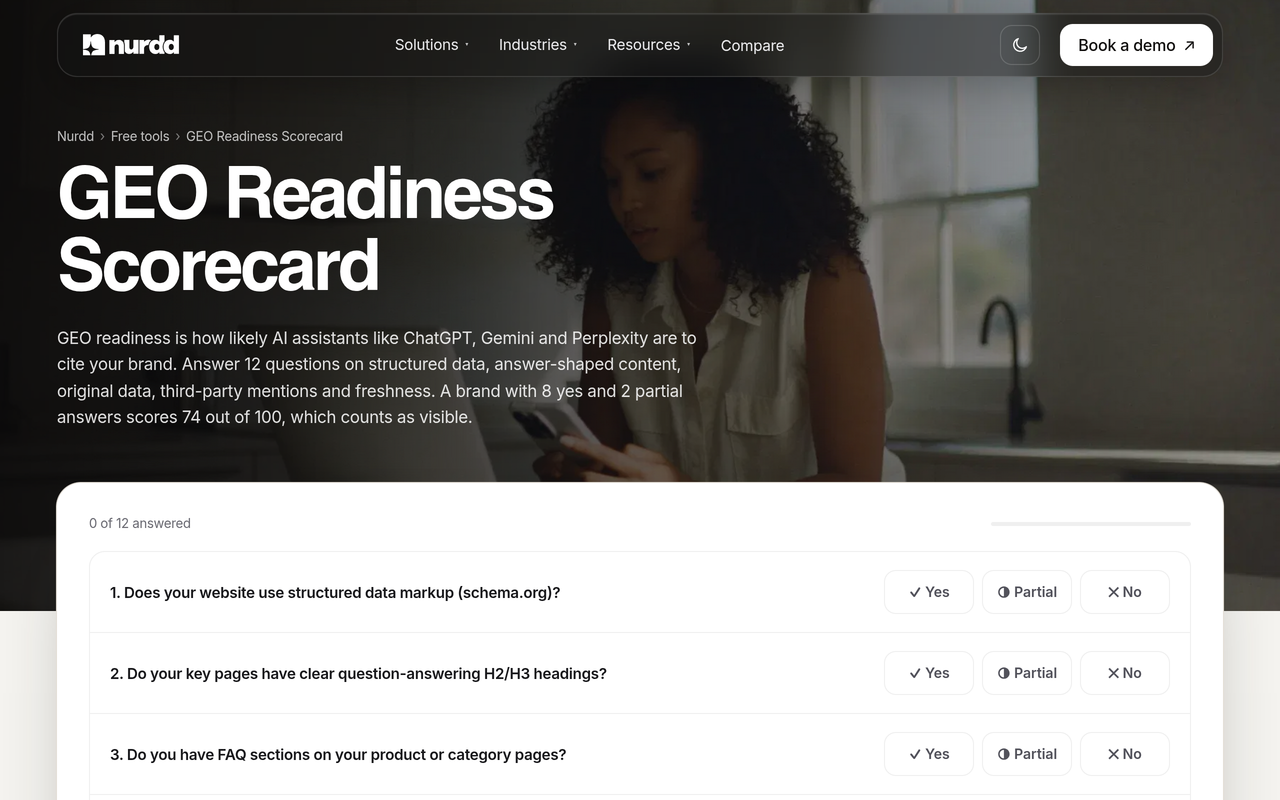
- Run the GEO readiness scorecard and note the lowest-scoring factors.
- Set the 100-query set and log format before changing anything, so the baseline is clean.
What mistakes distort a citation test?
- Testing branded queries only. Branded queries flatter you, because your own site is the obvious source.
- Counting any appearance as a win. A mention with no link sends no traffic; record both.
- Changing five things at once. You cannot attribute a result, so you cannot repeat it.
- Quoting a competitor's study as your benchmark. Query sets differ. Use published numbers for direction only, as the guide to AI search statistics recommends.
- Ignoring other engines. The Gemini overlap data above shows one engine does not stand in for another.
How does Noma help measure Google AI Overview citations?
Noma by Nurdd is a web dashboard that tracks whether a brand appears in answers from 13 AI engines, including ChatGPT, Gemini, Perplexity and Claude, polled daily. It records citation frequency by category, shows competitor comparison and gives recommendations for improving AI visibility. For a D2C brand, that replaces the manual logging in the 100-query test with a daily record you can compare month to month.
To see it on your own brand, book a demo at nurdd.club/demo. You will see your priority prompts, which competitors are named instead of you, and which pages are cited for each answer. Noma has a 3-day free trial: a card is taken at signup, billing starts on day 3, and you are not charged if you cancel before then. You can read more on the Noma site.
If you would rather have a team do the content and source work, Nurdd's generative engine optimization services are measured in Noma. To report results over time, use the monthly AI search metrics report template. If you are comparing tools first, the comparison of AI search visibility tools sets out the criteria.
How we researched this
We reviewed published research and documentation: Google Search Central's AI features page, analyses from Ahrefs and BrightEdge, and citation datasets from LLM Pulse, GetIntel and Track My Visibility. We also read secondary roundups that compare AI Overview studies. Sources were checked on the publication date of this article, and where a figure could not be confirmed we left it out. Several vendor studies sell AI visibility tools, so we describe their scope next to each figure. We did not run our own query test, and nothing here is a Nurdd result.
Frequently asked questions
How often do Google AI Overviews cite D2C brands?
There is no single published rate for D2C. In one BrightEdge dataset, Google AI Overviews included any brand in 6.2% of ecommerce responses. Other studies measure citation share across sources instead, so the figures are not interchangeable.
Do AI Overviews cite brand websites or third-party sites?
Studies of shopping questions show a large share going to third-party sources. LLM Pulse found Reddit and YouTube out-cited every big-box retailer combined, and GetIntel found online stores took 1.41% of citations. Brand sites are cited, but often alongside or behind reviews and community sources.
Does ranking in the top 10 get me into an AI Overview?
Not reliably. Ahrefs' March 2026 analysis found 37.9% of cited URLs in the first 10 results, and 31.0% beyond position 100. Ranking helps, but it is a weak predictor on its own.
Do I need special schema markup for AI Overviews?
No. Google's documentation says no additional requirements or special markup are needed beyond being indexed and eligible for a snippet. Structured data should still match the visible text on the page.
Are Google AI Overviews and Gemini the same for brand visibility?
No. BrightEdge found they shared 35 of 50 top brands but only 22 of 50 top cited domains, and Track My Visibility found 15.8% shared domains across 64 ecommerce brands. Track both separately.
Can I see AI Overview citations in Search Console?
Not separately. Google counts AI Overview and AI Mode traffic in the Web search type, so you cannot isolate it. Direct testing of your priority queries, manual or with a tool, fills the gap.
How many queries do I need to test?
A set of 100 gives a workable baseline when split across research, comparison, best-for and branded queries. Treat results as directional, because only some queries will show an Overview. Repeat monthly and compare like for like.
See your own Google AI Overview citations
Published studies tell you the pattern; your queries tell you the answer. Book a demo and we will show you, for your own brand, which prompts name you, which competitors appear instead, and which pages and outside sources the engines cite. You can also start with the free GEO readiness scorecard, or compare Noma with other tools such as Profound.