
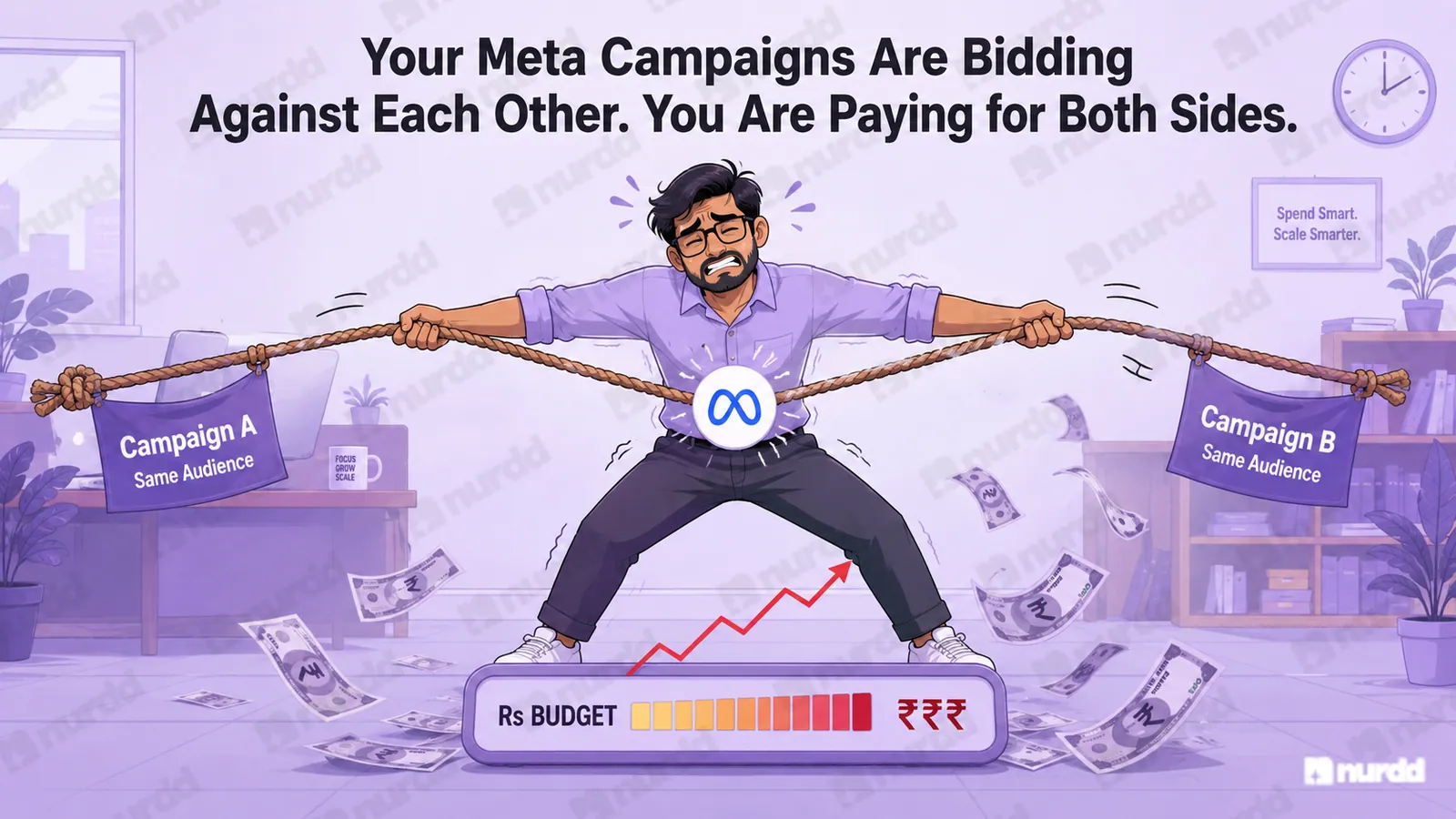
Check Meta’s Audience Overlap tool in Ads Manager: go to Audiences, select two or more audiences, then choose Actions > Show Audience Overlap. Over 20% signals a meaningful problem; reduce it with exclusions and clear audience ownership.
Picture an auction. You want to buy something. You put in a bid. Then you find out that someone else in the auction also put in a bid and that someone else is also you. This is what happens when you run multiple Meta campaigns with overlapping audiences. You compete against yourself. Your own campaigns drive up the price of reaching your own potential customers. This is called audience overlap, and it's one of the most common silent budget killers in any Meta account with more than two active campaigns.

What Causes Overlap
The most common source is running a lookalike audience and a broad audience simultaneously. Lookalike audiences are built from your customer data. Broad audiences are Meta's full network. In practice, a significant portion of your lookalike audience exists inside Meta's broad audience too. Running multiple lookalike audiences from different seed audiences also creates heavy overlap in the middle.
How to Check Right Now
Meta has a built-in tool called Audience Overlap. Go to Ads Manager. In the left navigation, go to Audiences. Select two or more audiences by checking the boxes. Then click Actions and select "Show Audience Overlap." Meta will show you the overlap percentage. Above 20% is a meaningful problem. Above 40% and you're actively competing against yourself at significant scale.
What High Overlap Does to Your Account
When two of your ad sets are eligible to reach the same person, Meta runs an internal auction to decide which ad set wins. But when you're bidding against yourself, even the winner is paying a higher price than necessary. Your bids artificially inflate each other. Higher CPMs, higher cost per click, higher cost per result without any increase in actual audience reach. It also creates attribution confusion. If the same customer sees Ad Set A and Ad Set B before buying, both get credit. Your results look better on paper than they are in reality.

The Fix: Clean Campaign Architecture
Give each campaign a clear audience ownership. One campaign owns new prospecting via broad or Advantage+. A separate retargeting campaign owns past visitors and engagers. If you're running lookalike audiences, exclude them from your broad prospecting campaign so they're not targeted by both simultaneously. Use exclusion audiences aggressively. Every campaign should explicitly exclude audiences owned by other campaigns. If you want to compare two approaches, run them as separate ad sets within one campaign not as separate campaigns.
In Meta's auction, efficiency isn't about spending more or less. It's about not spending the same money twice on the same person.
Sources & References
Meta Business Help Centre — Audience Overlap Tool Documentation (2026): https://www.facebook.com/business/help/122923658166355
Jon Loomer Digital — Meta Ads Audience Overlap Guide: https://www.jonloomer.com/facebook-audience-overlap/
Social Media Examiner — Facebook Ads Internal Competition and How to Fix It: https://www.socialmediaexaminer.com/facebook-ads-audience-overlap/
AdEspresso — Meta Auction Dynamics and Self-Competition Explained: https://adespresso.com/blog/facebook-ads-auction/
Northbeam — Attribution Inflation in Multi-Campaign Meta Accounts 2025: https://www.northbeam.io/blog/facebook-attribution-inflation

Find the right creators — and verify they're real.
Nia gives brands access to 10M+ Indian creator profiles, TruAI fake follower detection, pre-spend ROI forecasting, and product-level sales attribution. Completely free.