AI Search Visibility
Answer Engine Optimization Agency vs In-House Tooling
Compare hiring an answer engine optimization agency with in-house AEO and a tracking tool on cost, speed and control, and decide what to outsource.
 Sheetal Shakshi31 Oct 202616 min read

Before you pay an answer engine optimization agency, build your own baseline and keep the scoreboard in-house. Most tracking, prompt selection and on-page fixes fit a normal marketing team with a tool. Noma by Nurdd tracks 13 AI engines, including ChatGPT, Gemini, Perplexity and Claude, so you decide what to outsource from your own data.
Should you hire an answer engine optimization agency? Not before you own a baseline of your AI visibility. Most tracking, prompt selection and on-page fixes can be run in-house with a tool, and the scoreboard should stay with you under any contract. Outsource only tasks you can name, scope and measure.
Key takeaways
- Measure first. Own your AI visibility baseline before any contract, so you can tell whether an agency's work moved anything.
- Published agency retainers start at about $2,500 a month at the lowest tier, with boutique programs up to $18,000 and enterprise tiers higher, so a 12-month commitment is a five- or six-figure decision.
- Google's own guidance says optimizing for generative AI search is still SEO, so be sceptical of any agency selling a secret AEO method.
- Keep tracking, prompts, brand facts and the scoreboard in-house; scope any outside help narrowly, by task and by deliverable.
- Make a 30-day baseline plus a short, scoped pilot your first outside contract, not a long retainer.
- Noma by Nurdd gives you the baseline across 13 AI engines with a 3-day free trial, so the decision rests on your own data.
Quick answer: should I hire an answer engine optimization agency?
It depends on which of three things you lack: capacity, expertise or measurement. Measurement is the one you should never hand over, because someone on your side has to verify that the work changed how AI engines describe your brand. An answer engine optimization agency that also runs the tracking and writes the report is marking its own homework.
The practical default for most brands is to run tracking and the weekly review in-house with a tool, then buy outside hours only for tasks you have scoped against that baseline. The decision table later in this post maps each AEO task to an owner.
What does an answer engine optimization agency actually do?
An answer engine optimization agency tries to increase how often, and how accurately, your brand appears in AI-generated answers. HubSpot (AEO guide) defines AEO as improving how often and how accurately your business appears in answers on engines like ChatGPT, Gemini and Perplexity. That definition names two outcomes: frequency and accuracy.
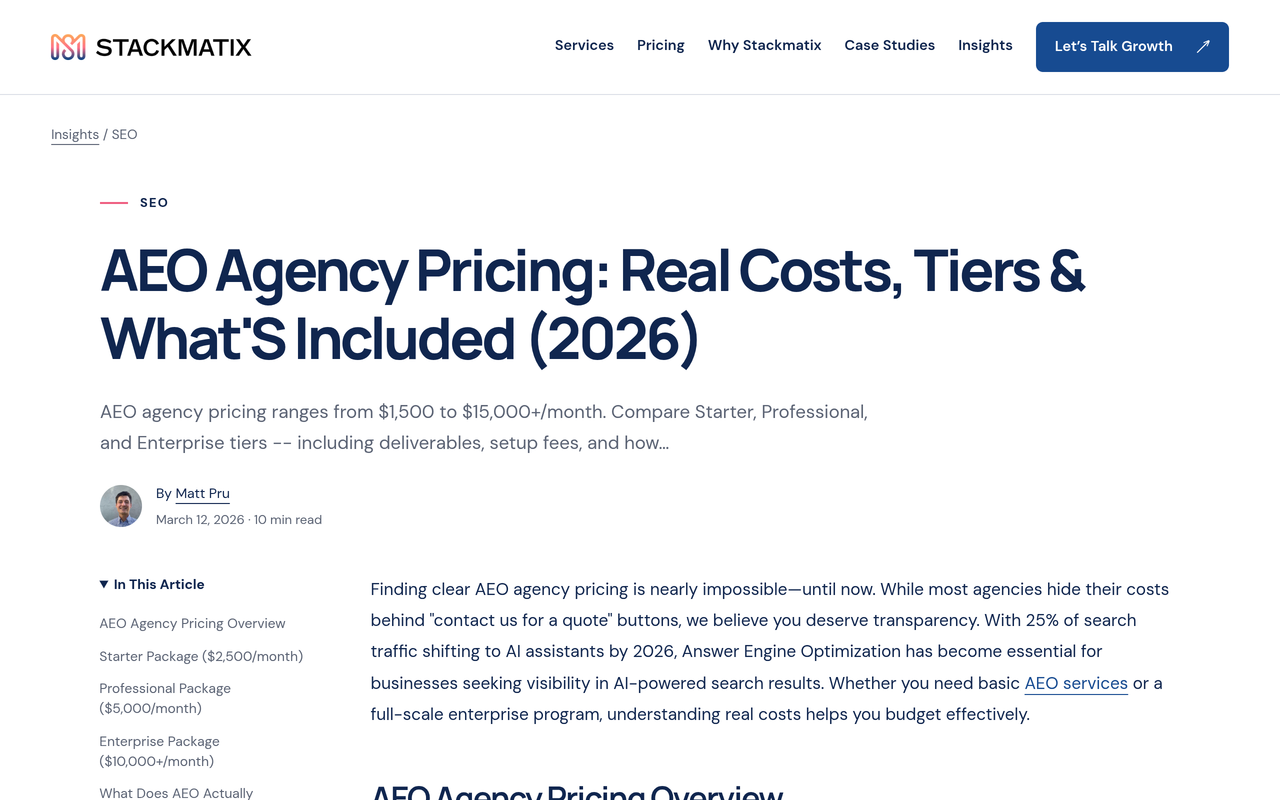
Agency scopes vary, but published packages cluster around the same deliverables. The Stackmatix, March 2026 pricing page lists an audit, schema markup, optimized articles each month, backlinks, Reddit and Quora seeding, and reporting on AI share of voice. Those are SEO-adjacent tasks with an AI-visibility label.
Is AEO a separate discipline from SEO?
Google says no. In May 2026, Search Engine Journal, May 2026 reported that Google's new documentation defines AEO and GEO and states that optimizing for generative AI search is still SEO. The same report says Google lists llms.txt files, chunking content, special markup and inauthentic mentions as things site owners do not need for Google Search.
Google has also said it is testing a Search Console control for appearing in generative AI Search features, and has shared updated guidance for website owners, in a Google announcement. The rules come from the platforms, not from agencies.
That matters when you evaluate a pitch. Google speaks only for its own products, and engines such as ChatGPT and Perplexity have their own retrieval behaviour. Still, an agency that charges for tactics Google calls unnecessary should show evidence from the other engines. For background, see our explainer on what generative engine optimization is.
An answer engine optimization agency sells three kinds of work: content production, technical implementation and off-site citation building. Measurement is a fourth category that a brand can, and usually should, own itself.
How much does an AEO agency cost compared with in-house?
Published retainers differ by who is selling. The sources below are agencies and agency-adjacent blogs that publish their own pricing, so treat them as asking prices, not market averages. All were checked in October 2026.
| Model | Published figure | Source |
|---|---|---|
| Agency, starter tier | $2,500 a month | Stackmatix, March 2026 |
| Agency, professional tier | $5,000 a month | Stackmatix, March 2026 |
| Agency, enterprise tier | $10,000+ a month | Stackmatix, March 2026 |
| Agency or GEO retainer, typical range | $3,000 to $15,000 a month; audit alone $1,500 to $5,000 | The Remarkable Agency, 2026 |
| Boutique B2B SaaS programs | $5,000 to $18,000 a month | LoudFace, 2026 |
| In-house hire, loaded cost | $120,000 to $200,000 a year (LoudFace's own estimate; Stackmatix gives $7,000 to $12,500 a month) | LoudFace, 2026; Stackmatix, March 2026 |
| Noma by Nurdd | 3-day free trial; card taken at signup, billing starts on day 3, no charge if cancelled before | Noma, October 2026 |
Market ranges are wider than any one page suggests. Omnieclipse describes AEO as complementary to SEO and priced similarly, with a market that runs from DIY to $50,000+ a month.
Worked example: what a 12-month agency commitment costs
Take the professional tier from Stackmatix at $5,000 a month. Over 12 months that comes to $60,000 (5,000 × 12). LoudFace's own estimate for a loaded in-house hire is $120,000 to $200,000 a year, while Stackmatix gives $7,000 to $12,500 a month, which works out to $84,000 to $150,000 a year. The Stackmatix page lists 15 to 25 optimized articles a month at the $5,000 tier.
Now compare the ends of the Stackmatix range. At $2,500 a month the year costs $30,000; at $10,000 a month it costs $120,000. The arithmetic is ours; the inputs are the sources'. The lesson is that the two sources disagree on the cost of a hire, so price your own hire before comparing, and ask what output each option gives you for the money. A tool subscription plus a part-time owner sits in neither column.
What the agency results claims do and do not tell you
The Stackmatix page projects 15 to 25 percent improvements in AI visibility for targeted queries on its starter tier within 3 to 6 months. These are the agency's own expectations, not independent research, and the page does not say how visibility was measured. Ask any agency which tool and which prompts define its numbers, and who owns the data.
How much of AEO can I do in-house?
More than most agency pitches suggest. Tracking, prompt selection, brand-fact cleanup, FAQ and definition pages, and the weekly review all sit within a normal marketing team's reach. What can exceed in-house capacity is volume writing, third-party placement and engineering time, and those are the tasks to scope tightly if you buy them.
Google's guidance points the same direction. The Search Engine Journal report says Google emphasizes non-commodity content, meaning material that adds something a competitor's page does not. That is a judgement an in-house team that knows its product is well placed to make.
Decision table: who should own each AEO task?
| AEO task | Default owner | Why |
|---|---|---|
| Choosing the prompts to track | In-house | You know your buyers' questions; see which prompts to track. |
| Daily or weekly visibility tracking | In-house with a tool | A tool does the polling; a person reads the trend. |
| Brand description and entity facts | In-house | Only you can confirm what is true; see the guide to brand descriptions for AI search. |
| Rewriting key pages as direct answers | In-house | Needs product knowledge, and is repeatable. |
| High-volume article production | Scoped freelancers or agency, fact-checked in-house | A capacity question, but product facts must be checked by you. |
| Schema and technical fixes | Developer | Engineering time; Google says no special schema is required for AI features, so scope it narrowly. |
| Digital PR and third-party mentions | PR partner, with authenticity rules | Needs relationships; Google warns that inauthentic mentions are not helpful. |
| Reporting and success definition | In-house | The buyer should own the scoreboard. |
Notice the pattern: the tasks that need judgement and data sit with you, and any task bought from outside is tied to a baseline you own.
Agency vs in-house tooling: cost, speed and control compared
| Criterion | AEO agency | In-house with a tracking tool | Hybrid |
|---|---|---|---|
| Cost structure | Monthly retainer, often with minimum terms | Software subscription plus staff time | Tool subscription plus scoped outside hours |
| Time to first data | Audit phase first; reporting cadence is set by the contract | Trial start to first dashboard | Tool data on day one, outside scope set after |
| Who defines prompts and metrics | The agency, unless you insist otherwise | You | You |
| Data ownership | Varies; ask in writing | Yours | Yours |
| Verification of results | Often the same party that did the work | Independent of any vendor of labour | Independent |
| Exit cost | Contract notice period | Cancel the subscription | Cancel either side |
Speed: what to check before you pay for volume
Speed is easy to promise and hard to verify. Before paying for volume, ask how long onboarding takes, who learns your product, and how many drafts need your corrections. A retainer that ships many pages with wrong product facts is slower in practice, because every error has to be found and fixed.
Time to insight is the speed that matters most, and it is the one a tool gives you first. A dashboard shows which engines mention you and which rivals appear instead, so any outside scope starts from evidence rather than from an audit you pay for. Start with a Noma baseline, then decide how many hours you need to buy.
Control: the criterion buyers underweight
Control is who defines success. If the agency chooses the prompts, runs the tracking and writes the report, it is marking its own homework. Keep the scoreboard in your hands, even if some work is outsourced. Our guide to AI search share of voice shows a metric you can compute yourself.
Cost: retainers versus tools
Tool pricing is a fixed line; retainers bundle labour with tracking. Before you pay agency rates for monitoring, ask whether it is a live tool you can log into or a periodic report, and whether you keep access when the contract ends.
How do I decide? A six-question scorecard
Answer each question yes or no. For questions 1 to 4, each yes points towards scoped outside help and each no points towards in-house. Questions 5 and 6 are separate checks.
- Do you have fewer than one full-time person who can write and edit for AEO?
- Do you need more than about ten new or rewritten pages a month?
- Do you lack a developer slot for technical fixes this quarter?
- Does your category depend on third-party reviews, lists or press that you have no relationships for?
- Do you already have a baseline of your AI visibility across engines? (No means measure first.)
- Would you commit to a retainer for at least six months without a baseline? (Yes is a warning sign.)
Three or more yes answers on questions 1 to 4 suggest scoped outside help. If question 5 is a no, do the baseline before you sign anything, whatever the other answers say. If question 6 is a yes, stop and reread the section on common mistakes.
How do I run a 30-day baseline before choosing? (checklist)
This is the step-by-step test we recommend before any retainer. Each step produces something you can show an agency or a leadership team.
- Write 20 to 30 prompts buyers would ask. Result: a prompt list covering category, comparison and problem questions. Why: untracked prompts cannot be improved. Use the prompt selection guide.
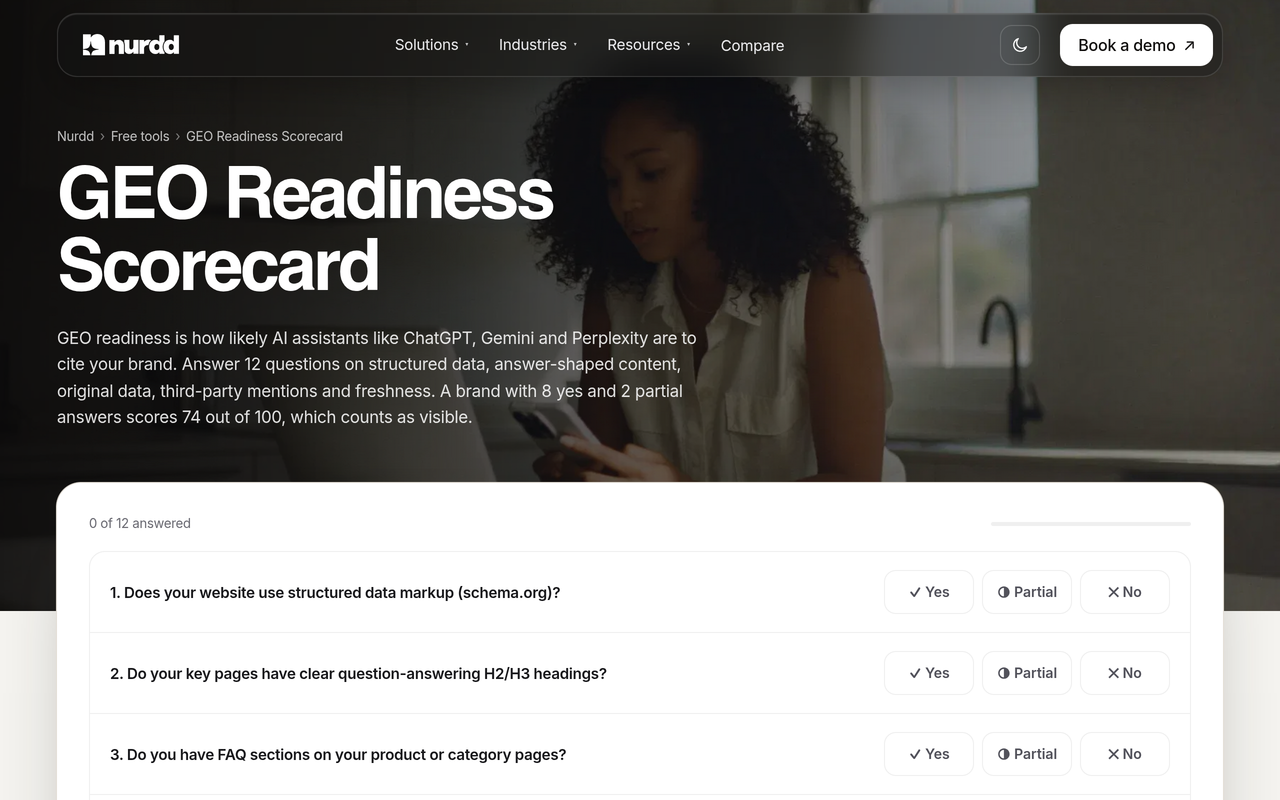
- Score your site's readiness. Result: a 12-factor view of gaps. Why: it tells you whether the problem is content, structure or off-site presence. Try the GEO readiness scorecard.
- Start tracking across engines. Result: a baseline of mentions and citations per engine. Why: engines behave differently, as in our engine comparison.
- Record competitor presence. Result: a list of rivals appearing where you do not. Why: it defines the gap any outside help would be paid to close.
- Fix what you can in two weeks. Result: updated brand description, answer-first key pages and FAQ. Why: it shows how much an in-house team can move before spending on a retainer. See the AEO audit checklist.
- Review the trend at day 30. Result: movement or none per engine. Why: this is the evidence you take to an agency, with a defined scope and target.
What should I ask an answer engine optimization agency before signing?
Use these as a procurement list. An agency that answers vaguely is telling you something.
- Which tool measures results, and will you give us read access to it?
- Which prompts and engines define success, and who chose them?
- What is the notice period, and is there a setup fee?
- Which deliverables depend on off-site placement, and how do you keep mentions authentic?
- How do you handle the tactics Google calls unnecessary, such as llms.txt and chunking?
- Who writes the content, and who checks product facts?
- What happens to the content and the data when we leave?
A good answer to the sixth question is rare and valuable. Content that misstates your product can be repeated by an AI engine, which turns a sloppy draft into a brand-accuracy problem. Our guide to writing content AI engines quote shows the standard to hold writers to.
What are the common mistakes when choosing between agency and in-house?
- Signing before measuring. Without a baseline, any movement can be credited to the agency and none can be disproved.
- Buying an SEO retainer relabelled. The Remarkable Agency notes that anything under $1,500 a month is usually rebranded SEO. Ask what is different from the SEO work you already buy.
- Tracking too few engines. A report that covers only a couple of platforms can miss where buyers actually ask. Compare coverage before agreeing a scope.
- Chasing mentions you cannot defend. Google's guidance says seeking inauthentic mentions is not as helpful as it might seem. Durable placements come from real coverage.
- Outsourcing the scoreboard. Keep the dashboard and the definition of success with your team.
- Ignoring the cause. If AI engines ignore you because of thin or unclear pages, a retainer on volume will not help; read why AI engines ignore a brand first.
How does Noma help you decide what to outsource?
Noma by Nurdd is a web dashboard that tracks whether your brand appears in answers from 13 AI engines, including ChatGPT, Gemini, Perplexity and Claude, polled daily. It shows citation frequency by category, a competitor comparison and recommendations for improving AI visibility. For a team weighing an answer engine optimization agency against in-house work, Noma supplies the baseline and the ongoing scoreboard that either route needs.
Want to see this for your own brand? Book a demo and we will show how your brand and your competitors appear across the engines Noma tracks, so you can mark which tasks to keep and which to scope for outside help.
What Noma gives you that a retainer does not
This table sets out Noma's own facts against the questions to put to any agency. Agency cadence and coverage differ by contract, so the right-hand column is what to ask, not a claim about any one provider.
| Row | Noma by Nurdd | What to confirm with an agency |
|---|---|---|
| Engine coverage | 13 AI engines, including ChatGPT, Gemini, Perplexity and Claude | Which engines are monitored under the tier you are quoted |
| Tracking cadence | Polled daily | How often data is refreshed and reported |
| Competitor comparison | Built into the dashboard | Whether competitor analysis is a live view or a periodic report |
| Recommendations | Actionable recommendations to improve AI visibility | Which recommendations come with deliverables |
| Commitment | 3-day free trial; card taken at signup, billing starts on day 3, no charge if cancelled before | Minimum term and notice period |
| Who owns the scoreboard | Your team, in your own dashboard | Whether you get access to the data and keep it after you leave |
The case for Noma rests on its own facts: 13 engines, daily polling, a built-in competitor comparison and a dashboard your team owns. Noma is a visibility tool and does not write or place content, so use it to decide what to do and how it is going, and spend any outside budget only on tasks you have scoped against that data.
If you are weighing Noma against other tracking tools, see our comparisons with Profound, Peec AI and AthenaHQ, or the wider list of AI search visibility tools. If you work at an agency yourself, the agency industry page covers that use case.
Three scenarios: which model fits?
A SaaS marketer with one writer
The team has strong product knowledge but little capacity. Use a tracking tool for the baseline, rewrite comparison and definition pages in-house, and scope outside help only for article volume and third-party placement. See AI visibility for SaaS for category context.
An ecommerce brand with no developer time
Technical fixes are the bottleneck. Keep prompts and brand facts internal, and outsource the schema and product-feed work on a fixed-scope project, not an open retainer. Google says no special markup is required for AI features, so ask for structured data to be justified by rich results, not AI promises.
An agency or consultancy serving clients
Your clients will ask for proof. Use the same baseline-first routine for each client and keep reporting transparent. Our guide to tracking an AI visibility score week over week gives a reporting rhythm.
What should the first 90 days look like?
Days 1 to 30: baseline, as above. Days 31 to 60: in-house fixes on the five to ten pages that matter most, plus a scoped pilot if the scorecard showed a capacity gap. Days 61 to 90: compare the new trend with the baseline per engine, and decide whether to extend, expand or stop.
This sequence keeps any vendor accountable to a number you own. It also protects you from the common pattern where the first quarter of a retainer is audit work you could have produced yourself. For free organic tactics that need no agency at all, read how to get mentioned in AI answers without ads.
Conclusion: what to do next
Hiring an answer engine optimization agency is a decision to make after you have measured, not before. Run the 30-day baseline, mark each task with an owner from the decision table, and sign only a scoped, time-limited contract that leaves the scoreboard with you.
Noma gives you the baseline across 13 AI engines, with a 3-day free trial at nomahq.app. To see your own brand's visibility, competitor gaps and a task-by-task split of what to keep in-house, book a demo. Browse more of our free tools and comparisons in the meantime.
How we researched this
We reviewed published agency pricing pages and pricing articles, Google's AI search guidance as reported by Search Engine Journal, Google's own announcement about website-owner controls, and HubSpot's AEO guide. All sources were checked in October 2026. We did not run hands-on tests, interview agencies or use customer data, and prices are published asking prices that may change.
Frequently asked questions
Should I hire an answer engine optimization agency?
Only once you have a baseline to hold them to and a task you cannot cover yourself, such as volume writing or third-party placement. If you have no such gap, a tracking tool and a small internal routine usually cover the work. Either way, keep the measurement in-house.
How much of AEO can I do in-house?
Most of the judgement work: prompt selection, brand facts, answer-first pages and the weekly review. Volume writing, technical implementation and third-party placement are the usual candidates for outside help. The decision table in this post assigns an owner to each task.
How much does an AEO agency cost?
Published retainers start at about $2,500 a month at Stackmatix's lowest tier, with its top tier at $10,000+. The Remarkable Agency quotes $3,000 to $15,000, LoudFace quotes $5,000 to $18,000 for boutique programs, and Omnieclipse describes a market reaching $50,000+. A standalone audit is quoted at $1,500 to $5,000 by one source. These are asking prices, so confirm what is included and the notice period.
Is AEO different from SEO?
From Google Search's perspective, no. Its May 2026 guidance, as reported by Search Engine Journal, says optimizing for generative AI search is still SEO. Other engines retrieve differently, so tracking across several engines is still worthwhile.
Do I need llms.txt or special schema for AI search?
Google says you do not need llms.txt, special markup or chunked content to appear in its generative AI features. Structured data remains useful for rich results. Treat any agency line item built on these tactics as something to question.
How long before AEO work shows results?
It varies, and the numbers agencies publish are their own projections, not independent studies. Set a 30-day baseline and a 90-day review per engine, then judge by your own trend data.
What does Noma by Nurdd track, and is it free?
Noma tracks whether your brand appears in answers from 13 AI engines, including ChatGPT, Gemini, Perplexity and Claude, polled daily. It offers a 3-day free trial: a card is taken at signup, billing starts on day 3, and you are not charged if you cancel before then.
Can I use a tracking tool and an agency together?
Yes, and it is the setup we suggest when you have a real capacity gap. The tool gives you the scoreboard; the outside team executes a scoped list of tasks against it. To see how that would look for your brand, book a Noma demo.