AI Search Visibility
AI Search Visibility Analysis: How to Earn More Mentions
A repeatable six-step AI search visibility analysis: choose prompts, log named brands, trace cited sources, then close the gaps that cost you mentions.
 Sheetal Shakshi30 Oct 202613 min read

An AI search visibility analysis is a repeatable test: choose a fixed set of buyer prompts, run them on several AI engines, record which brands are named and which sources are cited, then fix the gaps. Brands earn more mentions by publishing on the sources the engines already trust and by re-measuring every week. Noma by Nurdd automates the tracking across 13 AI engines.
An AI search visibility analysis is a structured test of whether AI engines name your brand when buyers ask category questions. You choose a fixed set of prompts, run them on several engines, record which brands appear and which sources are cited, then close the gaps you find. This guide gives you that method step by step, with the formulas and a worked example.
Most teams skip the method and check a few prompts by hand, which produces anecdotes rather than a baseline. The aim here is a measurement you can repeat next week and compare, so every change you make has a visible effect.
Key takeaways
- Use a fixed prompt set, grouped into brand, category and comparison clusters, so results are comparable week to week.
- Run every prompt several times per engine; one answer is a sample, not a result.
- Record three things per answer: brands named, order of mention, and the source domains cited.
- The cited sources tell you where to publish. Mentions follow presence on the pages the engines already trust.
- Report mention rate, citation rate and AI share of voice, and always state the prompt set behind them.
- Re-run on a schedule: weekly for top prompts, monthly for the full set.
What is an AI search visibility analysis?
An AI search visibility analysis measures how often, how prominently and from which sources AI engines present your brand in generated answers. It is the AI-search counterpart of a rank check, except there is no fixed list of links to read a position from. Instead you read sentences, lists and citations.
It differs from a one-off prompt test in three ways: the prompts are fixed, the runs are repeated, and the output is a set of rates that can be compared over time. It also differs from traditional SEO reporting. A Data-Mania benchmark write-up, October 2026 reports that organic traffic volume correlates only weakly with AI citations (r = 0.23), so strong Google traffic does not guarantee AI mentions.
An AI search visibility analysis answers four questions: Are we named? Next to whom? Based on which sources? And what changed since last time?
Why is a one-off check not enough?
AI answers vary between runs, between engines and between weeks. A Contentor guide, October 2026 advises running each prompt several times and attaching a margin of error to every rate. Its example: with 200 answers and an observed rate of 19%, the plausible range runs from about 14% to 25%.
Engines also disagree. A Shadow guide, October 2026 cites PromptAlpha data saying only 11% of domains are cited by both ChatGPT and Perplexity. Winning on one engine tells you little about another, which is why a multi-engine view matters. For the engine-by-engine differences, see Perplexity vs ChatGPT vs Gemini: which AI engine matters most.
What does the analysis measure? The core metrics
Several vendors publish near-identical definitions, and it helps to fix yours before you start. The table below uses the definitions from SearchEye, October 2026 and Unusual, May 2026.
| Metric | Formula | What it tells you |
|---|---|---|
| Mention rate (share of answer) | Answers naming your brand ÷ valid answers | Whether you are in the conversation at all |
| Citation rate | Answers linking your domain ÷ valid answers | Whether engines treat your pages as a source |
| AI share of voice | Your mentions ÷ all tracked-brand mentions in the same answers | Your standing against competitors |
| Source overlap | How often the same cited domains recur across engines | Which sources to prioritise for outreach |
Unusual gives a simple example: if you run 100 prompts and your brand appears in 27 answers, your share of answer is 27%. Define up front whether a mention in a list of ten counts the same as a first-place recommendation, and keep that rule unchanged.
How do I run an AI search visibility analysis? Six steps
Step 1: Build a fixed prompt set
Action: write 20 to 50 prompts in three clusters: brand ("Is [brand] good for...?"), category ("best [product] for [need]") and comparison ("[brand] vs [competitor]"). Shadow suggests a library of 15 to 50 queries across those clusters.
Result: a locked list you reuse without edits.
Why: changing the wording changes the answers, so any edit breaks comparison with last week. Take prompts from real customer questions, sales calls and "People also ask". Our guide on which prompts to track for AI search visibility goes deeper on selection.
Step 2: Choose engines and run each prompt several times
Action: pick the engines your buyers use, at minimum ChatGPT, Gemini, Perplexity, Claude and Google AI Overviews, and run each prompt at least three times per engine on a clean session.
Result: a table of answers, not a single screenshot.
Why: repetition shows how stable your presence is. A brand named in one of three runs is fragile; one named in all three is established.
Step 3: Record brands named, order and sentiment
Action: for every answer, log each brand named, its position in the answer, and whether the wording is positive, neutral or a caveat.
Result: a competitor map showing who the engines treat as the default choices in your category.
Why: the brands that appear beside you define the competitive set the engines believe in, and it is often different from the set your sales team names.
Step 4: Extract the cited sources
Action: list every URL and domain cited in the answers and group them: your own site, competitor sites, review sites, forums, news and publisher lists, video.
Result: a ranked list of the domains that feed answers in your category.
Why: engines assemble answers from pages they retrieve. If a "best of" list that omits you is cited in many of your category answers, that page is a higher-value target than any new post on your own blog.
Step 5: Diagnose each gap
Action: for every prompt where you are absent, label the cause using the decision table below.
Result: a prioritised fix list rather than a vague "do more GEO".
Why: different gaps need different work. Content edits will not fix a missing third-party listing.
Step 6: Fix, then re-measure
Action: ship the highest-impact fixes, then re-run the identical prompt set weekly for the top prompts and monthly for the whole set.
Result: a trend line that links each change to a movement in mention rate.
Why: Shadow notes that citation distributions shift within weeks through model updates and index refreshes, so a single audit goes stale quickly.
How do I turn gaps into fixes? A decision table
This framework is our own synthesis of the cited-source data. Match what you see in Steps 3 and 4 to the likely cause and the first fix.
| What you observe | Likely cause | First fix |
|---|---|---|
| Never named, and your site is never cited | Engines cannot find a clear answer on your pages | Add direct-answer sections and a clear brand definition; see how to write a brand description AI engines can cite |
| Named, but your site is not cited | Engines learned of you through third parties | Strengthen your own pages on the exact claims third parties repeat |
| Competitors named, cited domain is a review or list page | Missing third-party presence | Pitch inclusion, supply facts and updated product details to that publisher |
| Named on one engine, absent on another | Different retrieval sources per engine | Compare cited domains per engine and fill the missing ones |
| Named, but described wrongly | Outdated or conflicting pages | Correct source pages, align structured data, and refresh the claims |
| Named only in brand prompts, never category prompts | Low category association | Publish comparison and use-case content that ties you to the category terms |
For the common causes in more depth, read why your competitor is cited in AI answers and you are not and why AI search engines ignore your brand.
A worked example: from raw answers to a gap list
The numbers below are illustrative, to show the arithmetic; they are not results from any real brand. Suppose you track 40 prompts on four engines, three runs each. That gives 40 × 4 × 3 = 480 answers.
- Your brand is named in 96 answers: mention rate = 96 ÷ 480 = 20%.
- Your domain is linked in 38 answers: citation rate = 38 ÷ 480 ≈ 7.9%.
- Across all 480 answers, tracked brands are named 600 times in total, and yours accounts for 96 of them: AI share of voice = 96 ÷ 600 = 16%.
Now apply the margin-of-error rule. Using the Contentor guidance that rates need an interval, a 20% rate on 480 answers is a rough 16% to 24% range, and answers from the same prompt are not fully independent, so treat it as a guide. A move from 20% to 22% next month is noise; a move to 30% is a signal.
The gap is clear: you are mentioned about two and a half times more often than you are cited (20% against 7.9%). That points to engines learning about you from third parties. Step 4 would then show which review and list domains appear most, and those become the outreach list. The fix is not more blog posts; it is presence on those pages.

How can my brand earn more mentions in AI answers?
Mentions come from being present, consistent and easy to quote on the pages engines retrieve. The analysis tells you which pages those are; the work is then to appear on them accurately. These are the levers, in the order we would test them.
- Answer the prompt directly on your own pages. Put a 40 to 60 word answer under a question-style heading, then support it with detail. Our guide to the sentence structure that gets quoted in AI answers shows the patterns.
- Name the entity in full. Write the brand and product names in each passage so an excerpt still makes sense out of context.
- Get onto the cited third-party pages. Use the Step 4 list: roundups, comparison pages, forums and publisher guides. See how to get your brand mentioned in AI answers without ads.
- Keep facts consistent everywhere. Pricing, features and descriptions should match across your site, profiles and listings. Add schema where it fits; see schema markup for AI search engines.
- Add comparison and FAQ content. Buyers prompt with comparisons and questions, so pages shaped like those prompts match the retrieval. Start with an FAQ page built for AI search.
- Refresh older pages. Competitors' older posts often win because they are established; see why engines recommend a competitor's old post.
Authorship is not the lever people assume. A SearchEye summary of a 2025 Ahrefs analysis reports cited URLs were 3.6% purely AI-generated, 8.6% purely human-written and 87.8% mixed, so measure actual citation performance rather than labelling content by how it was written.
Checklist: your first analysis in one afternoon
- Write down five competitors and the three buyer needs your category serves.
- Draft 30 prompts: 8 brand, 14 category, 8 comparison. Lock the wording.
- Pick four engines. Run each prompt three times in a fresh session.
- Log brands named, their order and any caveats for every answer.
- Log every cited URL and group the domains by type.
- Compute mention rate, citation rate and AI share of voice with the formulas above.
- Label each missing prompt using the decision table.
- Choose the top three fixes and set a re-run date.
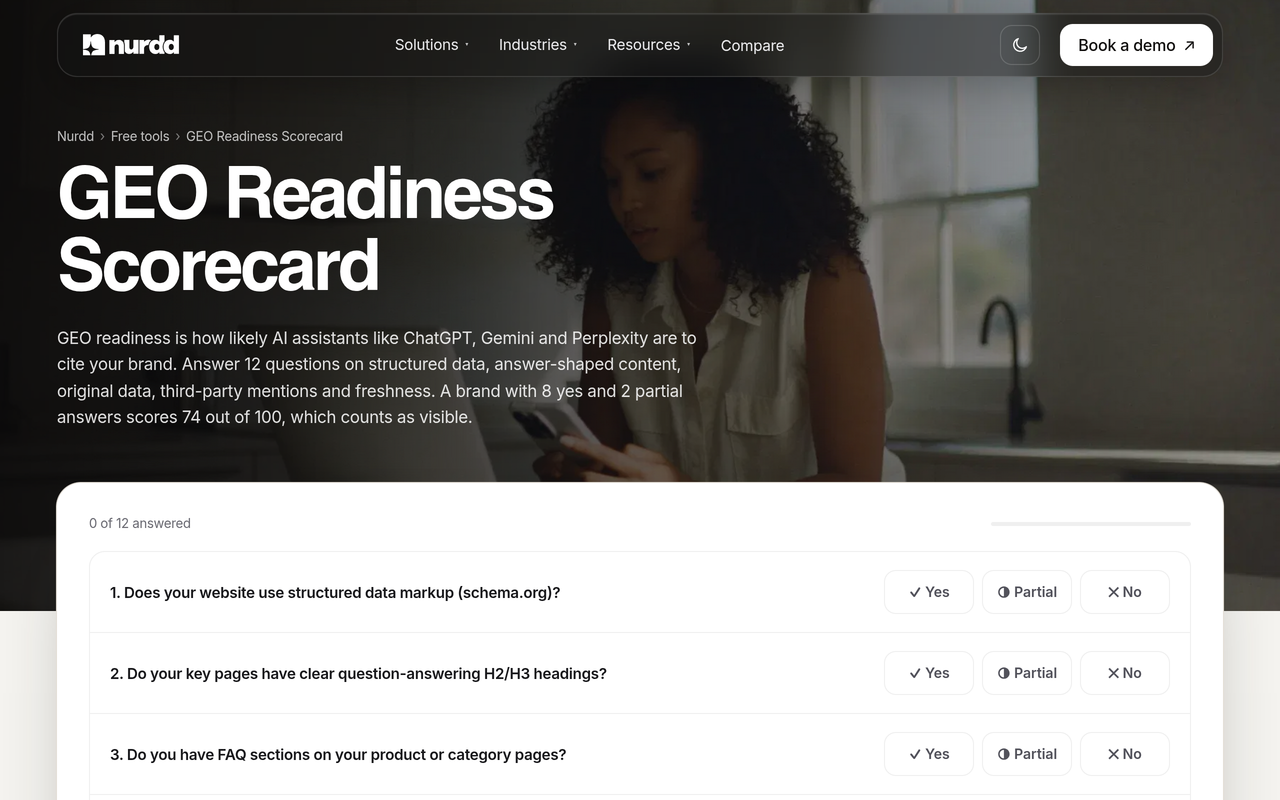
Do the quick pre-check first with the GEO readiness scorecard, which scores 12 readiness factors. Then follow with the manual run.
Common mistakes in AI search visibility analysis
- Testing three prompts and calling it a baseline. A set this small cannot show a trend.
- Editing prompts between runs. You lose comparability and cannot attribute changes.
- Ignoring the cited sources. Mentions are the outcome; the source list is where the leverage is.
- Treating one engine as all of AI search. Only 11% of domains overlap between ChatGPT and Perplexity in the PromptAlpha figure Shadow cites.
- Reporting rates without a sample size. State how many answers sit behind each percentage.
- Mixing definitions. A Kompozy guide, August 2026 warns that prompt coverage and true share of voice are different numbers often given the same name.
- Measuring once. Without a schedule, the analysis is a snapshot that ages quickly.
For a measurement habit that lasts, see how to track your AI search visibility score week over week and how to measure AI search share of voice.
How do I compare manual analysis with automated tracking?
| Factor | Manual spreadsheet | Noma by Nurdd |
|---|---|---|
| Engines covered | As many as you have time to open | 13 AI engines, including ChatGPT, Gemini, Perplexity and Claude |
| Polling | When someone remembers | Polled daily |
| Competitor comparison | Hand-tallied | Built-in competitor comparison |
| Citation frequency by category | Hand-coded | Shown on the dashboard |
| Next actions | Your own reading of the data | Actionable recommendations to improve AI visibility |
| Trial | Not applicable | 3-day free trial; card taken at signup, billing starts on day 3, no charge if cancelled before |
Manual runs are the right way to learn the method. They stop scaling once you track dozens of prompts across many engines, because the repetition the method needs multiplies the work.
How does Noma automate the analysis?
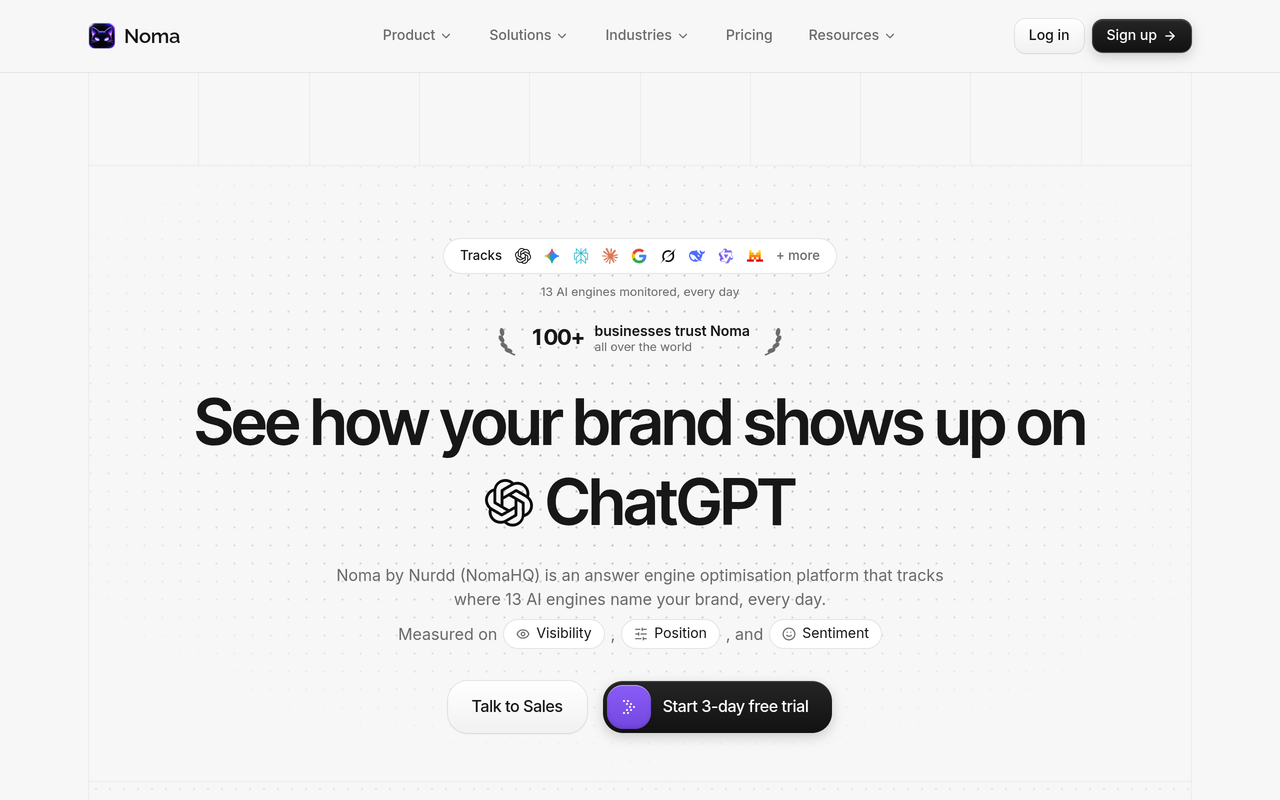
Noma by Nurdd is a web dashboard that tracks whether a brand appears in answers from 13 AI engines, including ChatGPT, Gemini, Perplexity and Claude, polled daily. It shows citation frequency by category, competitor comparison and actionable recommendations for improving AI visibility. In terms of the six steps, it handles the repeated runs, the logging and the trend line, so your time goes to Steps 5 and 6.
Noma by Nurdd is built for brands and marketing teams that want to know whether AI assistants recommend them when customers ask category questions. It replaces the spreadsheet with a daily, multi-engine record you can compare week over week, and it sits alongside the Nurdd free tools rather than replacing your content work.
Want to see how it works? Book a demo to see how Noma by Nurdd works.
If you are weighing tools, see how Noma compares in Noma vs Profound, Noma vs AthenaHQ and Noma vs Semrush, or read the wider comparison of AI search visibility tools.
How often should I repeat the analysis?
Run the full prompt set monthly and spot-check your highest-value prompts weekly. That cadence is recommended in the Shadow guide, and it fits how quickly citations move. Log any content release, listing or press mention on the same timeline so you can tie changes in mention rate to actions.
After each fix, give the engines time to re-retrieve before judging it. A change that does not show in week one may appear in week three. Avoid reacting to a single run; wait for a shift larger than your margin of error.
How we researched this
We searched the primary keyword and reviewed current published guides on AI visibility metrics, share-of-voice formulas and prompt-set design from analytics and SEO publishers. Each cited page was checked on the publication date of this post, and numbers are quoted as those sources state them. The worked example is illustrative and is labelled as such. We did not run hands-on tests, interviews or customer studies for this post, and Noma facts come from Nurdd's own product information.
Frequently asked questions
How do I run an AI search visibility analysis?
Build a fixed prompt set, run each prompt several times across multiple AI engines, and record the brands named and the sources cited. Calculate mention rate, citation rate and share of voice, diagnose each gap, fix it, and repeat on a schedule.
How can my brand earn more mentions in AI answers?
Find the domains that engines cite for your category prompts, then earn accurate presence on them while making your own pages quotable. Direct answers, consistent facts and comparison content give engines clear material to draw on. Re-measure weekly to see what worked.
How many prompts do I need?
Start with 20 to 50, spread across brand, category and comparison clusters. Shadow suggests 15 to 50 queries. More prompts give steadier rates, but only if you keep the wording fixed.
How many times should I run each prompt?
At least three times per engine, more for important prompts. Answers vary between runs, and rates need a margin of error. Contentor's example shows a 19% rate on 200 answers spans roughly 14% to 25%.
What is the difference between a mention and a citation?
A mention means the answer names your brand. A citation means the answer links to a page, ideally on your domain. Brands are often mentioned without being cited, which usually means engines learned of them through third parties.
Does Google ranking guarantee AI mentions?
No. The Data-Mania benchmark reports a weak correlation (r = 0.23) between organic traffic and AI citations. Treat AI visibility as a separate channel to measure.
Can I do this without a tool?
Yes, with a spreadsheet and patience, and it is a good way to learn the method. Tracking many prompts across many engines daily is where automation helps. Noma by Nurdd offers a 3-day free trial with a card taken at signup.
Which engines should I track?
Track the engines your buyers use, and do not assume overlap between them. Noma covers 13 AI engines, including ChatGPT, Gemini, Perplexity and Claude, so you do not have to pick in advance.
Start your analysis with Noma
The method works in a spreadsheet, and it works better when the repeated runs are automated. Book a demo to see how Noma by Nurdd at nomahq.app tracks brand mentions, competitors and cited sources across 13 AI engines. You can also browse the free Nurdd tools, read what generative engine optimization is, or see the AEO audit checklist.