AI Search Visibility
Why AI Search Engines Ignore Your Brand (And How to Fix It)
AI search engines ignore brands they cannot reach, understand, verify or find corroborated elsewhere; here is how to test each cause and fix it in order.
 Simran Rawat29 Jul 202616 min read

AI search engines ignore a brand when they cannot reach its pages, extract a specific claim from them, or find independent sources that confirm it. Diagnose it in five layers (access, understanding, evidence, corroboration, freshness), fix the earliest broken layer first, then re-run the same prompts to measure the change.
AI search engines ignore your brand when they cannot reach your pages, pull a specific claim from them, or find other sources that confirm you exist in your category. Usually more than one cause is at work. This guide gives you a five-layer test, a decision table and a fix order.
Key takeaways
- Treat invisibility as five separate layers: access, understanding, evidence, corroboration and freshness. Fix the earliest broken layer first, because later fixes do nothing if a crawler cannot read the page.
- Run a fixed set of 20 buyer prompts on each AI engine before changing anything, so you have a baseline to compare against.
- Replace slogans on your top pages with plain, checkable statements: what you make, for whom, with which specifics and which proof.
- Do not chase shortcuts. Google's own documentation says llms.txt files, content chunking and manufactured mentions are not needed for its AI features.
- Measure the same prompts weekly. A single check tells you little, because answers differ between engines and between runs.
Why do AI search engines ignore some brands?
AI answer engines do not rank brands the way a directory does. They retrieve pages, read them, and compose an answer from what the pages say. Google describes this in its guidance as retrieval-augmented generation, where the system pulls relevant pages from its index and then reviews specific information on them (Google Search Central, October 2026). It also describes query fan-out, where the model sends several related searches at once to gather more material.
That has two consequences for an ignored brand. First, if your page is not retrieved for any of the fanned-out queries, it never reaches the writing stage. Second, if it is retrieved but says nothing specific, the model has nothing to quote and moves on to a page that does.
There is also a measurement trap. Semrush reported that 62% of AI citations in its study were "ghost citations", where a page was cited but the brand was not named in the answer (Semrush, June 2026). Being cited and being mentioned are different outcomes, so track both.
Engines also disagree with each other. In an Ahrefs analysis of brand citations, 86% of the sources were unique to each assistant (Ahrefs, September 2025). A brand can therefore be visible in one engine and absent in another, which is why a single manual check misleads. The article on Perplexity vs ChatGPT vs Gemini covers how the engines differ, and why your brand isn't showing up in ChatGPT answers goes deeper on one engine.
What are the five layers that decide whether AI engines mention you?
Most advice lists six or seven reasons in no particular order. A more useful way is to treat them as a stack, because each layer depends on the one beneath it. The framework below is the one used in the rest of this post.
- Access: can the relevant crawlers fetch your pages at all?
- Understanding: can a reader, human or machine, tell in one pass what you sell and to whom?
- Evidence: do your pages contain specific, checkable claims worth quoting?
- Corroboration: do independent sources describe you in the same terms?
- Freshness and measurement: are your pages kept current, and do you track the result?
The decision table maps what you see to the layer most likely at fault, how to test it and what to change first.
| What you observe | Likely layer | How to test it | First fix |
|---|---|---|---|
| Your brand never appears, and neither do any of your pages as sources | Access | Read your robots.txt and check each AI crawler rule; fetch a key page logged out | Allow the search crawlers you want; make key content render without login or heavy scripts |
| Your pages are cited but the answer describes you wrongly or vaguely | Understanding | Ask each engine "what does [brand] do?" and compare to your own one-line description | Put a plain-language definition near the top of the homepage and product pages |
| Competitors are named, you are not, and your pages are generic | Evidence | Highlight every sentence on a top page that a stranger could verify; count them | Rewrite the opening 200 words with specifics, sources and named proof |
| You rank on Google but are missing from ChatGPT or Perplexity answers | Corroboration | Search your category terms and list which third-party sites appear; check whether you are on them | Earn real coverage, reviews and listings on the sites engines already cite |
| You appeared last quarter and have since dropped | Freshness | Check the last-updated date of your top pages against competitors | Update the pages with current facts and a visible update date |
| You cannot tell whether anything is changing | Measurement | Do you have a saved prompt set and a weekly record? | Fix the prompt set, then record mention rate per engine |
How do you diagnose why your brand is ignored? (step by step)
The steps below follow the stack. Each one gives you an action, the result you should have afterwards and the reason it matters.
- Write a fixed prompt set of 20 buyer questions. Include category questions ("best [product type] for [need]"), comparison questions and problem questions, and leave your brand name out of most of them. The result is a repeatable test. It matters because brand-name prompts only prove the engine knows you exist, not that it recommends you. The article on which prompts to track for AI search visibility explains how to pick them.
- Run the set on each engine and record three things per answer. Note whether your brand is named, which brands are named instead, and which sources are cited. The result is a baseline table (a template follows below). It matters because the cited sources show you exactly where the engine looks for your category.
- Check access. Open your robots.txt and look for rules covering AI crawlers. Vendors separate their crawlers by purpose: OpenAI's documentation, as summarised by Search Engine World, notes that each setting is independent, so a site can allow OAI-SearchBot for search results while disallowing GPTBot for training use. The result is a clear yes or no on whether blocking is your problem. It matters because Ahrefs found that about 5.9% of sites disallow GPTBot (Ahrefs, September 2025), and a blanket rule copied from a template can block more than you intended.
- Check understanding. Ask each engine to describe your company in one sentence, then compare it with your own. The result is a list of gaps, such as the wrong category or an outdated product line. It matters because the engine's description is built from what your pages and other sources say. The guide on writing a brand description AI engines can use shows the format.
- Audit evidence on your five most important pages. Underline each sentence that contains a specific fact someone could verify. The result is a count, and for most marketing pages it is low. It matters because a model needs something concrete to quote in answer to a concrete question.
- Map corroboration. List the third-party sites cited in step 2 and check whether your brand appears on each. The result is a short outreach and listings list. It matters because pages that confirm your claims independently give the engine a reason to trust yours.
- Fix in layer order, then re-run the same 20 prompts after two to four weeks. The result is a before-and-after comparison on identical prompts. It matters because changing five things and measuring nothing leaves you guessing which one worked.
A baseline sheet you can copy
Record one row per prompt and engine. The last column is where the diagnosis happens, because it forces you to name a layer instead of writing "not visible".
| Prompt | Engine | Brand named? (yes/no) | Brand cited as a source? (yes/no) | Competitors named | Sources cited | Layer suspected |
|---|---|---|---|---|---|---|
| Best [product type] for [need] | ChatGPT | |||||
| [Your brand] vs [competitor] | Perplexity | |||||
| How do I solve [problem your product addresses]? | Gemini |
If "named" is no and "cited" is no across every engine, start at Layer 1. If "cited" is yes and "named" is no, you are in ghost-citation territory and the work sits in Layers 2 and 3.
Worked example: turning a prompt test into a visibility number
The arithmetic is simple, and the figures below are placeholders to show the method, not results from any brand. Suppose you run 20 prompts on one engine and your brand is named in 3 answers. Your mention rate is 3 divided by 20, or 15%.
Now count citations separately. If the engine cites your site in 5 of the 20 answers but names you in only 3, then at least some of your citations are ghost citations of the kind Semrush described, where the page is used and the brand is not named (Semrush, June 2026). For scale, if 100 citations followed Semrush's 62% pattern, 62 of them would carry no brand mention. In that case your problem is Layer 2 or 3 (the page is useful but does not make the brand name stand out), not Layer 1.
Which of the causes is most common, and how do you fix each?
Your pages contain no extractable claims
AI answers are built from sentences that can be lifted out and still make sense. A line such as "our formula is trusted by thousands" cannot be checked and answers no question, so it gives the engine nothing to use. A line that states what the product is, what it contains or does, for whom, and which study, certification or document supports it can be quoted.
Use this pattern for the first 200 words of each key page: [Brand] is a [category] that [does what] for [who]. It [specific attribute, with the number and where it came from]. Then link the evidence. Do not invent figures to fill the template; if you have no verifiable number, state the verifiable fact without one.
Research supports adding evidence rather than adjectives. In the original GEO study, methods such as adding citations and quotations improved source visibility by up to 40% in generative engine responses (OpenReview, Aggarwal et al.). A later paper reported keyword stuffing had a negligible effect, around 3%, while citing sources, adding statistics and adding quotations each showed positive effects (arXiv, March 2026). These are research settings, not guarantees for your site, but they point the same way: evidence beats volume.
For rewrite examples, see how to write website content AI engines quote and the sentence structure that gets cited.
Nobody independent describes you
Engines compare what you say about yourself with what others say. Ahrefs lists building a presence on third-party websites as the first step in optimizing for LLM search (Ahrefs, September 2025). The practical route is to find the publications, review sites, forums and directories that appear in the sources column of your baseline table, and earn accurate coverage there.
Be careful with the shortcut. Google's guidance says that seeking inauthentic mentions is not as helpful as it might seem, because its ranking systems focus on high-quality content and other systems block spam (Google Search Central, October 2026). Real reviews, genuine press coverage and honest community participation are the safe options. Creator content can also serve this role; see how to brief a creator for AI-cited content and how to get mentioned in AI answers without ads.

Your site does not say plainly what you do
If the homepage is mostly imagery and a tagline, a reader or a machine has to guess your category. The fix is a short, plain definition near the top, repeated consistently across your site, your profiles and your listings. Inconsistent descriptions (a different category on each profile) make it harder for any system to connect them to one entity.
Google says it can process JavaScript content provided it is not blocked, but notes that JavaScript sites are generally more complex to optimize (Google Search Central, October 2026). If your key claims only appear after a script runs or behind an interaction, move them into the main page text. Structured data can reinforce what the page already says; the guides on schema markup for AI search and structured data for AI Overviews show what to mark up.
A crawler cannot reach you
This is the cheapest cause to rule out and the most costly to miss. Check robots.txt rules, firewalls and bot-protection settings that may block search crawlers while allowing browsers. For Google, a page must be indexed and eligible to appear with a snippet to be shown in its generative AI features (Google Search Central, October 2026). A page with a noindex tag or a restrictive snippet setting is out before anything else is considered. OpenAI publishes its own crawler overview; read it before editing robots.txt.
Your content is stale
Ahrefs analysed 17 million citations across seven AI search platforms and reported that content cited in AI is 25.7% fresher than content in organic results, with a 13.1% preference for recently updated content (Ahrefs, September 2025). Refresh your key pages with current facts, and show a real update date only when something has genuinely changed.
You are optimising for one engine, or none
Because 86% of sources were unique to each assistant in the Ahrefs analysis, a fix that works for one engine may not carry over. Track each engine separately. The guide on getting cited by Gemini and the piece on getting ChatGPT to recommend your brand go engine by engine.
Which layer should your team suspect first?
The likely culprit differs by the kind of site you run. The table below is a starting hypothesis to test with your baseline sheet, not a finding.
| Type of site | Layer to suspect first | Why | Where to read more |
|---|---|---|---|
| Ecommerce brand with lifestyle-heavy product pages | Evidence | Product copy often leans on adjectives and has few verifiable specifics | Ecommerce industry page |
| Software company with pricing and features loaded by scripts | Access and understanding | Key claims may not be in the page text a crawler reads | SaaS industry page |
| Agency or consultancy with thin service pages | Corroboration | Engines look for independent confirmation of what you do and for whom | Agencies industry page |
What does not fix the problem?
Some popular fixes are weaker than their reputation. Google's guidance lists several things it says you can ignore for its search features: creating llms.txt files, breaking content into tiny chunks, rewriting content only for AI systems and seeking inauthentic mentions (Google Search Central, October 2026). It adds that an llms.txt file will neither harm nor help your visibility in Google Search.
Google Search Central states that optimizing for generative AI search is, from Google's perspective, still SEO, and that no third-party tool has access to its internal ranking or AI systems.
That does not mean other engines behave identically, and the guidance applies to Google. It does mean that fundamentals (clear pages, crawlability, original content) come before tricks. Treat any vendor promising guaranteed placement with caution, including tools in this space.
How long does it take for fixes to show up?
Timelines depend on the engine and on which layer you fixed. WebFX reports that brands typically start to appear within two to twelve weeks of consistent optimisation, with faster movement on engines that retrieve live web content and slower movement where training data matters (WebFX, April 2026). That is one agency's estimate, not a rule, so use it as a planning range and rely on your own weekly prompt data.
A practical schedule: fix access in week one, rewrite the top five pages in weeks one to three, begin corroboration outreach in parallel and re-run your prompts at week four. Keep the same prompts so the comparison is fair. The article on tracking your AI search visibility score week over week shows a simple recording format.
Checklist: the 10-point fix order
- Save a set of 20 buyer prompts and run it on every engine you care about.
- Record mention, competitor names and cited sources for each answer.
- Confirm robots.txt and firewall rules allow the search crawlers you want.
- Confirm key pages are indexable and render their main text without scripts or login.
- Write one plain sentence that defines your company and use it consistently.
- Rewrite the first 200 words of your top five pages with specific, sourced statements.
- Add visible proof: named studies, certifications, documentation, real reviews.
- List the third-party sources engines cite in your category and pursue honest coverage there.
- Refresh pages whose facts are out of date and note real update dates.
- Re-run the same prompts after four weeks and compare mention rate per engine.
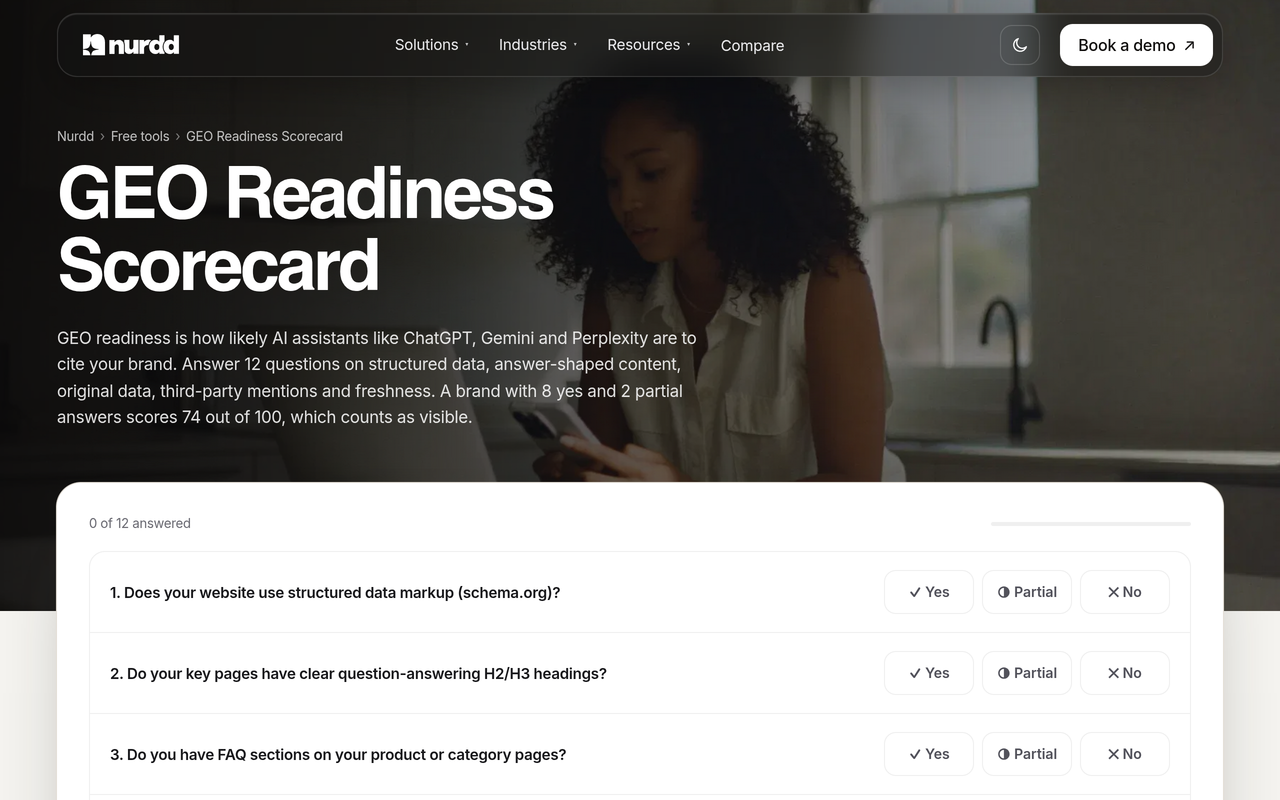
You can score your starting position with the free GEO readiness scorecard, a 12-factor check of readiness for AI answers. The AEO audit checklist and the guide to checking whether your website answers questions the way AI engines expect pair well with it.
What mistakes keep brands invisible?
- Testing once. One answer from one engine is an anecdote. Run the full set, on each engine, on a schedule.
- Testing only with the brand name. That checks recognition, not recommendation. Most buyers ask category questions.
- Fixing content before access. A perfect page behind a blocking rule helps no one.
- Writing more instead of writing specifically. Google notes that a high quantity of pages does not make a site higher quality, and that creating variations mainly to manipulate AI responses can violate its scaled content abuse policy (Google Search Central, October 2026).
- Ignoring ghost citations. If you are cited but not named, your page is useful but your brand is not attached to the answer. Put the brand and its category in plain sentences on the page.
- Treating competitor presence as luck. The cause is usually visible in their cited pages. The piece on why your competitor is cited and you are not shows how to read them, and why older competitor content keeps winning covers the freshness side.
How does Noma help you find and track the cause?
Noma by Nurdd is an AI search visibility dashboard that tracks whether a brand appears in answers from 13 AI engines, including ChatGPT, Gemini, Perplexity and Claude, polled daily. It shows citation frequency by category, compares you with competitors and gives recommendations for improving AI visibility. It replaces the manual prompt-by-prompt spreadsheet with a daily record of where you are named and where you are not.
Book a demo at nurdd.club/demo and we will show you, for your own brand, where you appear and where rivals are named across the engines you care about.
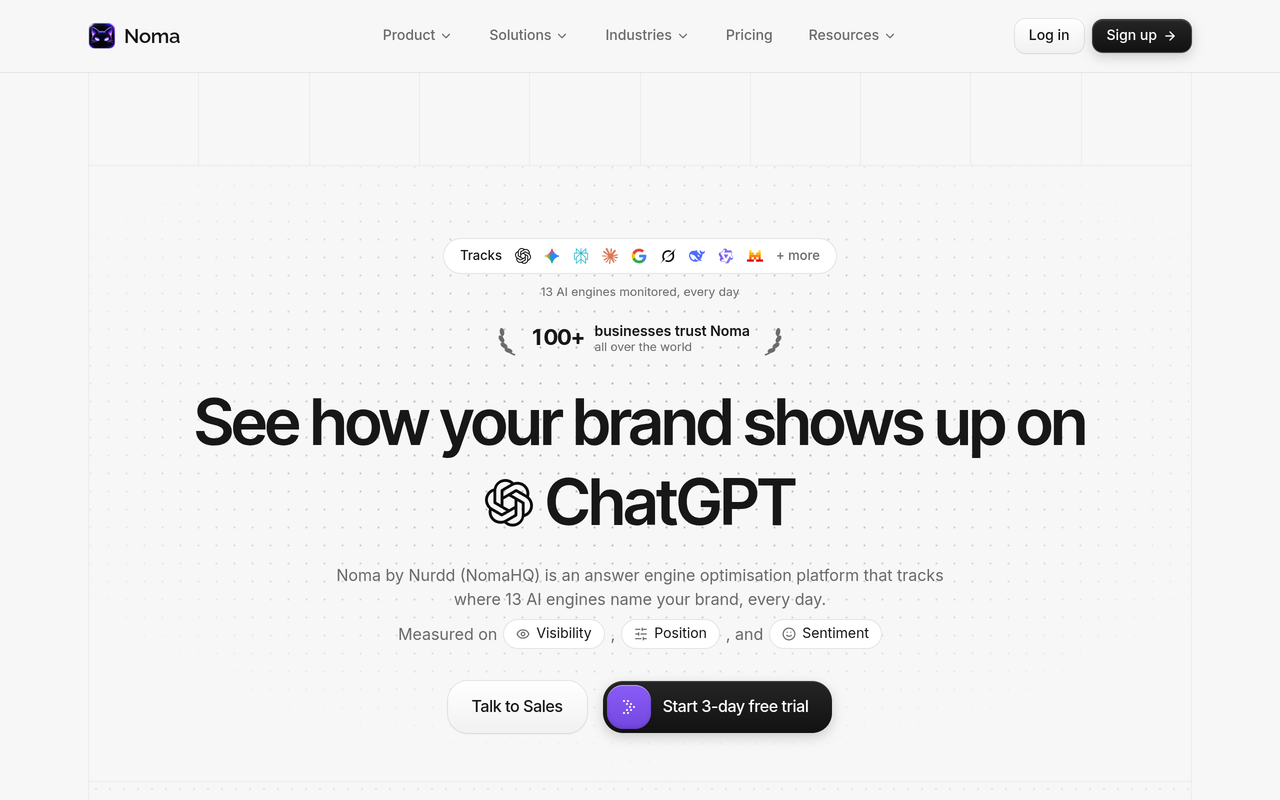
Noma has a 3-day free trial. A card is taken at signup and billing starts on day 3, with no charge if you cancel before then. See the product at nomahq.app. If you are still deciding between tools, the comparison of AI search visibility tools and the page on AI search share of voice explain what to measure. For a one-to-one view, see Noma vs Profound and the complete guide to GEO.
How we researched this
This post was written by Simran Rawat and rebuilt from an earlier version on this site. The review covered platform documentation (Google Search Central), a research paper and its open-review record on generative engine optimisation, industry studies from Ahrefs and Semrush, an agency article from WebFX, and the crawler information published for OpenAI's bots. I also read competing guides on the same topic to make sure this one covers their ground and adds a layered diagnosis, a decision table and a test method. All sources were checked on the publication date of this post. No hands-on testing, interviews or customer data were used, and the worked example uses placeholder arithmetic, not real results.
Frequently asked questions
Why is my brand not showing up in ChatGPT or Perplexity?
The most common reasons are blocked or unreachable pages, vague copy with nothing specific to quote, and little independent coverage of your brand. Run 20 category prompts and record which brands and sources appear, then work through access, understanding, evidence and corroboration in that order.
Does ranking on Google mean AI engines will mention my brand?
Not automatically. Google says its generative features rely on its core ranking and quality systems, so good SEO helps there. Other engines cite different sources, and the Ahrefs analysis found that 86% of sources were unique to each assistant.
Should I block or allow AI crawlers?
If you want to appear in AI search answers, do not block the crawlers that fetch pages for search. Vendors separate search and training crawlers, so you can set rules for each. Review each vendor's own documentation before editing robots.txt.
Do I need an llms.txt file?
Google's guidance says its search features do not use llms.txt and that creating one neither helps nor harms your Google visibility. You may still add one for other systems that read it, but do not treat it as a substitute for clear, specific pages.
How long until AI engines start mentioning my brand?
One agency reports two to twelve weeks of consistent work for many brands, with faster movement on live-retrieval engines. Your timeline depends on which layer was broken, so measure with the same prompts every week instead of relying on a general estimate.
What is a ghost citation?
A ghost citation is when an AI answer cites your page but does not name your brand. Semrush reported that 62% of AI citations in its study were of this kind. Put your brand name and category in clear sentences on the cited page to improve the chance of being named.
Can I check my AI visibility for free?
You can run a manual prompt set and score your pages with the free GEO readiness scorecard. Noma by Nurdd also offers a 3-day free trial, with a card taken at signup and billing starting on day 3 unless you cancel first.
Want to see where AI engines name your brand and where they name your competitors instead? Book a demo and we will walk through your own category prompts, the sources engines cite and the gaps to close first.