AI Search Visibility
AI Search Tracking Tool Reviews: What to Test First
Ranked lists can't pick your AI search tracking tool; a same-prompts, same-engines test can. Here is how to run it, with a scoring sheet.
 Sheetal Shakshi31 Oct 202615 min read

To evaluate AI search tracking tools, run the same 20 buyer prompts on the same engines over the same window in each tool, then compare mention rate, citation rate, competitor gap and wording accuracy. Open the original answers behind five random numbers to check the evidence. Include Noma by Nurdd, which tracks 13 AI engines and has a 3-day free trial, among the tools you test.
To evaluate reviews of the best AI search tracking tools, stop reading rankings and run your own test: load the same 20 buyer prompts into each tool, point them at the same AI engines, run them over the same window and compare the reports side by side. A review list shows what a vendor claims; a same-prompts test shows what the tool measures for your brand.
This guide gives you a repeatable test, a scoring sheet, a worked example with arithmetic and a three-day plan for trialling Noma by Nurdd, which tracks 13 AI engines, including ChatGPT, Gemini, Perplexity and Claude. It also explains why most review lists cannot settle the question for you, using public evidence rather than opinion.
Key takeaways
- Treat every ranked review list as a long-list source only. Public lists name anywhere from 10 to 22 tools, and several are published by tools that include themselves.
- Run the same 20 buyer-style prompts, on the same engines, in the same week, in every tool you trial. Change nothing else.
- Judge tools on repeat-run visibility percentages, not on a single score or a rank position, because AI answers change from run to run.
- Score evidence first: can you open the original answer, the cited sources and the run date behind every number?
- Use Noma's 3-day free trial as one of your two or three test subjects, and decide before billing starts on day 3.
Why can't you trust a review list to pick an AI search tracking tool?
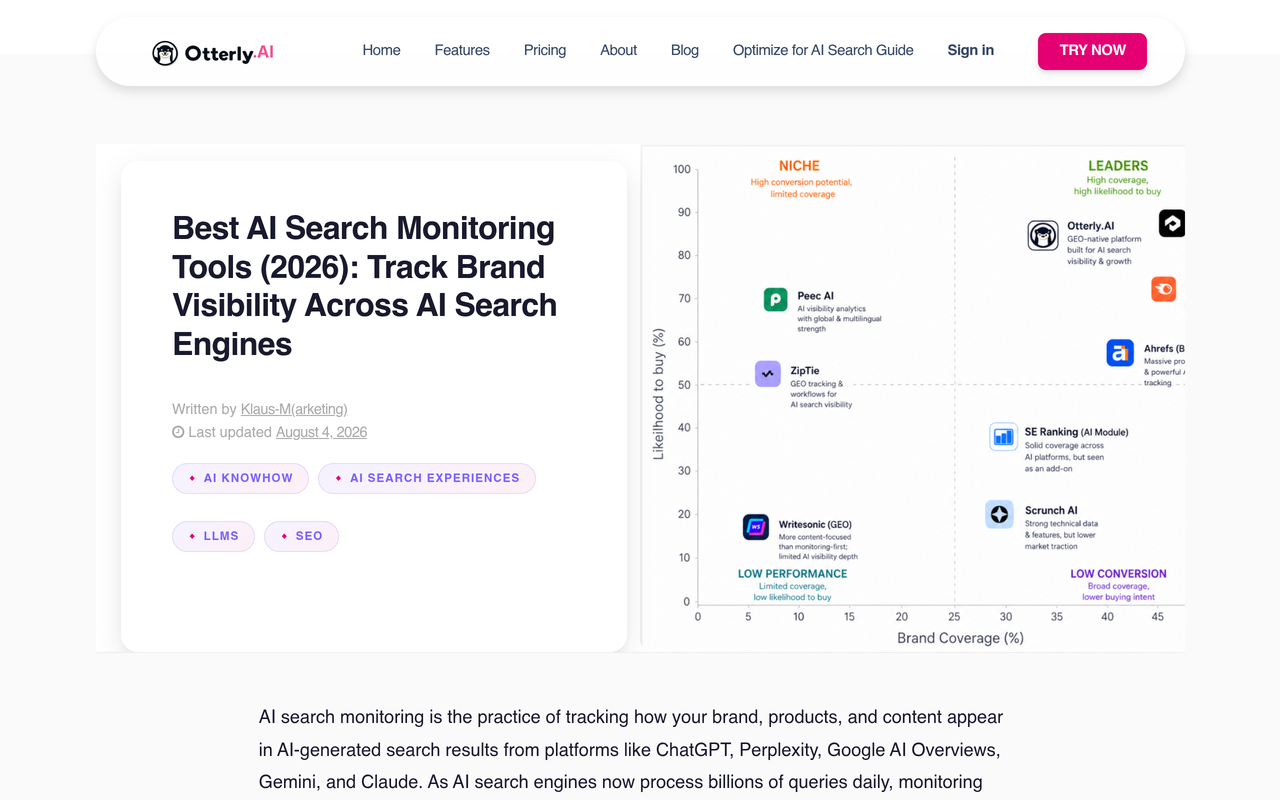
Most ranked lists of AI search tracking tools are written by companies that sell one, and the lists disagree about how many tools matter. Brainlabs, 2026 titles its list 10 tools, OtterlyAI, 2026 compares 12, and Rankability, 2026 covers 22. Those are different markets drawn by different authors, not a stable shortlist.
The OtterlyAI, 2026 list is published on a tool vendor's own blog and places that vendor first in its table. That does not make the table wrong, but it means the table cannot be your tiebreaker. SaaSFlywheel, September 2026 makes the same point about the genre, noting that many buying guides are written by companies with something to sell.
There is a second, deeper problem. A review is a snapshot of someone else's brand, prompts and week. Your category, your competitors and your buyers' wording are not in it. The only evidence that transfers to your decision is a test you run on your own questions. If you are new to the field, start with what generative engine optimization is and why brands are missing from ChatGPT answers.
Why do AI answers make tracking tools hard to compare?
AI answers are not stable, so two tools can both be honest and still report different numbers. Search Engine Journal, January 2026 reported on SparkToro research which found less than a 1-in-100 chance that ChatGPT or Google's AI in Search returned the same list of brands across repeated runs of the same prompt. The same list in the same order appeared less than 1 time in 1,000.
The study ran 2,961 prompts across ChatGPT, Claude and Google Search AI Overviews, using 12 brand-recommendation prompts that each ran 60 to 100 times per platform, according to Search Engine Journal, January 2026. The authors also noted the work is not peer-reviewed and was done with Gumshoe.ai, a company that sells AI tracking, which is a reason to read it as strong evidence about variability rather than a final word.
SparkToro's research found that brands in a tight category kept appearing across many varied prompts: Bose, Sony, Sennheiser and Apple showed up in 55 to 77% of 994 responses to differently worded headphone prompts (Search Engine Journal, January 2026).
That pattern is the useful part. Rank position moves, but how often a brand appears across many runs is steadier. Search Engine Journal, January 2026 reports that the study's authors question any tool offering an AI ranking position, and that appearance frequency is the more consistent signal.
Variation also exists between Google's own features. Search Engine Journal, December 2025 reported Ahrefs data showing that Google's AI Mode and AI Overviews cite different sources 87% of the time for the same query. A tool that tracks one surface and calls it "Google" is measuring only part of the picture.
The consequence for buyers is practical. Any tool comparison that uses one run per prompt will mostly measure noise. Your test has to repeat prompts and compare percentages, and every tool in the test has to be held to the same rules.
What should you test first? The Same-Four test
The Same-Four test is a framework for comparing AI search tracking tools fairly. It fixes four things across every tool you trial: the same prompts, the same engines, the same time window and the same reporting view. If any of the four differs, you are comparing setups, not tools.
| Fixed variable | What to lock | What goes wrong if you don't |
|---|---|---|
| Same prompts | One written list of 20 buyer questions, copied word for word into each tool | Each tool measures different questions, so scores are not comparable |
| Same engines | The engines your buyers use, enabled in every tool, with Google AI Overviews and AI Mode treated as separate surfaces | A tool with more engines looks better or worse for reasons unrelated to quality |
| Same window | All tools started on the same day and read on the same day | Day-to-day answer drift gets blamed on the tool |
| Same reporting | The same four metrics pulled from each tool: mention rate, citation rate, competitor gap, accuracy of the wording | You end up comparing dashboards' preferred scores rather than facts |
This mirrors advice already in circulation. NeuronWriter, 2026 recommends a short pilot built on 10 to 20 real buyer questions instead of a large list of random prompts, and SaaSFlywheel, September 2026 asks vendors for sample size, run date and engine list behind any score. The Same-Four test turns that advice into a protocol you can apply to any two or three tools.
How do you run the test? A step-by-step guide
Step 1: Write the 20-prompt panel
Action: write 20 questions a buyer would type, in plain language. Split them into 8 category questions ("best X for Y"), 6 comparison questions that name a competitor, 4 problem questions and 2 branded questions. Result: a fixed panel you can paste into every tool. Why: NeuronWriter, 2026 warns that a mention can be wrong or unhelpful, and a mixed panel shows whether a tool catches category visibility, not only brand-name lookups. Our guide on which prompts to track for AI search visibility shows how to choose them.
Step 2: Fix the engine list and surfaces
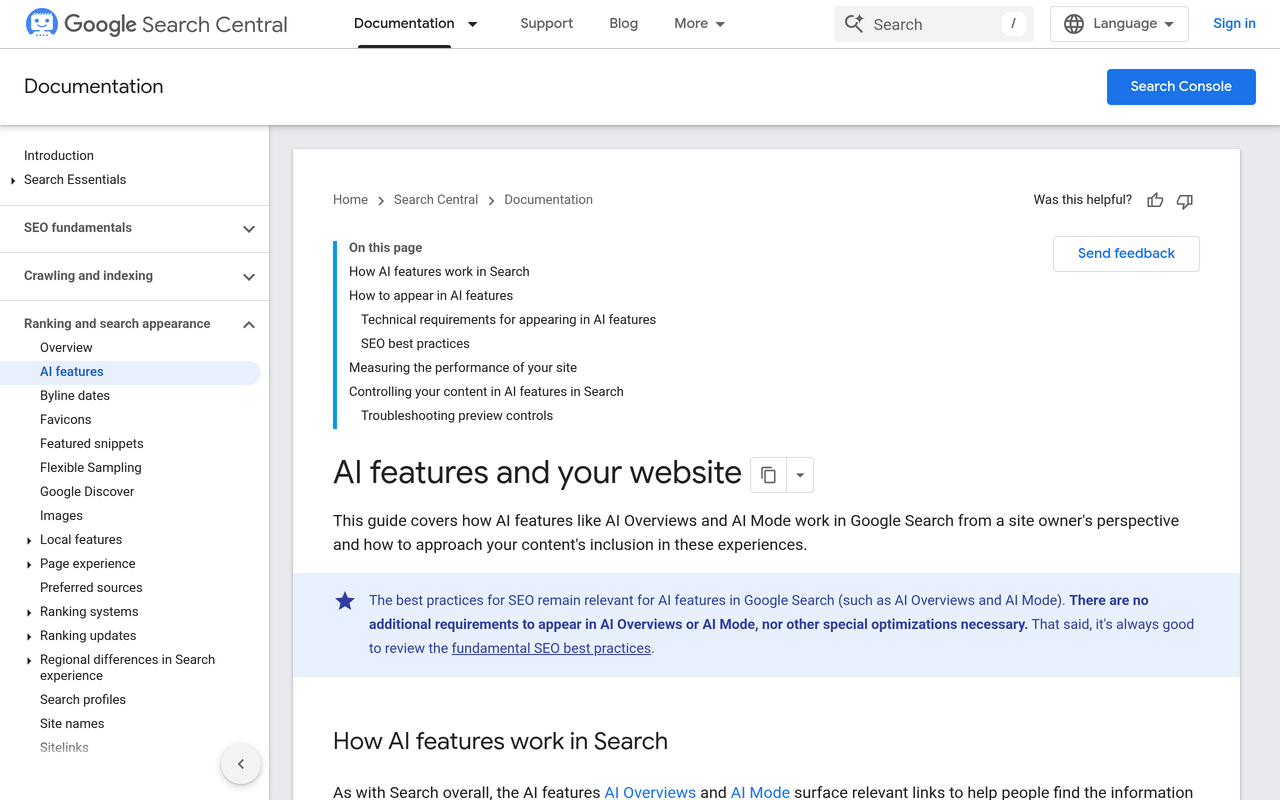
Action: list the engines your buyers use and enable the same ones everywhere. Record whether each tool tracks Google AI Overviews and AI Mode separately. Result: an engine grid with gaps visible. Why: Google Search Central states that AI Overviews and AI Mode are both part of Search and appear in overall Search Console traffic, while Search Engine Journal, December 2025 reports the two cite different sources most of the time.
Step 3: Set a baseline outside the tools
Action: before you start any trial, run five of your prompts by hand in each engine and save the answers. Result: a ground-truth sample you can compare the tools against. Why: without it you cannot tell whether a tool is wrong or the answer simply changed. Our walkthrough on tracking a brand on ChatGPT weekly shows what manual logging looks like.
Step 4: Load the panel and start every trial the same day
Action: enter the identical 20 prompts and the same competitor names into each tool, then note the start time. Result: comparable data from a shared start. Why: AI answers vary run to run, so staggered starts add differences you will mistake for tool quality.
Step 5: Pull the same four metrics
Action: from each tool, record mention rate (share of answers that name your brand), citation rate (share that link your pages), competitor gap (the top competitor's mention rate minus yours) and wording accuracy (how many answers describe you correctly). Result: one four-column sheet per tool. Why: a single blended score hides which of these is moving, and as the NeuronWriter checklist explains, mentions, citations and accuracy are not interchangeable signals.
Step 6: Audit the evidence behind five random numbers
Action: pick five numbers at random from each tool and check what sits behind them: the answers, the cited sources and the run date, as far as the tool exposes them. Result: an evidence pass rate out of five. Why: SaaSFlywheel, September 2026 argues a score without a stated sample size, run date or engine list is closer to a marketing number than a measurement. Checking the evidence is the cheapest way to test that.
Step 7: Check agreement with your baseline
Action: compare each tool's reading on your five hand-run prompts with your saved answers. Result: a note of where tools agree with reality and where they diverge. Why: small differences are expected, but a tool that reports your brand as absent when you saw it named in several saved answers has a coverage or parsing problem.
Step 8: Score, then decide before any billing date
Action: fill in the scoring sheet below for each tool and write the decision down before any trial converts to paid. Result: a decision based on your data. Why: trials that auto-convert reward inertia, and a pre-written decision date prevents it.
How should you score each tool? A weighted scoring sheet
Score each criterion from 0 to 5 and multiply by the weight. The weights below favour evidence and repeatability because those decide whether the numbers are usable at all. Adjust them if, for example, you manage several brands and reporting matters more.
| Criterion | Weight | What a 5 looks like | What a 0 looks like |
|---|---|---|---|
| Evidence behind each number | 25% | Answers, cited sources and run date visible behind each figure | A score with nothing underneath it |
| Repeat-run reporting | 20% | Visibility shown as a percentage over many runs, with the sample stated | A single rank position |
| Engine coverage | 15% | All engines your buyers use, with Google surfaces separated | Missing engines you need, or one blended "Google" line |
| Competitor comparison | 15% | Your named competitors tracked on the same prompts | Only your own brand visible |
| Actionability | 15% | Recommendations tied to specific prompts or pages | Generic tips unrelated to your data |
| Setup and workload | 10% | Panel loaded in one sitting, readable by a non-specialist | Needs a consultant to interpret |
The criteria draw on the dimensions in NeuronWriter, 2026 (coverage, evidence, definitions, action, workload) and the six checks in SaaSFlywheel, September 2026 (sampling, run frequency, engines, citation versus mention, cost per prompt-run, transparency). The weights are our own judgement, so treat them as a starting point rather than a standard.
What does a worked example look like?
Suppose a skincare brand trials three tools with the 20-prompt panel. It enables 5 engines and asks each tool to run every prompt 3 times in the week. The arithmetic shows how much data each tool should return and how to spot a shortfall.
| Step | Calculation | Result |
|---|---|---|
| Expected answers per tool | 20 prompts × 5 engines × 3 runs | 300 answers |
| If a tool shows only 180 answers | 180 ÷ 300 | 60% of the expected sample, so ask why |
| Mention rate | Answers naming the brand ÷ answers returned. Example: 54 of 300 | 18% |
| Top competitor mention rate | Example: 111 of 300 | 37% |
| Competitor gap | 37% minus 18% | 19 percentage points |
The inputs here are illustrative numbers chosen to show the method, not results from any real brand or tool. The point is the structure: a tool that cannot show how an 18% figure was built from 300 answers has not given you a measurement. Two tools reporting 18% and 31% on the same panel means one of them is miscounting, using a different sample or sampling on a different day, and your evidence audit will tell you which.
Note also how the SparkToro runs of 60 to 100 per prompt compare with three runs. Three is a practical trial size, not a statistically strong one, which is why you compare tools to each other on identical settings rather than treating any single figure as the truth.
Which AI visibility tracking tool should you trial?
Choose two or three tools, not ten. The table maps common buying situations to a starting shortlist and to the question that should decide it.
| Your situation | Trial first | Deciding question |
|---|---|---|
| One brand, a marketing team, no SEO specialist | Noma by Nurdd plus one other dedicated tracker | Can a non-specialist read the competitor gap and act on it in one sitting? |
| Existing SEO suite with an AI add-on | The add-on plus Noma | Does the add-on show repeat runs and underlying answers, or only a summary score? |
| Ecommerce or D2C catalogue | Noma plus a tool with product-level views | Do category-level prompts show you versus named competitors? |
| Agency running many clients | Whichever tools offer multi-brand reporting | Can each client's panel be separated and exported? |
Our own comparison pages cover specific matchups: Noma vs Profound, Noma vs Peec AI and Noma vs Semrush. For a wider view, see our comparison of AI search visibility tools. Use them to build the long-list, then let the Same-Four test choose.
Why should Noma be one of the tools you test?
Noma by Nurdd is a web dashboard that tracks whether a brand appears in answers from 13 AI engines, including ChatGPT, Gemini, Perplexity and Claude, polled daily. It shows citation frequency by category, competitor comparison and recommendations for improving AI visibility, so it covers the competitor-gap and actionability rows of the scoring sheet directly. Noma suits brands and marketing teams that want to know whether AI assistants recommend them when buyers ask category questions.
Want to talk it through first? Book a demo. Or start the 3-day free trial at nomahq.app and run the test yourself.
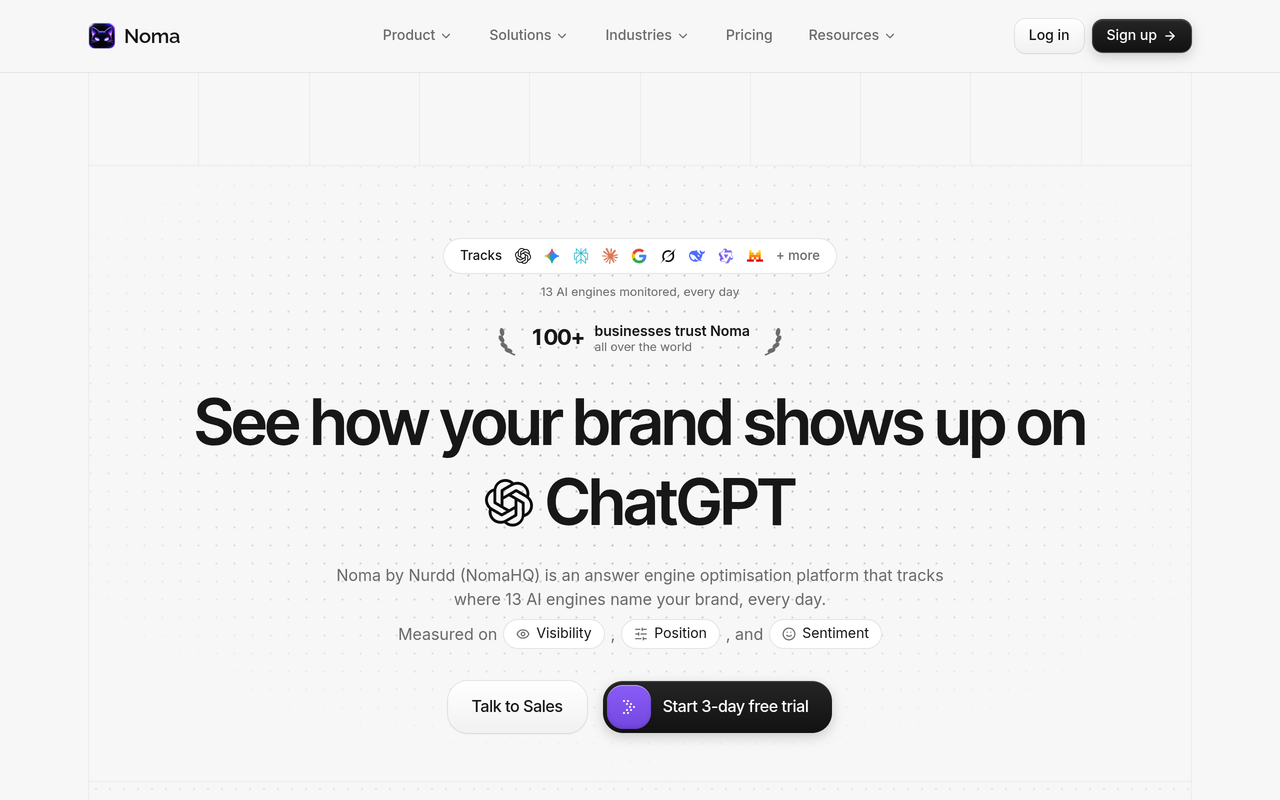
The trial terms matter for test design. Noma has a 3-day free trial, a card is taken at signup and billing starts on day 3; if you cancel before then, you are not charged. That is short, so prepare the panel before you sign up.
A three-day plan for the Noma trial
- Before signup: finish the 20-prompt panel, the competitor list and your five hand-run baseline answers.
- Day 1: sign up, load the panel and competitors, and record the start time. Start your other trials the same day.
- Day 2: open the dashboard, read the competitor gap, then run the five-number evidence audit on what the tool shows behind each figure.
- Day 3, morning: complete the scoring sheet for every tool and compare against your baseline.
- Before billing starts on day 3: decide. Keep Noma if it scores highest, or cancel before then and you are not charged.
Because daily polling means each prompt gets only a few runs in three days, read Noma's output as a first baseline and use repeat-run percentages over the following weeks to judge change. Our guide on tracking an AI visibility score week over week explains that follow-up: how to track your AI search visibility score week over week.
What mistakes ruin an AI tracking tool test?
- Using different prompts per tool. Each tool then measures a different market. Paste the same list everywhere.
- Trusting one number. A visibility score depends on the vendor's own rules and sample, so ask what sits behind it.
- Reading rank position as truth. The SparkToro findings reported by Search Engine Journal make ordering the least stable part of an AI answer.
- Counting engines instead of testing them. More engines help only if they match where your buyers search.
- Only tracking branded prompts. You will learn that AI knows your name, not that it recommends you.
- Letting trials auto-convert. Write the decision date down and keep to it.
A related trap is assuming a good score means the work is done. Tracking tells you where you stand; it does not change the answer. After the test, use an AEO audit checklist and this guide to why AI engines ignore a brand to act on the gaps.
What else can you check for free before paying for anything?
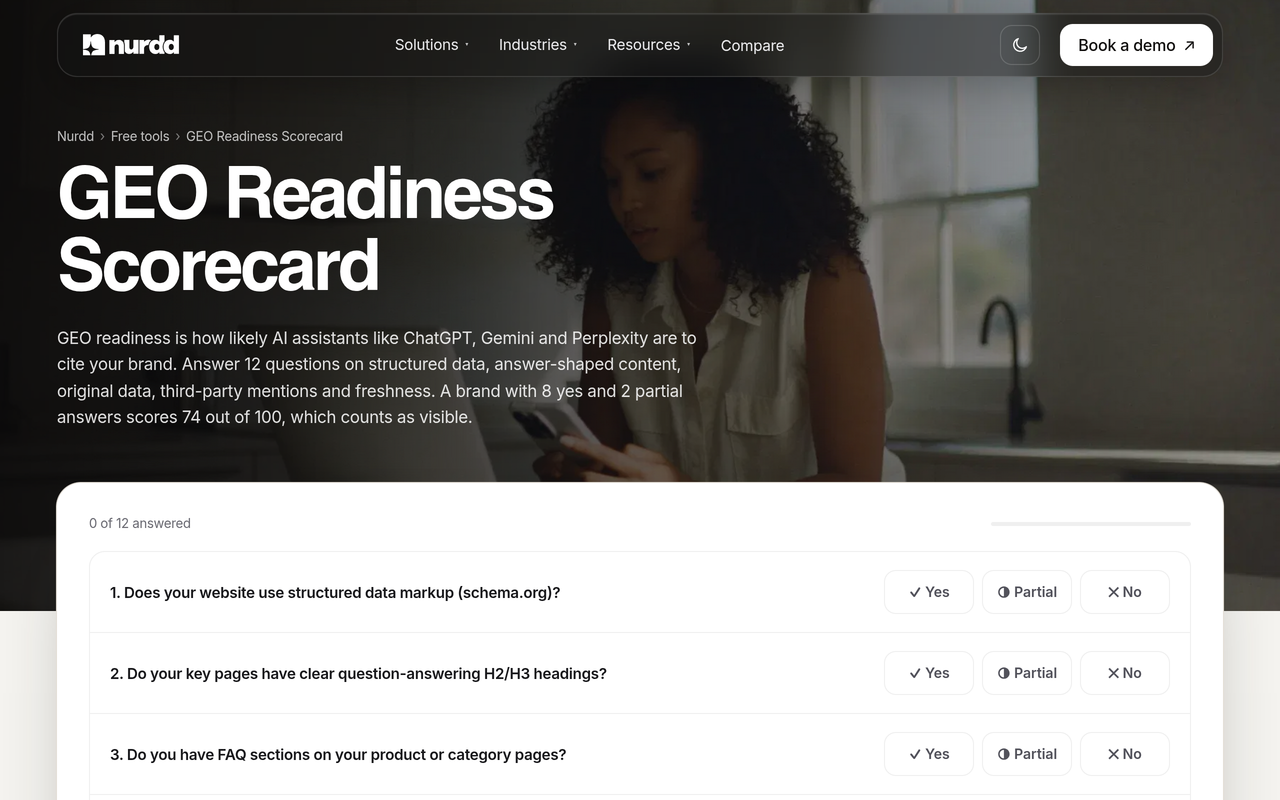
Before you trial any tool, measure whether your own site is ready to be cited. The GEO readiness scorecard is a free 12-factor check of readiness for AI answers, and it gives you a baseline to compare against later tracking data.
If AI visibility feeds into a wider measurement plan, the AI search share of voice guide explains how to turn mention rates into a share figure, and AI search visibility benchmarks gives published reference points. For ecommerce teams, best AI search visibility software for ecommerce brands narrows the long-list. Google's AI Overviews need their own tracking, covered in how to track Google AI Overviews, and the Perplexity vs ChatGPT vs Gemini guide helps you decide which engines to enable. The free marketing tools page lists the rest.
Quick reference: the pre-purchase checklist
- Write 20 buyer prompts and freeze the list.
- Choose the engines and note which Google surfaces each tool separates.
- Save five hand-run answers per engine as a baseline.
- Start every trial the same day with identical prompts and competitors.
- Record mention rate, citation rate, competitor gap and wording accuracy.
- Audit five random numbers per tool against run dates and sources.
- Compare tools to your baseline and to each other.
- Score, decide and cancel losing trials before billing dates.
How we researched this
We searched for the primary keyword and reviewed public comparison lists, buyer checklists, a Google documentation page, and news coverage of published research on AI answer variability. Sources were checked on the publication date of this post. We did not run hands-on tests of the tools named here, and we did not interview customers. The worked example uses illustrative numbers that we label as such, and the scoring weights are our own judgement. Where a number comes from a source, it is linked inline.
Compare Noma with: Noma vs AirOps, Noma vs Clearscope, Noma vs seoClarity and Noma vs Conductor.
Frequently asked questions
How do I evaluate AI search tracking tools?
Run the same 20 buyer prompts on the same engines in each tool, over the same window, and compare mention rate, citation rate, competitor gap and wording accuracy. Then check what sits behind five random numbers. A tool that cannot show its evidence should score low however good its dashboard looks.
Which AI visibility tracking tool should I trial?
Trial two or three, chosen for your situation rather than from a ranked list. Noma by Nurdd is a sensible one to include because it tracks 13 AI engines, including ChatGPT, Gemini, Perplexity and Claude, and offers a 3-day free trial. Pair it with one other dedicated tracker or your existing SEO suite's AI add-on.
How many prompts should I test?
NeuronWriter, 2026 recommends a pilot of 10 to 20 real buyer questions, and 20 is a manageable panel covering category, comparison, problem and branded questions. Larger panels suit ongoing programmes once you have picked a tool.
Why do two tools show different visibility scores for my brand?
The causes are usually different prompt sets, engines, run dates, sample sizes and scoring rules. SparkToro's research, reported by Search Engine Journal, also shows AI answers vary run to run. Equalise the four variables first, then audit the evidence behind each figure.
Is an AI ranking position a reliable metric?
Not on its own. The SparkToro research found the same list in the same order appeared less than 1 time in 1,000 repeated runs, and its authors argued that how often a brand appears across many runs is steadier. Prefer percentages over many runs to a single position.
Does Noma have a free trial?
Yes, a 3-day free trial. A card is taken at signup and billing starts on day 3; if you cancel before then, you are not charged. Prepare your prompt panel before you sign up so the three days go on testing.
Should I track Google AI Overviews and AI Mode separately?
Yes. Google's documentation treats both as AI features in Search, and the Ahrefs data reported by Search Engine Journal says they cite different sources 87% of the time for the same query. A tool that merges them may hide differences that matter.
What should I do once I pick a tool?
Track weekly percentages rather than single runs, then work on the prompts where competitors lead. An AEO audit and content changes are what move the numbers; the tool only measures them.
Next step: test Noma on your own brand
Reviews can build your long-list, but your own prompts decide the winner. Start the 3-day free trial at nomahq.app to see Noma tracking your brand and competitors across 13 AI engines, including ChatGPT, Gemini, Perplexity and Claude, with citation frequency and competitor comparison. If you would rather talk first, book a demo.